Gradient, divergence and curl are the three first-order derivatives of vector calculus. Each is built from the same operator ∇ = (∂/∂x, ∂/∂y, ∂/∂z).
The gradient ∇φ turns a scalar field into a vector field pointing towards steepest increase. For φ = x² + y², ∇φ = (2x, 2y), pointing outward and growing with distance. The divergence ∇ · F turns a vector field into a scalar measuring net outflow. For F = (x, y, z), ∇ · F = 3 everywhere, a uniform source. The curl ∇ × F measures local rotation. For F = (−y, x, 0), ∇ × F = (0, 0, 2), a steady spin about the z axis.
These operators appear in Maxwell's equations, fluid flow and heat transfer, and they are used to model flow in blood vessels.
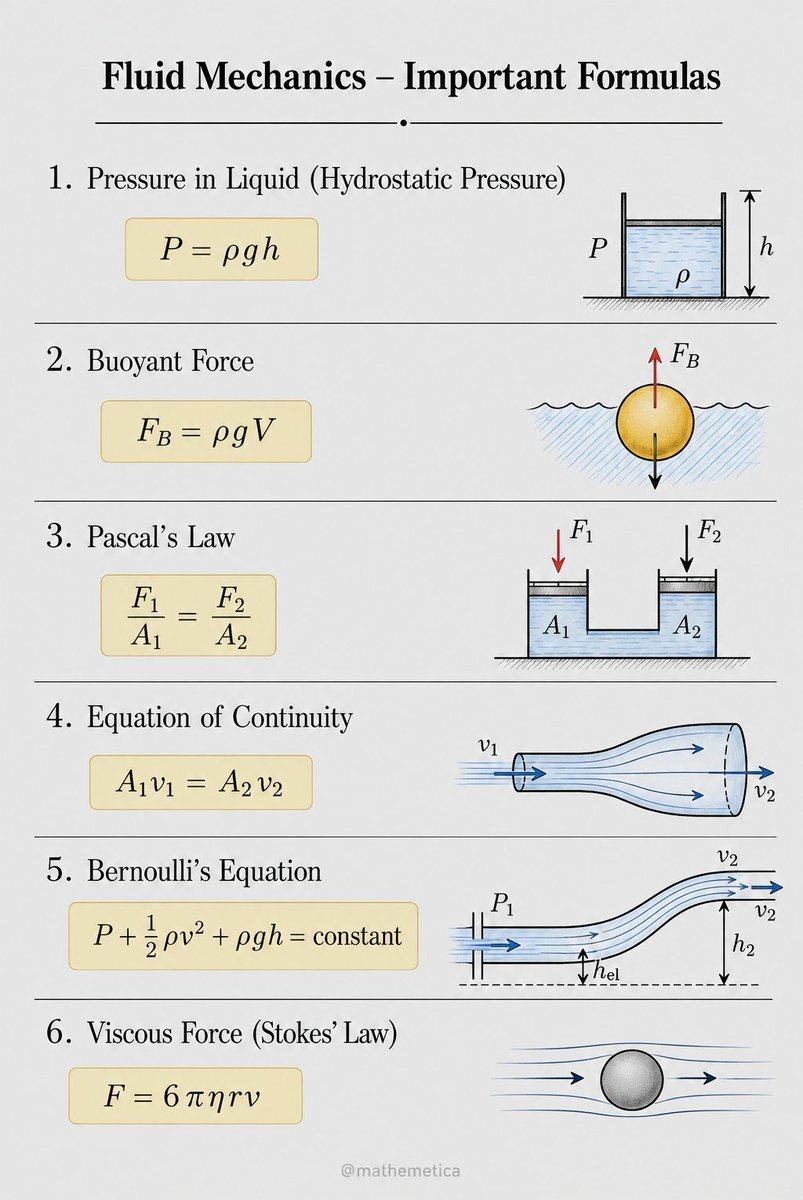
Fluids hide the simplest laws of nature inside everyday motion.
Hydrostatic pressure grows only with depth. A submerged body feels an upward force exactly equal to the weight of the fluid it displaces. Force spreads undiminished through a confined liquid, so a small push on a narrow piston lifts a far larger load.
Flow rate is conserved: where a pipe narrows, speed must rise. Bernoulli’s relation then links that speed to a drop in pressure and a change in height. Viscosity finally resists, dragging a sphere through a fluid with a force proportional to its radius, speed, and the fluid’s resistance.
These six equations turn the invisible into the predictable.
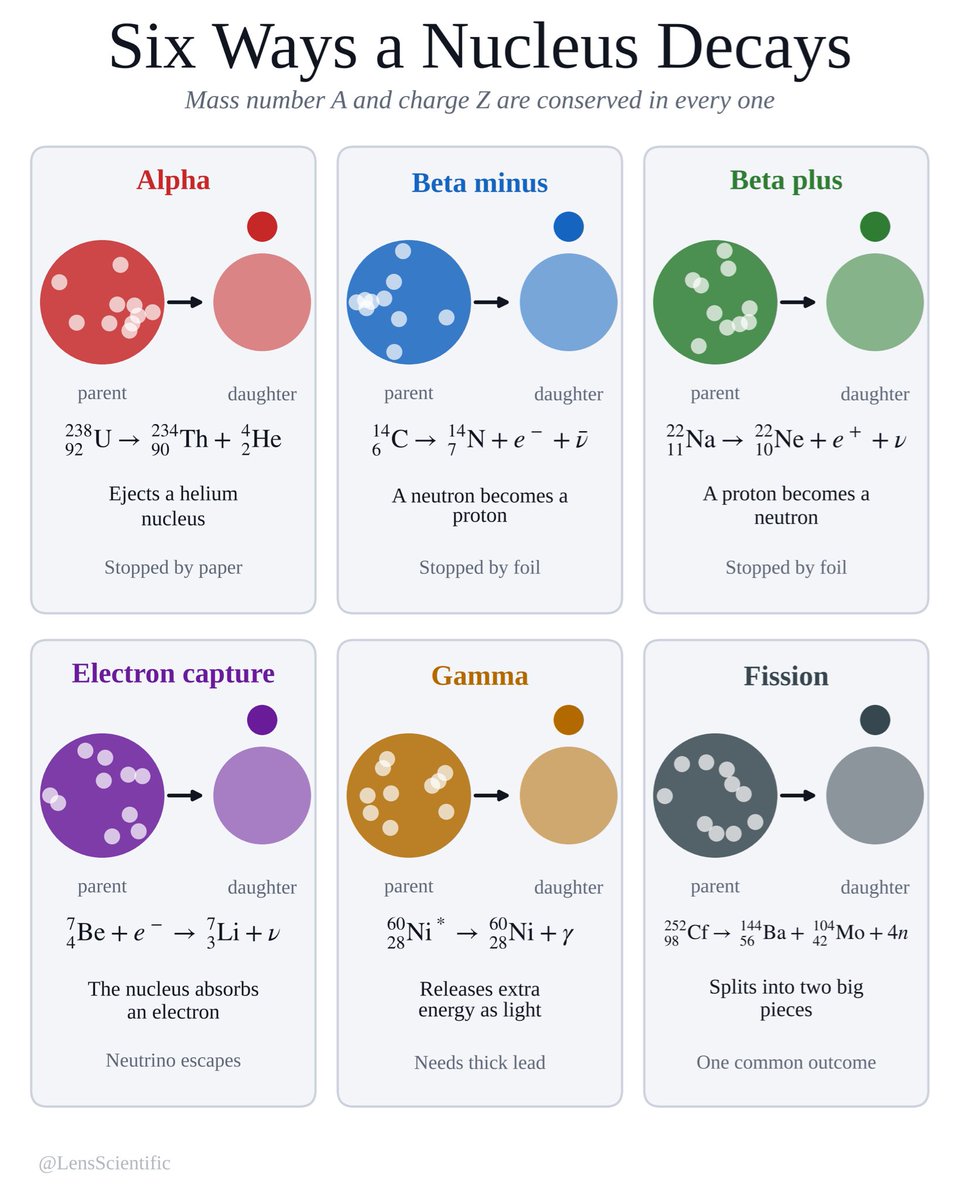
Radioactivity was found by accident, and it took about a decade to sort out that there were several different processes hiding in it.
Henri Becquerel noticed it in 1896 when uranium salts fogged a photographic plate wrapped in black paper. Ernest Rutherford named alpha and beta rays in 1899, and gamma rays were identified soon after. Wolfgang Pauli proposed the neutrino in 1930 to rescue energy conservation in beta decay, and it was detected in 1956.
Fission was recognised in 1938 by Otto Hahn and Fritz Strassmann, with the explanation supplied by Lise Meitner and Otto Frisch. Californium 252 undergoes it spontaneously and is used as a compact neutron source.
The upside down triangle is called nabla, after a Greek word for a harp of that shape. William Rowan Hamilton introduced the symbol in the 1830s, and the name came later as a joke among Scottish physicists.
The three operations are really three questions about a field.
Which way is uphill? Is more flowing out of this point than in? Does the field spin around it? Gibbs and Heaviside turned Hamilton's heavier machinery into these simple tools in the 1880s, and fluid and electromagnetic equations are still written with them.
When two waves overlap, their amplitudes combine, not simply their intensities. A difference in travel distance changes their relative phase, creating alternating regions of constructive and destructive interference.
When the waves arrive in phase, their amplitudes add, producing maximum intensity (4I₀). When they arrive completely out of phase, they cancel, producing darkness (zero intensity).
The geometry is governed by the path difference:
Δφ = (2π/λ)Δr
For coherent sources, whole-wavelength differences produce bright fringes, while half-wavelength offsets produce dark fringes.
Energy is not destroyed at dark fringes. It is redistributed across the interference pattern.
The same principle appears in water waves, sound, light and quantum experiments, where individual photons and electrons build up interference patterns through repeated detections.
Whether a solid is copper or glass depends on a gap that is only a few electron volts wide.
Felix Bloch showed in 1928 that electrons in a crystal fill bands of allowed energies, and Alan Wilson used the idea in 1931 to explain why some solids conduct and others do not. Silicon sits in between. Adding a trace of phosphorus or boron to it supplies carriers, and that doping made the transistor of 1947 possible.
A semiconductor gets better at conducting as it warms, the opposite of a metal, where hotter atoms get in the way of the electrons.
When matter meets its mirror, both vanish—and pure energy is born.
An electron and positron collide. Their rest masses disappear completely. What remains is two gamma rays racing outward, the exact conversion written as e⁻ + e⁺ → γ + γ. Nothing is lost; mass has simply changed form.
Scale that up to a proton and antiproton. Their quarks and antiquarks cancel, releasing a spray of new particles—pions, muons, photons, neutrinos—each carrying a share of the original mass-energy. The process is never the same twice.
E = mc² is not a slogan. It is the bookkeeping of the universe: every gram of matter holds the energy of a city, waiting only for its opposite to set it free.
The Jacobian, the Hessian and the Wronskian are three determinants that answer three different questions. The first measures how a map changes volume, the second how a function curves, the third whether functions are independent.
The Jacobian determinant of a map F is det(∂fᵢ/∂xⱼ), the factor by which small areas or volumes change. The Hessian collects second derivatives ∂²f/∂xᵢ∂xⱼ; at a critical point in two variables, det H > 0 with f_xx > 0 is a minimum, det H > 0 with f_xx < 0 a maximum, and det H < 0 a saddle. The Wronskian of f₁, …, fₙ stacks the functions and their derivatives; if it is nonzero at some point, the functions are linearly independent.
For sin x and cos x the Wronskian is −1, so they form independent solutions of y″ + y = 0.
Physical quantities are vectors in a four-dimensional exponent lattice.
Multiplying two quantities adds their (mass, length, time, temperature) exponents. The unit tesseract at the origin displays every combination of the four base dimensions.
Energy sits at (1, 2, −2, 0). Multiply force by length and you land exactly there. Specific heat is that vector minus mass and minus temperature.
The rules of measurement are the addition table of this lattice.
The 1847 Equation That Trains Every Neural Network
θ ← θ − η∇L(θ), written by Augustin-Louis Cauchy to solve the equations of astronomy.
L is the loss, a landscape of how wrong the model is, and θ is where the model stands on it.
The gradient ∇L points uphill, toward the steepest rise, so the minus sign turns the model around and sends it downhill (red arrow).
η, the learning rate, is the length of each step: too small and the ball crawls (left), too large and it overshoots the valley and flies off (right).
A real network walks this landscape in billions of dimensions at once, using a small random batch of data to estimate the slope at every step.
Language models, AlphaFold and image generators all learned by walking downhill on a 179-year-old rule, one tiny step at a time.
Electricity, magnetism and light were once studied as separate phenomena. James Clerk Maxwell changed that in the 1860s.
His four equations showed that electric and magnetic fields are deeply connected. A changing magnetic field creates an electric field, while a changing electric field helps produce a magnetic field.
The result was one of physics’ greatest unifications, and it revealed that light itself is an electromagnetic wave.
خلف كل مشهد نراه، تختبئ قوانين فيزيائية ومعادلات رياضية تفسر كيف يحدث كل شيء، من سقوط قطرة ماء، صمود جسر فوق نهر، إلى حركة الكواكب Stellar Motion وانتشار الضوء
ما يبدو بسيطا وإعتياديا لنا، قد يخفي وراءه أحد أعقد أسرار الكون ...
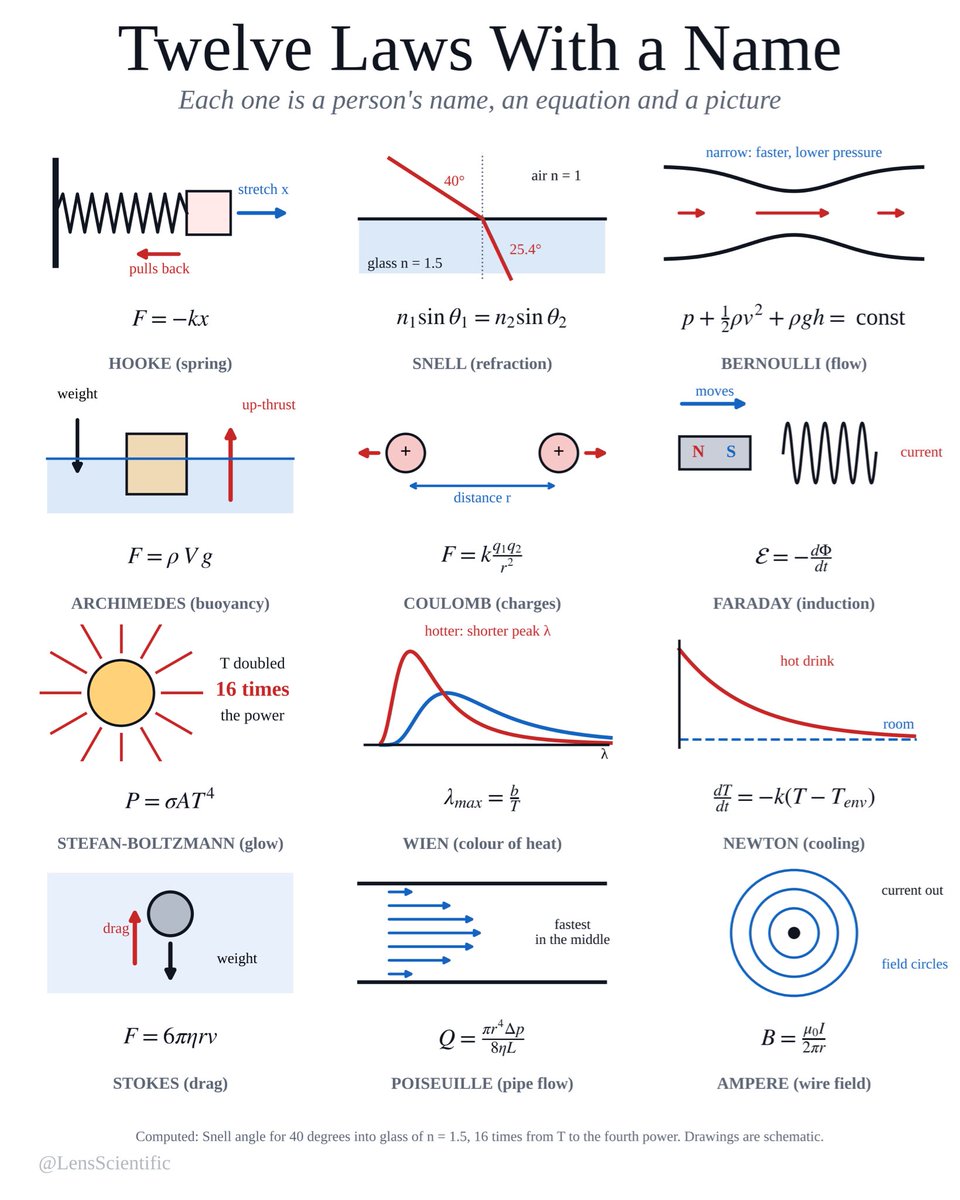
The statistician Stephen Stigler joked in 1980 that no scientific law is named after its true discoverer.
Naming a law after a person is a tradition, and it is often unfair to whoever found it first. Snell's law of refraction is a good example. Ibn Sahl, a mathematician working in Baghdad, described it around 984. Willebrord Snell found it again in 1621, and René Descartes published it in 1637 without crediting him.
John Archibald Wheeler famously summarized General Relativity as matter tells spacetime how to curve, and curved spacetime tells matter how to move.
Newton described gravity as an attractive force between masses. Einstein changed the picture: gravity is connected to the geometry of four-dimensional spacetime, where space and time are inseparable.
The Einstein field equations express this relationship:
Gᵤᵥ = (8πG/c⁴)Tᵤᵥ
Matter and energy determine spacetime curvature, while freely falling objects follow paths called geodesics:
d²xᵘ/dτ² + Γᵘₐᵦ(dxᵃ/dτ)(dxᵇ/dτ) = 0
This geometry explains phenomena such as Mercury's orbital precession, gravitational time dilation, the bending of starlight and gravitational waves.
Newton's gravity remains an excellent approximation in weak gravitational fields and at low velocities. Einstein's theory reveals the deeper geometry behind it.
Gravity is not simply a force acting through space. It is a manifestation of spacetime geometry.
Thermodynamics began as an attempt to build better steam engines and ended up governing everything from refrigerators to black holes.
Sadi Carnot's 1824 book was almost ignored until Émile Clapeyron and later Kelvin picked it up, and he died of cholera in 1832 at the age of 36. The first and second laws were then formulated in the 1840s and 1850s. Boltzmann's formula for entropy is carved on his gravestone in Vienna.
Nernst's 1906 result has a consequence. Absolute zero can be approached as closely as you like but never reached in a finite number of steps.