Latest Chinese activity data reinforces the view that China’s deeply imbalanced growth model is worsening further. The use of industrial policy & currency undervaluation contributes to large global imbalances that need to be addressed asap.
https://t.co/kzqbyIsrUo
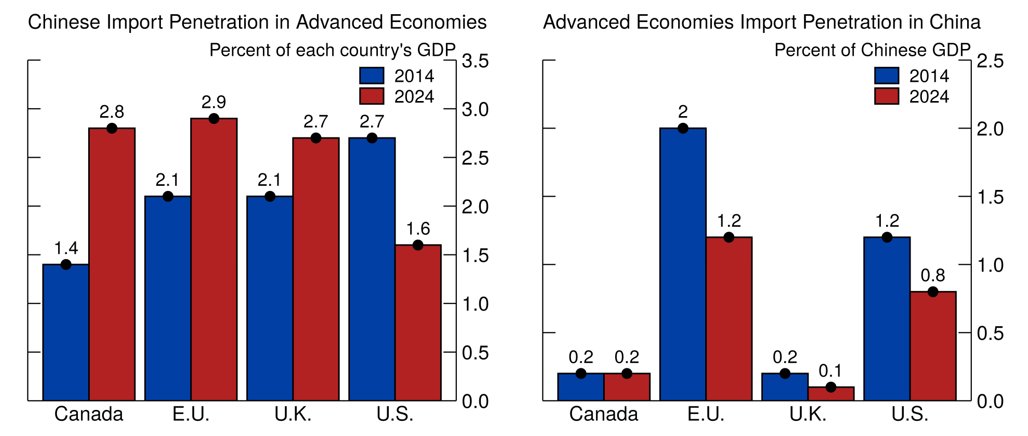
Brad is right here: a simple look at the data reveals that since 2018 China doubled down on export les strategy while also pursuing so-called "self-reliance", aiming to reduce it's import dependance.
1/2
1/ China's June trade data reinforce two stories that are happening at the same time.
First, China Shock 2.0 is still very much alive: China's export machine continues to move rapidly up the value chain.
🧵
@AmSantacreu
New FEDS Note with co-authors: using both cross-state and cross-country evidence, we find labor markets with low population and labor force growth are not necessarily more recession-sensitive.
https://t.co/l4bRuhXkJU
The US labor market is entering a very different demographic environment: slower population growth, weaker labor force growth, and sharply lower net immigration.
In that world, should weak or negative payroll growth be read as labor market fragility?
Food for thought!
"Is the Inflation Process in Advanced Economies Different After the Pandemic?" by François de Soyres, Avani Pradhan, and Zina Saijid.
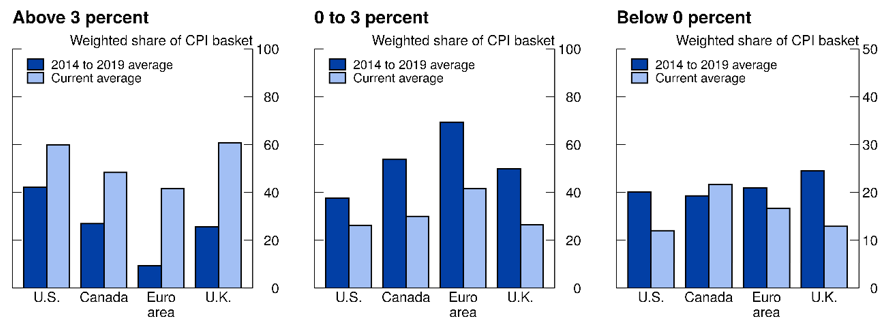
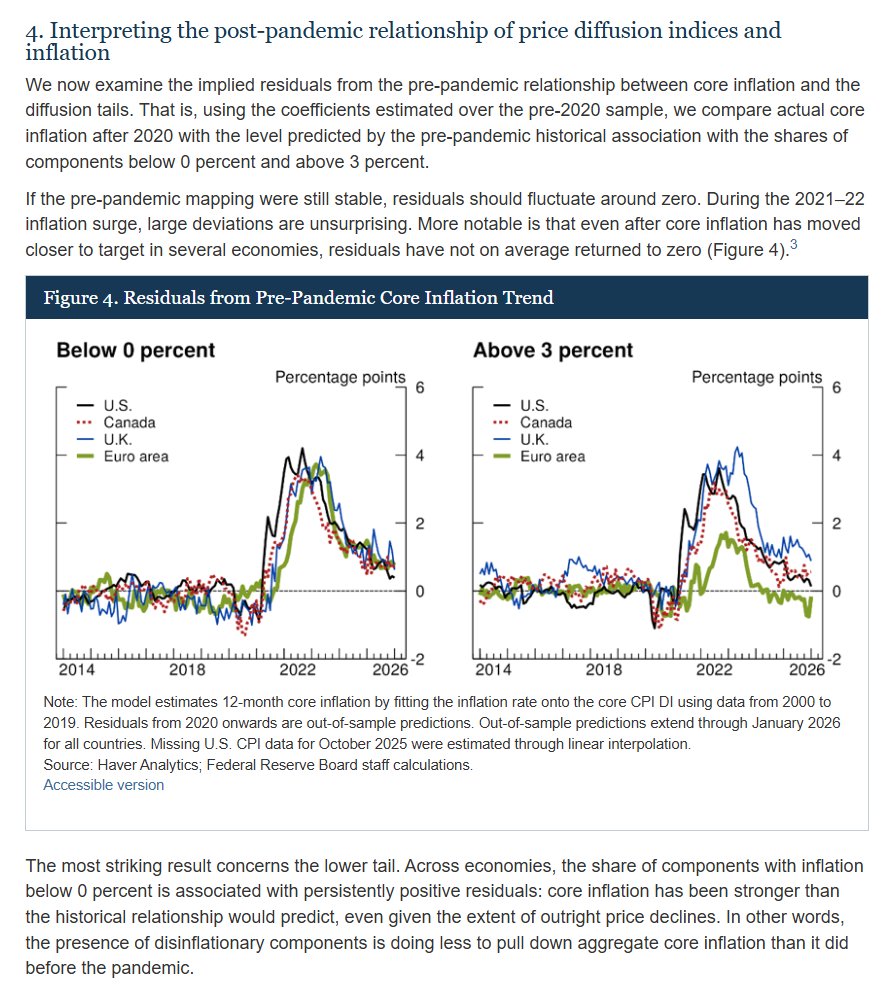
"Even as headline inflation returns to or nears central bank targets in advanced economies, according to the approach we have followed here, the composition of price pressures remains different from the pre-pandemic era. A larger share of CPI categories now experiences inflation above 3 percent, while deflation has become rarer. In some countries, the relationship between inflation and the breadth of price changes may have shifted, but more data will be needed to assess whether this shift represents a lasting change in the inflation process."
https://t.co/gsPAAxhzWt
Highly relevant! Good to see that there are increasingly nuanced perspectives on geoeconomic fragmentation.
"Understanding Trade Fragmentation" by Florencia Airaudo, François de Soyres, Ece Fisgin, Alexandre Gaillard, Ana Maria Santacreu, Keith Richards, and Henry Young
"In this note, we provide evidence that fragmentation is neither symmetric nor uniform. First, China—the world's largest exporter, accounting for about 15 percent of global exports—does not fit the standard fragmentation narrative. Its export penetration continues to rise even in geopolitically distant markets, while its imports from these same markets decline, leading to growing trade imbalances. Second, we show that the effect of geopolitical distance on trade varies sharply by the technology intensity of the goods being traded: high-tech goods are more sensitive to geopolitics than low-tech goods."
https://t.co/kk1tEy651E
Fed research suggests the inflation engine may be running differently across advanced economies since the pandemic:
1/ More categories continue to see price growth above 3%, with broad-based wage growth in services appearing to be a key driver
2/ Even categories with flat or falling prices aren't pulling the overall number down the way they used to
3/ Pre-pandemic models consistently underpredict current inflation, suggesting the relationship between price dispersion and aggregate inflation may have shifted https://t.co/fjdQTsaV8e
Thanks @NickTimiraos!
One way to interpret our results in the Note is that price pressures may have become more diffuse. Pre-COVID, sectoral price changes tended to remain more contained, but more recently, they might propagate more broadly across the economy.
That is: even if price pressures start in a narrow set of sectors (...like the recent surge in energy, especially in Europe and Asia!), they can spread through Core via input costs, wage indexation, strategic complementarities in price setting, etc...
In short: relative price changes can have economy-wide effects, complicating the “purely transitory” narrative.
China is indeed gaining world market share in high-tech sectors, but really the striking feature is that it did so without ceding market share in lower-value industries.
It's not "moving up the value chain", but rather "expanding dominance to *all* sectors".
This piece (https://t.co/6sW6ONW6wR) shows that although inflation rates have been similar in advanced economies, there is substantial variation in the underlying causes and composition, contextualizing why some CB started easing policy rates before others.
This analysis (https://t.co/3vE4V8YKmD) highlights the role of Fiscal Policy in shaping both the GDP recovery and the inflation surge in the US. (@AmSantacreu, @hlyoung8)
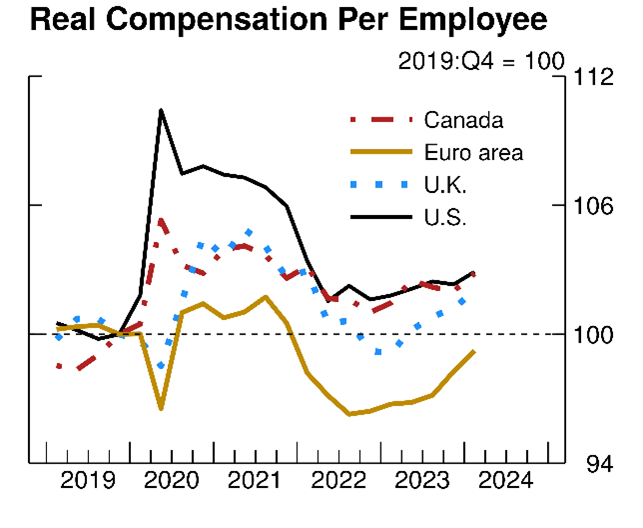
The last mile of disinflation will likely require further cooling in nominal wage growth. That said, high nominal wage growth in the euro area likely reflects a catch-up for the previous loss in real wages.