Trade fragmentation is often framed as the world splitting into blocs—countries trade within blocs, but not across them, as presented in many IMF or ECB reports. This is wrong.
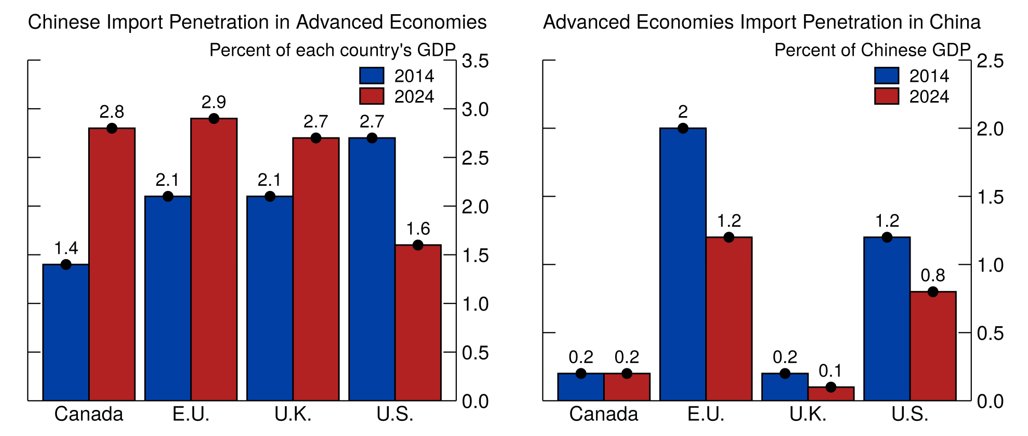
In a new FEDS Note, we show this misses what’s actually happening in the data: fragmentation is uneven and asymmetric, not a clean decoupling. Chinese exports keep gaining share in advanced-economy markets, while China simultaneously becomes less open to imports from those same economies.
Our new VoxEU column with @F_Airaudo, @FSoyres. Ece Fisgin, @ag_Gaillard, Keith Richards, and @hlyoung8 is out. We examine China's dual role as key supplier of critical inputs and rising high-tech competitor in reshaping trade dynamics. https://t.co/SNaWOgCcpd via @cepr_org
New #IFDPPaper finds evidence that trade flows and policy interventions are fragmenting along geopolitical lines—particularly in strategic sectors since 2022. Fragmentation patterns vary significantly depending on how geopolitical distance is measured. https://t.co/zQk6an7EPf
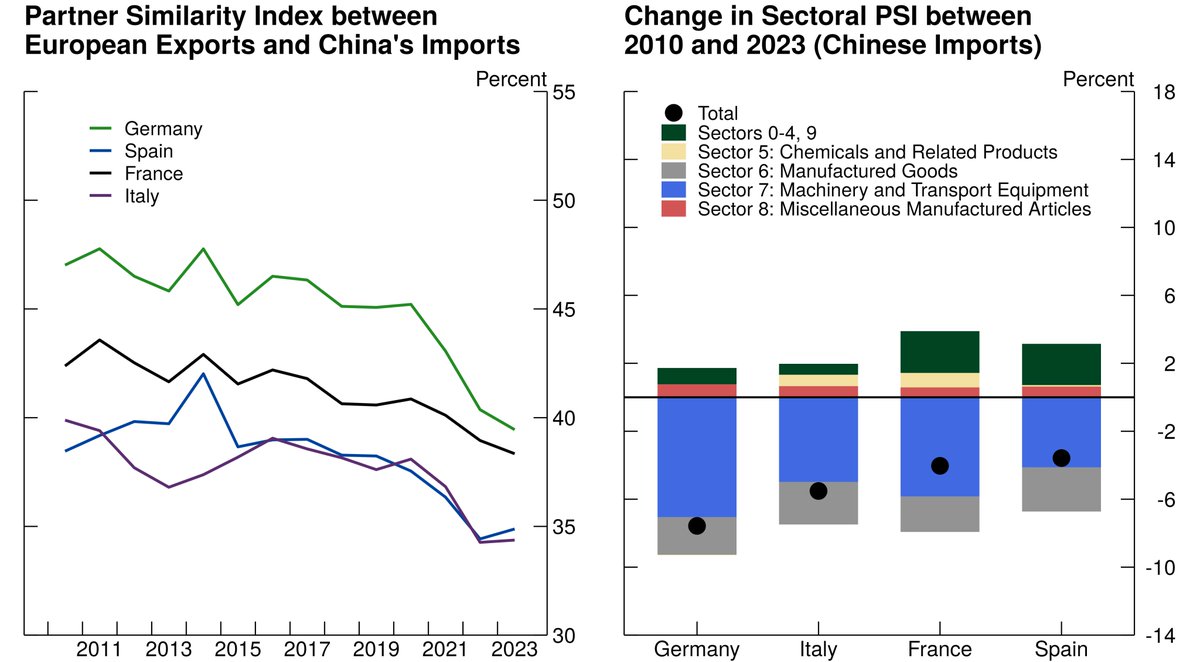
2. China’s import basket is becoming increasingly *different* from what euro area countries export.
This relates to China's "self-reliance" efforts and could potentially limit European exporters' ability to benefit from Chinese growth.
From Partner to Rival: how China’ sectoral repositioning changes the nature of trade relationships.
A new Feds Note with @AmSantacreu, @hlyoung8, @ag_Gaillard and Ece Fisgin.
+ an open dataset + soon a longer paper. 👇👇
A few quick thoughts on the 25% tariffs on Mexico and Canada -- a move that is likely to be considered one of the most self destructive economic policy steps in recent history.
1/
Harvard economics professor Ed Glaeser:
VP Harris housing plan is "too small and too poorly targeted."
To solve the housing crisis, Dr. Glaeser says we must borrow from The National Minimum Drinking Age Act of 1984. What does booze have to do with housing? Glad you asked:
-- Like housing, drinking ages were highly local issue. The federal government couldn't change it directly, but they could incentivize states to change it.
-- The law "demanded states raise the minimum age to buy or publicly possess alcohol to 21 — or face a reduction in federal highway funds. The threat of losing such funds is a big stick," Dr. Glaeser writes.
Why should housing be a federal issue?
-- "And while the merits of any battle over a particular project are debatable, the overall cost to our country is beyond doubt. We are just not building enough homes, especially in the coastal markets where there is the most demand. Per capita, there was less than half as much permitting in 2023 as in 2003 or 1973."
-- "Residents have made it particularly difficult to build in the most productive parts of America, such as Silicon Valley, which means that America’s G.D.P. is much lower than it would be if people could move to where the jobs pay the most. Areas with the most upward mobility limit building the most, which makes America more permanently unequal."
How could such a proposal be structured?
-- Target problematic offenders with high housing costs AND low construction. "The legislation could establish minimum construction levels over three years for all counties with median housing values above $500,000. States with high-price, low-construction counties would have to figure out how to overrule local zoning codes themselves or lose federal transportation funding."
In closing:
"America’s housing crisis is a deep, self-inflicted wound. Ms. Harris is right to want to do something, but it is hard for the federal government to engineer change at the hyperlocal level. Tying federal transportation spending to building activity may be the best way to induce change."
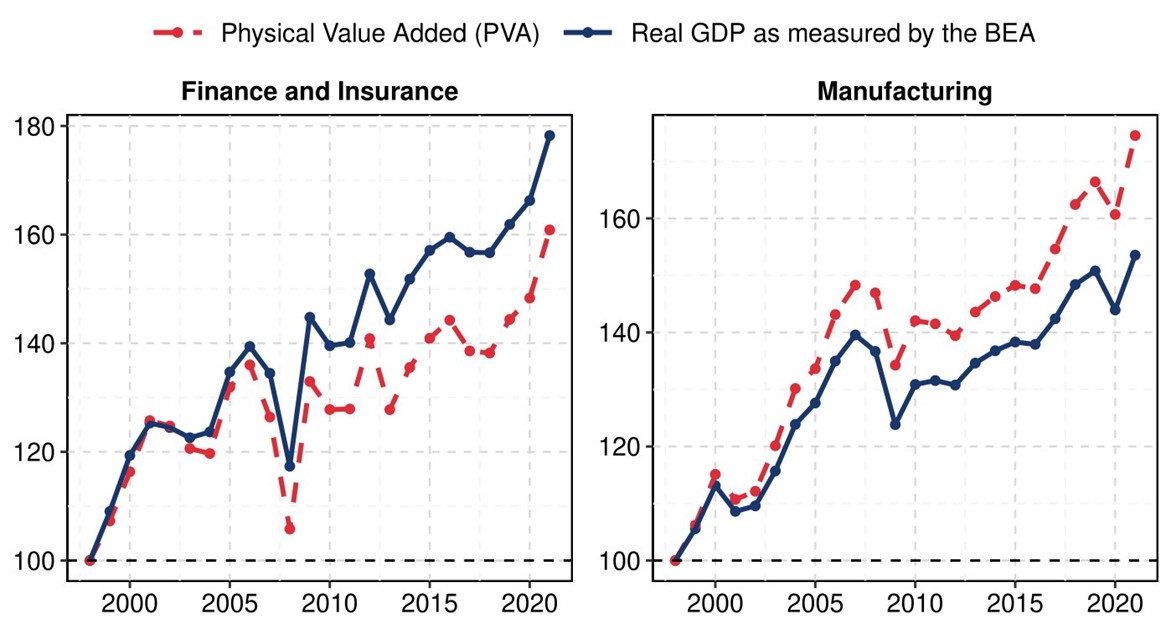
When base period prices contains a markup, real GDP fluctuates with profits. Accounting for this bias, @FSoyres, @ag_Gaillard & @hlyoung8 argue that national accounts overestimate growth in the finance sector, while it underestimates it in manufacturing.
https://t.co/3RevK4WIfV
When base period prices contains a markup, real GDP fluctuates with profits. Accounting for this bias, we argue that national accounts overestimate growth in the finance sector, while it underestimates it in manufacturing. (2/2)
@voxeu@ag_Gaillard@hlyoung8