Our Open-Source project is now live!
You can start using it to build and orchestrate your own AI-powered vulnerability research workflows.
If you enjoy it, we'd really appreciate it if you:
Give the repository a star on GitHub https://t.co/rJJjx0PN7Z
Share it with your friends and fellow researchers
Let us know what you think - we're actively improving it and would love your feedback.
Join our Discord community: https://t.co/Qnq5d57e3L
We’re releasing the first open-source version of Open-Kritt!
Open-Kritt helps security researchers use AI for vulnerability hunting like never before.
It’s a battle-tested system that has already helped us earn multiple six-figure bounties.
Read our launch article, where we explain how Open-Kritt works and share the research tricks behind it: https://t.co/UJBMaJ4cyk
Open-source (don't forget to ⭐): https://t.co/rAUz22i4OO
Join our Discord community: https://t.co/WzXMUKWxcR
And that’s exactly why almost everything ends up being a duplicate. Researchers need to find a way to bring their own unique edge to the research process when using LLM’s if they want to discover findings others miss, or at least find them first.
Let’s set the record straight: @lcfr_hax was the first to discover php2shell and develop a working exploit. See his August 5 tweet: https://t.co/I88EQFrUHa
His work convinced the PHP Foundation to invest in fixing this entire bug class. He then worked around the clock to review, test, and retest the patches.
Yep, exactly. It's also a way for me to "vet" how a project handles these situations.
If I feel a project is unfair or unkind, I simply stop researching them. There are plenty of projects to spend my time on, so how they treat negotiations and whitehat's definitely factors into where I choose to research.
And here I am, having reported vulnerabilities throughout my career that could have resulted in a total of several billions (yes, with a B, > $2B) being *stolen*, while my total earnings are around $2M.
So what's the lesson the industry is teaching researchers?
That next time we should steal the funds first, then negotiate a "responsible disclosure," return 80–90%, and walk away with 10–20%?
Obviously, no. But it's insane that the incentives can make that rhetorical question even possible.
The bounty world is broken.
Blackhats exploit a protocol and get treated like kings in negotiations. Meanwhile, whitehats disclose the exact same kind of vulnerability privately, prevent any damage from happening, and then spend months arguing with projects that try to downgrade the finding and pay the bare minimum.
I'm fighting several cases like this right now. Millions of dollars protected, vulnerabilities responsibly disclosed, and yet projects still don't want to pay the amounts they themselves advertised.
We should be making responsible disclosure the overwhelmingly obvious choice.
Instead, the current state of Web3 is doing its absolute best to discourage whitehats while creating increasingly attractive incentives for blackhats and "grayhats".
Those incentives are backwards, and eventually the ecosystem pays the price.
‼️ Self-proclaimed whitehat hackers used a vulnerability to drain Liquid Network of 4000 BTC ($320M USD) yesterday.
Just now they've returned 3400 BTC and kept 600 BTC ($47M) as a 'bug bounty'. They've also 'responsibly' disclosed the vulnerability in a PGP-encrypted message.
@mirza@injective Bold statement for a project that treats whitehats poorly.
Maybe if @al_f4lc0n (and others with similar stories) were treated fairly, top researchers would’ve kept reviewing @injective, and this exploit might never have happened.
@0xDestinyae Thankfully, ours was confirmed as Critical, so I assume we'll get paid. :)
But four months without an answer is crazy... Have you tried requesting mediation through the platform? At this point, I definitely would.
I read KiiChain’s postmortem and realized something pretty crazy. About 3 weeks ago, we privately reported a critical exploit chain to another Cosmos-based project that reached the same unsafe StateDB subtraction through a completely different path. Thankfully, they confirmed and fixed it really quickly.
These weren’t the exact exploit chain, but they shared the same unsafe StateDB balance primitive: a native balance subtraction that could wrap around in `uint256`. Letting it underflow is an important primitive, but the subtraction alone isn’t enough to steal anything.
Normally, the EVM checks that an account has enough balance before subtracting. To exploit this, you still need another state or accounting bug that breaks that assumption, and then a way to turn the broken balance into real money.
So this does NOT mean every Cosmos EVM chain was exploitable. It depends on the implementation and how each chain keeps its Cosmos and EVM balances in sync.
Sadly, we made a mistake: we didn’t go looking through every other chain that might have had the same primitive.
I tried to understand why, and I think there are 2 main reasons:
1. We focus our research on targets that have bug bounty programs. We didn’t even know some of these other chains existed, and we weren’t aware of a bounty program for projects like KiiChain. Blackhats don’t have that restriction.
2. The underflow primitive on its own isn’t enough to steal funds. An affected project would also need a separate bug that makes the underflow reachable and exploitable. This made us wrongly assume the issue was specific to the project we were reviewing.
I’m genuinely sad that we didn’t connect the dots before real users got hurt.
But on the bright side, our report helped protect literally tens of millions of dollars (no exaggeration) on the chain we reviewed (though we haven't gotten paid for this one yet).
I think this incident shows why bug bounty programs and responsible disclosure matter. It also shows why security updates need to be coordinated between upstream maintainers and the downstream projects using their code.
Our Open-Source project is now live!
You can start using it to build and orchestrate your own AI-powered vulnerability research workflows.
If you enjoy it, we'd really appreciate it if you:
Give the repository a star on GitHub https://t.co/rJJjx0PN7Z
Share it with your friends and fellow researchers
Let us know what you think - we're actively improving it and would love your feedback.
Join our Discord community: https://t.co/Qnq5d57e3L
We’re releasing the first open-source version of Open-Kritt!
Open-Kritt helps security researchers use AI for vulnerability hunting like never before.
It’s a battle-tested system that has already helped us earn multiple six-figure bounties.
Read our launch article, where we explain how Open-Kritt works and share the research tricks behind it: https://t.co/UJBMaJ4cyk
Open-source (don't forget to ⭐): https://t.co/rAUz22i4OO
Join our Discord community: https://t.co/WzXMUKWxcR
@LeBon_Chasseur@Kritt_AI We are using Netlify, so https://t.co/CfzBpIiCYs might be blocked in your country. If that’s the case for you just go straight to our Github: https://t.co/LXwipghV3k
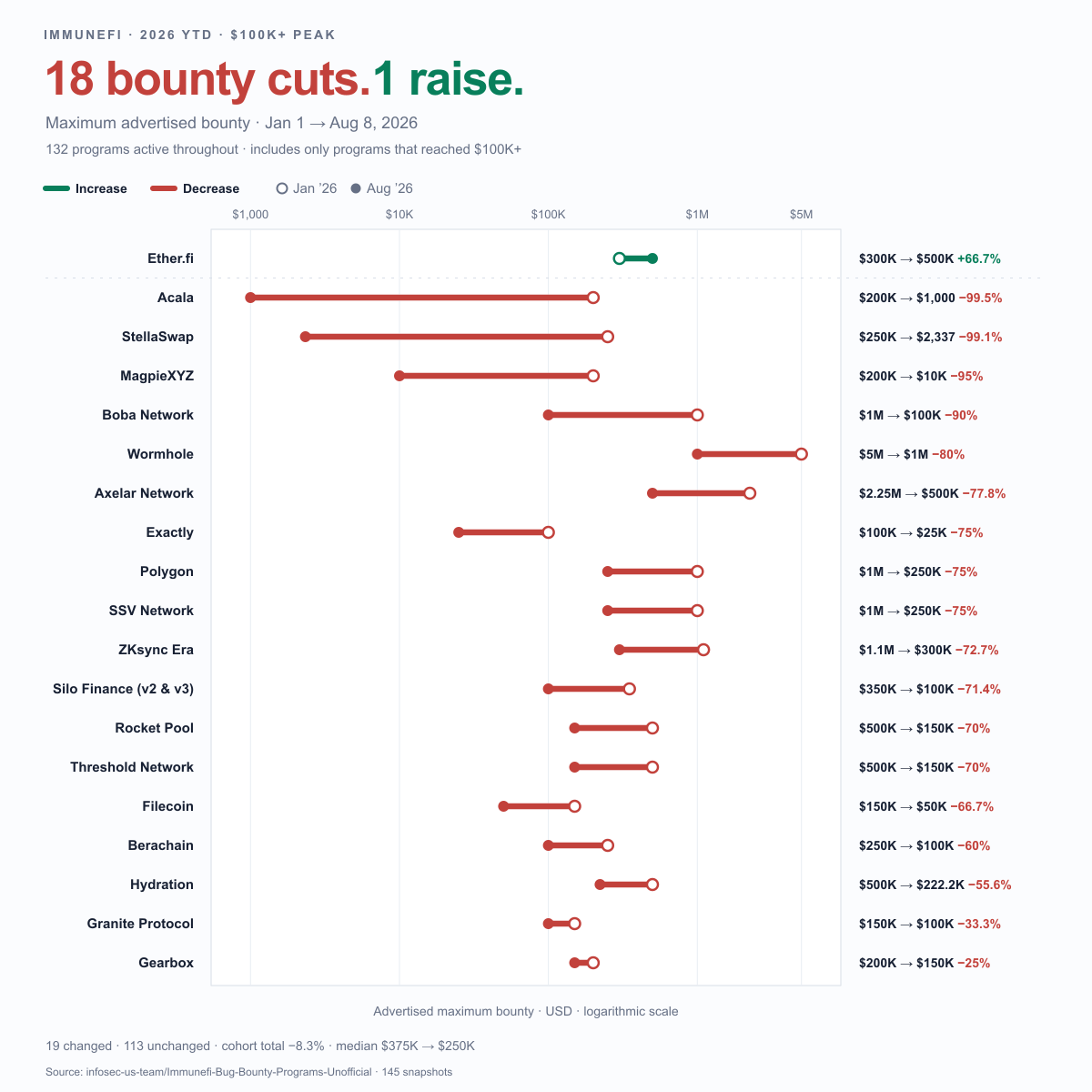
While hacks are ramping up in 2026, bounties are falling behind...
Among 19 active Immunefi programs that changed their max payout, only 1 increased it. The other 18 cut it - some by a lot.
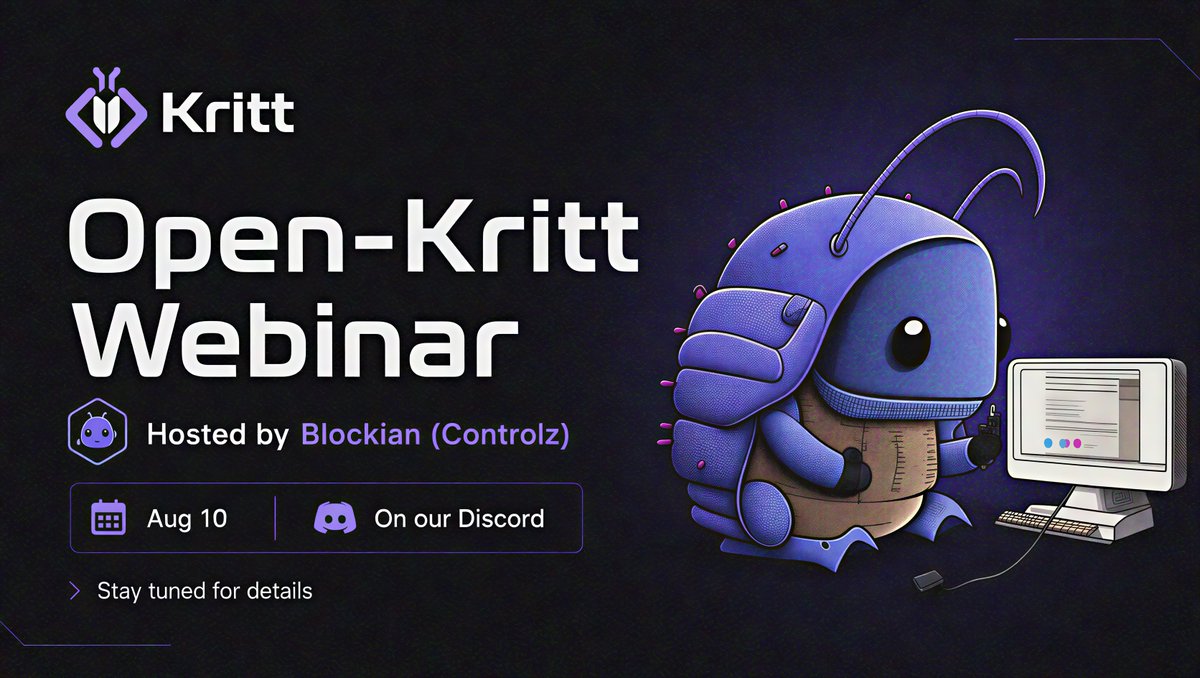
Join us for a live Open-Kritt webinar with @_blockian (@controlz_1337).
He’ll walk through how he works with Open-Kritt, how to build a workflow, and will answer your questions live.
On the Kritt Discord.