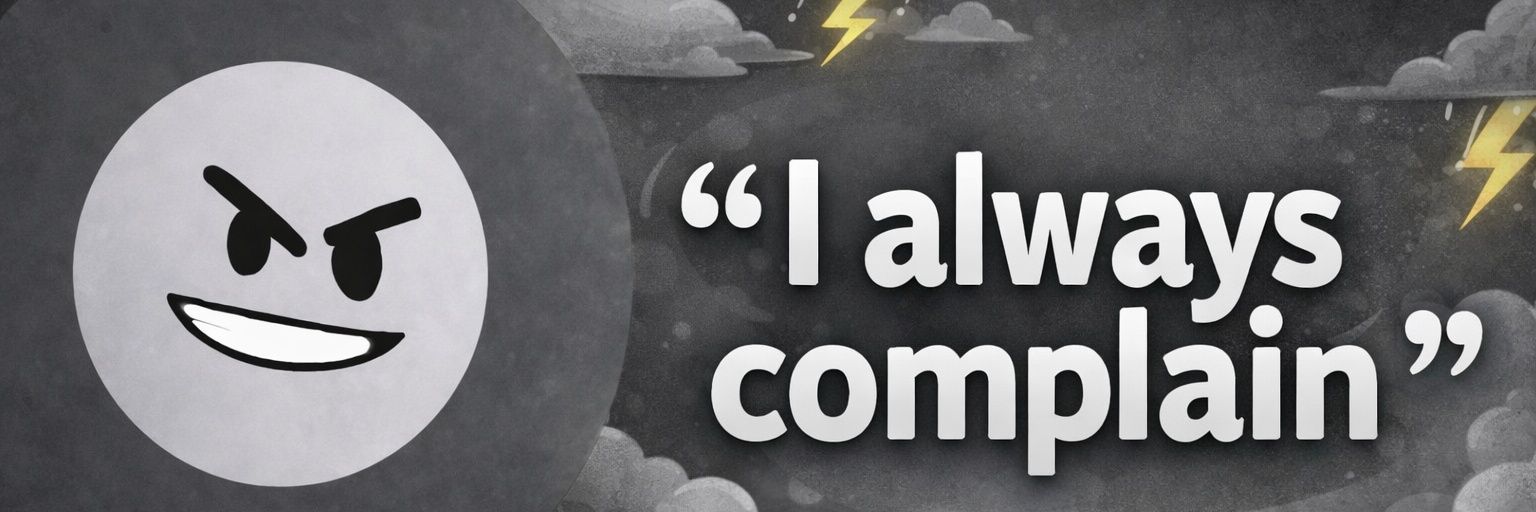
My SmartX trader type: “The Candle Prophet.”
“You can chart every line except the one marking enough exposure.”
Find yours in 6 questions. Join the waitlist for up to 50% off fees and a share of 10,000 USDT in rewards.
https://t.co/cFVGUupsT2
The longest project I have ever worked on, Good 6 hours of hardwork/mental work, but being determined to wrap it up pulled through.
Four cities. Four universities. Countless lessons. One unforgettable journey. 🇷🇺❤️
Some stories may arrive later than expected, but the experiences, lessons and memories behind them are always worth sharing.
My New Day Education 2026 experience took me across Moscow, Yekaterinburg, Kazan and Saint Petersburg, challenging perceptions and showing me how education can connect people beyond borders.
To young graduates dreaming of studying abroad: Don’t let stereotypes or other people’s experiences define a world you haven’t explored yourself.
Sometimes, you have to experience the world to understand it.
I hope to become part of the bridge connecting Nigeria, Russia and future generations of global learners.
What if your next academic destination is Russia? ❤️🇳🇬🇷🇺
#RUDNUniversity
#NewDayEducation2026 #russia
@UnilorinNGR@UniversityRudn@vanguardngrnews
i didn't understand structured notes, so i took both sides of one.
when i first opened Note Systems, i saw things like coupon, shield, barrier, autocall, observations, strike...
and i was like yh...i have no idea what's going on here.
so instead of trying to understand everything from the docs, i decided to actually use it.
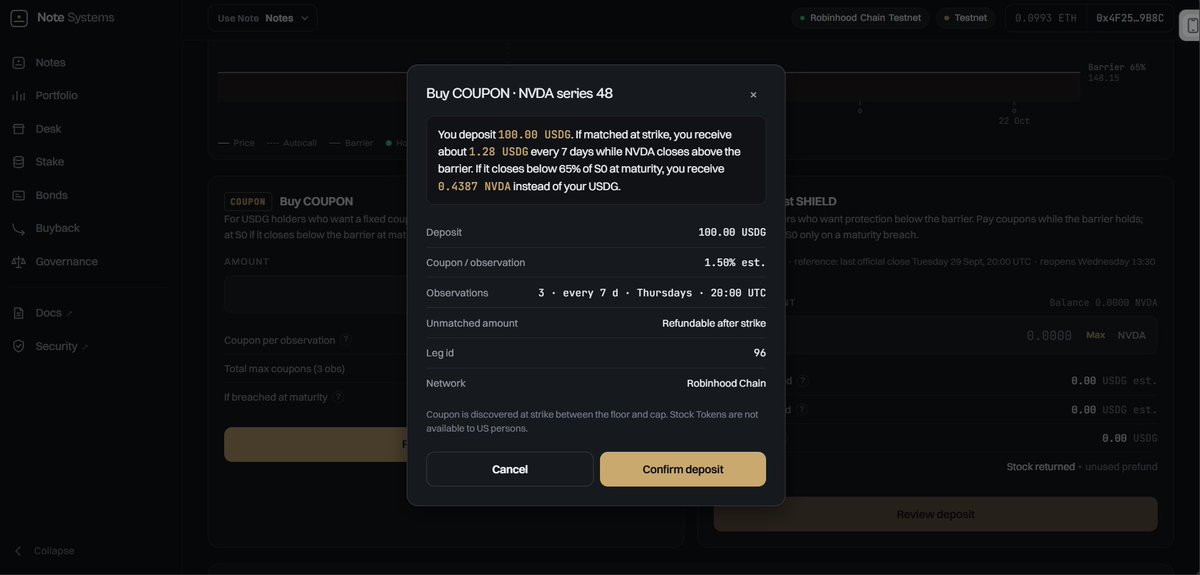
i picked an NVDA note and started with COUPON.
the easiest way i've found to understand it is this:
someone has cash and wants yield.
someone else has stock and wants protection if that stock crashes badly.
COUPON gets paid to take that downside risk.
SHIELD pays to transfer it.
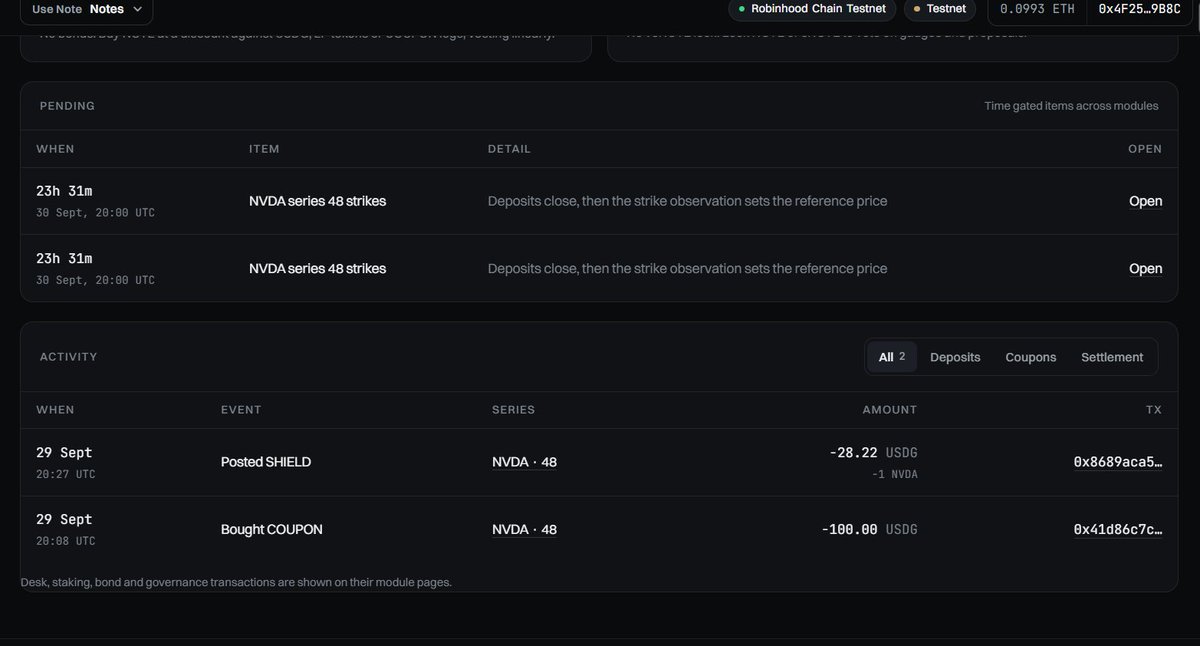
so i put 100 USDG into COUPON.
the note had a 65% barrier and 3 observations.
if the conditions hold, i can earn coupons.
but if NVDA finishes below that barrier at maturity, i don't simply get my $100 back. i can receive NVDA at the original strike price instead.
that's when the yield started making sense.
i'm being paid to take that risk.
okay...COUPON finally made sense.
but then i wanted to understand the person on the other side.
so i became SHIELD too 😂
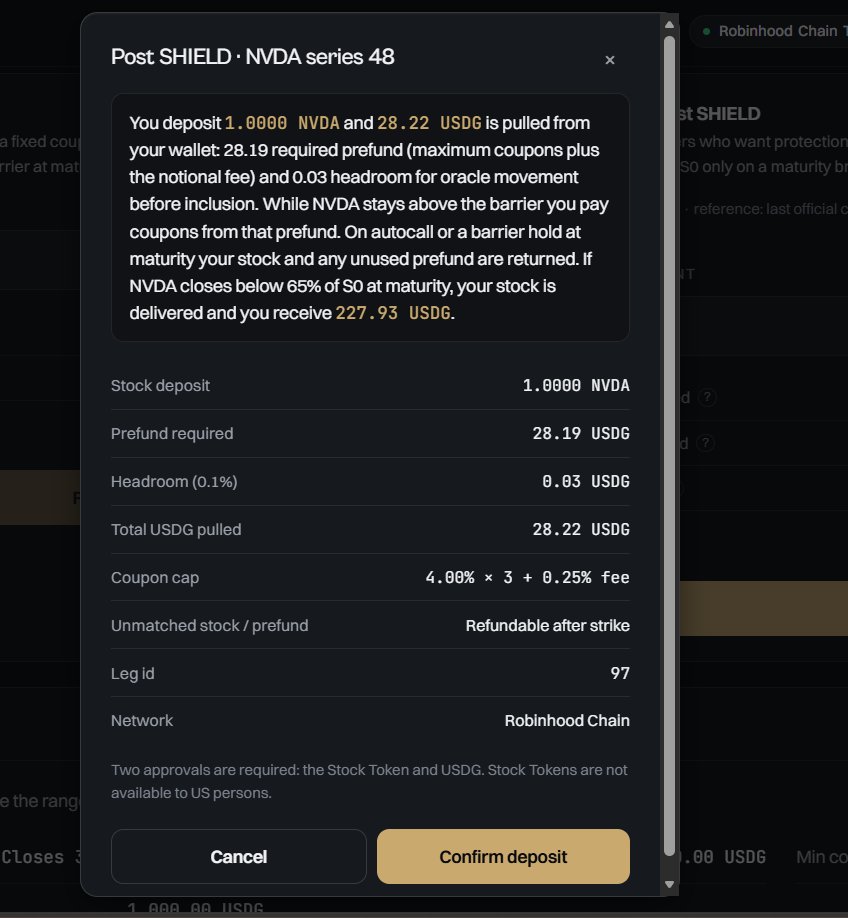
i posted 1 NVDA, worth about 227.93 USDG, and Note pulled another 28.22 USDG as prefund.
that confused me at first.
why am i depositing USDG when i've already deposited NVDA?
then it clicked:
SHIELD is the side paying the coupons.
since the final coupon hasn't been determined yet, that obligation is prefunded.
if the note ends without a maturity barrier breach, i get my stock back + unused prefund.
if NVDA has the defined maturity breach, i deliver the stock and receive the protected USDG amount.
and that's when i finally understood the relationship:
COUPON gets paid to absorb the downside risk.
SHIELD pays to transfer it.
one person's coupon is basically another person's protection cost.
but there was still one thing i didn't understand.
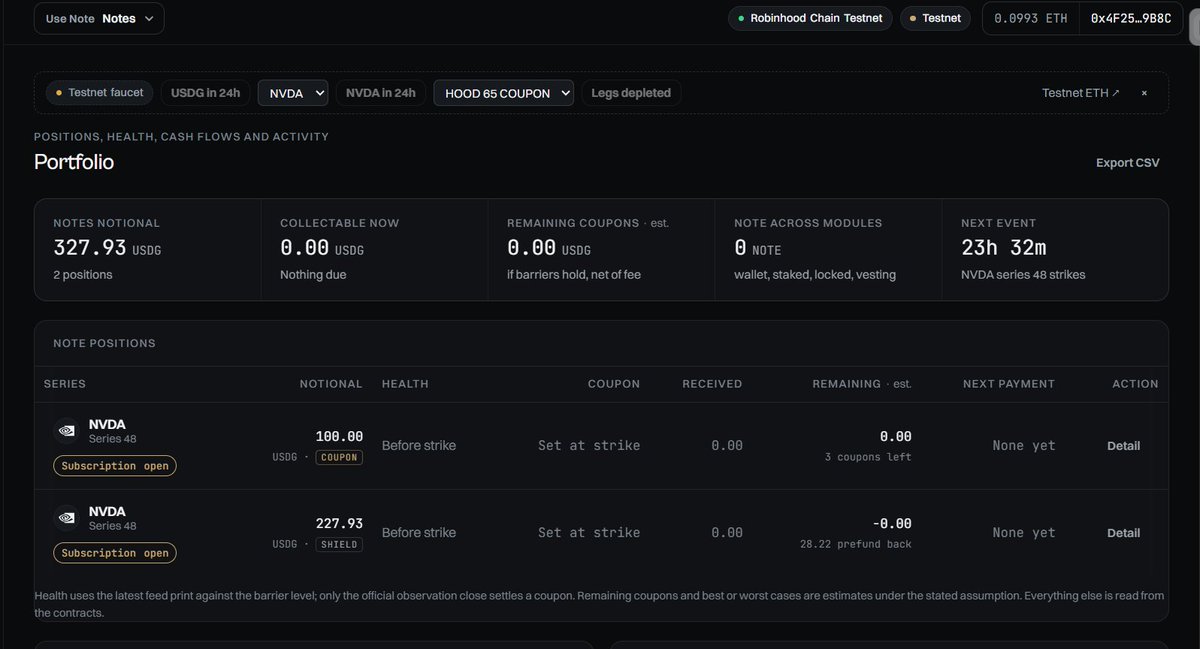
after doing both, i opened my portfolio and literally had both sides of the same NVDA note
100 USDG → COUPON
1 NVDA → SHIELD
but both still said:
coupon: set at strike.
so if COUPON receives the coupon and SHIELD pays it...
who decides what the coupon actually is?
turns out, the market does.
simplified, the discovered coupon is based on:
reference coupon × SHIELD demand / COUPON demand
bounded by a predefined floor and cap.
so when more stock wants protection than there is capital willing to take the risk, the coupon goes up.
when more capital is competing to earn coupons than there is demand for protection, it goes down.
that's coupon discovery.
and honestly, this changed how i look at yield.
initially, i saw 1.5% and thought:
“okay...that's the yield.”
now i'd first ask:
“what exactly am i being paid 1.5% to risk?”
i'm obviously not a structured products expert after one night on testnet 😂
my positions haven't even struck yet.
but yesterday, “autocallable barrier note” sounded like financial alphabet soup to me.
now my mental model is:
COUPON: pay me to take your defined downside risk.
SHIELD: i'll pay to transfer that risk.
coupon discovery: let the market determine what that risk costs.
still a lot more for me to learn, but i finally get it.
sometimes reading more docs isn't what makes something click.
sometimes you just have to use it.
in my case, i apparently had to take both sides 😂
learned this one by actually using @notesystems robinhood:0xc4f730335fb9e439ca5552f7b52b8e638c4245b0
(all transactions were made with test assets on Robinhood Chain testnet)
ai agents can move capital.
but should they?
introducing Terms - a pre-execution authorization layer for autonomous capital, built for the @openservai SERV Hackathon.
Terms checks a treasury mandate against live IXS RWA vault evidence before capital is allowed to move.
the flow: mandate → IXS evidence → policy engine → SERV verification → IXS preflight → action gate.
and the demo captured exactly why Terms exists:
policy: EXECUTE
SERV: VERIFIED
IXS: BLOCKED
action gate: WITHHELD
the allocation was authorized, but live execution conditions didn't permit it, so no transaction data was released.
authorization ≠ execution feasibility.
missing evidence isn't permission either: Terms can EXECUTE, HOLD, or ESCALATE depending on what can actually be established.
built for the IXS RWA Vaults track.
live: https://t.co/IEgamevwDX
github: https://t.co/yqod93utB9
capital that knows its terms.
what if you could research a token without knowing what happened next?
that’s the idea behind Parallax, my submission for the @nansen_ai Meridian Buildathon.
crypto research has a hindsight problem.
once a token pumps, crashes, or becomes a huge story, it’s easy to look back at old onchain data and convince ourselves the outcome was obvious.
Parallax removes that advantage.
choose a token and a historical cutoff. Parallax uses Nansen’s historical data to reconstruct what was actually knowable at that moment, participant flows, smart money movement, price context and evidence coverage.
everything after the cutoff is sealed behind a temporal firewall.
you see the evidence.
you make your decision.
you lock it.
only then do you get to see what happened next.
if historical data is missing, Parallax keeps it unavailable instead of silently turning missing evidence into a signal.
Time Machine lets you revisit curated historical moments without hindsight.
Investigate lets you reconstruct your own moments across Ethereum and Solana, with deterministic evidence receipts and Nansen provenance.
no buy/sell calls. no prediction score.
evidence, not prediction.
live: https://t.co/u0nuIMHCvy
github: https://t.co/mfUt7HYnxw
the future changes how the past looks.
one mistake i made with my last build was deploying it on render's free tier.
render is good, but the free tier has a cold start after your app sits idle.
normally, that's just a few extra seconds.
in a hackathon? those seconds matter.
a judge clicks your demo, sees a loading screen, and might assume it doesn't work.
the app works perfectly, but first impressions matter.
lesson learned: don't just build for the demo. build for the person judging it...
ever wondered what happens when you want exposure to a stock onchain… but there are multiple tokens representing the exact same company?
different issuers.
different contracts.
different liquidity.
different lifecycle states.
different levels of verifiable evidence.
which one should actually fulfill your order?
that's the problem i built fulcrum to solve.
users choose stocks. fulcrum handles tokens.
instead of asking users to understand every tokenized representation, fulcrum starts with the underlying intent.
say you want $1 of tesla exposure.
fulcrum:
→ discovers the available onchain representations
→ verifies identity, issuer, lifecycle + market evidence
→ removes representations that fail mandatory gates
→ ranks only the survivors using executable economics
→ selects a strict winner or refuses to select one
→ gets a fresh execution route
→ inspects + simulates the transaction
→ requotes before wallet authorization
→ executes only if policy still passes
in the demo, fulcrum evaluates tslax by xstocks and tslaon by ondo.
tslax passes the mandatory representation gates and becomes the strict winner.
tslaon doesn't have all the evidence fulcrum
requires, so it's excluded before economic ranking.
and here's an important part:
selection isn't permanent authorization.
markets and routes change.
so before execution, fulcrum checks everything again.
if the fresh transaction passes → ready_for_signature
if it doesn't → execution_denied
no blindly executing an old decision.
no forcing an unverifiable route through.
pyth provides market-reference evidence.
jupiter provides executable solana routes.
fulcrum provides the decision layer:
should this representation and this transaction fulfill the user's equity intent right now?
policy before routing.
built on solana and submitted to stocklana
github ↓
https://t.co/kWZcaltCcf
try fulcrum ↓
https://t.co/GSv5f5tsFd
demo below 🎥