AI Drug Discovery Is Becoming a Bottleneck Trade
I get excited when an industry starts going through a real regime change. AI drug discovery (“AIDD”) increasingly looks like one of those moments.
Two things are happening:
1/ Upstream: the frontier AI labs are piling in.
2/ Downstream: The supply chain is clearly moving.
Supply-chain checks suggest the upstream picks-and-shovels of discovery and early preclinical R&D are starting to feel the increase in experimental volume.
DNA → protein → assays → sequencing → automation → preclinical testing
Names across that stack include $TWST , @GenScript , $ILMN , $TXG , lab-automation vendors and CROs.
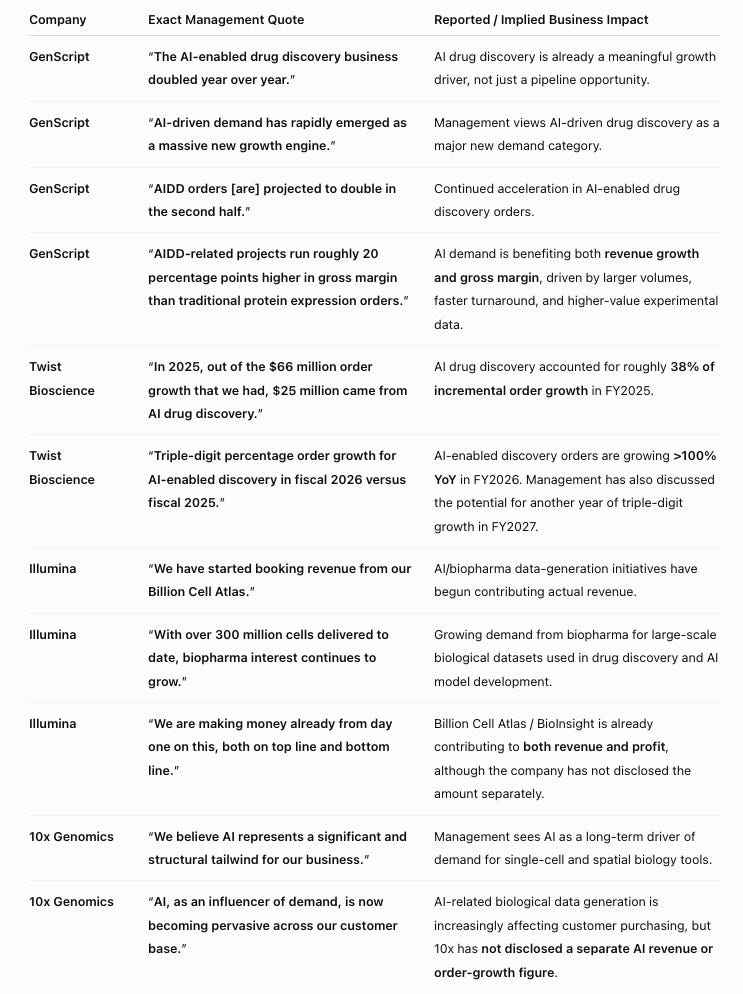
$TWST expects triple-digit percentage growth in AI-enabled drug-discovery orders in FY26, and another year of triple-digit order growth in FY27.
@GenScript's AIDD business doubled YoY in 1H26. Its current platform advertises industrial-scale validation of 4,000+ designs/day, with integrated sequence-to-data workflows. Our channel checks suggest the ramp is moving even faster: roughly 8,000 designs/day currently, with a path toward ~16,000/day by YE26.
---
Why does AI drive more wet-lab demand?
1/ AI makes hypothesis generation almost free → way more shots on goal.
The bottleneck is moving from expert-driven design to biological validation.
2/ AI models need continuous experimental feedback — and both good and bad data are useful.
Traditionally, only the highest-conviction A+ candidates might get pushed into expensive validation. With AI, even the B/C candidates can be valuable because failed experiments generate training data.
@GenScript has said its sequence-to-binding workflow can return data in 4–7 days, and that faster cycle times matter because AI models depend on continuous experimental feedback.
@Anthropic is a clean example. @claudeai designed 1,320 protein binders. @adaptyvbio converted those digital sequences into DNA, expressed the proteins and tested binding. Only 354 actually bound. And the 966 failures are not wasted. They are useful negative labels: what does not express, what does not bind, what has poor affinity. Those results help train the next model iteration.
3/ Wet labs are no longer just making drugs. They are making training data.
$TWST / @GenScript increasingly look like biological data foundries.
$TWST explicitly talks about generating model-ready data from AI-designed sequences. In some workflows, the customer may care less about receiving the physical protein than about getting structured experimental results back into the model.
Traditional drug discovery asks: “Does candidate X work?”
AI drug discovery also asks: “What can this experiment teach the model?”
---
TAM of AIDD
If AI is simply a better R&D tool, the relevant spending pool is the $300–400B of annual global pharma R&D. If AI meaningfully increases the number of viable drug programs, the opportunity is larger because it expands downstream demand for DNA synthesis, protein production, assays, and preclinical work.
Near term, we can also size demand from AI-company spending. If Anthropic reaches $80B of ARR in 2026 and spends just 1% on AIDD, that alone would imply ~$800M of annual investment.
---
Trade setup
This is a trade that could have long legs. It’s hard to really stop working until PhaseI/II results (2028+)
It smells a lot like the bottleneck trade we just saw in semis: GPUs → HBM → networking → power/cooling. In biology, It basically follows the drug discovery process downstream: AI models → designs → DNA/protein → assays → preclinical capacity.
After the upstream picks-and-shovels, animal testing could become the next bottleneck. Monkey prices are already near prior highs and CRO capacity is tight. AIDD pushing more candidates into preclinical development would only add demand.
?? But clinical trials are still the bottleneck?
This is the biggest pushback I keep coming back to. No matter how fast discovery becomes, drugs still need to go through preclinical → Phase I → Phase II → Phase III → approval. You still need patients, time and capital.
But that doesn’t mean the bottleneck trade won’t work. More viable candidates — especially with higher success rates — still means more demand throughout the development process.
And who knows: clinical trials themselves may eventually be optimized by AI.
?? What breaks the trade?
Near term, the picks-and-shovels trade breaks if experimental budgets stop growing, AI-generated designs don’t translate into useful wet-lab hits, or capacity catches up too quickly.
Longer term, the thesis breaks if AI drugs look great in discovery / Phase I but fail at normal rates in Phase II/III. That is why Phase II matters so much.
?? Milestones
Late 2026–2027: first Isomorphic-designed drugs enter human trials; more AI-native programs move into IND-enabling work / tox.
2028–2030: clinical trial results start telling us whether AI-designed drugs actually perform better than conventional drugs.
Calling all the "bottleneck bros". :) @jukan05@zephyr_z9@aleabitoreddit@ParadisLabs
+++
More comprehensive analysis: https://t.co/vaTuiyyYB6
❄️ $MU If you want to understand why HBM will solve the AI inference bottleneck, read this thread.
"The working memory of the AI is stored in the HBM. If you have a long conversation with an AI, overtime, that memory, that context memory is going to grow TREMENDOUSLY" -Jensen at CES 2026.
Endless Inference = Endless Memory
Inference is becoming a memory-bound challenge, not just a compute one. The explosive growth of AI inference will drive a structural shift in the memory industry, particularly for leaders like Micron.
High Bandwidth Memory (HBM) sits in the critical path for overcoming inference bottlenecks for billions of users worldwide. It will also flatten the DRAM market's historically volatile supply-and-demand cycles, ushering in a prolonged and durable fundamentals with sustained high pricing and profitability.
Let me start with a quote from 1996. Yes, three decades ago.
“It’s the Memory, Stupid!” — Richard Sites
In 1996, computer architecture pioneer and lead designer of the DEC Alpha, Richard Sites, famously declared, “It’s the Memory, Stupid!” in a seminal paper. He emphasized that memory hierarchies, not just raw processing power, were the true bottlenecks in computing performance. Three decades later, his words resonate more strongly than ever in the age of AI.
As AI models grow larger and more complex, the focus has shifted from training these massive systems to deploying them efficiently through inference: the process of generating predictions, recommendations, or responses in the real world. Every ChatGPT query? That's an inference call.
During inference, models must rapidly access enormous amounts of data from memory to produce outputs. Traditional memory solutions often cannot deliver the required bandwidth, causing processors to idle while waiting for data. This is the classic “memory wall” problem Sites warned about.
In essence, training thrives on brute-force GPU compute due to its high arithmetic intensity, while inference relies heavily on high-bandwidth memory (HBM) to keep data flowing fast enough to fully utilize that compute.
HBM breaks through the memory wall by offering ultra-low latency and massive throughput, often in the terabytes-per-second range. This specialized DRAM is stacked directly onto processors like $NVDA / $AMD GPUs or Google's TPUs with a 3D architecture with through-silicon vias (TSVs). These act like high-speed elevators in a vertical “apartment building” of memory dies, minimizing latency, maximizing bandwidth, and reducing power consumption: perfect for AI workloads.
A decade from now, AI inference will explode as younger generations integrate AI deeply into daily life. Projections estimate the AI inference market reaching $250–520 billion by 2030–2034, with inference compute demand growing at over 35% CAGR in the coming years, outpacing training.
By 2030, inference is expected to account for over half of AI data center workloads, dominating even more in the 2030s as billions of people and devices rely on AI daily.
HBM production is DRAM-intensive and diverts significant resources from consumer markets, contributing to the dramatic DRAM price surges we have seen recently.
Producing 1GB of HBM consumes roughly 3 times more wafer capacity (the raw silicon starting material) than 1GB of standard DDR5 DRAM.
Yields are lower due to the complexity of stacking and interconnects, requiring even more wafers for usable output.
Result: Even though HBM represents only a fraction of total DRAM bits shipped, it consumes a disproportionate share of production resources.
It is a zero-sum game. Every wafer used for HBM is one not used for regular DDR5 or LPDDR5X.
Total DRAM supply growth remains limited (around 10–16% YoY in 2026), while demand surges 30–35%+, creating a severe imbalance. New fabs and capacity expansions are underway, but meaningful relief likely will not arrive until 2027–2028.
Micron has sold out its entire 2026 HBM capacity (including industry-leading HBM4), confirming this sustained AI-driven demand in the foreseeable future.
Long-term forecasts remain uncertain as AI is still in its early stages. Physical AI has yet to see a significant breakthrough, and the market is only beginning to understand the long-term dynamics of AI and HBM.
What's for sure is that the AI Inference Winter Is Coming. Billions of people will ask questions to ChatGPT and Grok and we need $MU HBM for AI to proliferate.
HODL the Shares.