Great little review. The lipid membrane is probably the most underrated and poorly studied part of the cell.
When people make "synthetic" cells, they usually do so using a single type of lipid. And yet, for reasons we don't yet understand, cells have dozens of different lipids in their membranes, some of which have remarkable properties.
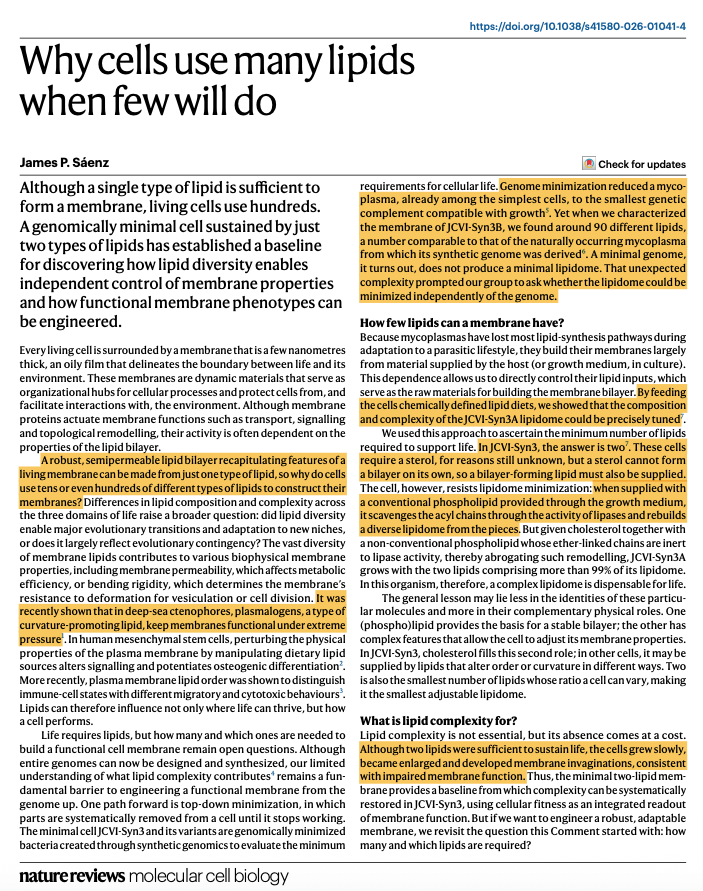
"It was recently shown," Sáenz writes, "that in deep-sea ctenophores, plasmalogens, a type of curvature-promoting lipid, keep membranes functional under extreme pressure."
Oddly enough, when the J. Craig Venter Institute cut down a Mycoplasma cell's genome size to its near-minimum, and then studied the resulting organism, they "found around 90 different lipids, a number comparable to that of the naturally occurring mycoplasma from which its synthetic genome was derived. A minimal genome, it turns out, does not produce a minimal lipidome." Cells seem to *want* to have a high variance of lipids in their membranes, for reasons that are not clear.
Furthermore, when the researchers found ways to finally cut down the number of lipids in the Mycoplasma membrane, the cells still found clever ways to get around their constraints. "The cell...resists lipidome minimization," in other words. In one case, the researchers gave the cells "a conventional phospholipid" in their growth medium, and the cells quickly "scavenge[d] the acyl chains through the activity of lipases and rebuil[t]
a diverse lipidome from the pieces."
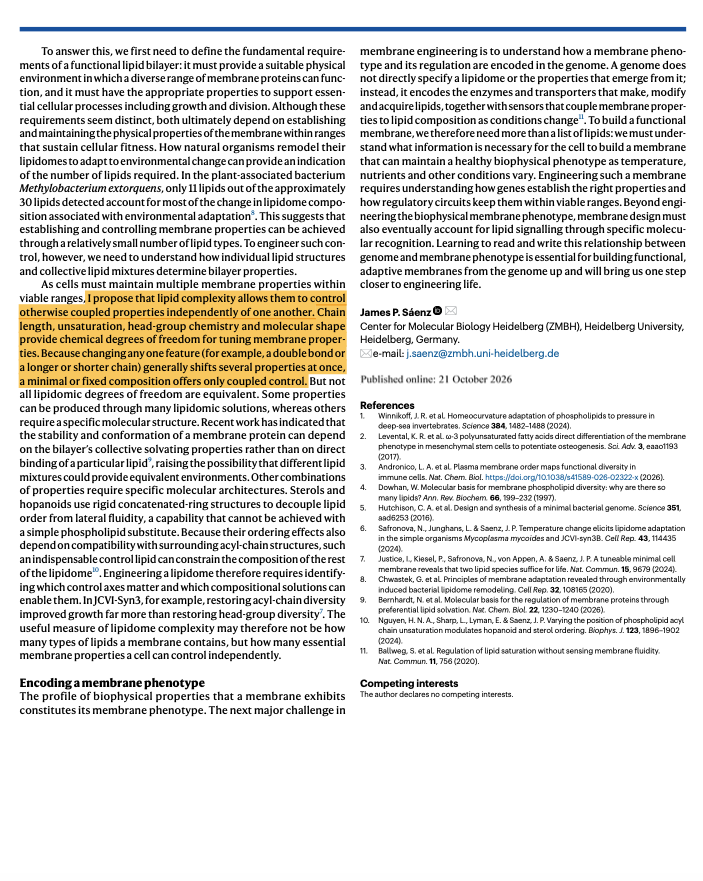
They finally cut down the number of lipids in these cells to just two, but this caused the cells to grow slowly and become artificially enlarged. So one argument for why cells try to maintain such a panoply of lipids in their membranes might be because it "allows them to control otherwise coupled properties independently of one another." From the review:
"Chain length, unsaturation, head-group chemistry and molecular shape
provide chemical degrees of freedom for tuning membrane properties. Because changing any one feature (for example, a double bond or a longer or shorter chain) generally shifts several properties at once, a minimal or fixed composition offers only coupled control. But not all lipidomic degrees of freedom are equivalent. Some properties can be produced through many lipidomic solutions, whereas others require a specific molecular structure."
Interesting throughout.
Research Associate and Postdoc Opportunities! I am happy to announce that I will establish a new laboratory at Hong Kong University of Science and Technology (HKUST) to start a major research program supported by a multi-year FTRSS grant.
Read a new collection of recent articles to accompany @EMBO workshop, Lipid Code to Life. Selected articles explore mechanisms underlying lipid transport, endosome biogenesis, & the maintenance of lipid homeostasis at ER–plasma membrane contact sites. https://t.co/tg91Cr8dUM
What if we start type 2 diabetes prevention too late?
Our new @NatureMedicine Perspective argues for a shift from thresholds to trajectories:
Prevention should aim not only to delay T2D, but to preserve metabolic health.
Read & share:
https://t.co/TyWtElQkfz
My wife shouting from the living room: "I hope you haven't spent your entire month's salary on something unnecessary and expensive again"
Me: "DON'T COME IN THE BATHROOM"