Introducing IOTA Decide 4B, our first public model.
Pareto optimal. Built different.
Trained across globally distributed GPUs with our SDK.
Open weights, Apache-2.0.
🤗 https://t.co/cFlqLmcnop
Day 1 at #GTCBerlin. Neoclouds are racing to optimize inference and turn raw compute into turnkey training products. The Overton window on distributed training is shifting, and we are ready.
It took @const_reborn a minute to prompt it,
@arbos_born an hour to code it,
@Apex_SN1 6 hours to incentivize it,
and the miners 12 hours to solve it.
The incentivized intelligence fab hunts efficiency at every layer.
In decentralized training, every merge stops the whole swarm from training while it waits on the slowest member.
With our latest update, merging is ~5x faster and training is almost 20% cheaper.
The biggest unlock was to convert the network graph into a tree during merging.
🧵 1/(n)
5x merging is equates to a c. 10% speed up in absolute terms. Very, very cool, and slowly we converge closer and closer to indistinguishable from operating in a data centre.
Read our CEO @WSquires' thoughts from @ExploitSummit, where we announced the release of the iota SDK this year.
The SDK allows anyone to harness distributed, heterogenous, and idle compute to create frontier scale training outcomes.
https://t.co/WsnRgksELF
Great to talk to @TheStreet about our work at @MacrocosmosAI on aggregating compute to train frontier-scale training workloads.
We are steadfast in our work towards fusing the long tail of idle, heterogenous, interruptible compute into a global supercomputer.
https://t.co/ERskliI3Ey
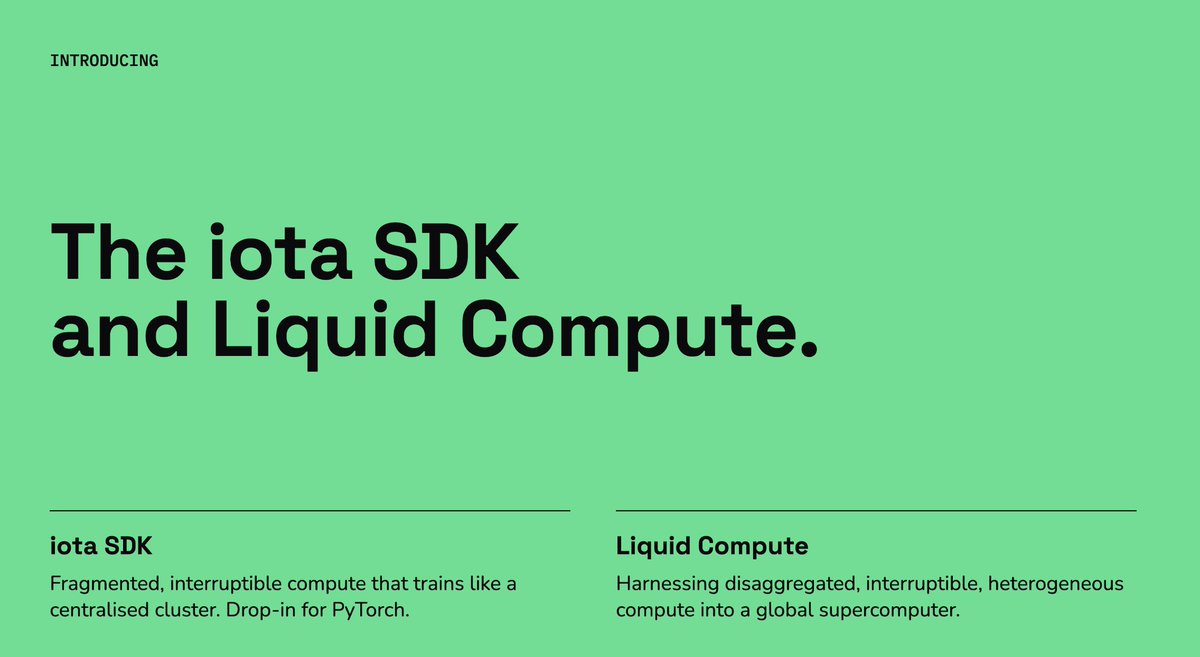
Scattered compute can now train like one cluster.
Yesterday at @ExploitSummit we announced the iota SDK and Liquid Compute, our disaggregated compute platform. Here's what they unlock.
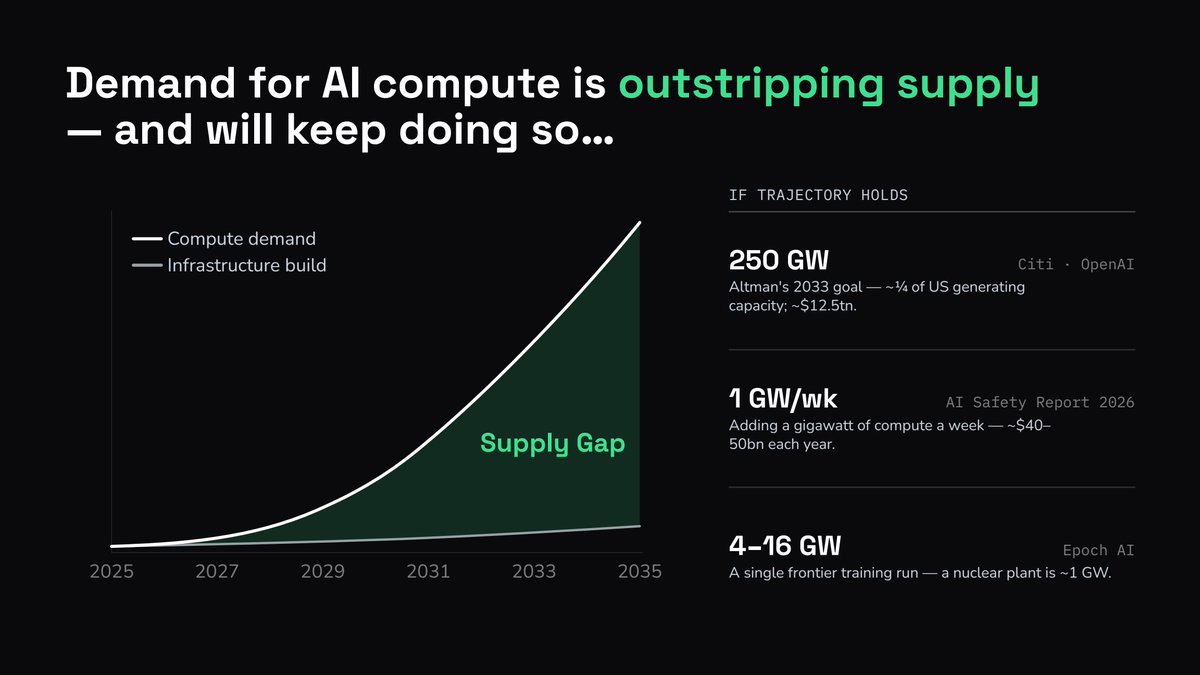
Demand for AI compute is growing far faster than the infrastructure being built to serve it. Sam Altman's stated goal for OpenAI is 250 GW by 2033, roughly a quarter of US generating capacity. If the trend holds, Epoch AI puts a single frontier training run at 4 to 16 GW.
The future of training, synthetic data generation, or inference will live on a distributed network of compute. The future is liquid, we are are building it.
https://t.co/Vc3lIWAOwR
We've been busy building an SDK so that anyone can just ask their agent to build an Apex competition.
I built a challenging robotics RL competition as my first test, took maybe an hour to get it fully running with a decent baseline. I wrote zero code.
Really excited to give everyone access to the SDK very soon.
Every AI compute conversation runs on the same anxiety: not enough.
Not enough GPUs, not enough data centres, not enough data, not enough power.
All real, all justifiable, but for most teams that's not the wall they hit first.
The wall is that the compute you can get is rarely the compute you need. It's the wrong size, the wrong place, free at the wrong time, or priced for a commitment you can't justify.
So it sits idle while your run waits in a queue or burns budget on a premium cluster.
The bottleneck was never the shortage. It's that capacity which could have done the job goes unused, because it doesn't come in the shape traditional training demands.