@cosmoshub Brasil community ⚛️ | Awareness and development for the cosmos app-chains. A economia aberta, escalável e interconectada do futuro: a Interchain.
Todos desacreditaram de Ethereum e diziam para migrar tudo para Solana.
Agora, Instituições estão buscando criar suas próprias blockchains de L1 independentes.
Todos olhos estão a caminho da @cosmos.
Aguarde 🔥
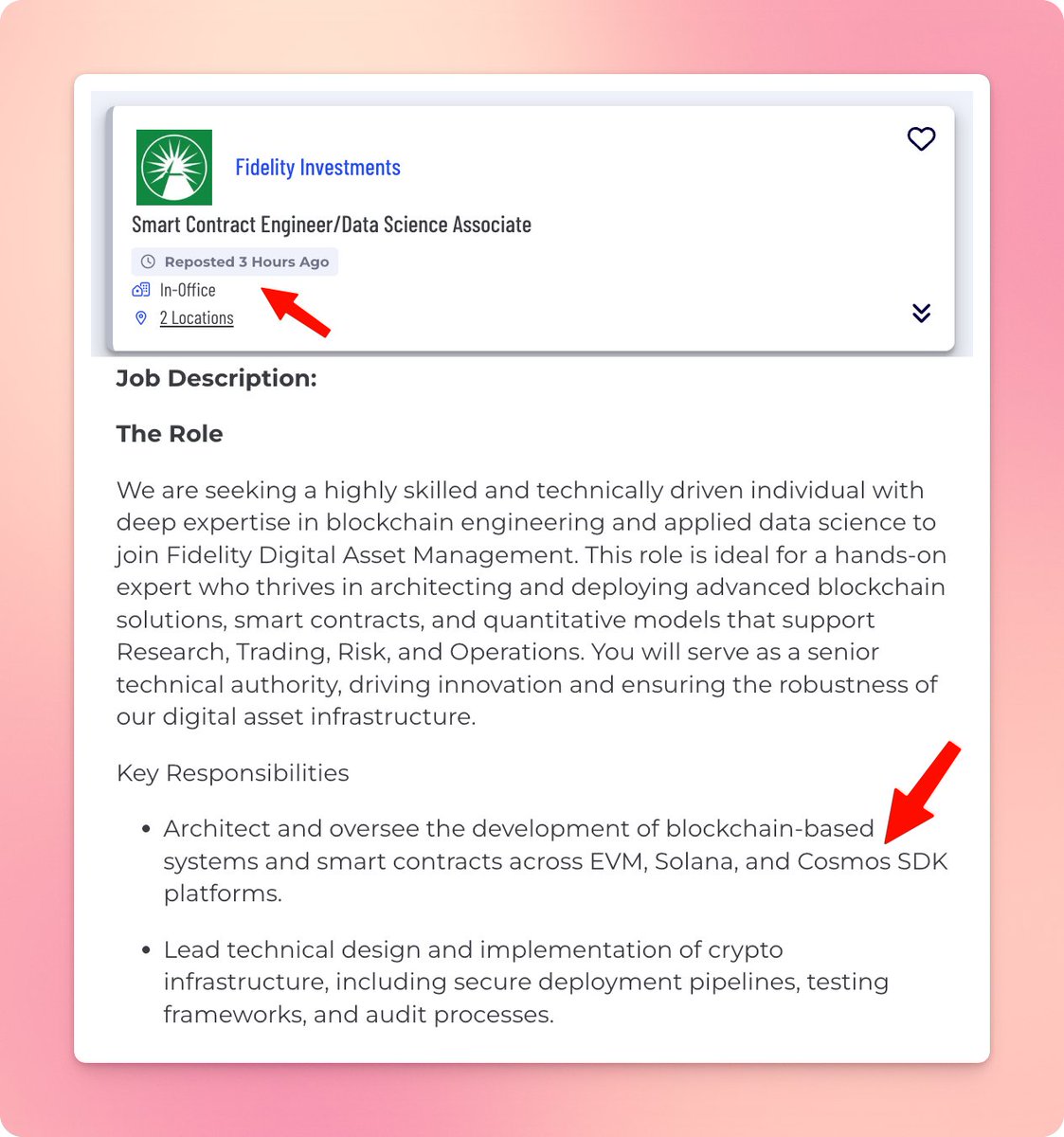
Fidelity is building a Digital Asset Operating Platform for onchain finance.
They are also hiring talent across EVM, Solana & Cosmos SDK.
2026 is shaping up as the year institutions shift from being onchain to operating onchain.
Fidelity lists Cosmos SDK in its blockchain stack - Top-10 global asset manager treating the @cosmos stack as core infrastructure (alongside the others).
▫️ Exact line from the @DigitalAssets Job posting:
“Architect and oversee the development of blockchain-based systems and smart contracts across EVM, Solana, and Cosmos SDK platforms.”
▫️ What they’re actually building: Fidelity Digital Asset Management’s production investment platform - smart contracts, blockchain data pipelines, quant/trading/risk integration for retail + institutional clients.
Stack keeps winning...
https://t.co/LP51xklS3c
Yes, it's going to be a while before any of this routes through the Hub or has value accrual back to $ATOM holders (if ever) - but this is a start. I'm not in a rush but YMMV.
NFA. DYOR.
🫡
Vitalik announced that the rollup-centric roadmap is over.
For Optimism, Arbitrum, Base, and the rollups built on their frameworks, this raises urgent questions about platform risk, independence, and longterm commercial viability.
Cosmos was built for this moment.
Read more ⬇️
There have recently been some discussions on the ongoing role of L2s in the Ethereum ecosystem, especially in the face of two facts:
* L2s' progress to stage 2 (and, secondarily, on interop) has been far slower and more difficult than originally expected
* L1 itself is scaling, fees are very low, and gaslimits are projected to increase greatly in 2026
Both of these facts, for their own separate reasons, mean that the original vision of L2s and their role in Ethereum no longer makes sense, and we need a new path.
First, let us recap the original vision. Ethereum needs to scale. The definition of "Ethereum scaling" is the existence of large quantities of block space that is backed by the full faith and credit of Ethereum - that is, block space where, if you do things (including with ETH) inside that block space, your activities are guaranteed to be valid, uncensored, unreverted, untouched, as long as Ethereum itself functions. If you create a 10000 TPS EVM where its connection to L1 is mediated by a multisig bridge, then you are not scaling Ethereum.
This vision no longer makes sense. L1 does not need L2s to be "branded shards", because L1 is itself scaling. And L2s are not able or willing to satisfy the properties that a true "branded shard" would require. I've even seen at least one explicitly saying that they may never want to go beyond stage 1, not just for technical reasons around ZK-EVM safety, but also because their customers' regulatory needs require them to have ultimate control. This may be doing the right thing for your customers. But it should be obvious that if you are doing this, then you are not "scaling Ethereum" in the sense meant by the rollup-centric roadmap. But that's fine! it's fine because Ethereum itself is now scaling directly on L1, with large planned increases to its gas limit this year and the years ahead.
We should stop thinking about L2s as literally being "branded shards" of Ethereum, with the social status and responsibilities that this entails. Instead, we can think of L2s as being a full spectrum, which includes both chains backed by the full faith and credit of Ethereum with various unique properties (eg. not just EVM), as well as a whole array of options at different levels of connection to Ethereum, that each person (or bot) is free to care about or not care about depending on their needs.
What would I do today if I were an L2?
* Identify a value add other than "scaling". Examples: (i) non-EVM specialized features/VMs around privacy, (ii) efficiency specialized around a particular application, (iii) truly extreme levels of scaling that even a greatly expanded L1 will not do, (iv) a totally different design for non-financial applications, eg. social, identity, AI, (v) ultra-low-latency and other sequencing properties, (vi) maybe built-in oracles or decentralized dispute resolution or other "non-computationally-verifiable" features
* Be stage 1 at the minimum (otherwise you really are just a separate L1 with a bridge, and you should just call yourself that) if you're doing things with ETH or other ethereum-issued assets
* Support maximum interoperability with Ethereum, though this will differ for each one (eg. what if you're not EVM, or even not financial?)
From Ethereum's side, over the past few months I've become more convinced of the value of the native rollup precompile, particuarly once we have enshrined ZK-EVM proofs that we need anyway to scale L1. This is a precompile that verifies a ZK-EVM proof, and it's "part of Ethereum", so (i) it auto-upgrades along with Ethereum, and (ii) if the precompile has a bug, Ethereum will hard-fork to fix the bug.
The native rollup precompile would make full, security-council-free, EVM verification accessible. We should spend much more time working out how to design it in such a way that if your L2 is "EVM plus other stuff", then the native rollup precompile would verify the EVM, and you only have to bring your own prover for the "other stuff" (eg. Stylus). This might involve a canonical way of exposing a lookup table between contract call inputs and outputs, and letting you provide your own values to the lookup table (that you would prove separately).
This would make it easy to have safe, strong, trustless interoperability with Ethereum. It also enables synchronous composability (see: https://t.co/9jy6v1X6Fw and https://t.co/gZmu3YjebM ). And from there, it's each L2's choice exactly what they want to build. Don't just "extend L1", figure out something new to add.
This of course means that some will add things that are trust-dependent, or backdoored, or otherwise insecure; this is unavoidable in a permissionless ecosystem where developers have freedom. Our job should make to make it clear to users what guarantees they have, and to build up the strongest Ethereum that we can.
Our vision is, over the next decade, every major company will have their own, interconnected blockchain.
That vision requires four things to be true: performant ledgers, neutral connectivity, programmable privacy, and network autonomy.
The 2026 Cosmos Stack roadmap delivers on all of them, and doubles down on Cosmos' core strength.
First, 5,000 TPS sustained in production. That's 10x what SWIFT processes today, on par with Mastercard, on every single chain. We are taking the most battle-tested consensus in crypto, and making it the obvious choice for finance.
Second, Proof-Of-Authority. This lets institutions control their own networks and stay compliant.
Additionally, IBC is expanding to Solana, EVMs, and any ledger. We are building privacy that works across counterparties without breaking compliance.
Right now, the use cases reshaping finance are stablecoins, tokenization, cross-border payments, and banks and institutions are choosing to build their own ledgers to accomplish them.
Why? Compliance, performance, interoperability, control, customization and optimization.
We used to see small pilots on Hyperledger, or institutions tokenizing a fraction of their assets across a couple chains. That's changing. Banks are building production-scale blockchains, and what Cosmos can solve is the network effect between them.
One bank on a chain is a pilot.
Ten banks connected to each other is a new market.A new payments network. A new financial infrastructure.
The amount of friction this solves is unmeasurable. If not, look at @Figure, @OndoFinance, and @circle - exporting services to banks and chains globally.
The goal: make Cosmos the default over Hyperledger, smart contracts, or any third-party chain by making the best solution, even better.
2026: Cosmos.
The world 𝘄𝗶𝗹𝗹 run on blockchain.
It's happening now: from loans (@Figure), banking (@progmat_en), and global markets (@OndoFinance), to Artificial Intelligence (@Fetch_ai).
Blockchain is disrupting every market, and institutions are choosing Cosmos as the operating system.
Figure. Ondo. Swift.
Japan. Europe. The U.S.
These businesses, builders, nations, are moving capital markets into tokenized rails to reach a new scale.
Why? It's simple. Faster-time-to-cash, programmable compliance and payments, and the ability to access any market, anywhere.
The lineup continues to grow, with Dr. Bernhard Kronfellner, Partner and Associate Director at @BCG (the Boston Consulting Group), joining @CosmoverseHQ 2025!
We've landed.
Follow for verified updates, announcements, localized content in 8 languages and community discussions, all in one place.
Join here: https://t.co/qwNmmSecMg ⚛️
The Global Markets Alliance welcomes @RWA_xyz.
https://t.co/lUoOxl98e7 is the leading analytics platform for tokenized real-world assets, tracking the growth, adoption, and infrastructure shaping the rapidly growing tokenized asset sector.
They join a growing coalition of exchanges, wallets, custodians, and infrastructure providers working to align standards for how tokenized stocks and ETFs move onchain.
JUST IN:
Stripe is officially building their own L1 blockchain alongside prominent crypto VC Paradigm named "Tempo" according to Fortune Crypto.
It is a "high-performance, payments-focused blockchain" for the Fintech giants customer base.
Cosmos was right!
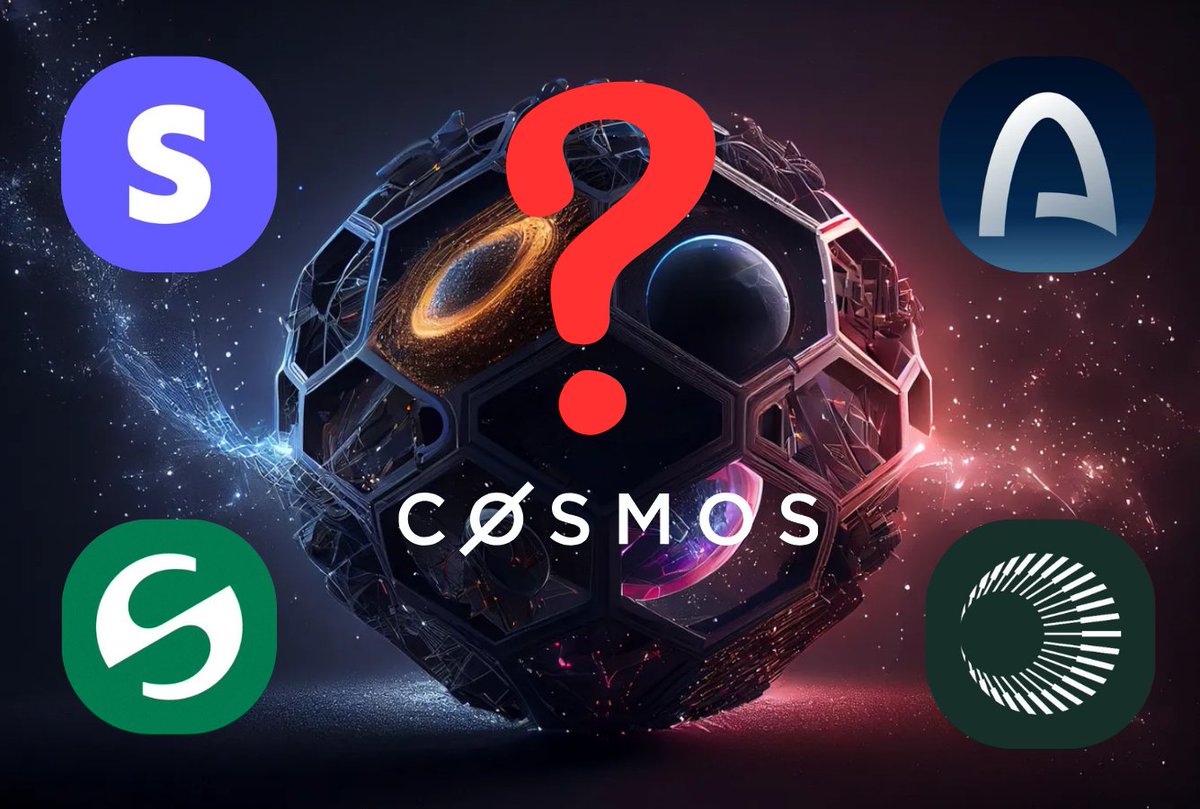
Major institutions just announced the launch of sovereign L1 chains.
🔸Tempo (by Stripe) => L1 chain dedicated to stablecoins
🔸 @arc (by Circle) => L1 chain for stablecoin payments
🔸 @stable (by Tether/Bitfinex) => Specialized L1 for stablecoins
🔸 @PlasmaFDN (by Tether/Bitfinex) => Stablecoin-oriented L1 chain
What are the odds that some of these projects will build on the Cosmos SDK and closely collaborate with Interchain Labs (ICL)?
This would be a huge validation for the ICL leadership and @cosmoshub, which recently pivoted from building an EVM chain to supporting institutions and enterprises in launching their own L1 chains using Cosmos tech!
Btw, Arc uses Malachite, a high-performance consensus engine developed by @informalinc. Hence, it's very likely the chain is built on the Cosmos SDK, as Informal Systems are the former developers of the Cosmos Tech Stack.