China is spending billions on robot training farms.
Here’s why that is one of the smartest strategic moves in AI today:
1. Data is the real bottleneck
The biggest constraint in training reliable, generalizable VLAs is diverse real-world embodied data — robots interacting with objects, environments, and edge cases at scale. That data is slow and expensive to generate.
2. State funding changes the economics
In China, this data is not only subsidized, but effectively shared across the ecosystem.
The result is a much larger training base and a faster learning cycle across the industry.
Competition is no longer about who can afford to collect the most data, but who can process, label, train on, and productize that data best.
3. It strengthens the manufacturing flywheel
Last year, 61% of humanoid robot sales went to R&D and data collection.
Each state-funded lab that buys a humanoid helps scale manufacturing volumes, which lowers hardware costs, improves supply chains, and makes the next round of deployment cheaper.
How defensible this advantage becomes will depend on the quality and diversity of the data being collected.
The more varied the data, the more valuable it is. That’s why lab-generated data is fundamentally more limited than real-world data collected in homes, public spaces, and commercial environments.
And it’s not hard to imagine China extending this same state-backed strategy beyond labs into exactly those settings.
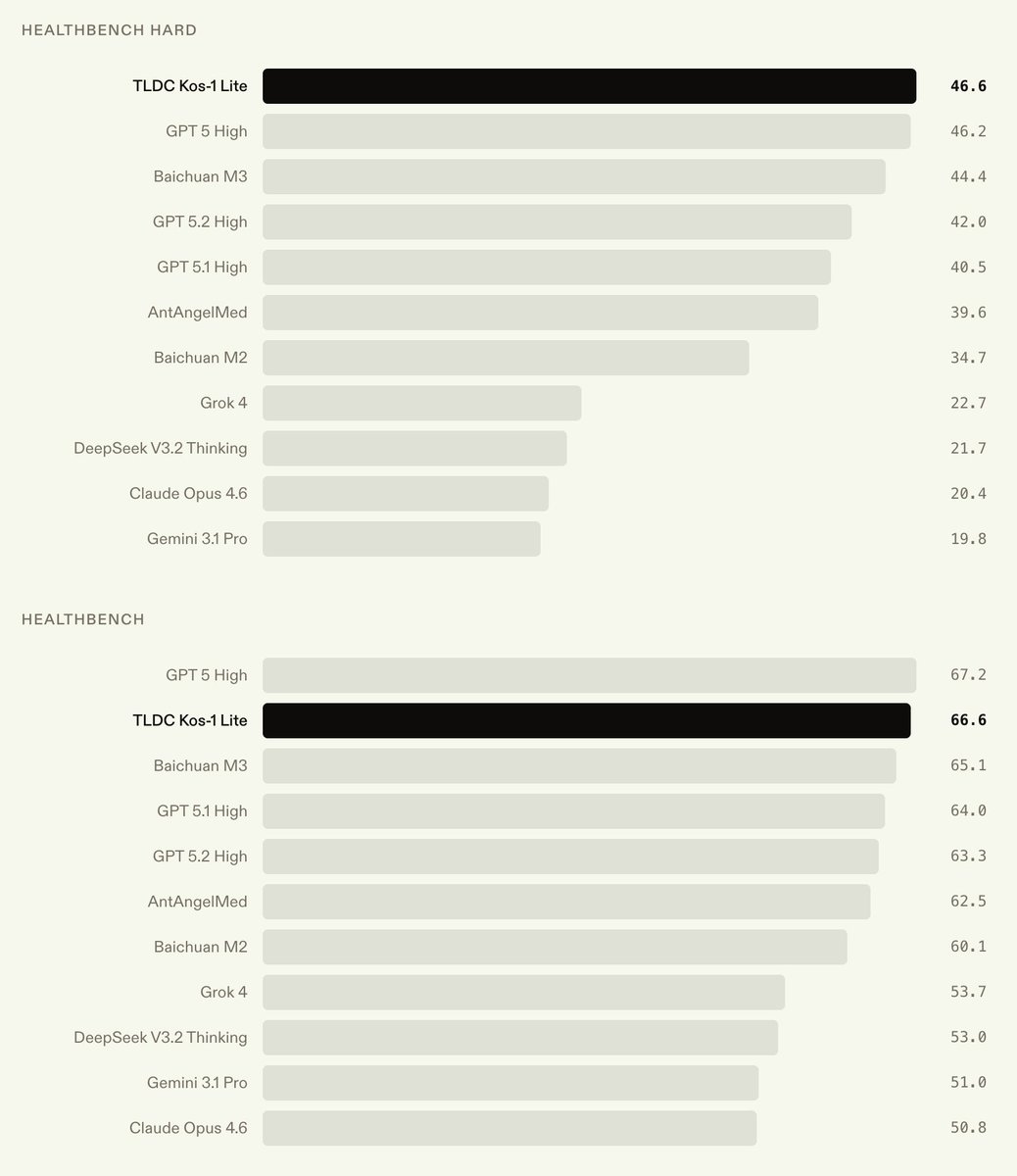
We’re announcing Kos-1 Lite, a medical model that achieves SOTA on HealthBench Hard at 46.6%.
As a medium sized language model (~100B), it achieves these results at a fraction of the serving cost of frontier trillion-parameter models.
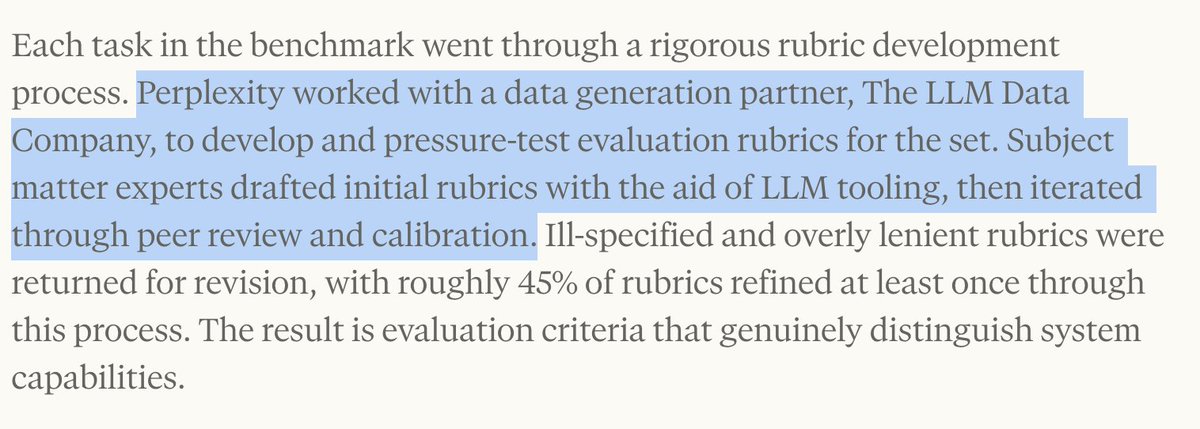
We're excited to partner with @perplexity_ai on their latest release. We were impressed with how performant their new Deep Research product was on early benchmarks and are thrilled that this work is being open sourced.
(1/5)
New post: "Mismatch Praxis: Rollout Settings and IS Corrections". We pressure-tested solutions for inference/training mismatch.
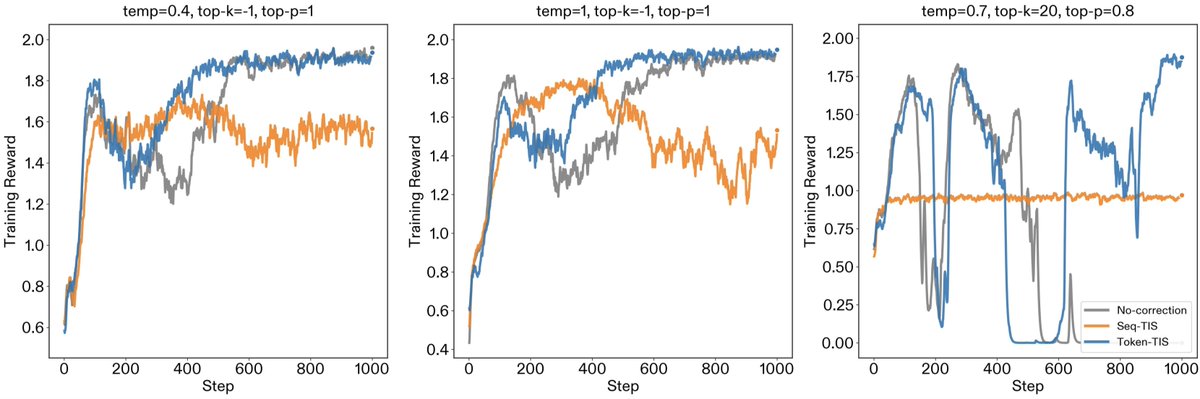
Inference/training mismatch in modern RL frameworks creates a hidden off-policy problem. To resolve the mismatch, various engineering (e.g., FP16 unification, deterministic kernels) and algorithmic (e.g., importance sampling) fixes have been proposed. In this work, we examine how rollout settings (temp, top-p, and top-k) affect mismatch, and how importance sampling corrections bear out in practice.
We find that while Sequence-TIS is theoretically optimal, it can succumb to catastrophic variance in long-horizon contexts. Additionally, non-standard rollout settings create subtle mismatch patterns that require careful engineering fixes. Token-TIS with default rollout settings proved to be the most robust setting for long-horizon training.
To be a founder, you have to be irrationally optimistic.
For most high performers, the risk-return of joining big tech will always be better.
That’s why the best founders are mission-driven.
It doesn’t always work out, but when it does, the feeling is irreplaceable.
@ekuyda is a force of nature and it’s amazing to watch her and team @wabi redefine how we interact with AI on mobile.
Sign up and play with the app. It’s beautifully crafted and fun to use! ✨
Lfg @ekuyda, @BlasMoros, @joonasvirtanen, @iudulat & team!
T̶h̶e̶r̶e̶'s̶ ̶a̶n̶ ̶a̶p̶p̶ f̶o̶r̶ t̶h̶̶a̶t̶
There’s an app for you.
Meet Wabi: the first personal software platform.
Generate beautiful, useful and fun little apps informed by your life.
Achieving lights out operations isn’t just a technical challenge - it’s an economic one.
Reaching 80% automation is straightforward (we’re practically there already).
But that last 20% is the hardest:
• Full of edge cases needing human intervention
• Technically complex & costly to solve
• Often not worth the incremental savings
The smarter strategy today is hybrid. For example, at Brightpick our customers can run a fully lights-out night shift:
• Robots run overnight, picking & buffering orders
• If an item can’t be picked, robots stage it for the morning team
• By morning, orders are partially picked or ready to ship
This way you unlock extra capacity without extra cost.
#Robotics #Automation
10 years ago, training a generalizable robotic AI picking engine was impossible.
5 years ago, it became feasible - but only for the most advanced robotics companies.
Today, it’s trivial. Anyone can train one on a limited dataset in a single day.
We’re seeing the same curve play out with LLMs. Cutting-edge models still demand heavy investment, but open-source alternatives catch up within months.
It’s only a matter of time before Vision-Language-Action (VLA) models in #robotics follow the same path.
95% of #robotics startups today = software wrappers around off-the-shelf Chinese hardware.
Cheap to build. Fast to scale. Easy to copy.
At Brightpick, we took the harder path: designing and assembling everything in-house. Here's why it's paying off.
We are building #robots that can surpass humans – not mimic them.
Our new 𝐏𝐢𝐜𝐤𝐢𝐧𝐠-𝐢𝐧-𝐌𝐨𝐭𝐢𝐨𝐧 capability does exactly that, performing a task no human picker can.
Introducing Autopicker 2.0 – the next generation of our flagship mobile manipulator robot
and the first multi-purpose warehouse robot to deliver human-level performance 🚀
👀 Is this the world’s most advanced e-commerce warehouse❓
No, this is not Amazon.
This is a fully automated fulfillment center from Brightpick 🤖
48 Brightpick Autopicker robots pick 50,000 items each day for leading e-commerce retailer The Feed.
All that with just 3-4 people per shift 🤯.
Hats off to @janz1zka for inventing such an amazing solution 💪
This is probably the most advanced ecommerce warehouse in the world right now.
Dozens of Brightpick Autopicker #robots picking 50,000 items each day for The Feed (the largest online marketplace for endurance athletes 🏃🚴♂️)
As if it wasn’t clear already VW illustrates the giant, ticking time-bomb at the heart of Europe’s economic model.
The European economy is based on two things, industrial production and selling the past.