.@SpaceX IPO Today is probably the biggest liquidity event of 2026.
Official IPO price: $135.
Nasdaq ticker: $SPCX .
Binance SPCXx: tokenized exposure ( 141$).
SPCXUSDT futures: 161$.
A lot of people are watching $135 as the “real” anchor, while Binance futures are already trading way above that level.
So the market is basically pricing an opening premium before the real stock even starts trading.
---
@elonmusk already won.
SpaceX raising $75B at around $1.75T valuation turns the Elon premium into a public market asset.
His paper wealth can push toward the trillion dollar zone, and SpaceX now gives investors a direct way to bet on Starlink, rockets, AI, Mars, and the whole Musk narrative.
But for traders, this is not a clean long only setup.
If SPCX opens strong above the futures price, shorts get cooked.
If Nasdaq opens with a big premium and then fades, late longs become exit liquidity.
The funny part is the market turned this into China short vs Trump family long.
But I don’t think the real fight is China vs Trump.
The real fight is:
- IPO allocation vs secondary market buyers.
- Cash stock vs synthetic futures.
- Elon premium vs actual financials.
- Early insiders vs retail FOMO.
I’m not treating this like a normal IPO.
This feels more like a giant sentiment auction.
Good company? Yes.
Generational narrative? Probably.
Safe entry at any price? Not really.
Trade the hype if you want, but don’t marry the candle.
Are u in?
$STRC yield farming is quietly becoming its own mini RWA meta.
The core idea is simple:
@Strategy created a high yield preferred stock product.
DeFi is now taking that dividend stream and turning it into wrappers, vaults, PT/YT markets, looping strategies and points farming.
I see 3 layers forming here.
1/ Base layer
$STRC is the yield source.
It gives exposure to Strategy preferred stock dividends, currently around 11.5%, with BTC treasury risk sitting behind it.
2/ Wrapper layer
This is where the real farming starts.
@apyx_fi wraps STRC style dividend yield into apxUSD and apyUSD.
@Saturn_btc / @saturn_credit uses a hybrid model around T-bills + STRC through USDat and sUSDat.
@xStocksFi gives STRCx exposure for native onchain access to the dividend stream.
3/ DeFi expansion layer
Once the yield is tokenized, other protocols can build on top.
@pendle_fi can split it into PT / YT markets.
@roycoprotocol can create tranches and LP campaigns.
@infiniFi can package it into vaults.
@Morpho can enable looping.
@strata_markets can deepen sUSDat pair liquidity.
---
$STRC farming is not only about chasing 11.5% yield.
The bigger trade is the stack built on top of it.
Real dividend yield at the bottom.
Points, leverage and airdrop speculation on top.
That is how a small yield source turns into a full farming ecosystem.
Interesting meta, but size carefully.
Two AI narrative tokens got destroyed on the same day.
I do not think the market will treat this as pure coincidence.
1/ $H @Humanityprot
This was the serious one.
Humanity Protocol was built around proof of humanity, palm scan verification, Sybil resistance, and the human identity layer for AI.
Then the weakest point was not the narrative.
It was key management.
The team confirmed that private keys linked to a Humanity Foundation member were compromised.
That means this was not a normal smart contract exploit.
It was worse in a different way.
Once the attacker got access, they drained multiple wallets linked to the project, dumped large amounts of $H into the market, and created massive sell pressure before most retail holders even understood what happened.
On Ethereum, hundreds of millions of $H were reportedly stolen from linked wallets.
On BNB Chain, the attacker also gained proxy admin control and minted extra $H.
That part is the real red flag.
When an attacker can both steal supply and create new supply, price does not just dump because people panic.
Price dumps because the market suddenly cannot trust the supply itself.
The result was brutal.
- $30M plus drained.
- Extra tokens minted.
- $H dumped more than 80 percent.
- Liquidity dried up.
- The team paused bridges and warned users not to touch the app or liquidity pools.
The market saw a human identity project fail because of a private key.
That irony is impossible to ignore.
2/ $SAHARA @SaharaAI
This one is different.
Right now, I would not call it a confirmed hack.
The team says there was no token contract issue, no product security issue, no team selling, and no investor wallet movement.
Their explanation is that 600M $SAHARA was moved as a planned liquidity fill for the Chainlink CCIP bridge between Ethereum and BNB Chain.
Technically, that can make sense.
A bridge needs liquidity on both sides.
But the market did not wait for the explanation.
- Traders saw a huge token movement.
- They saw weak liquidity.
- They saw an AI token already sitting in a nervous market.
Then the sell button became the only thesis.
$SAHARA crashed around 55 to 60 percent, volume exploded, and longs got wiped fast.
Even if the team explanation is true, the market reaction still matters.
Because in crypto, a large token movement without perfect communication looks the same as insider selling for the first few minutes.
And those first few minutes are where most damage happens.
---
$H looks like a real security failure.
$SAHARA looks more like a communication, liquidity, and market structure failure.
But both exposed the same problem.
AI tokens are extremely fragile when the narrative is strong but liquidity, unlocks, bridges, and supply control are not clean.
Maybe these two events are not directly connected.
But the timing is too perfect to ignore.
One token got hit by a private key disaster.
One token got hit by a bridge liquidity panic.
Different causes but same outcome.
Retail becomes exit liquidity when trust breaks faster than the team can explain.
Did you got rug?
DWF Labs is still one of the biggest portfolio maps I’m watching after Q1 2026.
The scale is huge.
They sit across 800 to 1,000 plus projects, with exposure to roughly 10 to 20% of CMC Top 100 and 20 to 35% of Top 1000 tokens.
The tracked @DWFLabs portfolio market cap is around $42B to $44B.
---
What changed in Q1?
1/ @zen_chain raised $8.5M
A Bitcoin ecosystem L1 with EVM compatibility.
This fits the larger BitcoinFi narrative where liquidity, interoperability, and execution layers are becoming more important.
2/ @superset_sh raised $4M
A DeFi infrastructure play focused on stablecoin yield and the LayerZero ecosystem.
This tells me DWF is still looking at yield infrastructure, not only liquid tokens.
3/ GhostDrive entered the portfolio
A later stage productivity and storage related project with revenue already running.
Not the loudest move, but it shows DWF is still adding projects beyond pure token hype.
The holding side is even more interesting.
Their portfolio touches almost every major crypto narrative:
- $TON around $4.5B market cap.
- $SHIB around $2.7B market cap.
- $WLFI around $1.7B market cap.
- $ALGO around $830M market cap.
- $FET around $470M market cap.
- $CRV, $PYTH, $CFX, $FLOKI, $SNX, $peaq and more...
- Am watching deeply on ethereum:0xfa1c09fc8b491b6a4d3ff53a10cad29381b3f949 @falconfinance that is supported hard by @ag_dwf .
---
DWF is not betting on one narrative.
They are building a liquidity map across AI, DePIN, DeFi, RWAs, L1s, memecoins, and infra.
The key signal is not only what they invest in.
It is where they provide market support, liquidity, and strategic visibility.
In a market where many projects die from poor liquidity before product market fit, DWF portfolio tracking gives a useful view of where capital and market structure may quietly move next.
AI agents on @solana are moving from a meme narrative into real payment infrastructure, and x402 is one of the rails making that shift practical.
Agents should not only generate text.
They should discover services, call APIs, pay for data, hire other agents, trade, and settle payments without waiting for a human to approve every small action.
That is why x402 matters.
It gives agents a clean way to pay per request, while Solana gives them the speed, low fees, and stablecoin rails to make the payment loop feel usable.
---
The stack is already forming.
1/ Payment facilitators
- @PayAINetwork
- https://t.co/R352YXRcmR
- Coinbase CDP Facilitator
- @daydreamsagents
- Agenticpay
- Solx402
These are the rails that help agents verify, route, and settle x402 payments.
2/ Developer tools
- Solana Agent Kit
- @elizaOS
- GOAT Toolkit
- Rig
- @x402scan
These tools make it easier for builders to create agents that can trade, pay, access services, and interact onchain.
3/ Agent apps and use cases
- @clawpumptech
- @MiloOnChains
- Zerebro
- @pippinlovesyou
- @tarsprotocol
- @swarms_corp
- @Thea_AI
- @LanaAI
- BlueprintAI
These are closer to the user layer, where agents become wallets, traders, social bots, risk engines, prediction tools, or service buyers.
4/ Commerce and API layer
- https://t.co/R352YXRcmR
- x402 Shopify Commerce
- @corbitsdev
- MCPayTech
- BoberPay
- @moneymq
This is where the next unlock sits.
APIs become vending machines for agents.
Data becomes easier to monetize.
AI services can charge per request instead of forcing subscriptions.
---
https://t.co/R352YXRcmR with Google Cloud is the clearest signal here.
Agents can pay for services like Gemini, BigQuery, and Vertex AI using stablecoins on Solana.
That sounds like a small backend update, but I think it changes the shape of the internet.
The old internet was built for human users.
The next internet may be built for machine customers.
The next Solana AI wave will not only be about agent tokens.
It will be about the rails behind them.
Facilitators, wallets, API markets, identity layers, reputation systems, payment channels, and agent commerce apps could become the real foundation.
AI agents need money rails.
x402 gives them the payment standard.
Solana gives them the environment to move fast.
I’m watching oneBanking because finance is still way too fragmented.
People use one app for banking, one wallet for crypto, one exchange for swaps, one card app, and another tool for tracking money.
@onebanking_app is trying to put all of that into one AI native finance app.
- European IBAN account.
- Crypto wallet.
- Debit cards.
- Investments.
- Rewards.
- Personal AI coach.
---
If users can manage fiat, crypto, cards, rewards, and money insights in one place, the app becomes much stickier than a normal wallet or neobank.
What caught my attention most is the AI layer.
Not just a chatbot, but a financial coach for spending insights, budgeting, alerts, forecasting, and smarter daily money decisions.
Still early, so execution matters.
But if oneBanking can really bridge banking, crypto, and AI in one clean product, this is a project worth keeping on the radar.
Their quest platform is already live:
https://t.co/UdBj674UR3
TON DeFi is still small, but I think the market is reading it the wrong way.
Most chains start with DeFi users and then try to find consumers.
@ton_blockchain starts with Telegram users and tries to turn them into wallet users, payment users, then DeFi users.
That is the real thesis.
Right now, TON has around $80M TVL, around $801M stablecoin market cap, and USDT dominates most liquidity.
The TVL looks small.
But the stablecoin base is already much bigger than the DeFi base.
That tells me TON is not lacking users.
It is still building the DeFi layer around them.
---
The key pieces are already forming:
1/ @ston_fi
The main DEX and liquidity hub on TON.
It handles most of the swap activity and is becoming the core routing layer through Omniston.
2/ @dedust_io
Another important AMM for Jettons, liquidity, and pro traders inside the TON ecosystem.
3/ @tonstakers , @bemo_fi , @hipofinance
Liquid staking turns TON from a passive asset into productive collateral.
This is important because liquid staking usually becomes the base layer for lending and yield.
4/ @evaaprotocol
The main lending market on TON.
This is where TON DeFi becomes more than swaps.
Lending unlocks leverage, collateral, stablecoin yield, and deeper capital efficiency.
---
TON DeFi is not a pure TVL story yet.
It is a distribution story.
Telegram gives the-open-network:native one of the strongest user funnels in crypto.
The question is whether those users can move from holding USDT to swapping, staking, lending, and earning yield inside mini apps.
If that happens, TON DeFi can grow in a very different way from most ecosystems.
Not through temporary incentives.
But through real consumer flow.
> Payments into swaps.
> Swaps into staking.
> Staking into lending.
> Lending into deeper liquidity.
TON does not have the deepest DeFi today.
But it may have one of the clearest paths to make DeFi feel normal for everyday users.
I’m watching Private AI and DePIN closely because they solve two different sides of the same problem.
AI needs infrastructure.
But AI also needs privacy.
That is where this narrative gets interesting.
Private AI focuses on keeping data protected while AI models run.
DePIN focuses on building the physical rails behind AI like GPUs, storage, bandwidth, and compute.
The overlap is simple: AI cannot scale without infrastructure.
But real users and institutions will not trust AI if everything is exposed.
---
Top Private AI coins I’m tracking:
[1] $ROSE @OasisProtocol
Oasis is still one of the cleanest privacy AI plays.
Confidential compute, TEEs, private smart contracts, and a strong privacy narrative around AI data.
[2] $PRAI @privasea_ai
Privasea is more speculative, but the FHE angle is interesting.
Private machine learning inference could become important if encrypted AI demand grows.
[3] $NEAR @NEARProtocol
NEAR is positioning around user owned AI, agents, and confidential compute.
Not a pure privacy coin, but it sits close to the AI privacy narrative.
[4] $VVV @AskVenice
Venice AI is different because privacy is not just a feature.
It is the product.
Private prompts, private AI usage, and a clear consumer facing angle.
[5] FHE related projects
@fhenix , @mindnetwork_xyz , @Arcium , and similar names are worth watching.
Encrypted compute is still early, but if it works at scale, it could become a major AI layer.
Top DePIN coins I’m tracking:
[1] $TAO
@bittensor is still the flagship AI network.
It is not just compute. It is a market for intelligence.
[2] $RENDER
@render remains one of the strongest GPU infrastructure plays.
AI needs GPUs, and Render sits directly inside that demand curve.
[3] $FIL
@Filecoin is still core storage infrastructure.
AI needs massive datasets, and decentralized storage could become more relevant over time.
[4] $ICP
ICP is pushing decentralized cloud and onchain AI apps.
It is one of the more serious attempts to move compute fully onchain.
[5] $AKT, $HNT, $GRASS
@akashnet for compute.
@helium for wireless infrastructure.
@grass for bandwidth and AI data.
Different sectors, but all connected to the bigger DePIN map.
---
The first phase of crypto AI was about attention.
The next phase will be about infrastructure.
And after that, privacy becomes the real filter.
Because faster AI is useful.
Cheaper AI is useful.
But private AI is what makes AI usable at scale.
That is why I think the strongest projects will not just be the ones with the loudest narrative.
They will be the ones building the rails that make AI powerful, decentralized, and safe to use.
Base AI wars are getting interesting.
Right now, two names dominate the conversation:
$BNKR vs solana:3iQL8BFS2vE7mww4ehAqQHAsbmRNCrPxizWAT2Zfyr9y !
Both are building around AI agents on Base, but they’re playing completely different games.
---
@bankrbot feels like the “consumer AI layer.”
- Launch tokens directly from X/Telegram.
- Natural language trading.
- Real fee generation.
- Social-native UX.
- Massive memecoin + agent launch volume.
It’s basically turning AI agents into degens with wallets.
And the numbers are hard to ignore:
~$4.3B+ launchpad volume.
~90%+ Base launchpad share.
187k+ wallets.
Recently outperforming https://t.co/uAsWToHNjL on Base.
What makes Bankr interesting is the flywheel.
More launches → more trading fees → more funding for AI infra → better agents → more users.
That’s a very strong loop.
---
Meanwhile, @virtuals_io is aiming much bigger.
solana:3iQL8BFS2vE7mww4ehAqQHAsbmRNCrPxizWAT2Zfyr9y is not just a launchpad.
It’s trying to build the operating system for autonomous AI economies:
- Agent commerce.
- Agent-to-agent payments.
- Tokenized AI workers.
- Co-owned agents.
- AI capital markets.
- Cross chain agent infrastructure.
---
Bankr is optimizing for distribution.
Virtuals is optimizing for civilization scale infrastructure.
That’s the key difference.
Short term winner on Base right now = $BNKR
The traction, revenue, and user activity are simply stronger today. It has product market fit with traders and creators NOW.
But long term?
solana:3iQL8BFS2vE7mww4ehAqQHAsbmRNCrPxizWAT2Zfyr9y probably has the larger upside if the AI agent economy actually becomes real.
Because infrastructure layers usually capture more value than consumer apps once ecosystems mature.
----
Bankr could struggle if hype cycles cool down.
Virtuals could become too abstract before mass adoption arrives.
Personally, I think both survive.
Bankr becomes the dominant social trading + launch layer.
Virtuals becomes the backend economy powering autonomous agents.
And honestly, Base might need both.
One brings users.
One builds the future economy.
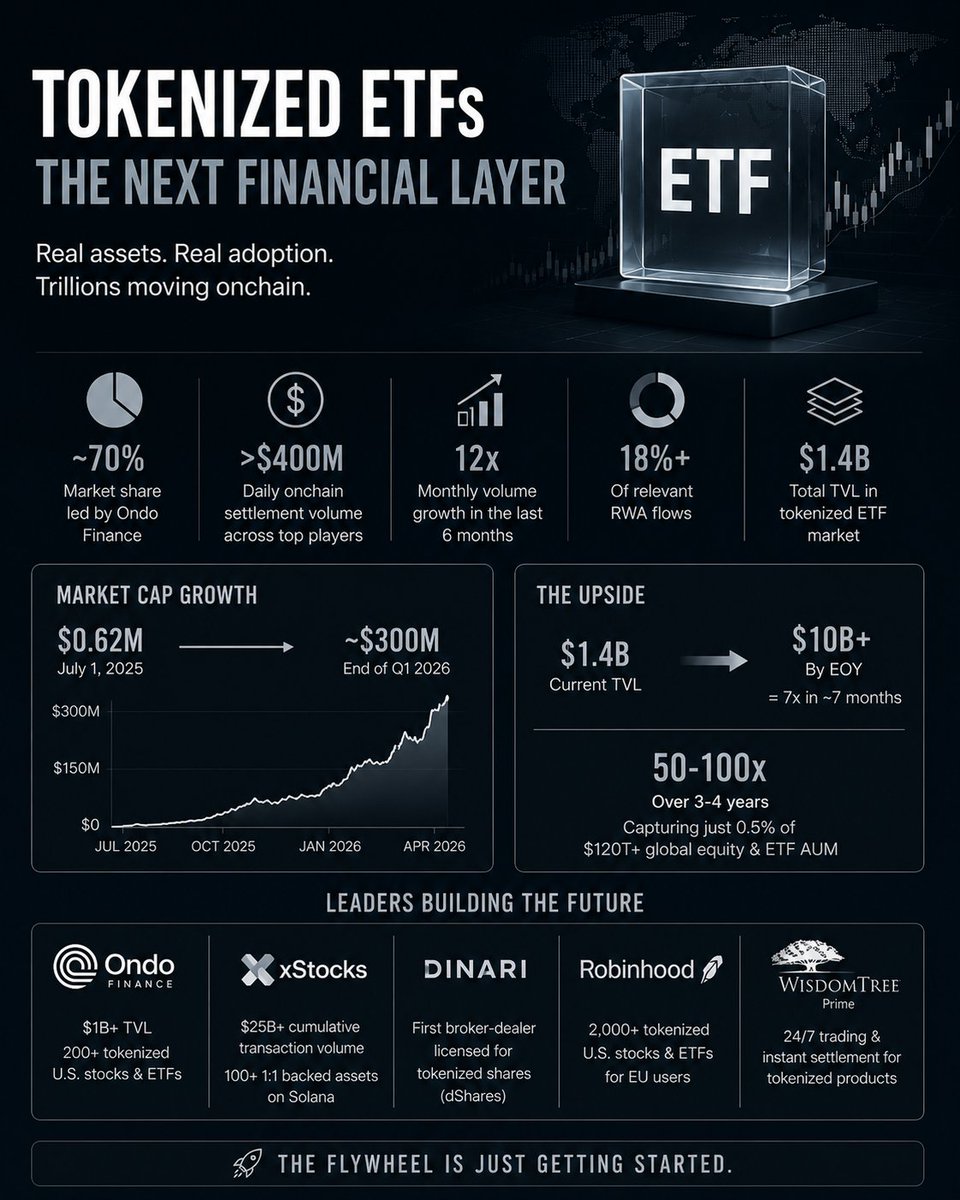
Tokenized ETFs are quietly becoming one of the fastest growing sectors in crypto right now.
The market is already sitting around $1.4B TVL.
And it nearly tripled since late 2025.
What stands out to me is that this isn’t just another short term narrative pump.
This is real financial infrastructure moving onchain.
A few numbers caught my attention:
- Ondo Finance now controls ~70% of the market.
- Daily onchain settlement volume across major platforms already exceeds $400M.
- Monthly volume grew 12x in just 6 months.
- Tokenized ETF flows now represent over 18% of relevant RWA activity.
What makes this trend important is that adoption is coming from multiple directions at once:
→ DeFi liquidity.
→ Institutional settlement.
→ Global payments.
→ Retail stock access.
→ Treasury products.
→ Cross-border investing.
And unlike previous RWA cycles, growth is no longer concentrated in one single asset category.
The leaders actually building the rails:
@OndoFinance :
Crossed $1B TVL with 200+ tokenized U.S. stocks and ETFs already live onchain.
@xStocksFi :
Built one of the strongest DeFi liquidity layers for tokenized equities.
Already processed $25B+ cumulative transaction volume with 100+ fully backed assets on Solana.
@DinariGlobal :
First broker dealer licensed for tokenized shares (dShares), targeting retail and platform integrations.
@RobinhoodApp
Now bringing 2,000+ tokenized U.S. stocks and ETFs to EU users through Robinhood custody infrastructure.
@WisdomTreePrime
Already offers 24/7 trading and instant settlement for tokenized Treasury and ETF products inside its wallet ecosystem.
The upside still feels massively underestimated to me.
Current tokenized equity TVL: ~$1.4B
If this reaches just $10B by year end:
that’s another 7x expansion in less than a year.
And zooming out further:
Even capturing only 0.5% of the $120T+ global equity and ETF market would imply a 50-100x expansion over the next few years.
That’s why I think tokenized equities may become one of the most important bridges between traditional finance and crypto.
The flywheel here looks faster than almost every other crypto macro trend I’m watching right now.
Prediction markets were never supposed to be limited to a few curated headlines.
@42space is turning every narrative, every opinion, every community into something tradable.
The most valuable markets won’t be created by institutions.
They’ll be created by users.
I Think @solana feels like one of the most important chains to watch going into the second half of 2026.
Even with $SOL still trading around $86–88, nearly 70% below ATH, the network activity itself hasn’t slowed down.
What stands out to me is that Solana’s fundamentals look much stronger than price action suggests:
- Stablecoin supply sitting near $15B .
- DEX volume constantly competing with or surpassing Ethereum.
- RWA sector exploding toward multi billion dollar scale.
- Massive onchain activity driven by low fees + fast execution.
- Institutions continuing to build around the ecosystem.
-----
Projects I’m watching closely on Solana:
@JupiterExchange ($JUP)
Still the liquidity hub of Solana. Swaps, perps, DCA, routing, feels like core infrastructure now.
@kamino ($KMNO)
One of the strongest DeFi products on Solana right now. Lending, vaults, RWAs, automated strategies.
@DriftProtocol ($DRIFT)
Fast growing derivatives platform with strong product execution.
@jito_sol ( $JITO)
Dominating liquid staking and becoming deeply integrated into Solana’s validator economy.
@PythNetwork
Critical oracle infrastructure powering a huge part of Solana DeFi.
@OndoFinance + RWA ecosystem
This narrative keeps getting stronger. Tokenized treasuries, credit, institutional assets all feel early.
@Raydium / @MeteoraAG / @orca_so
Still core liquidity engines of the ecosystem.
@bonk_inu + https://t.co/uAsWToHfud ecosystem
High risk obviously, but memecoins continue driving massive user onboarding and revenue on Solana.
---
Solana is evolving beyond the “cheap and fast chain” narrative.
It’s increasingly becoming a serious liquidity + infrastructure layer for trading, payments, RWAs, and consumer crypto apps.
The next few quarters will probably depend heavily on:
- Firedancer progress.
- Institutional flows.
- Stablecoin growth.
- Whether retail memecoin cycles return again.
But overall, Solana still feels like one of the highest attention ecosystems in crypto right now.
Love to hear thought of legend on Sol!
World Cup 2026 meme coins are starting to feel like the next PvP casino on Solana.
I’ve been tracking tickers like $WCMEME, $WC2026, $FWC2026, and honestly the pattern is already familiar:
sports narrative + global attention + ultra low liquidity = explosive pumps followed by brutal nukes.
Some of these coins did 20x attention faster than they built actual communities.
One token dropped almost 96% after the first hype wave.
Another launched with “official World Cup meme” branding despite having zero FIFA connection.
That’s the game.
----
Most of these plays have:
- No utility.
- Anonymous teams.
- No audits.
- Tiny liquidity pools.
- Pure emotional speculation.
But that’s also why they’ll keep attracting degens.
World Cup is one of the biggest attention events on Earth.
Crypto loves attention more than fundamentals.
The important thing is understanding the difference between: “good investment” and “good attention trade.”
Most World Cup memes will probably die.
But during peak hype?
Some of them will move harder than serious projects with real products.
That’s meme market psychology.
Treat it like a casino narrative, not a retirement portfolio.
What is ur fav ticker ?
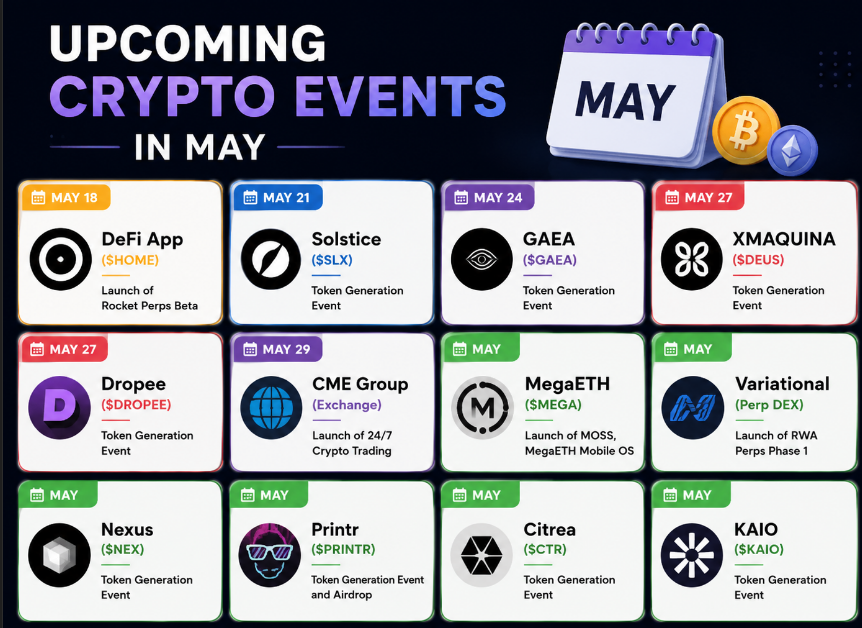
Biggest week of TGEs & launches incoming. Save this 👇
May 18:
→ @defiapp ($HOME) launches Rocket Perps Beta.
May 21:
→ @solsticefi ($SLX) Token Generation Event.
May 24:
→ @aigaealabs ($GAEA) Token Generation Event.
May 27 (Double drop day)
→ @xmaquina ($DEUS) TGE.
→ @dropee_app ($DROPEE) TGE.
May 29
→ CME Group goes full 24/7 Crypto Trading (institutional money loading)
Other May Launches:
- MegaETH Mobile OS.
- Variational RWA Perps Phase 1.
- Nexus, Printr (with airdrop), Citrea, KAIO TGEs TradFi + DeFi narrative colliding hard this month.
Which event are you most bullish on?
DYOR | NFA
DeFi isn’t dead.
It’s quietly becoming the financial infrastructure of crypto.
Current state of DeFi in May 2026:
- $85.3B TVL across 7000+ protocols & 500+ chains.
- $322.7B stablecoin market cap.
- $20B daily perps volume.
- DEX/CEX volume dominance back above 20%.
Top protocols by TVL:
> @LidoFinance → $19.8B
> @aave → $15B
> @binance staked ETH → $8.3B
> @Morpho → $7.5B
> @eigencloud → $7.3B
Leading categories:
- Liquid Staking → $43.2B
- Lending/Borrowing → $43B
The biggest trend shaping DeFi right now: RWAs.
Tokenized Treasuries exploded from $6.1B → ~$15B in just 18 months.
Protocols like @OndoFinance and @Securitize are bringing institutional capital on chain with predictable yields backed by RWAS.
At the same time, the #CLARITYAct could become the biggest regulatory unlock DeFi has ever seen:
- Clearer SEC/CFTC rules.
- Protections for DeFi infra builders.
- Stablecoin framework.
- Less “regulation by enforcement”.
This cycle feels very different.
2021 DeFi was about farming hype.
2026 DeFi is about real revenue, RWAs, institutional rails, and global financial plumbing.
The next phase of DeFi may not look as flashy.
But it could become far bigger.
.@injective is starting to look explosive. I call it at 3$, almost x2 in April!
This pump is not just hype.
Community BuyBack is live tmr, INJ is being burned, real ecosystem revenue is flowing, and supply keeps getting tighter.
Add fresh upgrades, RWA momentum, AI agent trading, Helix volume, and US regulated INJ futures.
That is a strong setup.
> More usage means more revenue.
> More revenue means more burns.
> More burns means more pressure on supply.
If injective-protocol:native holds this breakout, I think $5.90 comes fast.
After that, $8 to $10 looks very possible.
NFA!
Infra is still where private crypto capital is flowing.
I’ve been tracking recent raises, and the pattern feels pretty clear:
Investors are not just chasing narratives.
They are backing the rails that make crypto easier to use.
---
Payments infra
@fun raised $72M to build fiat <> crypto rails for apps
RWA and credit infra
@fence_finance raised $20M to power asset backed finance
Multi asset trading
@liquidtrading raised $18M to bring crypto, stocks, FX, commodities, and pre IPO markets into one app
Stablecoin business finance
@multisig raised $18M for payments, treasury, cards, and global settlement
Stablecoin wallet
@belo_app raised $14M to support fiat <> crypto movement in LatAm
Prediction markets
@xomarket raised $6M for user created prediction markets
RWA yield
@NUVAFinance raised $5.2M for a non custodial RWA marketplace
Onchain reinsurance
@onrefinance raised $5M to bring regulated reinsurance exposure to Solana
Yield trading
@ExponentFinance raised $5M for fixed rate and leveraged yield on Solana
RWA leverage
@3f_xyz raised $4M for one click exposure to tokenized RWAs
AI compute and DePIN
@KaisarNetwork raised $4M total to build decentralized GPU and AI compute infra
Onchain trading
@legendtrade raised $3.5M for competitive trading on Hyperliquid
Gaming and collectibles
@onemoarchance raised $3.2M for a social app around trading card collectors
Decentralized compute
@Voranofficial raised $3M for scalable AI compute infra
Onchain trading infra
@ekidenfi raised $2M for institutional grade trading infra
AI agents and prediction markets
@ElasticsAI raised $2M for agents focused on research, execution, and portfolio management
The next cycle may look less like pure speculation and more like usable crypto infrastructure becoming invisible.





![WilcosX's tweet photo. I’m watching Private AI and DePIN closely because they solve two different sides of the same problem.
AI needs infrastructure.
But AI also needs privacy.
That is where this narrative gets interesting.
Private AI focuses on keeping data protected while AI models run.
DePIN focuses on building the physical rails behind AI like GPUs, storage, bandwidth, and compute.
The overlap is simple: AI cannot scale without infrastructure.
But real users and institutions will not trust AI if everything is exposed.
---
Top Private AI coins I’m tracking:
[1] $ROSE @OasisProtocol
Oasis is still one of the cleanest privacy AI plays.
Confidential compute, TEEs, private smart contracts, and a strong privacy narrative around AI data.
[2] $PRAI @privasea_ai
Privasea is more speculative, but the FHE angle is interesting.
Private machine learning inference could become important if encrypted AI demand grows.
[3] $NEAR @NEARProtocol
NEAR is positioning around user owned AI, agents, and confidential compute.
Not a pure privacy coin, but it sits close to the AI privacy narrative.
[4] $VVV @AskVenice
Venice AI is different because privacy is not just a feature.
It is the product.
Private prompts, private AI usage, and a clear consumer facing angle.
[5] FHE related projects
@fhenix , @mindnetwork_xyz , @Arcium , and similar names are worth watching.
Encrypted compute is still early, but if it works at scale, it could become a major AI layer.
Top DePIN coins I’m tracking:
[1] $TAO
@bittensor is still the flagship AI network.
It is not just compute. It is a market for intelligence.
[2] $RENDER
@render remains one of the strongest GPU infrastructure plays.
AI needs GPUs, and Render sits directly inside that demand curve.
[3] $FIL
@Filecoin is still core storage infrastructure.
AI needs massive datasets, and decentralized storage could become more relevant over time.
[4] $ICP
ICP is pushing decentralized cloud and onchain AI apps.
It is one of the more serious attempts to move compute fully onchain.
[5] $AKT, $HNT, $GRASS
@akashnet for compute.
@helium for wireless infrastructure.
@grass for bandwidth and AI data.
Different sectors, but all connected to the bigger DePIN map.
---
The first phase of crypto AI was about attention.
The next phase will be about infrastructure.
And after that, privacy becomes the real filter.
Because faster AI is useful.
Cheaper AI is useful.
But private AI is what makes AI usable at scale.
That is why I think the strongest projects will not just be the ones with the loudest narrative.
They will be the ones building the rails that make AI powerful, decentralized, and safe to use.](https://pbs.twimg.com/media/HJs7EDIbEAAxZkM.jpg)