@wmiddelkoop Thanks for the share, Willem!
DB’s data is basically mapping the exact transition you warned about in The Big Reset: the quiet end of financial repression and the shift toward overt monetization. The bond market is screaming inflation regime while equities are still pricing tech recovery. One of them is wrong.
BREAKING: US-listed ETFs have attracted +$1.2 trillion in inflows year-to-date, the largest amount at this point of the year on record.
This figure is already double the inflows recorded over the same period in 2025.
This has also surpassed every full-year total in history except 2025, which saw +$1.5 trillion in inflows.
At the current pace, US-listed ETFs are on track to exceed +$2.1 trillion in annual inflows for the first time, ~50% above last year's all-time high.
Meanwhile, the semiconductor ETFs, $SMH and $SOXX, posted a combined +$13 billion in inflows in July, the largest monthly total on record.
ETF demand is surging at an unprecedented rate.
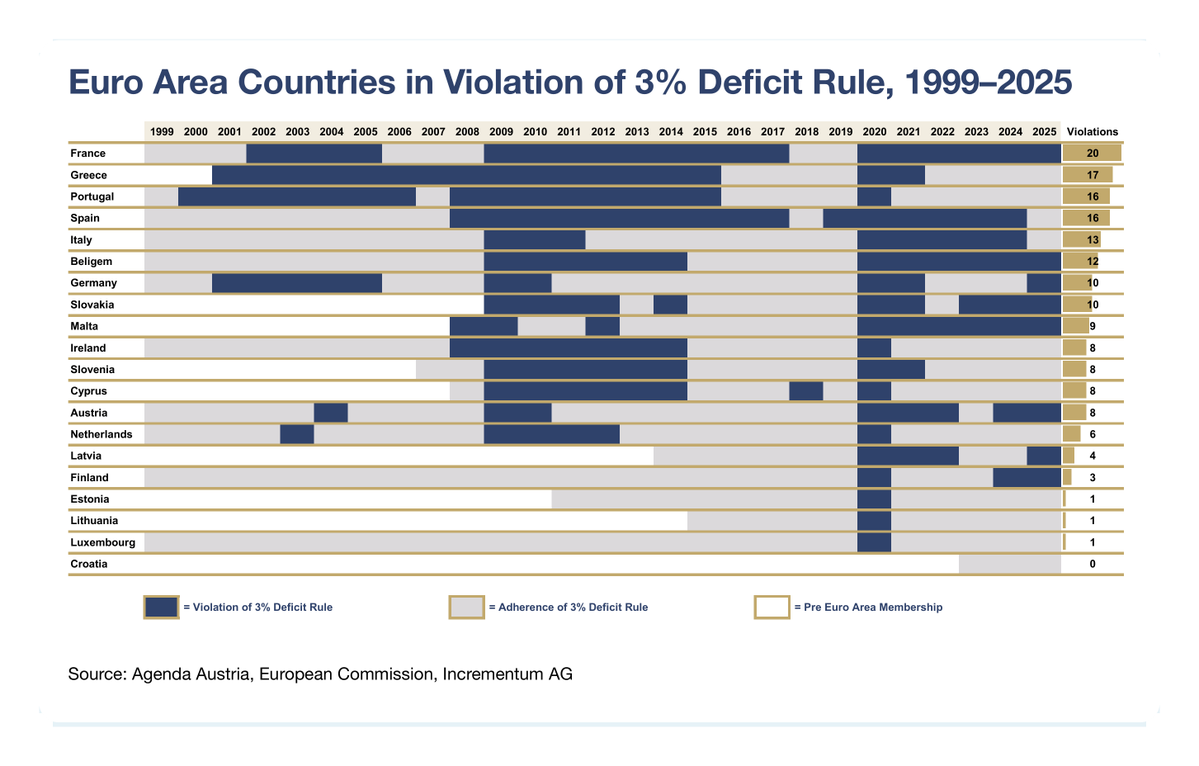
Twenty-seven years of the euro area's 3% deficit rule, and who kept it.
France 20 breaches. Greece 17. Portugal 16. Spain 16. Italy 13. Germany 10.
Croatia, the newest member, has zero.
Monetary union was sold as a hard money project. This is the enforcement record.
📣 Pre-register to earn up to 12% APY* on your assets! ✨
In an industry first, we’re introducing Earn, enabling you to earn a market-defining fixed-yield offer, on the assets you already own.
Pledge your gold, silver, stablecoins & major digital assets, and earn a fixed APY in the assets you've pledged, paid at the end of your term.
Why earn with Kinesis?
🤝 Earn on your referrals.
Refer a friend and earn 1% of their pledge upfront, plus 1% every year they stay pledged and the Referer's Yield.
⏳ Choose your timeframe.
The longer you pledge, the more you earn. Choose from 3, 6 or 12 months, with 12% APY* on a 12-month pledge.
🔓 Withdraw anytime.
Access to your capital remains, even if you end your term early. You’ll simply forfeit that term’s yield.
Kinesis also contributes 5% per annum on all earnings from assets pledged in the program to the Master Fee Pool, with contributions distributed monthly as yields to every Kinesis user.
Pre-register today to secure our introductory APY* of up to 12% - reserved for the first $25 million pledged.
🔗Pre-register today 👇
https://t.co/ft6lTnKTTS
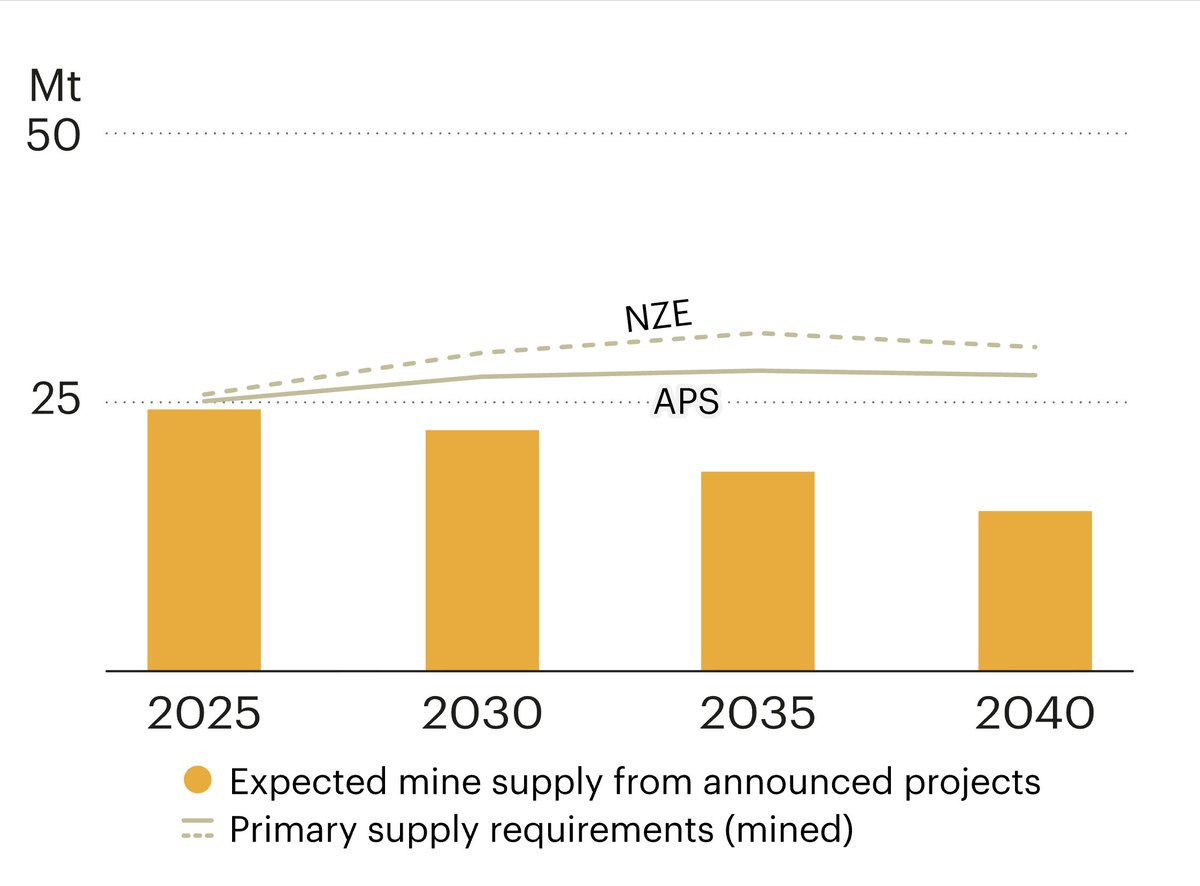
The world's largest copper producer is guiding for almost 30% less copper in 2026 than it mined in 2015.
Codelco chairman Bernardo Fontaine says there is "no possibility" of reaching the company's 1.7 million tonne target within four or five years.
Guidance for 2026 is 1.331 to 1.357 million tonnes. Output peaked at 1.89 million tonnes in 2015.
Data centres require 20 to 40 tonnes of copper per megawatt of applied power, according to the Copper Development Association.
The IEA projects primary copper supply will fall about 25% short of requirements by 2035.
Source: IEA (2026), Global Critical Minerals Outlook 2026
Hong Kong just activated trial operations for its new gold clearing & settlement system - complete with the new HAU price benchmark (now live on BBG) and direct Delivery Connect to the Shanghai Gold Exchange.
Asia is building sovereign physical gold infrastructure while the old London-centric system loses relevance.
Central banks have been accumulating for years. Now the rails are being laid too.
The map is changing in real time.
Hong Kong has launched a trial operation of a new gold clearing system, backed by several major banks, in a key step toward its ambition to become a major bullion-trading hub with price-setting power https://t.co/CGAvPoTCg0
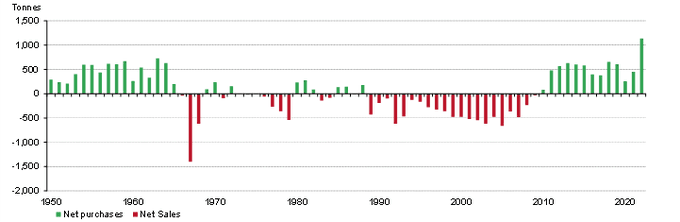
This gold bull market is unlike any before it.
In past cycles, central banks were net sellers of gold:
– 1970s: net sold ~1,000t
– 2000s: net sold ~3,500t
Today they're net buying 800–1,000t every year.
A force that worked against gold in every previous bull run has completely flipped. The biggest headwind is now the biggest tailwind 👀
While everyone is talking about datacentres, few are talking about how they will be powered.
The massive expansion of data centres across the USA will demand a once-in-a-generation upgrade of the electrical grid… and that requires a staggering amount of copper.
https://t.co/9Ox9zKHSEq
Do not falter on your #silver conviction.
-6 years of deficit
-Chinese silver premium
-Steady #Comex withdrawals for 6 months
-Lowest Comex open interest in decades
-Solar panel demand skyrocketing
-New solid state silver batteries
-Silver is a critical mineral
The government has indicated critical mineral price floors to be indicated by July 13th.
Conveniently close to the July 4th gold revaluation/bonds.
Do not get shaken out over the next few weeks. They could send silver into despair, but it could be to force majeure as cheaply as possible before it moons.
@robert_ivanhoe The Citi Copper Book nails the structural tailwinds. But even with prices near record highs, the industry is slashing growth capex and essentially no new mines are getting sanctioned.
Wrote up why this capital strike is keeping the structural deficit in place (despite textbook economics): https://t.co/p5qa34Qy39
Would be very interested in your take on what actually moves the needle on new mine development.
@IntrospectiveIn Fair point on cycle risk.
That said, if the capital strike is real and new mines keep getting deferred, the cycle itself might be shorter and more violent than in the past.
Do you still see gold as necessary insurance, or could the structural supply story change the risk/reward?
Copper just broke the most basic rule in economics - and almost nobody is talking about why.
Copper is trading at record highs, around $14,000 a tonne. The world is structurally short of it - the deficit is real and forecast to run for years. The textbook response to that is automatic: high prices summon new supply, capital floods in, mines get built, the shortage heals. It's the most reliable self-correcting loop in capitalism.
Except it isn't happening.
The global mining industry's response to record prices and a visible shortage has been to cut investment in new supply. Growth capex is being roughly halved into the teeth of the deficit. The price is screaming BUILD, and the industry is doing the opposite.
That single fact tells you more about money in 2026 than any Fed meeting.
But the deeper point isn't that mines are expensive. It's why capital won't build them even when the price says it should - and the answer is one most market commentary misses: in a financialized, fiat, high-time-preference world, refusing to build is rational. When your unit of account is being debased and policy turns capricious - tariffs that flip overnight, governments that switch off finished mines - the sane time-horizon for capital collapses. A twenty-year bet on a real asset looks reckless next to a buyback you can book this quarter. So soft money doesn't just dilute the dollar; it raises everyone's discount rate on patient, real-world capital and starves the very investment that physical supply requires.
The asymmetry, in one line: since the start of 2020, the U.S. money supply has grown about 45%; global copper mine supply grew about 11%. You can print dollars; you cannot print copper. That doesn't pump the price directly - copper is an industrial metal, not a monetary one - but it bends every incentive away from the slow, physical work of making more. The deficit is the downstream result.
That's what I call the capital strike. And it's why this isn't a cyclical spike you wait out - it's a structural floor.
A few things worth sitting with:
1) The market deficits even on recessionary demand. By one major bank's numbers, copper consumption only has to grow 0.9% this year to stay balanced - versus a 2.9% average since 1960. You don't need an AI boom or an EV miracle. You just need supply to keep disappointing, which it is.
2) The supply that exists is fragile. The world relies on roughly twenty mines for a third of its copper; the largest producing country is in decline; one state giant needs ~$35 billion just to keep output flat.
3) And the "fixes" fix nothing. When Washington floated a 50% copper tariff last year, it didn't create a single new pound - it reshuffled the global pile and minted a fortune for whoever sat closest to the policy spigot, before the arbitrage collapsed 96% in a matter of hours. (The sequel is due June 30.)
None of which means copper only goes up. There's a real bear case - China is still 57% of demand and barely growing, recycled scrap is doing heavy lifting, and a genuine hard landing would dent everything. I take it seriously. But the math keeps pointing the same direction, because the bear case lowers demand and does nothing to fix the broken supply side.
I wrote the full breakdown for subscribers - the four reasons capital won't build, the tariff "mirage" in detail, the honest bear case, what the metal is actually worth, and how the best-capitalized operators on earth (and the royalty desks I spend my time around) are quietly positioning for a market you can't print your way out of.
If you still think copper is a boring industrial metal, that's exactly why it's interesting right now.
→ Read the full deep dive:
https://t.co/p5qa34Qy39
Copper is at record highs.
The mining industry’s response?
Cut investment in new supply.
This chart shows the capital strike in one picture:
Full deep dive here → https://t.co/hYwhwtQDUD
The price is screaming “build”.
The incentives are answering: “return capital”.
History's patterns are clearest when it comes to money. Every regime that chose debasement over discipline eventually met the same end.
Gold doesn't predict the future - it just remembers every chapter that came before it. The setup looks familiar.