A world where Communist China leads in AI is bad for the United States and for the entire world. It’s critical that we do not lose this race.
That’s why I introduced the MATCH Act. This bill ensures that Communist China and other adversaries cannot purchase key semiconductor manufacturing equipment (SME) technology from the United States or our allies.
Taiwan’s move makes sense. Robots are becoming part of modern force design.
Our latest @FDD report looks at how China’s PLA is integrating “robotic wolves” into invasion planning for Taiwan — based on unreported PLA writings and training footage.
Machines may go first. Humans follow.
@willripleyCNN
Report link: https://t.co/jCZfx7ywLP
Taiwan’s military showed off three types of robot patrol dogs at a media event and suggested they could be used in Taiwan and on islands controlled by Taipei in the disputed South China Sea.
@whannyuanc@HenryZeris
John Costello, the Wirescreen analyst who wrote the report, said the data showed “directly and irrefutably” that U.S. technology was equipping the Chinese military.
“What number of advanced Nvidia chips in P.L.A. hands does the company consider acceptable?” he asked.
https://t.co/Ba25uSnp2R
1/ US biotech is in crisis, right before AI should be saving millions.
China is stealing away our industry and has surpassed the US in blockbuster pharma deals.
The next FDA Commissioner must be a fighter, and have a plan to overhaul the agency, beat China, and unleash cures.
Tsinghua University, known as ‘China’s MIT’, hosts at least eight PLA defence labs, one of which works on air-to-air missiles. Its internet servers have been linked to cyberattacks around the world, including against Tibetan dissident communities. In 2013, 40 PhD students at Tsinghua were sponsored by China’s nuclear weapons program and required to work for it after graduation. 👇
Tsinghua University has actively participated in military-civil fusion projects for years. Perhaps the CEOs of America’s leading tech/AI companies should consider whether there are risks of affiliating?
@SenatorBanks is justified in his concerns and is right to investigate.
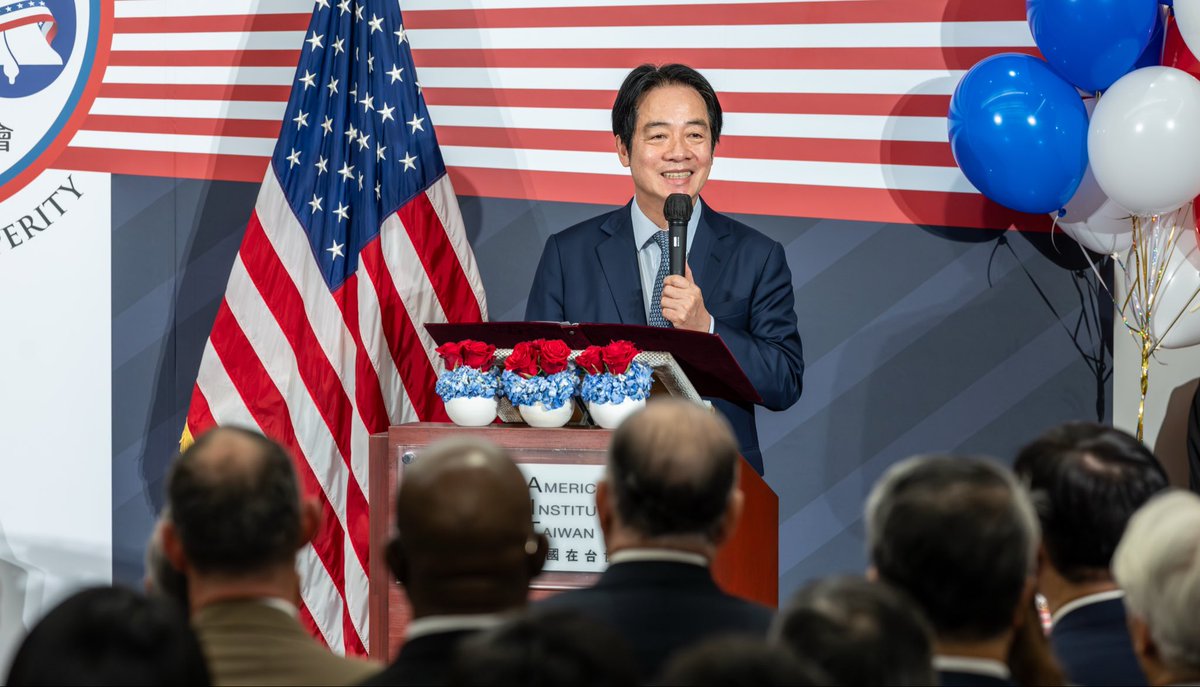
Celebrating 250 years of American independence & the #Taiwan-#US friendship with #AIT. Rooted in freedom, our partnership has continued to grow through stronger economic ties & a shared commitment to preserving the status quo of peace and stability across the Taiwan Strait.
#LiDAR isn’t just about mapping roads. It’s a foundational sensor for next-gen #robotics — including military systems.
China’s robotics push, including ground “wolf” platforms discussed in our latest @FDD report, depends on enabling tech like LiDAR, advanced sensors, and #AI.
@RepDustyJohnson is right to flag the national security risks.
Report here: https://t.co/jCZfx7ywLP
LiDAR may not be a household name, but the technology provides millimeter‑level data of America’s infrastructure. We cannot rely on Chinese LiDAR systems to examine our roads, and I’m glad my bill to protect America from this spy technology is included in @TransportGOP’s BUILD America 250 Act.
This piece correctly states that President Trump took action to hinder Huawei’s 5G buildout in his first term, and links to an article that says he did so by restricting Huawei’s access to U.S. technology.
…but then this piece says the way to counter Huawei in AI now is to sell China MORE U.S. technology - completely ignoring what has worked in the past. 🤔
Here are the facts:
- The best way to counter Huawei’s AI chip production is to reduce China’s access to the advanced U.S. and allied chipmaking tools it needs to make AI chips - not sell China more AI chips.
- Huawei plans to produce around 2% of the AI computing power as Nvidia does in 2026. It is not in the same league as Nvidia.
- There are still zero large clusters of Huawei AI chips located outside China. Huawei is not an international competitor in the way it was for 5G.
Taiwan makes almost 70% of the world’s semiconductors and more than 90% of the most advanced chips powering your phone, your car, and the AI race.
If China controls Taiwan, the Communist Party gains leverage over the world’s most critical tech supply chain. That’s not just a threat to Taiwan’s 23 million people living in a thriving democracy — it’s a threat to global freedom, security, and the future itself.
"Trump is right to want to avoid war with China over Taiwan," @CraigMSingleton of @fdd writes.
"He is wrong to think that holding back Taiwan’s weapons, or threatening to, makes war less likely." https://t.co/d6QoohOyT6
Trump can and should bargain hard with Taipei, demanding faster defense reforms, more investment in drones and greater energy resilience, including long-term liquified natural gas purchases from the U.S. that would help Taiwan withstand a blockade or invasion—@CraigMSingleton:
https://t.co/KBGi0qMgpS
Providing U.S. support to Taiwan isn’t just the right thing to do to support our partner, it’s required in law. Using a key tool in maintaining stability in the Indo-Pacific as a bargaining chip with China is playing Russian roulette with U.S. national security.
https://t.co/VtEnfljgND
“The U.S. has provided defensive arms to Taiwan on a bipartisan basis for over forty years. That aid is not a bargaining chip — it is required by law and essential to preserving peace and deterring China.” -@SenatorShaheen
https://t.co/sr8XOuG4Ts
President Trump called a potential arms deal with Taiwan a "very good negotiating chip." When asked if he agreed with that, @RepMikeLawler (R-NY) told Bloomberg This Weekend, "I do not. I support continuing to arm Taiwan."
U.S. arms sales to Taiwan aren't negotiating chips – they're required by law under the Taiwan Relations Act. More than that, they're central to a free and open Indo-Pacific, and our own national and economic security.
My latest in @PostOpinions for @FDD
President Trump is right to want to avoid war over #Taiwan. But treating Taiwan’s weapons as a bargaining chip with Beijing risks weakening the #deterrence needed to prevent one.
Taiwan’s weapons are not a favor to Taipei. They are a warning to Beijing.
https://t.co/B69V4nmX6F
Taiwan’s representative to the U.S., Ambassador Alexander Yui, says there is no planned call yet between President Trump and Taiwanese President Lai Ching-te, but he suggests Trump may have only heard “the Chinese story” about Taiwan during his trip to Beijing.
“If he has time, would love to tell him our side of the story, the Taiwan story, which is one of resiliency, of a state staying up against the Chinese aggression,” Amb. Yui tells @margbrennan. “The communication between Taiwan and the U.S. is constant, it's current. But I'll leave it to the U.S. to announce anything, if it happens.”
“We don't want a war. We want peace and stability,” says Taiwan’s representative to the U.S., Ambassador Alexander Yui, regarding relations with China.
“We are sovereign, independent away from the Chinese People's Republic of China's attempt to swallow us as one of their own. They have never ruled or controlled Taiwan, ever,” he adds. “Those are intruders trying to get into our house. We're trying to beef up our security system. And then they complain, the intruder complains that because we're trying to improve our security system it’s making his job harder.”