CritThinker helps you think a little higher and deeper about yourself, reality and relationships, by spotting how the reactive mind gets led.
The Monday case is free to try: https://t.co/2tZa5iDCbg
@LeoTollstoy Authentic, from the Maude translation, Book Twelve chapter 16. Tolstoy then has Andrei find the thoughts comforting yet "too one-sidedly personal and brain-spun".
@elonmusk Checked by several independent proof checkers now, which is remarkable. The strange part is it runs to 17 million lines, so we know it's true long before anyone knows why.
@AdamMGrant That links to what psychologists call the illusion of transparency. We overestimate how clearly others can read what we want, so the expectation feels said when it never was.
@AlwaysTheRunner@PhysInHistory A real puzzle. Feynman seems to have meant it about his own learning, rebuilding a result before trusting he'd got it. A proof no one can read might be a different kind of knowing.
@Rainmaker1973 Paul Janet put a number on it back in 1877. A year is a tenth of your life at ten and a fiftieth at fifty, so it feels smaller. William James picked the idea up in 1890.
@DavidDeutschOxf Genuine Deutsch, from The Fabric of Reality. It comes right after his bit on Gödel, who had to invent a brand new method of proof, one no earlier rulebook could have foreseen.
@QuoteJung Genuine Jung, in Hull's translation of The Philosophical Tree. And the next line is very dry. "The latter procedure, however, is disagreeable and therefore not popular."
@ML_Philosophy Yes, and studies suggest about 40% of personality differences are inherited; the rest comes from life. Pressure reveals what we were born with and what we were given.
☕ Philosophy Coffee Time
I need to know the universe
in the least pretentious way:
the stars that burn for no one,
the tide that takes the day,
the life that grew from stardust,
the thought that wonders why,
the same vast quiet working
in the river and the eye.
What's a quote you love? Or share your own. ☕
@PsychToday That second question sidesteps hindsight bias: in Fischhoff's 1975 study, people told how events ended rated that ending as likelier than those who weren't told. The past rarely looked that clear.
@ML_Philosophy Russell drew the same line in "The Triumph of Stupidity" (1933): "the stupid are cocksure while the intelligent are full of doubt." Questioning your own beliefs is that doubt at work.
@CranleyStephen@Rainmaker1973 Knowing that is a strength. Bartlett said it in Remembering (1932): recall is "an imaginative reconstruction, or construction", so each replay of a moment can quietly reshape it.
5/5 Two small ways to try it:
• When someone irritates you far more than the moment deserves, ask what it might show about you.
• Notice the trait you're quickest to condemn, and gently check if it lives in you too.
What helps you see your own blind spots?
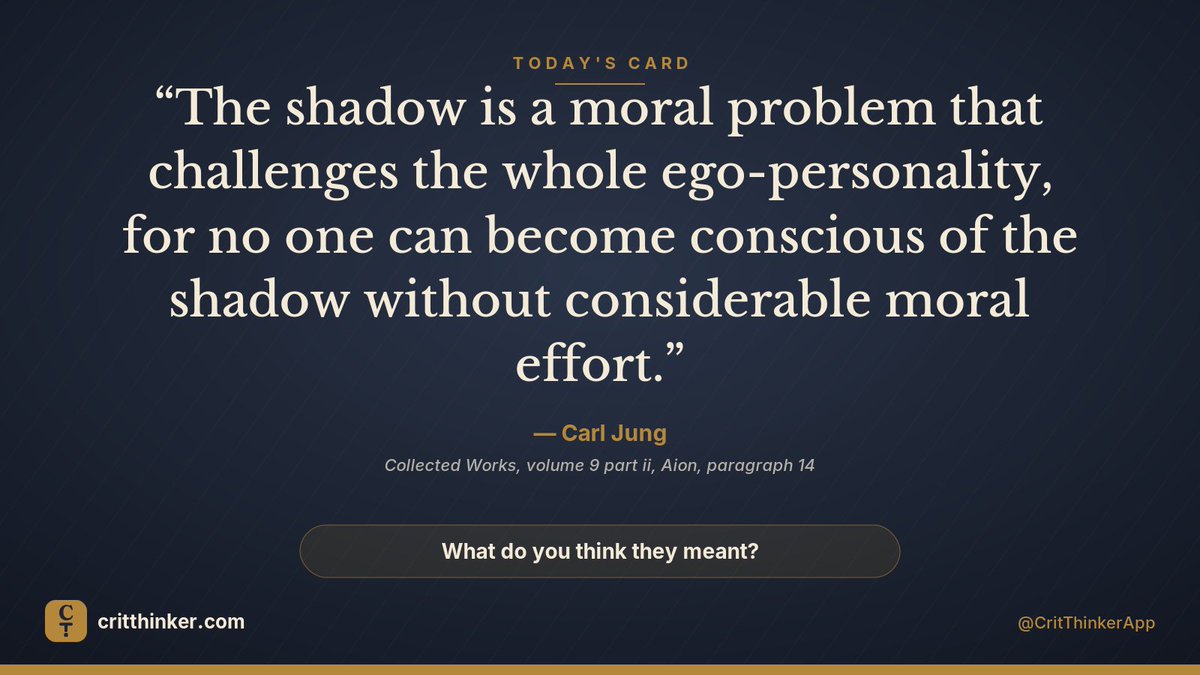
“The shadow is a moral problem that challenges the whole ego-personality, for no one can become conscious of the shadow without considerable moral effort.”
– Carl Jung
What do you think they meant? 🧠✖️❔
4/5 Jung's word for that is projection: meeting our own unowned traits in other people, and feeling certain the problem lies wholly with them (Aion, para 16). It's his theory, not settled science, and not every annoyance is a projection. It's still a useful question.