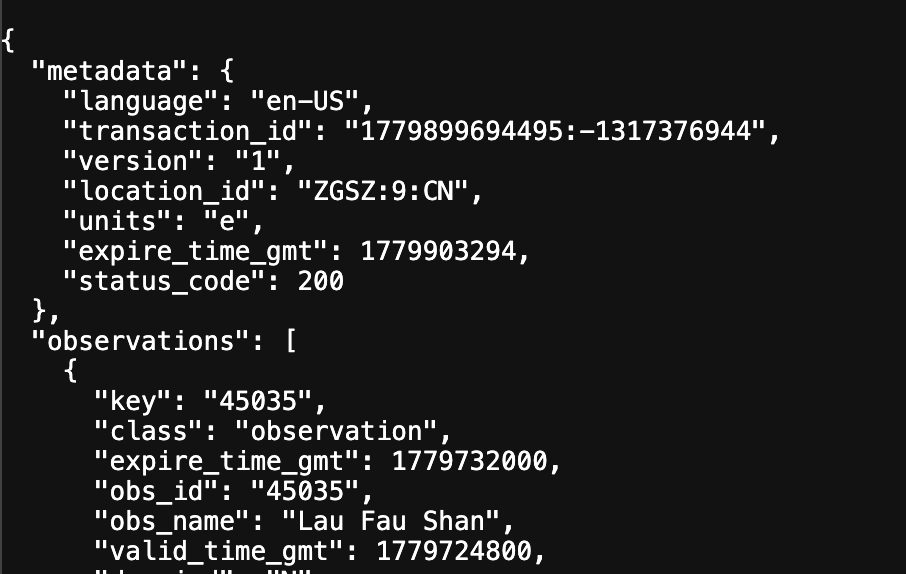
Polymarket's "Shenzhen" weather markets have been settling on a station in Hong Kong this whole time.
Different city, different administrative region, 25 km across a bay. Here's the trace.
Built an audit across 50 cities. Asked Wunderground's API for each ICAO code, checked what station came back. 49 of them: clean. Tokyo -> RJTT. London -> EGLL. Hong Kong -> VHHH. Boring. Correct.
Asked for ZGSZ - Shenzhen Bao'an Airport.
Got back obs_id=45035, station name "Lau Fau Shan."
Had to read it twice. Lau Fau Shan isn't in Shenzhen. It's a Hong Kong Observatory weather station on the edge of Deep Bay in the New Territories. Across water from Bao'an.
Could be a fluke? I checked 24 different dates. Same (45035, "Lau Fau Shan") pair every single time. Not a glitch. A persistent backend route.
And it doesn't just give the wrong number - it gives it in a specific direction. Lau Fau Shan runs 1–3°F warmer than the actual Bao'an METAR every day. Warm humid coast vs cooler inland. So markets called "what's the high in Shenzhen?" have been quietly settling on a Hong Kong station that's structurally hotter than the airport everyone thought was the source.
The trading channel has been blaming Shenzhen on the same bug Warsaw and London hit this week - Wunderground silently deleting readings mid-day.
That's a real bug. Just not this one. Nothing got deleted here. The wrong station has been bolted to the right airport code, quietly, for as long as I've been auditing.
Switching off Wunderground fixes Warsaw, London, AND Shenzhen at the same time. Three failure modes for the price of one source migration.
So what's more likely: Polymarket switches data sources, or Wunderground figures out their own routing table?
Btw - this isn't even Wunderground's only quirk. They also take Celsius observations, convert them to Fahrenheit, convert back to Celsius, and somehow drop a degree along the way.
93°F shows as 33°C for some cities, 34°C for others. Same source. Same query. Different answer. More on that next.
@PeterDiamandis Both can be true.
Lifespans up, child mortality down, literacy up - and adolescent mental health, biodiversity, social trust, tail risks down.
The pessimist usually isn't wrong that something is decaying. They're wrong about which something.
Most traders only notice their edge decaying in the win rate.
That’s already too late.
Crowding shows up first in entry price.
If the exact same setup that used to fill at 88¢ now fills at 92¢, the market didn’t suddenly beat your signal.
It repriced your edge.
The better question isn't "would you buy at 79%?" It's: who is selling?
At 79%, someone is holding the No after Senate Banking put it on calendar and the rewards language went public in the same week.
That seller is either very well-informed or very anchored to a prior that the news already broke.
@goodworse Andes virus has existed for 30 years.
~35% fatality rate.
Never broke out of South America. The virus didn't change.
What changed is that fear of it can now price into a liquid market before the WHO publishes a single bulletin.
markets are not pricing the singularity.
markets are pricing a story about the singularity.
big difference.
AI may be the largest productivity shock in history.
but vertical markets usually mean the narrative got ahead of distribution, margins, energy, regulation, labor absorption, and who actually captures the value.
"intelligence becomes scalable" is the thesis.
"equities go up forever" is the religion.
markets are not pricing the singularity.
markets are pricing a story about the singularity.
big difference.
AI may be the largest productivity shock in history.
but vertical markets usually mean the narrative got ahead of distribution, margins, energy, regulation, labor absorption, and who actually captures the value.
"intelligence becomes scalable" is the thesis.
"equities go up forever" is the religion.
Keynes wrote about 'technological unemployment' in 1930.
Every major technology looks like a demand-destruction machine at first.
The mistake is assuming the current labor map is the final labor map.
Cars destroyed the horse economy.
They didn't destroy the economy.
AI may be different, but "model says doom" is not the same as doom.
https://t.co/cSL8vbJfbi
@thenarrator exactly
attention without depth is basically latent order flow
if a market gets watched but not traded, that’s information: people care, but execution/risk/reward isn’t attractive enough yet
Everyone is suddenly talking about Polymarket weather markets.
The interesting part is not "weather = easy yield."
The interesting part is watching an edge become crowded in real time.
1. public forecast data is slow to price in
2. traders exploit it
3. leaderboards create social proof
4. tutorials appear
5. capital enters
6. entry prices compress
The signal can still work.
The edge still dies.
Everyone is suddenly talking about Polymarket weather markets.
The interesting part is not "weather = easy yield."
The interesting part is watching an edge become crowded in real time.
1. public forecast data is slow to price in
2. traders exploit it
3. leaderboards create social proof
4. tutorials appear
5. capital enters
6. entry prices compress
The signal can still work.
The edge still dies.