#Bitcoin $100K futures target achieved! 🔥
My confluences are shown in the chart,
and I shared insight last October about why I entered this trade.
Note: This is for futures, and I'm still holding some Bitcoin in spot trading.
Follow @CryptoBusy for more alpha this bull run! 🚀
#Bitcoin Open Position: Target is $100,000
🎯 Last Month: Called the MACD Bullish Cross
📈 Result: +30% BTC Move
🚀 Now: We're in PRICE DISCOVERY
When there's no ceiling above us, there's no limit to what's possible. $BTC
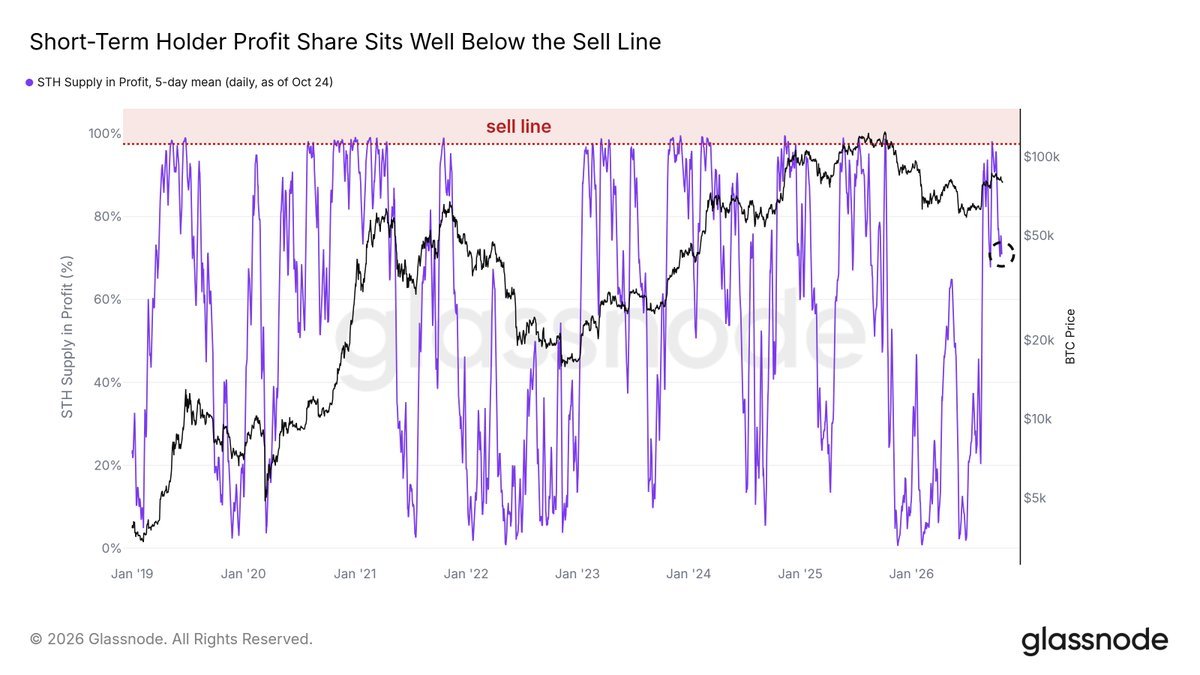
In late September, nearly 100% of short-term $BTC holders were sitting on profits, increasing the risk of profit-taking.
That figure has now dropped to around 70% following Bitcoin's recent correction.
A healthier setup for Bitcoin, but stronger buying demand is still needed to support the next move higher.
bulla-3:native broke above its descending resistance trendline near $0.093 and surged toward $0.155, gaining over 80% from its breakout area.
Price is now pulling back toward $0.13 after facing selling pressure.
If buyers defend $0.125–$0.13, BULLA could recover toward $0.15-$0.16.
However, losing $0.125 could trigger a deeper correction toward $0.11.
The breakout remains bullish, but holding support is key to maintaining momentum.
Top 10 Trending Crypto Projects on @CryptoRank_io
Here's what's catching attention across the crypto market right now:
@TheTNetwork@zealwallet@GoPlusSecurity@CapApp@BtcBox_Co_Ltd@SwapGlobal@eCash@PolymeshNetwork@ankr@ORE
Notably, eCash (+7.35%) and Polymesh (+2.28%) are among the positive movers, while CAP recorded $107.45M in 24-hour trading volume.
Zeal, BTCBOX, and SwapGlobal are also attracting attention through funding activity.
At Trireme Trading, we're watching how growing market interest translates into trading activity, liquidity, and long-term ecosystem development.
Which of these projects are you following?
@Daan618crypto@RomeProtocol The Portus example is what makes Rome interesting to me, bringing EVM users into Solana DeFi without the usual bridging friction is a big step forward.
@furan86999@RomeProtocol Shared liquidity and atomic execution could be a major unlock for DeFi, especially for traders managing positions across ecosystems. Great work by Rome!
@0xsunnhi@RomeProtocol I think this is the kind of innovation Web3 needs, less complexity for users and more flexibility for developers. Congrats to Rome for pushing this forward!
@lubijiaocheng What stands out to me is removing the need for bridges and separate liquidity pools, making EVM and Solana feel like one ecosystem. Great progress from Rome!
@furan86999@RomeProtocol I think this is a big step for developers who want to expand without rebuilding everything from scratch. Congrats to the Rome team for making EVM and Solana work closer together!
@0xD0M_@RomeProtocol The real opportunity is combining Ethereum's developer ecosystem with Solana's liquidity, without the usual friction of bridging between chains.
Congrats @RomeProtocol
@TradeCoinDream@RomeProtocol The real breakthrough is shared liquidity and state across EVM and Solana, without forcing developers to choose one ecosystem.
BREAKING: @injective JUST LAUNCHED A NEW AI COMPUTE MARKET!
ethereum:0xe28b3b32b6c345a34ff64674606124dd5aceca30 is taking AI infrastructure trading to another level with the launch of the SuperIntelligence Compute Index ($SICI)
For the first time on Injective, traders can gain exposure to a basket of @nvidia GPU rental prices through onchain perpetuals with up to 10x leverage.
Here's what makes $SICI interesting:
The index tracks five major GPUs powering AI infrastructure:
• H100: 40%
• B200: 25%
• H200: 15%
• A100: 10%
• RTX 4090: 10%
Instead of trading AI tokens or NVIDIA stock, users can now trade the actual cost of renting the computing power behind AI development.
So this is the kind of innovation that keeps me bullish on Injective's long-term direction!
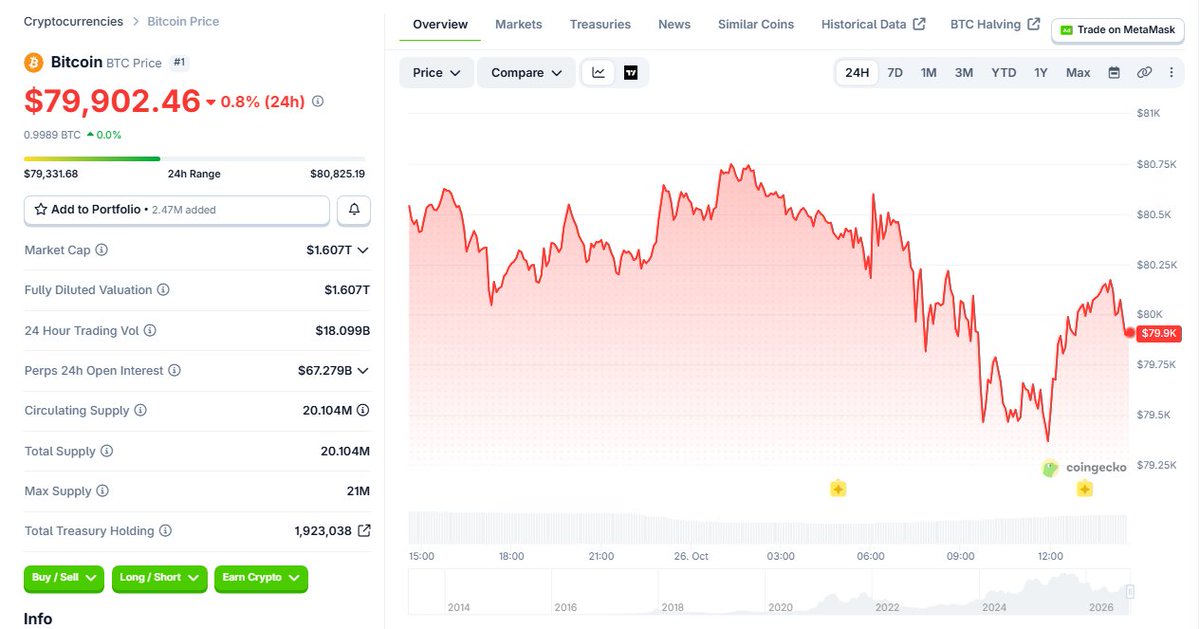
$BTC is trading around $80,000 as US spot Bitcoin ETFs reportedly recorded over $770 million in outflows.
The combination of ETF selling pressure, macroeconomic uncertainty, and weaker market sentiment is weighing on Bitcoin.
The $80K level is now an important area to watch. Losing this support could open the door toward $78K-$76K.
For now, Bitcoin needs stronger buying demand to absorb the selling pressure and regain bullish momentum.
$CAP has broken above its $0.074-$0.078 resistance zone after several days of consolidation.
Price surged toward $0.118, recording a strong bullish move of around 67% from the measured base.
Now trading near $0.108, CAP is seeing some profit-taking after the rally.
If buyers maintain momentum, a breakout above $0.118 could trigger another move higher.
However, a deeper pullback could see CAP retest $0.095-$0.100, with the previous breakout zone at $0.074-$0.078 acting as major support.
The bullish structure remains intact, but holding above the breakout zone is important for continued upside.
@ironwallet_app This is where tokenization starts getting interesting.
We're seeing traditional banking products move onchain, combining familiar financial services with 24/7 access and faster settlement.
Interesting divergence in the stablecoin market.
We have over $300B in stablecoin supply, yet trading volume has dropped significantly since January.
To me, this suggests liquidity is available, but trading demand remains weak.
If volume starts recovering while supply stays elevated, that could be a positive signal for the broader crypto market.
bitcoin:native
Stablecoin Trading Volume Has Dropped Nearly 50% Since January 2026
Stablecoin trading activity has slowed significantly this year.
Monthly volume fell from approximately $3.1T in January to $1.61T in July, before briefly recovering to $2.3T in September.
$USDT continues to dominate trading activity, followed by $USDC.
For the broader crypto market, this slowdown is worth watching.
Lower stablecoin trading volume may signal weaker trading activity and reduced capital turnover across exchanges.
However, trading volume alone doesn't tell us whether capital is entering or leaving the market.
At @TriremeTrading, we look beyond volume to understand liquidity depth, trading efficiency, and how capital moves across markets.
The question is: Will stablecoin trading activity recover heading into 2027?