A reminder that since its inception, not a single wallet who has held $BTC for 5+ years has realized a loss..
Now apply that strategy to $SUI
Ignore the short term noise and you will win... every time....
$SEND / $DEEP / $BLUE / $CETUS / $WSB / $FUD
Check out the below animation to watch the HODL Cave go deeper backwards in time from today.
You can pause this video when you first were exposed to #bitcoin to see the performance of various holding durations for your cohort.
📈 U.S. Demand Deposits Climb 26% to $7.1 Trillion in June 2026
U.S. demand deposits* rose 26% year-over-year in June 2026, reaching $7.1 trillion—extending their post-pandemic uptrend. As a share of the M2 money supply, demand deposits have expanded dramatically, rising from 10.5% in December 2019 to 30.5% by June 2026.
* Demand deposits in the U.S. are bank account funds—mainly in checking accounts—that can be withdrawn anytime without notice. They are highly liquid, usually earn little or no interest, and are a key part of the M1 money supply tracked by the Federal Reserve.
#FED #economy #liquidity #deposits #BroadMoney #MoneySupply #stocks
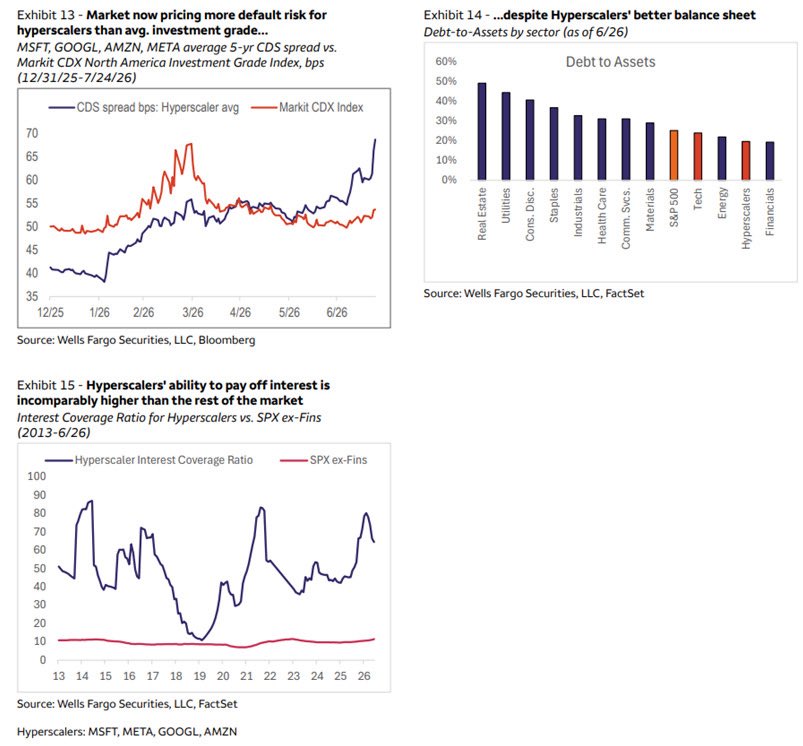
Market is overreacting to hyperscale credit spreads widening from my perspective. TL;DR Spot pricing for renting GPU compute materially above contracted rates implies hyperscalers are underearning while operating cash flow acceleration is an underestimated source of funds for AI capex.
The fact that spot prices for GPU rentals are at least 2x higher than contracted rates is the missing piece from the discussion about hyperscaler credit, which is the only fundamental factor behind this selloff. Multiple private companies are planning on spending at least 2x more per GPU for compute as contracts roll-off and some have spoken about this publicly.
As contracts roll-off, hyperscale growth rates are going to continue to accelerate as their installed bases of compute reprice higher. Hyperscale operating cash flow growth using a mix of estimates and actuals is modeled to accelerate from 31% in the first quarter of 2026 to 50% in the second quarter. This acceleration should continue for the rest of the year and this is not in estimates which incorrectly model a deceleration in the third quarter from my perspective.
Some math. Consensus estimates are probably for 25-35 gigawatts added by hyperscale and neoclouds in CY28 (using a range as standing up datacenters is hard and a lot of the neos plus labs are still private). At 60b per gigawatt, that is 1.5 to 2.2 trillion in capex. Consensus estimates for hyperscale/neo operating cash flow is 1.3 to 1.4 trillion. I think this gets revised up materially as contracts reprice and growth accelerates so the 100b to 700b that would hypothetically need to be plugged by debt goes away. And their credit profiles materially improve. Not to mention the said 100b to 700b would be less than 1 turn of incremental leverage on consensus EBITDA estimates. And obviously the Nvidia and Broadcom “credit wrappers” help improve creditworthiness as well given their FCF profiles.
OpenAI, Cursor/Grok and the various Open Source inference clouds have accelerated materially over the last two months per public data and Anthropic continues to grow insanely fast while likely generating FCF. This - along with the fact that spot prices for GPU rentals are so far ahead of contract - are the missing pieces from the BofA chart on hyperscale FCF vs. semiconductor FCF.
Hyperscalers are underearning and anyone who signed a contract for GPU compute in 2024 and 2025 is overearning. Operating cash flow will be enough to fund capex but as contracts reprice and cloud growth continues to accelerate then spreads likely come in as well.
Would also note that CDS markets are easy to manipulate - was a huge feature of the GFC - short the stock and then buy the CDS. So I would not put attach much signal to CDS.
Net, net I’m not that concerned about the widening spreads in hyperscale credit. The real risk is that bringing power online and energizing all these GPUs is really hard but we are getting better at this every day.
If you've been wondering how all of "this" -- the government's insane fiscal policies -- will eventually end, study this chart.
At some point, the market will balk. And because there's no duration in the funding curve, there will be an epic crisis.
The government is flying low into a box canyon.
There's no turning around. And no way to clear the rim.
They're not freezing your rent, they're freezing your housing providers' income, while their expenses keep increasing.
The point isn't to make your housing affordable, it's to make providing housing financially inviable, so government(s) can seize the unmanageable properties.
Our lack of financial literacy is going to destroy us.
https://t.co/Eix9fVp1BK
The market is severely undervaluing @circle
So many positives - CLARITY act, market maturity, leading on local legislation, US registered, growing dev programs with arc, growing payment partners.
They're very well positioned to be a behemoth in the coming years.
Government borrowing worldwide has reached unprecedented levels:
Global government bond issuance through bank offerings has surged to a record $504 billion in H1 2026.
This covers only government bonds sold through banks rather than regular auctions, a method particularly popular in Europe, and does not include US Treasury issuance, which relies exclusively on direct auctions.
This marks the 4th consecutive annual increase and even exceeds the H1 2020 pandemic emergency spending.
Italy has led all borrowers with ~$81 billion raised year-to-date, followed by Germany at ~$16.1 billion, while the UK, Belgium, and Serbia have each priced their largest government bond deals on record.
The global debt crisis is worsening.
I believe this whole MOU initiative is simply aimed at getting Iranian (and other crude supply coming through the SoH) back on the market to avoid a global recession.
Yes - accredited investor laws are the main reason for the wealth gap. The hilarious part is how in turn the politicians who complain about the wealth gap are the same who cheer for the accredited investor laws.
I think it’s time to revisit the accredited investor laws in the US.
Companies are staying private longer, where only accredited investors (aka rich people!) can invest. Retail investors can only come in after IPO, when much of the upside has already been captured.
These rules were created with the best of intentions, to protect regular people from scams - a noble idea. Unfortunately, in practice they've often made it illegal to get richer, unless you're already rich. A regressive tax!
We have to judge policies based on their outcomes, not on their intentions.
These are two possible routes I see:
1) Replace the rule with something merit-based, like a financial literacy test. Pass it and you're accredited. Having a qualification based on competency rather than your bank balance or income seems far more fair.
2) Remove the rule entirely. Let consenting adults assess their own risk. Disclosure requirements stay and fraud enforcement stays to punish bad actors.