A lot of people reached out asking about paid integrations, how protocols can even compete, and what the growth perspectives are for Fluid in this case. Here are some thoughts: Paying for integrations and exclusivity is simply part of growth strategy and business development. That's completely normal. A lot of people just do not know about this and think that eg Morpho is getting all integrations by default. Morpho has a very strong backing and an excellent BD team, but they won't be able to pay for every integration forever. There is also the question of alignment between partners.
Eg the Coinbase deal reportedly cost ~7x less than the Robinhood deal, yet Coinbase accounts for more than 60% of Morpho's TVL and has been a major contributor to $morpho becoming the highest-valued lending protocol. This high valuation helped to finance the deal with Robinhood, which is a direct competitor to Coinbase. CB is well known for their negotiating skills, so it'll be interesting to see what happens when they revisit that relationship.
I also agree with what @euler_mab said about tokens. A new token can open many doors. Like Euler, we chose not to launch with a new token and instead continued with the token from the previous protocol from 2021. That decision came with limitations, but when one opportunity closes, others emerge.
That said, I think it is too early and naive to think that there is a clear winner among lending markets and I am very excited about @0xfluid future.
But how can Fluid or other lending markets navigate in this space, which has turned into enterprise sales controlled by suits? First of all, the world is pretty big. There are thousands of banks, funds, fintechs with trillions of dollars in AUM. The pie is large enough for multiple winners.
Second, Fluid has a fundamentally superior architecture, and I know that matters to sophisticated integration partners. Instead of integrating separate lending markets, DEXes, and other financial primitives, partners can integrate once and access everything through a single stack while working with one team.
On top of that, Fluid is the only protocol with equivalent deployments across EVM, Solana, and soon Sui - three different VM ecosystems. (And what if I told you there are more VMs to come?)
Powered by Fluid We have had great success with our first distribution partner - @jup_lend powered by Fluid. A $2B TVL protocol with plenty of growth ahead.
We'll be launching additional white-label deployments with traditional asset managers, exchanges, neobanks, and other partners in the near future.
We don't have the luxury of paying for every integration, but we can win partners through better technology, white-glove support, and predictable economics instead of fee switches or curator fees that can be turned on at any time.
DEX v2 - it is a shame that we keep delaying it despite announcing it a year ago, but we have it ready and we will launch it sooner rather than later.
DEXes generate roughly 16x more fees per $1 of TVL than lending markets, so this will be a major focus for us this year.
There are plenty of other things I'd love to share, but every time I do, another market-wide armageddon seems to happen, forcing us to delay or reprioritize launches.
So this time, let's just wait for the launches themselves.
Stay Fluid 🌊
Excited to announce our collaboration with @Blackrock.
→Integration of USDe into BlackRock's Aladdin platform
→BUIDL as the primary asset for our whitelabel product
→Liquidity facility on BlackRock tokenized products
The integration of USDe on Aladdin provides unique institutional access for the >$20 trillion of assets managed by financial institutions on Aladdin.
StablecoinX Inc. @stablecoin_x is now trading on Nasdaq Global Market under the ticker "USDE".
As the first treasury company focusing on Ethena, StablecoinX gives public-market investors direct access to the most important emerging trend in all of finance: the secular growth of digital dollars.
a lot of crypto cards and neobanks advertise 0 FX fees
what they actually mean is that they are not *adding* any additional FX fees to the one already charged by Visa/Mastercard
to date, every crypto neobank piggybacks on the FX infrastructure provided by Visa & Mastercard
if a user has a USD card and spends in 🇧🇷Brazil, the merchant gets $BRL and the exchange is handled by Visa
to really get 0 FX you would need to receive the so called "interbank rate" which is the rate at which banks exchange currencies between one another and what you see on online currency converters like XE
the only way to get close to this and offer a more competitive rate is to build an FX engine in-house which is what players like Revolut and Wise have done but it involves complex treasury management and operations
in a nutshell they hold pools of different currencies on their balance sheet and when a user swaps e.g USD to EUR it's just an internal swap in their treasury
they can then settle with Visa/Mastercard directly in the merchant currency and avoid the markup for the user
but to avoid the FX risk that comes with holding multiple currencies on their balance sheet they need to hedge via forward contracts and try to net flows to hold as little float as possible
this is why they mostly only offer major currencies and not the more exotic ones because the cost of hedging, ops and lack of bi-directional flows makes it too costly
and even on major currencies the 0 FX amount is capped to $1000/month for most users
i think there's a real opportunity to move FX markets on-chain and let every neobank large or small tap into wholesale liquidity
0 FX for every user worldwide with no amount caps is how crypto neobanks become significantly better than their tradfi counterparts
salary deposits are obviously the holy grail for neobanks to create stickiness but there’s several reasons why it’s not trivial to achieve
first, habits are deeply entrenched
most people set their salary bank details once when they start working for a company and are unlikely to go through the hurdle of changing after
once the salary comes into the account, your outgoings like direct debits for rent, insurance, mortgage etc. are all connected to that account and it becomes a hassle to close the account
this is why bank customers have among the highest lifetime value (LTV) of any product segment
many people keep their first bank account for their entire life
the second reason is more technical and has to do with the inadequate banking rails used by neobanks
most neobanks give you a virtual iban allowing you to deposit funds but it’s not a full bank account capable of direct debits for recurring payments like rent and it’s not localized
e.g in the EU your neobank will give you a Lithuanian IBAN (LT…) bc the Lithuanian regulator is the most fintech friendly but you’re based in Germany and the dinosaur payroll software used by your employer only works with a DE 🇩🇪 IBAN
the good news is that there’s a whole segment of young people, travellers, freelancers etc. who are way more flexible and willing to jump through some hoops in exchange of a good UX (low FX, cashback etc.)
this is the early adopter segment that e.g Revolut grew with before obtaining more banking licenses and connecting more local payment networks to go after more normie audiences
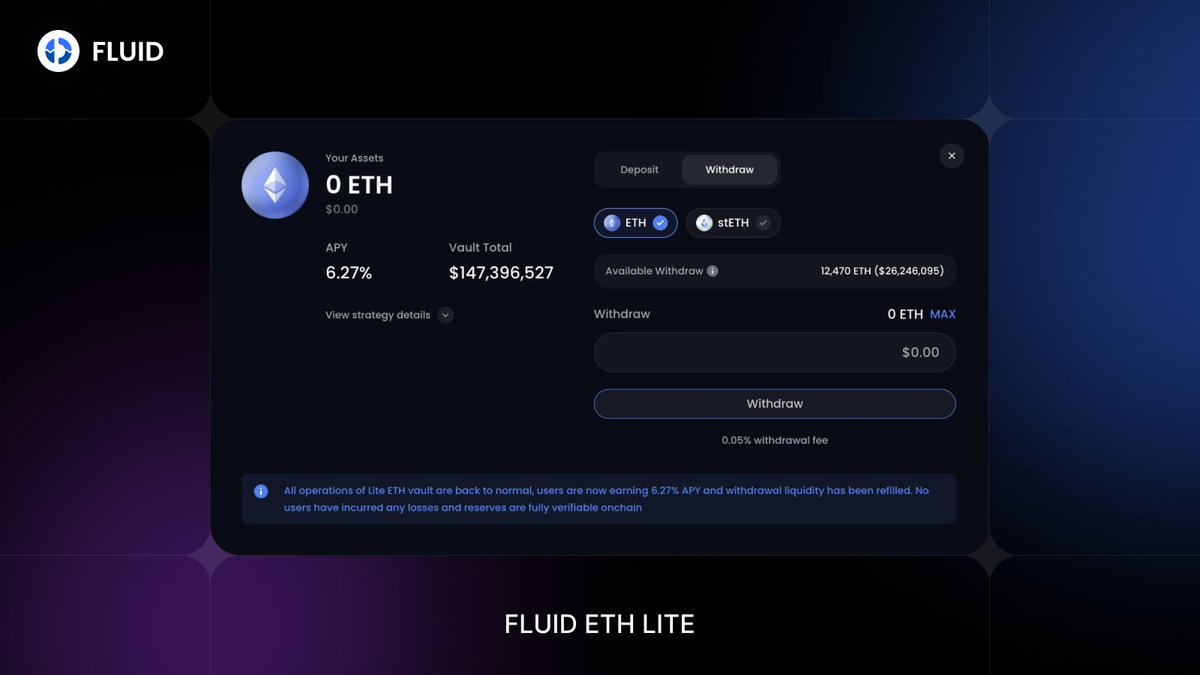
Lite ETH Vault operations are back to normal with 6.27% APR.
Lite Vault users have experienced no losses, $25M withdrawal liquidity has been replenished, and all reserves remain fully verifiable onchain.
The aWETH Redemption Protocol is now live on @Arbitrum and @Base.
After processing $400M+ in redemptions on Aave Ethereum, we're expanding to L2s.
This time, we’ll be opening up for all loopers to unwind while ETH lenders exit to LSTs.
How it works 🧵
If you live under a rock for the last 4 days, this is for you 🫡
Full recap of the rsETH / Kelp DAO exploit!
Includes:
- Detailed walkthrough of what happened
- Turmoil and contagion it created within the broader DeFi space
- Available options to resolve it
YT 🔗 in comment
Introducing aWETH Redemption Protocol
With ETH utilization at 100% on Aave, many lenders are currently unable to withdraw and face increasing risk if markets move.
aWETH Redemption Protocol allows ETH lenders to:
• Exit into wstETH or weETH
• Regain immediate liquidity
• Reduce exposure to liquidation risk
If you’re just lending ETH — you can fully exit.
If you have ETH collateral and another debt — your collateral is seamlessly swapped into wstETH or weETH while your debt remains the same.
We’re working alongside @LidoFinance , @ether_fi, @0xProject, @1inch,
@KyberNetwork, and other ecosystem partners to:
• Reduce systemic risk in DeFi
• Ease utilization pressure
• Support a healthier DeFi market
Our goal is simple: protect users while reinforcing the foundations of DeFi.
Capacity is initially limited to $1B in ETH.
https://t.co/VBIAT9FZyg
Growing security related product trend in DeFi
Just this week:
1) Safenet by @safe: Guardian network run by security companies to pre-screen your txs
2) Revoke Cash: browser extension that runs in parallel to your wallet
3) @OpenCover: insured yield vaults
More of this 👏
We just shipped the biggest update to the Revoke extension ever.
New features, new partner, and a completely overhauled approach to protecting your wallet.
Here’s everything 🧵