Unacceptable levels of wrongdoing by @TeamYouTube@youtube@nealmohan taking down 9 years of brilliant educational content. You should be absolutely ashamed of yourselves. In 2025, when Bitcoin is embraced by states, corporations, and the world at large, you guys are embarrassing yourselves.
$MSTR has acquired 6,911 BTC for ~$584.1 million at ~$84,529 per bitcoin and has achieved BTC Yield of 7.7% YTD 2025. As of 3/23/2025, @Strategy holds 506,137 BTC acquired for ~$33.7 billion at ~$66,608 per bitcoin. $STRK https://t.co/3vSGnTUVcE
Strategy is Bitcoin's only investment bank, with the most formidable capital moat in the history of investment banking. I've been saying this for months and now the evidence is undeniable.
An investment bank helps its client raise capital from the capital markets by creating securities that give investors exposure to the client.
Every investor group has their own preferences, and investment banks help structure offerings to match investor needs. Only by meeting the investment needs of various investors can the client maximize its capital raised, allowing the bank to earn the most money.
@Strategy creates securities for its only client: the Bitcoin network, which is the most antifragile and fastest growing network in the world. Strategy channels bitcoin through the Strategy capital structure to create de facto Bitcoin securities.
Look at the securities offerings so far:
- Several tranches of convertible bonds. Target investors: convertible bond traders, volatility arbitrageurs. These investors are buying CBs for the embedded option contract, which they can use to generate a return via delta hedging
- Strike ($STRK). Target investors: yield hunters who have appetite for possible upside. STRK is an everlasting call on $MSTR that doubles as a perpetuity.
- Strife ($STRF). Target investors: yield hunters who have no appetite for possible upside. STRF is just a perpetual income stream. There's no option value, this is just pure cash flow.
- Straight bonds (previously). Target investors: traditional fixed income investors. These are just bonds which mature and pay interest each year.
Bitcoin on its own does not have convertible bonds, preferred stock, or straight bonds. It needs an investment bank to underwrite securities so that it can raise capital from various corners of the capital markets. Strategy is that investment bank.
What is $MSTR common? It is the common equity in this investment banking operation. Each time the investment bank raises some capital for Bitcoin, the BTC Yield generated accrues to MSTR common shareholders. The bigger the demand for Bitcoin securities, the bigger the earnings potential of MSTR common.
Capital raises = Revenue
Dilutions = Cost of Revenue
BTC $ Gain = USD Earnings
What can cause this investment bank to fail? There are only three things:
1 - Bitcoin fails. This means our only client is gone. Fatal for IB business.
2 - Demand for Bitcoin securities disappears. This means our client can no longer raise capital from capital markets. Fatal for IB business.
3 - Strategy's bitcoin is somehow lost. This means our business capital disappeared due to mismanagement. Fatal for IB business.
Note that it is possible for #2 to happen in a prolonged bitcoin bear market. And this can cause #3 to happen if the IB cannot raise new capital and is forced to sell bitcoin to pay dividends and interest. As more dividend obligations are introduced, this exact risk grows. It is a topic worth significant discussion and thought, for another time.
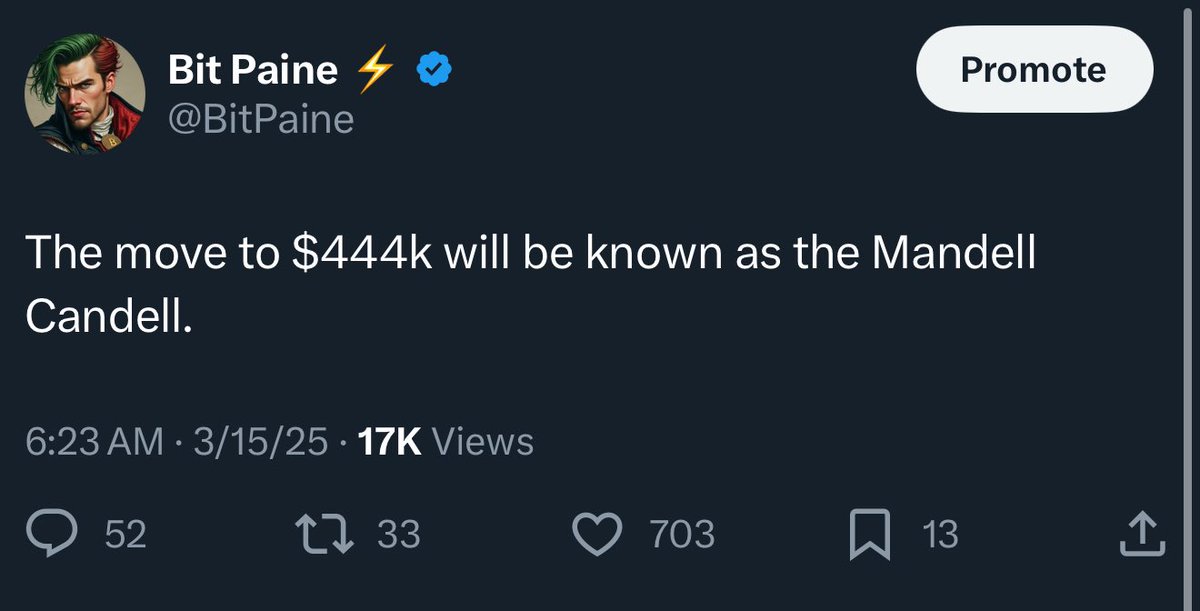
🧵1) On Nov 5, 2024 Josh Mandell correctly predicted the exact price of Bitcoin's close on March 14, 2025 ($84K), as prelude to a historic run. New research suggests precognition is possible—your consciousness can reach back in time to shape the past. Let's explore how.
A visual and written explanation of the $MSTR convertible bond graph that @RichardByworth and I discussed today min (25:30 in video below)
As the price of $MSTR is below the conversion price, the arb traders have material volatility “juice to squeeze” in the difference between the price of the bond held and the price of the underlying equity (light green on left side of graph)
As $MSTR is trading well in excess of the conversion price “In The Money” there is very little volatility “juice to squeeze” in the difference between the price of the bond and the equity. (light blue right side of the graph)
Convertible arb traders hope for price DECLINES since the underlying equity is deep in the money (excess of conversion price). Price declines benefit arb traders because the volatility “juice” is greater when trading closer to the conversion price
The reason the demand for the $MSTR convertible bond was so high in November of last year ($3B issuance at 60 vol) was because the arb traders were STARVING for NEW volatility to arb. The bond itself was trading like the underlying equity it tracked.
@RichardByworth anything you’d like to add?
My grok analysis on “who is bearing the risk” of todays subprime mortgages:
____
A distinction from the 2007-2008 financial crisis, a key shift in who bears the risk under the current mortgage policies:
In the 2007-2008 financial crisis, private banks and financial institutions carried much of the risk initially. They issued subprime mortgages, bundled them into mortgage-backed securities (MBS), and sold them to investors. When borrowers defaulted en masse, the losses hit private lenders, investment banks, and the broader financial system—until government bailouts stepped in to stabilize things. The risk was heavily concentrated in the private sector, amplified by lax regulation and speculative financial instruments.
Now, the risk profile has shifted under the Biden-era mortgage "relief" policies:
1. **The Federal Government (via FHA and Taxpayers):**
- The Federal Housing Administration (FHA) is insuring a growing number of risky loans—those with high debt-to-income ratios (above 43%) and low down payments (as little as 3.5%). When borrowers default, the FHA covers the losses, not the private lenders. Since the FHA is a government agency, this effectively transfers the risk to taxpayers. As defaults rise (especially with borrowers holding minimal reserves), taxpayers will foot the bill for bailing out the system, rather than private banks taking the hit directly.
- This is a key difference from 2007-2008: back then, private banks held the loans or securities initially, and government intervention came after the fact. Now, the government is proactively backing these loans from the start.
2. Private Lenders (Minimal Risk):
- Unlike in 2007-2008, private lenders today have “no skin off their backs” when issuing FHA-backed loans. Since the government guarantees these mortgages, lenders can originate risky loans without worrying about defaults. They collect fees and interest, but the downside is offloaded to the FHA. This reduces their exposure compared to the pre-2008 era, where they held the loans or securities on their balance sheets until they could sell them off.
3. Borrowers (Personal Risk, Not Systemic):
- Borrowers with high debt-to-income ratios and low reserves face personal financial risk—foreclosure, ruined credit, etc.—if they can’t keep up payments. But their individual defaults don’t directly threaten the broader system the way they did in 2008, because the government absorbs the loss rather than letting it cascade through private institutions.
*Why It’s Different from 2007-2008:
- **Risk Holder:** In 2007-2008, private banks and investors bore the initial risk, with losses spreading through the financial system via complex securities (e.g., CDOs). Today, the government (FHA) is the primary backstop, making it a more centralized, taxpayer-funded risk rather than a distributed private-sector one.
- **Mechanism:** The earlier crisis involved speculative lending and securitization that hid risk until it unraveled. The current situation, per the article, stems from explicit policy choices—easing underwriting standards and offering relief—that inflate demand and prices while piling risk onto the public ledger.
- **Scale and Visibility:** The 2008 crisis blindsided markets partly because of opaque financial products. Today’s risk is more visible (FHA loan data is public), but the article warns it’s still growing unchecked, potentially leading to a “subprime bubble” — one that hits taxpayers first rather than Wall Street.
The Catch:
the system is less prone to a sudden private-sector collapse like 2008, but it doesn’t eliminate the problem—it just changes the loser. If defaults spike (say, due to inflation or a recession), the FHA could face massive claims, draining federal funds. Congress might then need to step in with more taxpayer money, turning a housing issue into a fiscal one. It’s less “too big to fail” for banks and more “too big to ignore” for the government
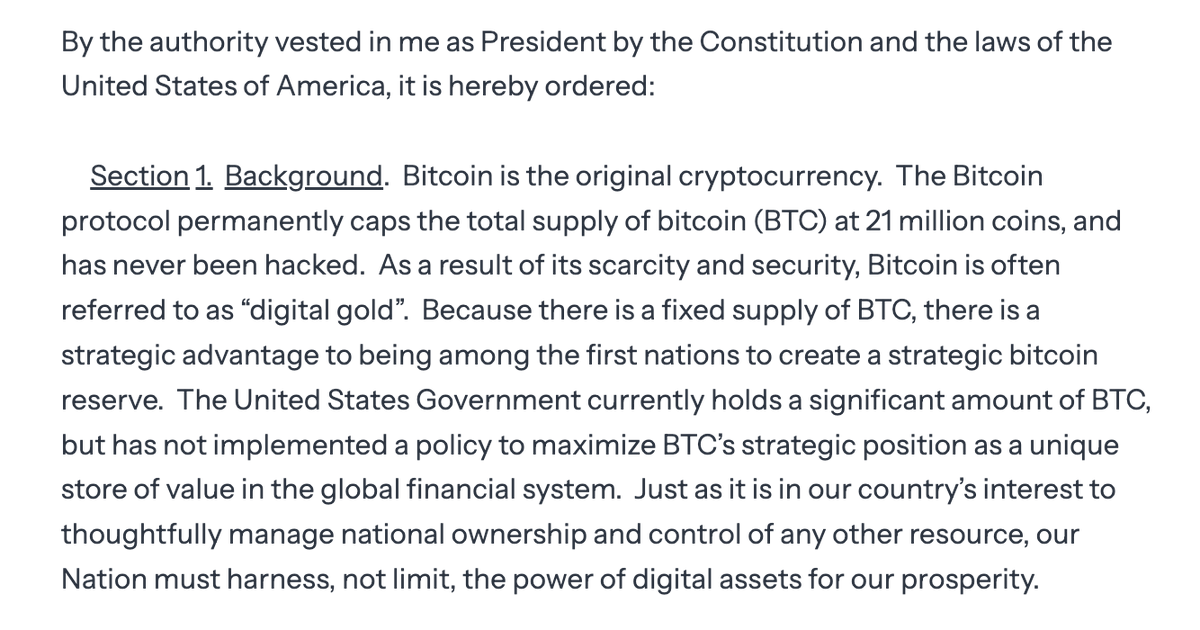
What's going to be crazy and really catch everyone off guard is if we start seeing the executive dept going full MSTR, like selling everything for Bitcoin and accumulating as much as it possibly can.
I don't see why that couldn't happen, not saying it for sure will, but they definitely laid out a legislative framework for it to be a possibility.
They can't spend ear marked "taxpayer" money on it without an act of congress, but the Executive branch has a lot of resources already earmarked for it's purposes and it can redirect those resources as it sees fit.
This is why Reagan was able to pass the Agriculture and Food Act of 1981 and suddenly the US government started giving away stockpiled cheese. This didn't require an act of congress, it was just a shuffling around of resources.
This cheese was a Federal subsidy to the dairy farmers inacted by the 1949 Agricultural Act, Raegan just redirected those resources as a "public good".
People underestimate how much of the governments resources the executive branch controls, even if they don't directly control spending.
It's something of a presidential passage (or privilege?) to lead with the pen and then battle out disagreements in the courts.
A sitting president would have to do a lot more than shuffling resources around to accumulate a surplus of certain commodities to break long established precedent.
The US did this with Land under Thomas Jefferson, the exceutive power speculated rightly on land purchases for United States territory.
Heck Jefferson technically didn't even get congressional approval to purchase Louisana for that matter until after the fact. He just spun it as an extension of his Executive treaty making power and spun it as a presidential act that was brokering peace with France to help Napoleon fund his war.
The Strategic Petreolum Reserve was Established by the Energy Policy and Conservation Act (EPCA) of 1975 by President Gerald Ford and just started using funds allocated to the Department of Energy's annual budget.
Now back to today you've got guys advising the White House who think that spirit of Executive plow driving was great and the next frontier in their sights is digital gold.
Why do I think that might happen? Because the dude in the room with the highest net worth at the white house crypto summit, who in 2020 was probably worth less than a billion, acquired 1% of the Bitcoin supply with leverage and has been out performing everyone for the last 4 years.
This is exactly the kinds of things the railroad executive cabinets did too. Brought in a bunch of the most successful land speculators, financiers, and railroad lawyers and started dumping huge piles of federal dollars into copying their strategies, and selling private contracts/grants to all of their buddies, also enriching themselves in the process.
It's just the way these things have historically worked.
$MSTR: In case some people are forgetting - "Why Investors Are Lending MicroStrategy Billions of Dollars at 0% Interest So It Can Buy Bitcoin" Link: https://t.co/ESB2dNUjbw
BREAKING: @RezolveAi announces MASSIVE $1 BILLION #Bitcoin Treasury Strategy 🔥
"This is more than an investment. We’re not just embracing the future of finance; we’re building it."
— Daniel M. Wagner, CEO
We're partnering with @fold_app to giveaway $250 in #bitcoin! 🟠
Just RT this tweet to enter. That's it ✅
Winner announced Tuesday 2/25 at 4PM EST.
We're doing this to celebrate the first ever bitcoin rewards credit card. Join the waitlist now!
https://t.co/vWu3X6zw8S
Strategy has acquired 20,356 BTC for ~$1.99B at ~$97,514 per bitcoin and has achieved BTC Yield of 6.9% YTD 2025. As of 2/23/2025, we hodl 499,096 $BTC acquired for ~$33.1 billion at ~$66,357 per bitcoin. $MSTR https://t.co/mNWDaXRE7N