Skepticism of corporate marketing and AI boosterism is always warranted, but I think the folks who accused Anthropic of overrating Mythos should check out this post by Mozilla developers indicating that the Firefox team fixed more security bugs in April using Mythos than in the past 15 months combined.
https://t.co/0hmpnz0pQZ
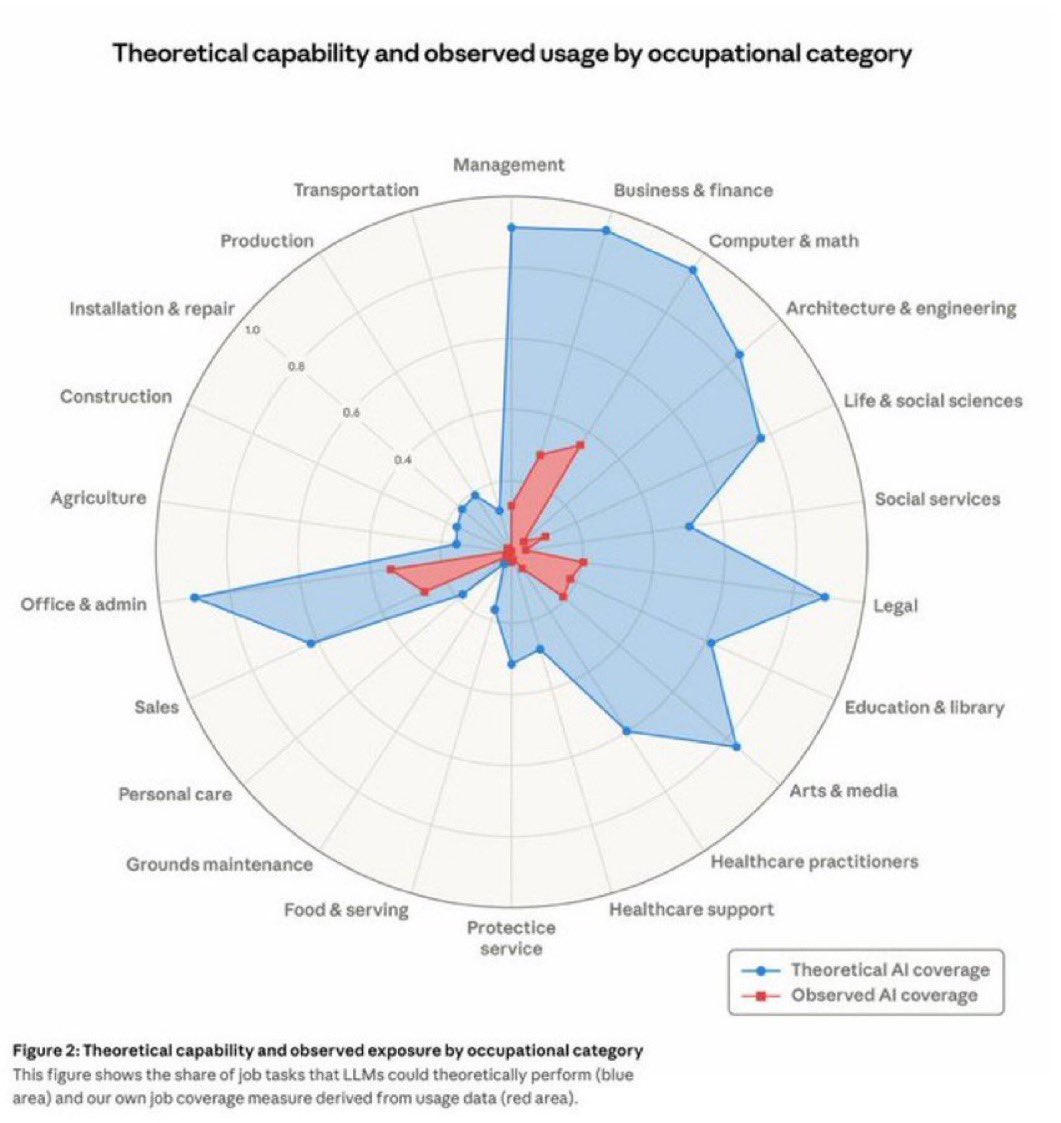
Anthropic's Revealing Chart on AI's Impact on Jobs
Anthropic has unveiled a pivotal chart that underscores the chasm between AI's capabilities and its real-world application in the workforce.
Derived from analyzing 2 million actual conversations with Claude, this radar chart, titled "Theoretical Capability and Observed Usage by Occupational Category," paints a stark picture of untapped automation potential across various job sectors.
At its core, the chart is a spider web diagram plotting occupational categories around a circular axis, with values ranging from 0 to 1.0 representing the share of job tasks.
The expansive blue area illustrates the theoretical coverage tasks that large language models (LLMs) like Claude could perform right now based on their inherent abilities. In contrast, the much smaller red area shows observed usage, drawn from real user interactions.
The visual disparity is immediate and profound: blue spikes outward significantly in fields like computer and math (reaching about 0.75), business and finance, and office administration, while red hugs close to the center, often below 0.2 across most categories.
This gap isn't just academic; it's a "career runway," as highlighted in discussions around the chart. For programmers, 75% of tasks are theoretically automatable, yet actual usage lags far behind.
Similar vulnerabilities appear in customer service, data entry, and financial analysis, roles traditionally seen as white-collar strongholds. Meanwhile, hands-on fields like construction, agriculture, and protective services show lower theoretical exposure, with blue areas dipping to around 0.1-0.3, suggesting AI's current limitations in physical or unpredictable environments.
Broader data amplifies the chart's message. As of early 2026, 49% of U.S. jobs expose at least 25% of tasks to AI, up from 36% a year prior. Yet, mass layoffs haven't materialized; unemployment in AI-vulnerable roles remains steady.
Instead, subtler shifts are underway: a 14% drop in hiring for 22-25-year-olds in exposed positions indicates companies are prioritizing experienced workers, shortening entry-level pathways for recent graduates.
The implications are clear: while AI's red footprint grows incrementally each month, the blue expanse signals accelerating change. College-educated, higher-earning professionals, once insulated are now most at risk, flipping the script on traditional labor disruptions.
Anthropic's chart isn't a doomsday prophecy but a wake-up call, urging workers and businesses to bridge the gap through adaptation, upskilling, and ethical integration of AI tools.
Please read the 5000 Days Series at https://t.co/tcKeuiQyql for answers on how you can thrive in the Interregnum.
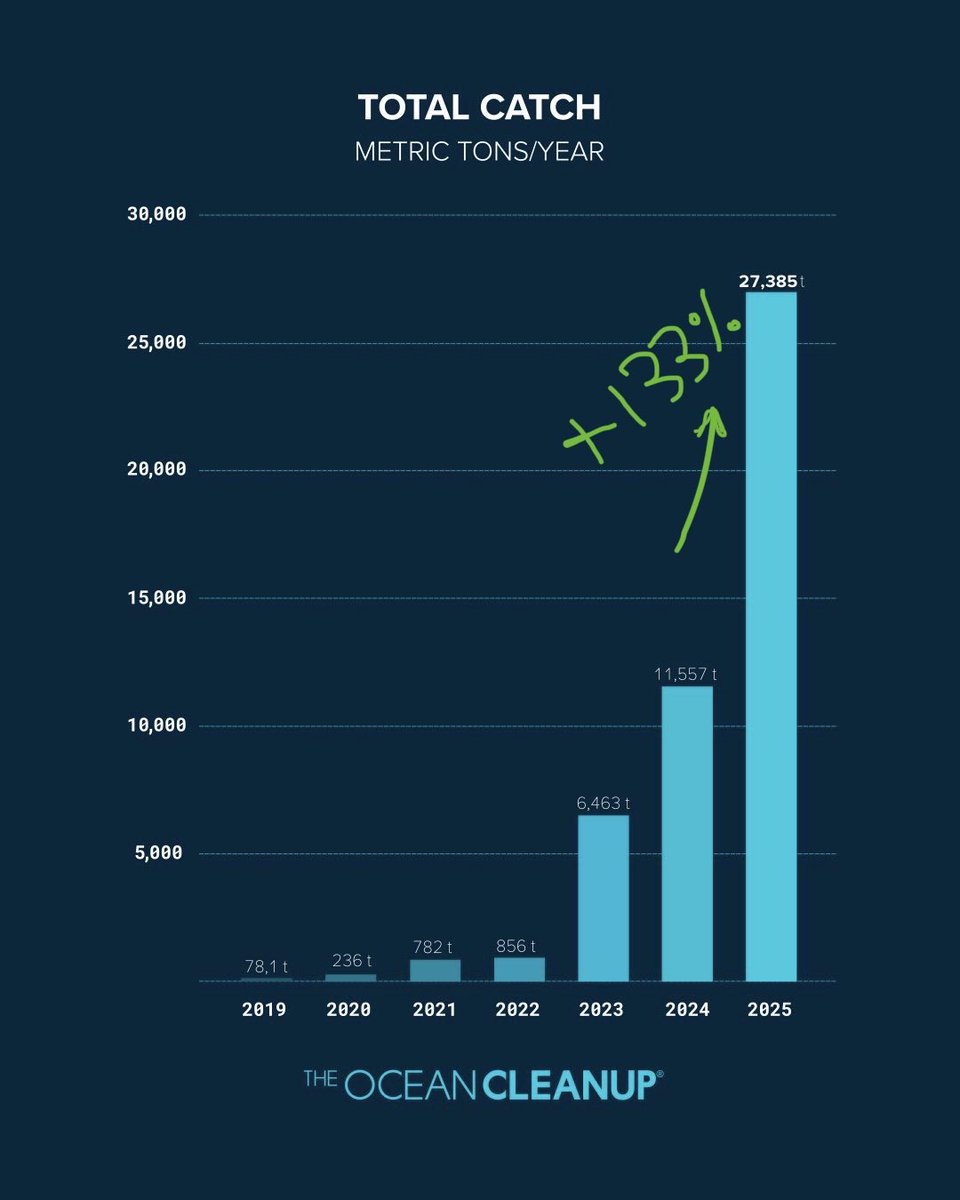
It's alarming to think how many people within how many companies are looking at this and thinking "We need to figure out how to get them to drink more."
Elon Musk gave a VERY thoughtful response when asked about tariffs and why the US needs to be extremely careful - here was his warning:
"I think you need to be careful with tariffs. I deal a lot with supply chain issues, like the global automotive supply chain for Tesla, for example, is incredibly complex...
We've got a factory somewhere else that's making a part that goes into the car. Now, if that part's suddenly twice as expensive, it messes everything up.
So you want to have tariffs be predictable so that companies can adjust their supply chain. I think companies are more than happy to increase manufacturing in America. It's just that you can't do it instantly.
So if you put up giant tariffs immediately. And don't give companies a chance to, build factories in America, you've got to build a building, you've got to install equipment, you've got to train people... that doesn't happen instantly...
You want to have a ramp so that people companies can adjust and build the factories and train the people and get the equipment in place. Otherwise, you basically just shock the system and it breaks or bad things happen.
So I'm against sudden giant tariffs because it's an impossible response if you've got to move 1,000 tons of equipment. In some cases, collectively, millions of tons of equipment.
You just can't do that overnight. It's literally impossible. So I think we want to be thoughtful about tariffs."
Here's my latest eclipse composite photo formatted for a mobile wallpaper, feel free to download it and use it!
I also have a high quality 4k version you can have, but I hosted it on my website so it wouldn't be compressed. I'll link it in the reply to this post.
Important to note- zero saturation and hue adjustments were made in this shot. Despite this being a composite from thousands of images, the color is 100% unedited from a single photo.
The camera can detect far more color than our eyes!
Last night I used 4 cameras to capture the ultimate HDR view of the lunar eclipse
This 300GB image shows the lunar surface in extreme detail, while revealing all rich color that was projected onto the surface
See the full res crop or get a print in the reply to this post
AI is making every product look the same. Same features. Same UI. Same smart assistant.
So if everyone has the same AI tools, what actually makes a product a $100M winning product?
Insights from a 50 page ebook "how to design products in the AI age" we wrote at @meetLCA:
Excited to share what we've been cooking @GoogleDeepMind to bring Gemini into the physical world! 🦾🧠
Here is an uncut interaction of the Gemini Robotics VLA helping me clean up my desk. 🔊
Interacting with a robot through voice is the most surreal experience, and parallels the giddy excitement I had playing with early LLMs that is hard to put in words. You've got to try it to believe it!
Over the next few days, we'll be sharing more such interactions that go beyond shiny demos and expose raw capabilities of our models. Stay tuned for more raw videos!
Tech Report: https://t.co/83NBmieIHZ
Blog: https://t.co/7VINxV3D3y
YouTube Playlist: https://t.co/pFLdQLDtiA