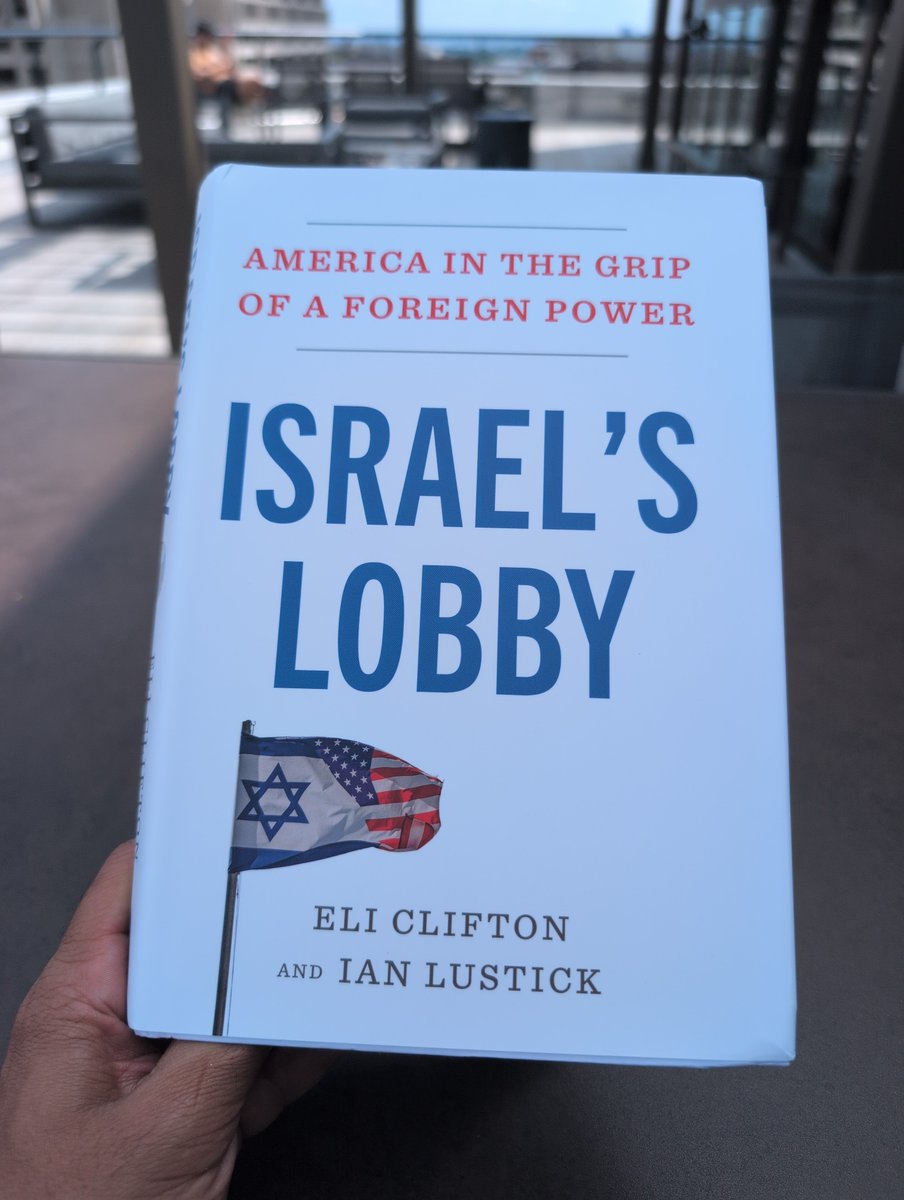
Well Well Well...
The reason they get these businesses so big and powerful is not purely by merit.
They own the Media so give people within their own tribe preference in advertising and business dealing.
Our economy is under an ethno-monopoly.
Iran’s Mehr News released a video claiming to show Supreme Leader Mojtaba Khamenei “for the first time,” with no date or location specified. The right side of his face cannot be seen in the footage.
Middle powers increasingly want security relationships without surrendering strategic autonomy. They want partners without patrons, interoperability without complete alignment, and additional security options without having to abandon existing ones. https://t.co/5wnN2pJFKq
JD Vance is warning Benjamin Netanyahu’s administration not to mess around with the United States, saying they may end up losing everything.
Vance says Trump is their last ally because the entire world already hates them.
"If I were in the cabinet of the Israeli government, I might not be attacking the only powerful ally I have."
🚨 BREAKING:
Putin:
“Once, I asked former French President Jacques Chirac, ‘Why is American leadership so aggressive and, in some cases, so narrow-minded?’
He replied to me in Russian: ‘Because they are uncultured people.’”
Paul Newman, in a 1983 statement, said that the United States constantly creates exaggerated enemies to justify wars and killings for profit, while ignoring crimes committed by entities such as Israel.
Turkiye is trying to flip Saudi Arabia against us and establish a hostile 'Sunni Axis' with nuclear Pakistan."
-Ex Israeli PM Naftali Bennett (Feb 2026)
Saudi Arabia, Pakistan and Turkey have signed a trilateral defense pact to strengthen collective security and regional stability.
The agreement comes as Iran is expected to assess its implications, raising questions about its impact on the region's security balance.
A Few Observations on the Saudi-Turkish-Pakistani Agreement From an Israeli and Iranian Perspective
1. Israel may be uneasy, but Israel is not the main reason for this agreement.
There will undoubtedly be voices in Israel that interpret the agreement as the emergence of a more assertive Sunni bloc that could eventually pose a challenge to Israel. But that would miss the primary Saudi motivation. For Riyadh, the agreement is first and foremost about a much deeper concern: whether Saudi Arabia can withstand the security challenges surrounding it on its own. The kingdom is looking for additional strategic depth and partners at a time when its regional security environment remains highly uncertain.
2. The real test will come when the agreement carries actual military costs.
The continuing Houthi attacks on Saudi Arabia provide an immediate test. Will they lead to meaningful Pakistani or Turkish involvement against the Houthis? The Houthis have already shot down a Turkish-made Bayraktar drone, although it was apparently operated by Saudi Arabia rather than Turkey itself. That distinction matters. The much bigger question is what happens in a genuine regional escalation. Imagine, for example, that Iran responds to a U.S. strike by attacking Saudi oil infrastructure. Would Turkey and Pakistan actually be prepared to take military action against Iran? That is where declarations of solidarity meet geopolitical reality. Neither Ankara nor Islamabad is eager for a confrontation with Tehran, and Pakistan's traditionally cautious approach toward Iran illustrates just how difficult such a decision would be.
3. The agreement does not close the door on Saudi-Israeli normalization.
From an Israeli perspective, the agreement should not be interpreted as determining the future of normalization with Saudi Arabia. Riyadh's security partnerships and its relationship with Israel operate on related but ultimately separate tracks. If Israel were to make dramatic progress on the Palestinian diplomatic track, it is entirely plausible that Saudi Arabia would once again show interest in advancing normalization. This agreement does not fundamentally change that calculation.
4. The agreement also reflects Saudi doubts about relying exclusively on Washington.
One of the most important drivers behind this development is Riyadh's disappointment and declining willingness to depend exclusively on the United States for its security. Yet Washington may not necessarily view the agreement negatively. An arrangement that contributes to regional stability without requiring additional American military resources could fit comfortably with longstanding U.S. demands that regional partners assume more responsibility for their own security. President Trump, in particular, has repeatedly described Turkey as an important regional actor. There is, however, a significant limitation: resources. Turkey faces serious economic constraints, while Saudi Arabia has its own growing fiscal pressures. This may be an important political and strategic agreement, but building a genuinely integrated military architecture will require considerably more money, capabilities and political commitment than signing one. In that sense, the agreement can also be understood as another consequence of the region's unsuccessful attempts to contain Iran through escalation alone.
5. Tehran may ultimately have more reason to watch this agreement carefully than Jerusalem does.
Turkey, Pakistan and Saudi Arabia are not looking for a war with Iran. But the agreement nevertheless has the potential to alter a regional balance of power that had increasingly been moving in Tehran's favor. Even without producing a formal anti-Iranian alliance, closer coordination among three major Sunni states, each possessing different military, economic and geopolitical assets, complicates Iran's strategic environment. The significance lies less in what the three countries intend to do today than in what they might be capable of doing together during a future crisis.
6. The UAE will also be watching closely.
Abu Dhabi has reasons to be considerably less enthusiastic about a growing Turkish role in Gulf security. The UAE has long viewed Turkish regional influence, particularly Ankara's historical ties to political Islamist movements such as the Muslim Brotherhood , as a strategic challenge. A deeper Turkish role in Saudi security affairs could therefore introduce another source of friction between Abu Dhabi and Riyadh, even as the two remain important partners on many other issues.
Bottom Line
The biggest tests of this emerging partnership are still ahead.
The continuing confrontation between Saudi Arabia and the Houthis is unlikely to disappear, and its potential for escalation remains significant. Saudi Arabia gains meaningful strategic backing at a moment when its security challenges continue to demonstrate the limits of acting alone. Turkey gains a potentially important foothold in Gulf security affairs. Pakistan, meanwhile, may gain the ability to share a burden it has historically faced largely on its own whenever Saudi security is threatened.
But the gap between strategic declarations and military commitments can be enormous.
The key question is therefore not what the agreement says on paper. It is what happens when one of these countries is actually attacked, particularly if responding means confronting Iran.
That will determine whether this becomes a genuine regional security architecture or remains primarily a political declaration of solidarity.
#IranWar
#turkey
#ksa
#Pakistan
🚨 BREAKING:
A Harvard law student to Blinken:
“How do you explain what you have done to the thousands of Palestinian children who died because of you? Genocide is your legacy.”
🚨 The Moment Trump Leaves the Iran War, the Petrodollar Dies Forever
Professor Jiang explains how the US economy is a giant Ponzi scheme dependent on Gulf nations investing in American tech. If Iran forces the Gulf to abandon the petrodollar for food security, the US economy will face total collapse and revolution in the streets.
Jeff Currie, former Goldman Sachs head of commodities and lifelong insider of the dollar system, just laid out the one line America cannot cross. Handing control of the Strait of Hormuz to Iran is not a tactical retreat. It is the formal end of the United States as global hegemon and the death of the dollar as the world’s reserve currency.
JP Morgan CEO Jamie Dimon said that Iran had its “throat on the Strait of Hormuz” for 45+ years and told the Trump administration to “finish this thing and finish it right.”
Bank of America reports that U.S. now only has 43-day emergency buffer of crude oil left in 45-year low.
Paul Newman In 1983 stated that the United States disregards the truth, always creating exaggerated enemies to justify wars and massacres for profit, while ignoring crimes committed by other nations like Israel.
Abdul El-Sayed: “I don’t believe in unconditional foreign military aid. That includes Israel, that also includes Egypt where my family immigrated from. I believe our kids have a right to our tax dollars. We’ve watched as Israel has conducted a genocide, has at baseline done apartheid, and has taken us into a war we have no business fighting so why are we sending money to that country to fund their military?”
The Trump administration has collected more than $13bn in revenues from Venezuelan oil sales this year, according to FT calculations. So what has happened to the money? John Reed unpacks Washington's conflicting accounts. https://t.co/qaOUYQ7Ghe