The potential of bio- and nanotech is enormous. Sufficient progress could stop aging, diminish age-related diseases like cancer and heart disease, and extend healthy lives. Molecular nanotechnology could help heal the biosphere, create an abundant economy, and facilitate affordable space exploration.
We encounter lots of ideas with potential to contribute to these outcomes. Many of them could be tested quickly with relatively small amounts of money. That is why we are launching a new fast grants program in longevity biotechnology and molecular nanotechnology!
With short review times after the application deadline, and smaller grants of around $10,000, we aim to quickly test and de-risk promising ideas.
The program runs quarterly, and we will do the first evaluations after the next deadline (March 31st).
Learn more and apply: https://t.co/rkqaI2mDqo
Excited to share @nablabio is partnering with 3 of the world’s largest pharma cos to use integrated AI and wet-lab tech to design antibodies against challenging disease targets. Thrilled to also add @radicalvcfund who led our $26M Series A to the family! https://t.co/fmF5s2UCj6
What would you make from protein if you weren't beholden to living cells to put them together? I've been thinking about for the past year at @Spec__Tech and wrote a roadmap for a coordinated research program called Macromolecular Additive Manufacturing.
https://t.co/ELkBJmpKjN
I've had a blast nudging at edge of sci-fi and what's possible with @Ben_Reinhardt and the @Spec__Tech team to build this program and can't wait to see where it goes next. Reach out to us if you are interested in putting this roadmap into action!
And this could lead to artificial ‘antibodies’ that engage many biological targets simultaneously, vaccines made from multiple parts of infectious agents for robust immunity to many pathogens, or rapid prototyping of cell-free factories with spatially organized enzymes.
@tim_huddy@LEGO_Group Congrats @tim_huddy, @kribler, and all! Wonderful to see the preprint posted. Super inspiring to see you making proteins as modular what I previously thought was only possible with DNA nanotech.
Geometrically standardized features give @LEGO_Group blocks their ability to be intuitively assembled into structures. Here we show that designed proteins can be made to a similar standard, enabling useful features in nanomaterials such as scalable size: https://t.co/u8b5mDbv2Z
This is an amazing opportunity for anyone wishing to join us and push the boundaries of new tech at @Spec__Tech. Applications are open for a couple more weeks and I encourage you to apply if you're looking for something totally unique!
Applications close on 25 May!
So please pass the application on to anybody who might be a good fit or apply if this is something you might want to do.
Application form here: https://t.co/IC3Ts517Fw
Have you experience with multifunctional protein biologics like multispecifics antibodies, therapeutic fusion proteins, etc? If so, I'd love to talk.
DMs are open or shoot an email to chris[at]https://t.co/OQuifS1U4v
@michael_nielsen All these approaches have trade offs and there is not currently a silver bullet to assemble "anything." But the widespread use of DNA origami by the DNA nano community and beyond shows that robust, generalizable methods for making things from molecules can have profound impact.
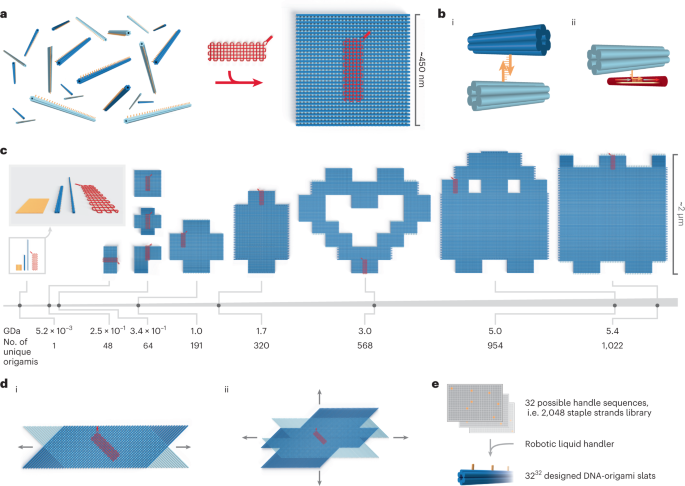
@michael_nielsen In my PhD, we tuned the sequence "glues" to require cooperativity to allow the DNA origamis to stick together. It drastically improved yield, allowing formation of structures with >1000 unique origamis.
https://t.co/FVbhE2CFSy
@michael_nielsen But there's a ton of nuance in programming these things together so that DNA assembles together at reasonable yield. You can see that in the fractal assembly @nanoassembly, where clever multistep protocols promotes formation of the desired product.
@michael_nielsen These these are fascinating! In fact, I was so drawn toward these challenges of diminishing yield that it became the focus of my PhD. In short, DNA is intuitive because you can program you readily program sequences as "glues" to stick strands and assemblies of strands together.
.@Ben_Reinhardt has always wanted to make the imaginings of science fiction novels a reality. He got his PhD with the goal of building spaceships; but became disenchanted with the existing venues for scientific and technological research.
1/ https://t.co/BZQ8LqyhdO
1/ For the past year, we’ve been building a new research organization:
Speculative Technologies (@spec__tech) exists to create an abundant, wonder-filled future by unlocking powerful materials and manufacturing technologies that don’t have a home in other institutions.
Crisscross origami, a new method developed at the Wyss for the first time allows researchers to grow DNA megastructures at the micron-scale with vast potential for future applications. @Cwintersinger @DionisMinev
@aersh0va@HiroshiSasak1 https://t.co/3mvdwjotSf