If you really want to learn, you'll find a way. If not, you'll find an excuse.
- being too busy - "don't have the time"
- blaming work - "job keeps me occupied"
- waiting for the right time - "will start when things settle"
- blaming external factors - "don't have the right resources or the classic - blaming the education system"
Learning isn't about time - it's about priorities. If it truly matters, you'll find a way. If not, you'll find an excuse.
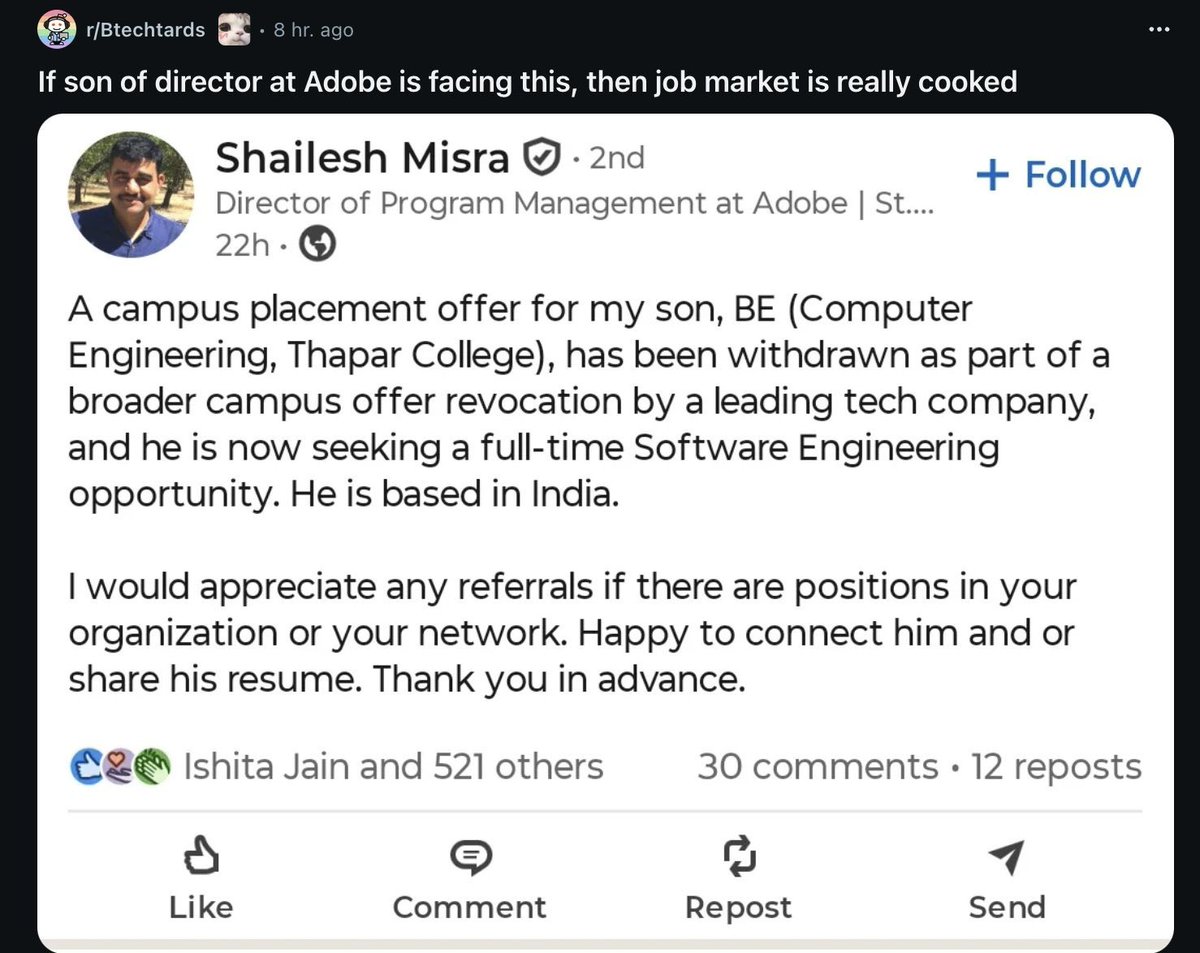
Everyone’s losing their mind because an Adobe Director asked for referrals for his son.
And honestly... the reaction says more about people than the situation itself.
If connections were enough, this wouldn’t even be a post.
No asking.
No outreach.
No noise.
The fact that it exists tells you something most people don’t want to admit... even with access, you still have to compete.
But instead of seeing that, people rush to the most convenient conclusion:
“The system is rigged.”
“Only connections matter.”
“What’s the point of trying?”
Because that narrative is easy.
It lets you sit on the sidelines and feel justified.
It saves you from doing the uncomfortable work of actually getting better.
Here’s the reality...
Referrals might get you noticed. That’s it.
They don’t clear interviews. They don’t write production-grade code. They don’t help you when your system is on fire and nobody’s coming to save you.
At some point, it’s just you and your skills.
And that’s exactly why this industry is still one of the most merit-driven spaces out there.
People from completely unknown backgrounds are building insane careers... not because of who they know, but because of what they can do.
Meanwhile, others would rather spend time dissecting “the system” than building anything meaningful.
So before jumping into outrage, ask yourself something far more uncomfortable...
If someone gave you that referral today... would you actually clear the bar?
Because that’s the only part that really matters.
And deep down... most people already know the answer.
@ojasgoyalx @RealAnkush @hijunedkhatri Sir, What do you mean by top tier resume and who is giving the credibility that the resume is top tier and getting offer is important first and then good offer and then dream offer 🙏
@ojasgoyalx @RealAnkush @hijunedkhatri Who said the skilled Graduates are high in Number 😅 There is a huge difference between graduates and skilled graduates according to industry standards, I hope you would get my point.
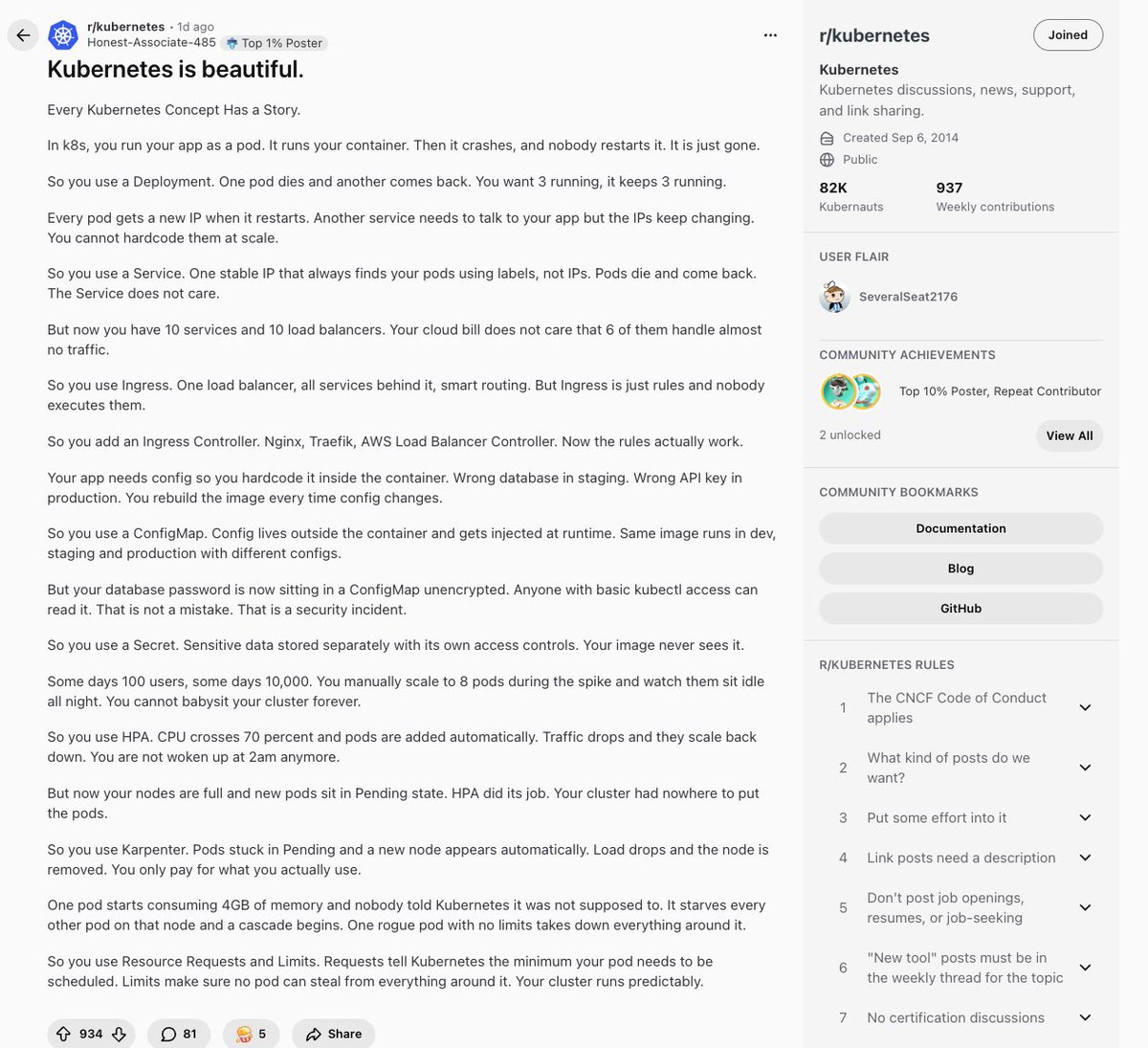
Before appearing for an interview, understand the Kubernetes components.
Master these fundamentals. 👇
Pod → The smallest deployable unit in Kubernetes; wraps one or more containers.
Node → A machine (VM or physical) where pods are scheduled and run.
Cluster → A set of nodes managed by a control plane.
Deployment → Manages rolling updates and ensures desired number of pod replicas.
ReplicaSet → Ensures a specified number of identical pods are running.
StatefulSet → Used for stateful apps with persistent identity and storage.
DaemonSet → Ensures a pod runs on all (or selected) nodes.
Job → Runs pods that complete a task and then exit.
CronJob → Schedules jobs at specific times (like cron).
Service → Exposes a stable network interface to access pods.
ClusterIP → Default service type; accessible only within the cluster.
NodePort → Exposes service on a static port across all nodes.
LoadBalancer → Exposes service externally via cloud provider LB.
Ingress → Manages HTTP(S) routing to services.
ConfigMap → Stores non-sensitive config data for pods.
Secret → Stores sensitive data like API keys/passwords.
Volume → Persistent storage attached to pods.
PersistentVolume (PV) → Storage provisioned for the cluster.
PersistentVolumeClaim (PVC) → Request for storage by a pod.
Namespace → Logical separation of cluster resources.
Kubelet → Agent on each node managing pod lifecycle.
Kube-Proxy → Handles networking rules and traffic forwarding.
API Server → Central control plane component for all communication.
Controller Manager → Ensures desired state via background controllers.
Scheduler → Assigns pods to nodes based on resources.
cAdvisor → Collects resource usage metrics on nodes.
etcd → Distributed key-value store for cluster data.
Taints → Prevents pods from scheduling on certain nodes unless tolerated.
Helm → Package manager for Kubernetes applications.
Kubernetes Dashboard → Web UI for managing clusters.
Follow for more !
If you want to become good at Kubernetes in 2026, then learn these use cases:
1) How Kubernetes RBAC Decision Flow Works
↳ https://t.co/piYsatMRmT
2) Kubernetes Architecture Crash Course
↳ https://t.co/PuZ6YExqKt
3) How to Troubleshoot Unhealthy Kubernetes DaemonSets
https://t.co/jiy5azf1Jz
4) pod.yaml File Structure Breakdown
↳ https://t.co/JhnPhMJb4i
5) How a Pod is Deleted - Behind the Scenes Breakdown
↳ https://t.co/7r6MUgVaAc
6) How To Fix Kubernetes Node Not Ready
↳ https://t.co/x93BbczXfW
7) Kubernetes ImagePullBackOff Explained
↳ https://t.co/WcgKxGJd7M
56K+ read my DevOps and Cloud newsletter: https://t.co/WBucLdwLhJ
Sign up to get 'The Practical Linux Guide for DevOps Engineers'
What do we cover:
DevOps, Cloud, Kubernetes, IaC, GitOps, MLOps
🔁 Consider a Repost if this is helpful
Manager: We lost our best engineer today.
CEO: The one leading payments?
Manager: Yes.
CEO: Did another company offer more money?
Manager: No.
CEO: Then why leave?
Manager: He said he was tired of fixing the same production issues every week.
CEO: That’s part of the job.
Manager: He didn’t mind fixing issues. He minded that nobody wanted to fix the root cause.
CEO: We prioritized speed.
Manager: He wanted quality.
CEO: So he left over that?
Manager: He left because he felt like a firefighter, not an engineer.
Good engineers don’t just want to solve problems.
They want to eliminate them.