The amount of respect you command is a direct byproduct of how high functioning you are, for high stress tolerance commands respect where low stress tolerance undermines it.
In simple terms: if you can outwardly handle stress with greater composure than others, you will naturally command more respect than they do. Respect thus accrues not as a conscious decision, but as an instinctive response to your conduct.
People will subconsciously evaluate your competence, placing you into one of two categories: asset or liability. If you are consistently steady under pressure and difficult to unsettle, you are deemed an operational asset, but if you collapse emotionally, offend easily, or routinely punish others for telling hard or sensitive truths, you will flag as a liability.
Respect and authority flows to those who are deemed assets. Would you want a leader with poor stress tolerance who is prone to outbursts, collapse or destabilisation? Of course not. That would unsettle you. You would prefer someone who remains poised under pressure, because you would feel safer with someone with an exceptional capacity to metabolise stress even beyond what is objectively healthy or humane. Leadership as such gravitates to those who are able to bear more than their fair share of stress, not to those who impose their emotional turbulence on to others the very moment they are subjected to it.
You seek someone unnaturally strong, who is capable of carrying not just their own burdens, but likewise yours. But you are neither unique or alone in holding that preference, for it is the underlying mechanism which determines how people intuitively designate leaders. To desire authority over others whilst being a source of emotional turbulence is thus not just naive, but incredibly immature. Authority necessarily then gravitates to those who serve the most stabilising function, because when it is given to the incapable, it results in dysfunction and tyranny.
High functioning individuals inspire trust, because they manage destabilising, urgent, or sensitive information without unravelling. Low functioning individuals erode trust, because they amplify chaos, crumble under pressure, and turn urgent or sensitive matters into liabilities, thereby imposing burdens which others are forced to carry in their place.
This is why if you want a relationship built on full and clear mutual transparency, you must be able to bear the costs of what you ask for. Both sides must be capable of absorbing shocks, disappointments, conflicts, and unpleasant truths without collapsing into hysteria or destructive anarchy. Respect simply is not owed, but earned. You are not entitled to what you have not proven you can endure, for it is the weight you are unable to carry that will define the limits of what others can trust you with.
Overwhelmingly true.
2 things to say:
1. Some of you will naturally have the ability to handle high stress situations, and won't realise this until you find yourself in them w/ the competence to match it.
A lot of you work jobs that are too easy for you.
- You perform worse at "easy" jobs & it decreases your overall confidence and self esteem.
- You wonder why you're not doing well at something that doesn't seem traditionally difficult.
- You assume because you struggle w/ something simple, you'd be incapable of doing anything 'harder' – and incorrectly accept this to be your functioning level.
It is not.
Environment is everything for you.
You expand or shrink more readily than others.
Counterintuitively: your life, wealth, confidence, and wellbeing drastically improve once you commit to doing something more challenging.
Others are built to survive in the mundane. But this is not acceptable for you. Entire body rejects it.
Your vision is blurry until you fix your gaze upwards.
2. I said I'm going to make the effort to directly recommend accounts w/ good non-slop content for you to follow as opposed to just reposting or QTing them.
SovereignIM is one of them. Recommended follow.
USA. There is a beast that lives beneath the American sink. It is always hungry. I have chosen to honor it.
The young man showing me the apartment said it casually, as if it were nothing. "Oh, and there's a disposal." He flipped a switch, and the drain ROARED — a grinding, growling thunder, hungry and alive — and then, at another flick, fell silent. Waiting.
I did not flinch. But I understood at once what I was dealing with.
For it is written that the oldest houses keep a guardian at the threshold of fire and water: a spirit of the hearth, fed in exchange for protection. Here, that spirit lives beneath the sink. It does not ask for prayers. It asks for scraps. And in return it devours what would rot, and keeps the whole house clean and sweet.
So I fed it, with respect. The rind of an onion. A bow. The switch. The roar of a grateful god. I thanked it each time. I named it. I began to leave it the best scraps, not the worst — for a guardian deserves the finest tribute a kitchen can give.
And here my heart rose, and I declared the thing a calmer man would not:
"I will feed this hungry spirit so faithfully, and so well, that on the day misfortune finally comes for this house, it will rise from the drain in a column of righteous thunder and devour my every enemy whole — and I will stand calmly beside the sink and say, 'this one has been with me from the beginning.'"
My landlord, doing the final walkthrough, heard the disposal roaring at midnight and knocked, concerned.
"Everything okay in here?"
"We are well," I said, gesturing to the sink. "He and I."
He did not understand. But he nodded slowly, and left us to it.
The drain has never clogged. The kitchen has never smelled of anything but morning. We have an understanding now, the beast and I.
So tell me, America.
You call it a garbage disposal. An appliance. A switch you flip without a thought.
I call it the loyal hearth-beast of every house —
fed in scraps, paid in thunder,
asking nothing but to be remembered at supper.
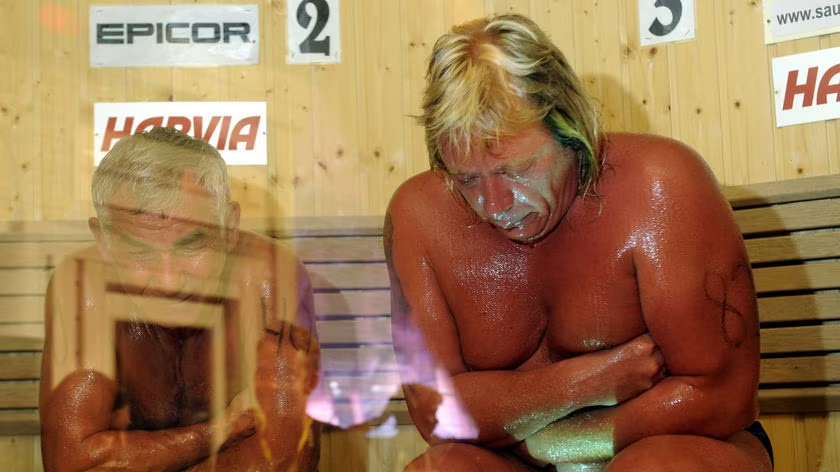
Just remembered the world sauna championship. Was one of the most interesting things I've read about
It used to be hosted in Finland every year until the incident in 2010. Rules were that it started at 110°C (230F). Then 1 litre of water was poured onto the stove every 2 minutes
The last person to walk out under their own power won
In 2010, both finalists had to be dragged out
The russian finalist died, burned all over, and the reigning Finnish champ went into a coma and woke up 6 weeks later with 70% of his skin burned, kidney failure and his airways completely roasted
One peculiar thing about it was there were no prizes. Only in one particular year did the winner get 1 small prize, some special heat resistant speakers that could be used in a sauna
But despite this, participants went to the edge of death every year and would do insane stuff like grow their hair out long specifically to cover their ears so it didn't get burned by the boiling water vapor
It was interesting to me because it's another piece of evidence that as soon as you create a ruleset... no matter how ridiculous it is, no matter how small the group of participants, no matter the extremely chance of death, and no matter a total lack of prizes. There will always be men willing to compete to the point of actually killing themselves
The male brain enters a kind of hypnotic trance where it will completely convince itself of the worthwhileness of the task, so long as it begins to venture seriously down the path of a competitive interest
It's kind of like a hijacking of the programming evolutionary mind, where no incentive makes sense but it happens anyway. You can find a million examples of this for every male interest on the planet. Just the simple act starting down a path confers it meaning to the person, and the more they are surrounded by other men who care about the same thing, the more they learn and compete, the more entranced by it they are, until their identity is fully subsumed by it and stuff like these sauna deaths happen
Seeing lots of things like this taught me to be very careful when I start down the path of any competitive interest or business, because getting hypnotized by what you are doing is essentially guaranteed. So it's good to assume it'll happen and be totally sure the outcome is worth your potential self-destruction
A guy calls his broker and asks about egg futures.
Broker says they’re at 25 cents.
Guy says, “Alright, buy me 100 contracts.”
A week later he calls again.
Broker says, “Good call. They’re at 35 cents now.”
Guy gets excited and buys 1,000 more.
Few days later, he calls again. Eggs are at 50 cents.
Now he thinks he’s a genius, so he buys 100,000 contracts.
Next day they’re at 65 cents. He buys a million.
Then they’re at 95 cents. He buys another million.
Then $1.25. He buys another million.
Next day, eggs are trading at $1.75.
He finally thinks, alright, this is probably enough. Time to take profit.
So he tells his broker, “Sell 2 million contracts.”
After a long silence, broker finally says:
“Sell to who? You’re the egg guy.”
So let me get this straight.
Jake Tapper is focused on attacking my Mom.
Jared and Ivanka are building a private island paradise on Albanian protected land.
Don Jr married the daughter of Epstein’s banker, and a startup his fund backs just got a record $620M Pentagon loan.
Eric is taking an Israeli drone company public for $1.5B in the middle of a war with Iran that nobody wanted.
And I know: “But what about your paintings, Hunter?”
Please.
Premodern societies tended to be rent by terrible wars. In the early modern period, tens of millions died in wars in Europe, India and China. Just one society found a kind of solution: Japan. Between 1603 and 1853, Japan enjoyed near-perfect peace. The ruling Tokugawa family achieved this through creating what might be seen as the largest prison in the history of the world, the city of Edo (modern Tokyo).
https://t.co/29RvgozjUc
Most of Japan was governed by about 260 nobles, called ‘daimyo’ (see first map). To secure their loyalty, the government required that the daimyo leave their families permanently in Edo, essentially as hostages to the state. Most daimyo women thus never saw the domains over which their husbands and sons ruled. The daimyo were also required to alternate years in Edo personally.
The result was that most of the surface area of Edo was given over to daimyo palaces, or to accommodation for the hundreds of thousands of samurai retainers they brought with them (see second map). This was arranged through an elaborate zoning system, probably the largest use of zoning before modern times.
Edo was extraordinarily top-heavy socially: about half of its population were samurai. Samurai were theoretically a warrior class, but since Japan was at peace, they did little real work apart from gentlemanly occupations like calligraphy. Their main income came in the form of tiny hereditary stipends from their daimyos or the government.
These stipends were fixed in perpetuity around 1600, declining gradually with inflation over the next quarter of a millennium. Most samurai thus lived in dignified but extreme poverty, their income determined by the favour in which one of their ancestors had stood centuries earlier.
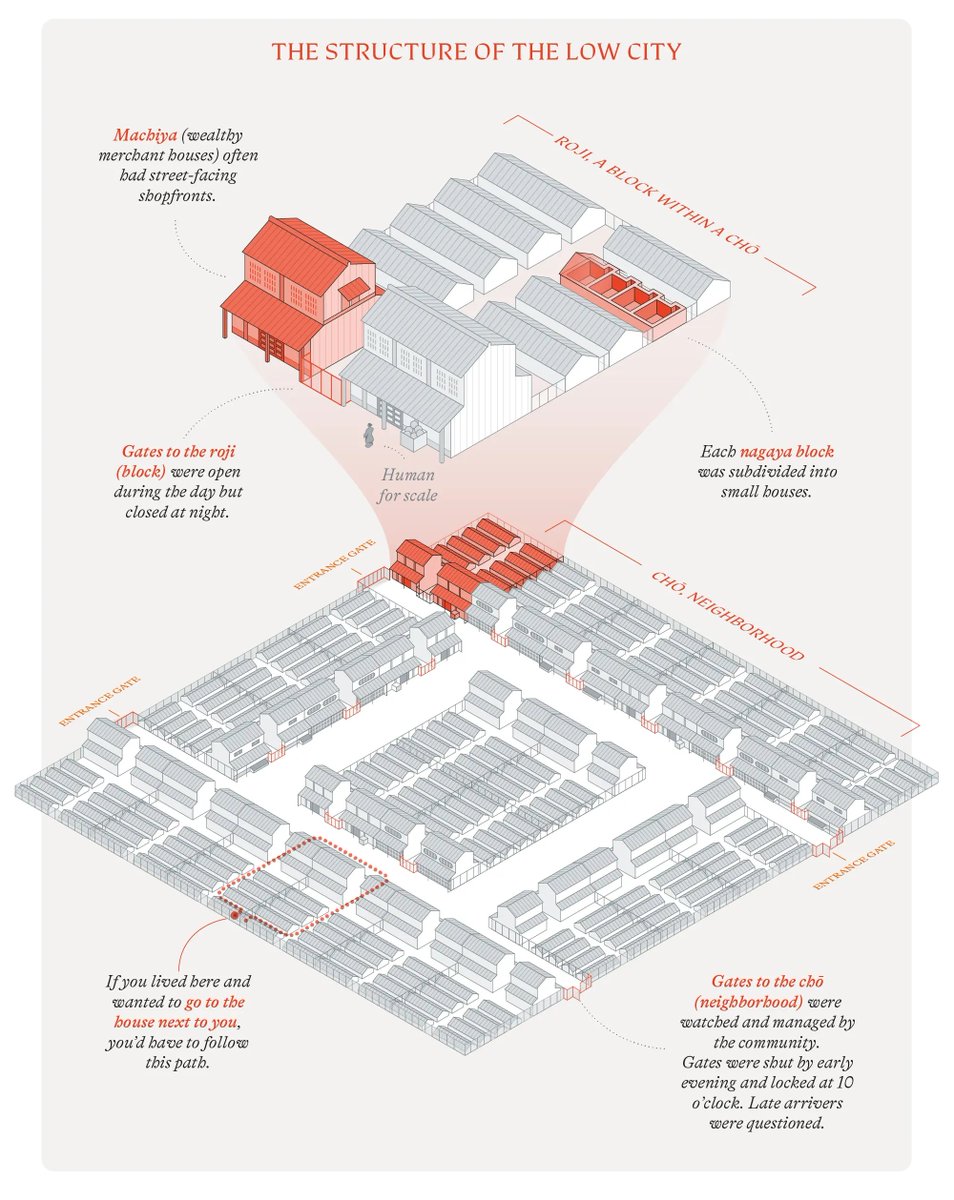
The commoner population was also tightly controlled. Commoner Edo was divided into some 1,500-2,000 fenced and gated blocks. These were then subdivided into gated alleys lined with small houses (see third map). The Low City was thus divided up by tens of thousands of internal checkpoints, all of which closed at night. Edo was not under threat of attack in the Tokugawa period and the city as a whole was not fortified. The purpose of this immense labyrinth of walls and gates was to control and monitor the movement of the population.
Prisons are useful things, and the Tokugawa system was a kind of success, making Japan the most peaceful society on earth. But it is also a disconcerting reminder of the power of rent-seekers, and how a whole city can be warped by the political exigencies they create. Edo is a particularly striking case of this, but it is far from alone.
Why things will eventually fall apart:
1. Everybody, even Google, seems to be treating AI as if it were some kind of winner take all competition like web search was, in which Google taking over 95%
2. But everybody is building essentially the same technical solution with essentially the same data, so there is no moat.
3. If there is no moat, nobody is going to take 90% of the market.
4. With no clear winners, nobody can charge monopoly prices; instead, you get price wars and commodity pricing.
5. Which means everybody will wind up overpaying compared to the modest profits they will be able to make in an intensely competitive regime.
Am I missing something?
AI bubble highlights
Anthropic :“Hey guys please
lend us money.”
Debt Financiers: “Great let’s see the numbers.”
Anthropic: “We would rather not!”
Ends well.
Documenting the headwinds I now see for AI.
It won't seem like it, but I love AI and am long-term positive. But when "math doesn't math" I take note.
1. The core thesis for foundation model lab investment has been high upfront investment made worthwhile by significant long-term profits.
2. These are capital intensive businesses and the compute commitments are very high relative to revenue and require strong growth over long time periods. The "leverage" (commitments versus revenue) is extremely high.
3. The fundamentals are not as positive as they previously were:
• Input costs are higher (commodities, chips, power)
• Interest rates are higher
• Competition is more intense
• Scaling Laws are now problematic: exponential costs/power cannot continue
4. Forecasting compute spend is challenging and high risk due to (a) revenue uncertainty and (b) algorithm uncertainty
5. Revenue growth appears to be slowing. The technology is valuable, but ROI is proving to be more expensive and take longer than anticipated.
6. The future is likely "different models for different use cases" with the lower end of the market being highly competitive.
7. Core use cases such as agentic software engineering are likely to need approaches beyond next-token prediction. They are Σ₂ᴾ complexity problems requiring multi-objective optimization and likely a combination of Transformers and other methods.
8. Current forecasts in memory makers are built largely on quadratic attention. That will not persist: we are already seeing work from DeepSeek, Minimax and Nvidia that can cut RAM needs by 80% or more.
9. This means semiconductor valuations are substantially overinflated and will go through the traditional glut versus shortage cycle.
10. For foundation model providers: lower costs with competitive differentiation is good. However, lower costs with a lack of differentiation would mean lower revenues. This makes it harder to (a) service commitments and (b) pay back investors.
11. Leverage is substantially higher than in previous cycles, evidenced by leveraged ETFs, call option activity and margin loans. Korea is particularly susceptible.
12. 0DTE options create a profile that has stronger parallels to portfolio insurance and 1987 than any other point I can remember.
13. The combination of exponential increases in call activity coupled with the ties of semiconductors to structured products means there is a non-trivial systemic risk to the financial system.
14. Implied earnings growth rates are inconsistent with other periods in history.
15. Macroeconomically we cannot and should not fund exponential cost increases. History has shown us repeatedly that there are better ways (see Quick Sort and Simplex).
16. Significant supply is hitting the market via IPOs.
––
Taken together: costs and competition are increasing while revenue growth is likely slowing. Valuations are fragile and prone to technology disruptions that are already here. Systemic financial market risk is extremely high.
At first glance, it looks like a group of fluffy kittens crossing the road. But in reality, these are Pallas’s cats, also known as manuls — one of the rarest and most elusive wild cats on the planet.
I ordered one pancake in America. The waitress wrote it down and said, "one short stack."
Short. I am a small and humble man. A short stack sounded perfect for me. I waited with a calm heart.
She returned carrying three pancakes, each the size of my face, stacked into a tower, with a block of butter on top sliding down the sides like slow lava.
This was the short one. I did not dare ask what the tall one looked like. Some knowledge a man is not ready for.
I ate for forty minutes. I was not full. I was afraid. The tower did not shrink. I am fairly sure it was growing back faster than I could eat it.
I had to surrender. I left half. In Japan, leaving food is a deep shame. So I leaned in close and apologized to the pancakes directly, in a low voice, one by one.
The waitress asked if I wanted a box. I did not know food could be taken into custody. I declined. I did not want it following me home.
In America, is the short stack truly the small one?
I need time to prepare my spirit before I ever face the tall one.
Carlos Whittaker did a 7.5-week no-screen experiment and the results are wild.
No phone. No TV. No laptop. No watch. Nothing. He even got his brain scanned before and after by a neuroscientist.
The outcome? His cerebellum healed years worth of damage in just seven weeks. His cognitive memory score jumped from the 50th percentile to the 99th percentile of adult men in America. He said he felt like a completely different human, sharper, clearer, more alive.
This one stopped me in my tracks. I’ve been feeling the scroll fatigue hard lately, and hearing someone actually measure the difference with real brain scans is next-level motivating.
Our constant screen exposure might be doing more quiet damage to our brains than we realize. Sometimes the simplest reset (doing less) creates the biggest upgrade.
Have you ever done a serious digital detox? Would you try one this extreme?