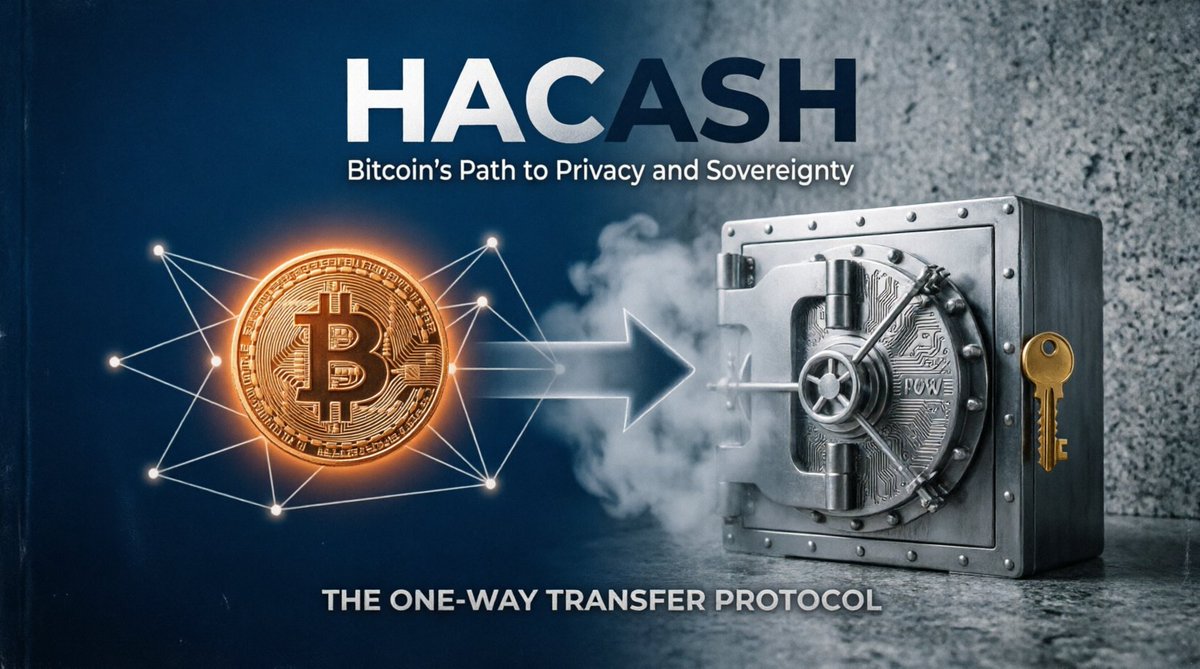
Let me explain the $BTC one-way transfer to #Hacash in the simplest way possible.
Imagine you have Bitcoin. You love Bitcoin. But you also wish Bitcoin could do more like send instantly, or use in apps, without waiting ten minutes per transaction or paying high fees.
#Hacash offers a way to do that. But it works differently than anything you've seen before.
Here's how it works, step by step.
You take your Bitcoin and send it to a special address on the Bitcoin network. This address isn't controlled by any person, company, or group. It's generated by math. No one knows the private key. Not even the Hacash team. Once Bitcoin goes there, it cannot be moved again. That's why we call it a black hole address.
When Hacash sees that your Bitcoin has arrived and been confirmed on the Bitcoin network, it does something simple. It creates the same amount of BTC on the Hacash network. And it gives control of that BTC to you. Not a wrapped version. Not an IOU. Protocol-native BTC, secured by Hacash's consensus.
The most important part: you use the exact same private key you used on Bitcoin. If you control your Bitcoin with a certain seed phrase or wallet, that same key controls your BTC on Hacash. You don't need to learn a new system. You don't need to trust a new custodian. Your keys, your coins. Always.
And here's something else that matters: it becomes private.
On Bitcoin, every transaction is visible to everyone. Forever. Your balance, your sends, your receives all public. That's great for verification, but not always great for privacy.
Hacash is different. Transactions are pseudonymous by default. Your activity isn't broadcast to the world unless you choose to share it. You can verify your own transactions without exposing them to surveillance. You can prove what you need to prove, to who you need to prove it to, without revealing everything to everyone.
This isn't about hiding. It's about choice. Privacy by default. Transparency by choice.
Why does this matter?
Because now your Bitcoin can do things Bitcoin wasn't designed to do. It can move in less than a second. It can be used in applications without risking smart contract exploits. It can participate in DeFi without approving infinite spending or signing blind transactions. And it can do all of this without forcing your financial life into the public eye.
And none of this requires you to trust a bridge operator, a multisig wallet, a federated validator set, or an oracle. There is no middleman. There is no upgradeable contract that can be paused or drained. There is only code that runs exactly as written.
This is not a bridge in the traditional sense. Bridges usually work both ways. They let you deposit BTC and get wrapped BTC, then later redeem it. That back-and-forth requires trust. It requires validators. It creates attack surfaces. We've seen what happens when those bridges fail. Millions lost. Users left with nothing.
Hacash removes that risk by removing the return path. Yes, it's one-way. Once your BTC is on Hacash, it stays on Hacash. That's not a bug. That's the design. By eliminating the ability to pull BTC back through a smart contract, Hacash eliminates the ability for attackers to exploit that path.
Think of it like moving your gold from a public vault to a private, fortified vault. You can't easily move it back, but while it's there, it's safer, more usable, more private, and still entirely yours.
https://t.co/ZkJbmOUJg3
#Bitcoin #Hacash
$BTC $HACD
@Bitcoin@BitcoinMagazine@Davincij15
The first era of #cryptocurrency was defined by speculation, narrative-driven valuation, and fragile economic abstractions. It delivered awareness, but at the cost of reintroducing the very trust assumptions #Bitcoin was designed to eliminate.
That model has reached its limit. Phase 1 must conclude so Phase 2 can begin.
Phase 2 is not a continuation of hype.
It is a return to first principles: #Soundmoney
verification over delegation, architectural constraints over marketing, and sovereignty over convenience. #Hacash does not compete within the old paradigm.
It extends Bitcoin’s foundational thesis by removing the custodial, probabilistic, and opaque layers that Phase 1 normalized. Structural privacy, atomic settlement, and protocol-native ownership are not optional features they are mathematical requirements for a system that must endure.
#Hacash isn't the next trend. It's the end of trends.
https://t.co/KjThHiXlim
https://t.co/liIknfMb4v
https://t.co/GPtcRRqjCj
https://t.co/dXb6v30JjS
https://t.co/IaeG2UYfEY
In a speculative boom, attention is abundant and scarcity is cheap. In a shakeout, attention becomes scarce and only the strongest reasons for existence tend to remain. #Hacash
One of the most overlooked existential threats to blockchain networks is state bloat. As networks grow, the cost of running a full node increases, inevitably leading to centralization.
Hacash addresses this through innovative storage economics. By implementing mechanisms that price state usage accurately and incentivize the pruning of obsolete data, Hacash ensures that the network remains lightweight and accessible to independent validators. This is not just a technical optimization; it is a prerequisite for long-term decentralization.
The heavy lifting of global financial infrastructure requires a unified, robust, and scalable foundation. Hacash provides exactly that. By seamlessly integrating sound monetary policy, native account abstraction, trustless settlement, and sustainable storage economics into a single, cohesive protocol
To dismiss this architectural leap is to misunderstand the trajectory of distributed systems. The game has fundamentally changed, and Hacash is the deal.
https://t.co/KjThHiXlim
https://t.co/liIknfMb4v
https://t.co/IWTaB0SUKF
#Hacash #Bitcoin
$BTC $HACD
The game has changed.
No more meaningless cycles.
#Zcash owns privacy. #Hacash owns the rest.
If you don't see #Hacash building the entire financial stack , you're just an idiot. Wake up.
What #Zcash is optimizing for
#Zcash was built around one core innovation:
strong on-chain privacy
shielded transactions
zk-SNARK cryptography
fungibility through hidden balances and addresses
The big question Zcash asks is:
How can digital money be private?
What #Hacash is optimizing for
#Hacash asks a different question:
How can a monetary system evolve into a complete financial system?
Its focus is on:
monetary issuance
transaction programmability
financial settlement
asset issuance
exchange primitives
storage economics
account abstraction
Privacy is not the centerpiece of the architecture in the way it is for Zcash.
If you're looking for a simple way to build, test, and deploy apps, give @Replit a try. It's great for quickly turning ideas into working projects without dealing with complex setup.
@amasad#Hacash
That take confuses adoption with sovereignty.
Yes, S&P 500 companies will use blockchain. For inventory. Logistics. Contracts. Internal settlement. But they don't need decentralization. They need efficiency, compliance, and control.
The "next big thing" isn't which chain gets corporate adoption. It's which architecture holds when corporations fail.
https://t.co/IWTaB0SUKF
People keep asking: Why isn’t #Hacash pumping?
Let’s be clear: pumping is easy. Influencer deals. Wash trades. Hype cycles. Any team can fake momentum for a month.
But Hacash isn’t a shitcoin. It’s not an influencer scam. It’s not built on charts or charisma.
It’s building something #crypto has never seen. Most teams couldn’t do it not because they lack funding, but because they lack the depth. The math. The architectural rigor. The patience to solve what actually breaks.
Hacash doesn’t run on luck. It runs on some of the sharpest, most relentless minds in the space. Devs who don’t chase pumps they engineer constraints that hold when everything else cracks. NFA.
They can fork the repo. Copy the tokens. Rewrite the pitch. But they can’t fork 7 years of uninterrupted Proof-of-Work. Can’t copy verified history. Can’t shortcut time. Can’t fake constraints that only hold under real stress.
Even if they start today, they’re already behind.
The Three PoW-native coins (HACD store of value, BTC reserve, HAC flatcoin) all fairly distributed, no pre-mine, no VC allocation
https://t.co/KjThHiXlim
https://t.co/liIknfMb4v
$BTC $HACD $HAC
#Hacash #Bitcoin
Let’s be honest. Nobody puts their real net worth into something that can be wiped out in seconds.
#Bitcoin’s current setup is too exposed. Public ledgers. Custodial chokepoints. Slow settlement. Traceable wealth.
Bitcoin needs the one-way transfer.
Without it? We just keep running the same fake, meaningless pumps.
It the only thing that actually matters long-term.
$BTC $HACD $HAC