@om_patel5 Well you can make the same argument with the human brain just reduce it to its simplest function, the neurons depolarization and hyperpolarization. And that’s your goats moving and stopping.
@Wellutwt To be fair shit writing have been earlier, how Homelander expected to be considered to be a god and maintain that position if he was subdue by three supes in the previous season. Imagine if five supes attacked him at the same time 🤯.
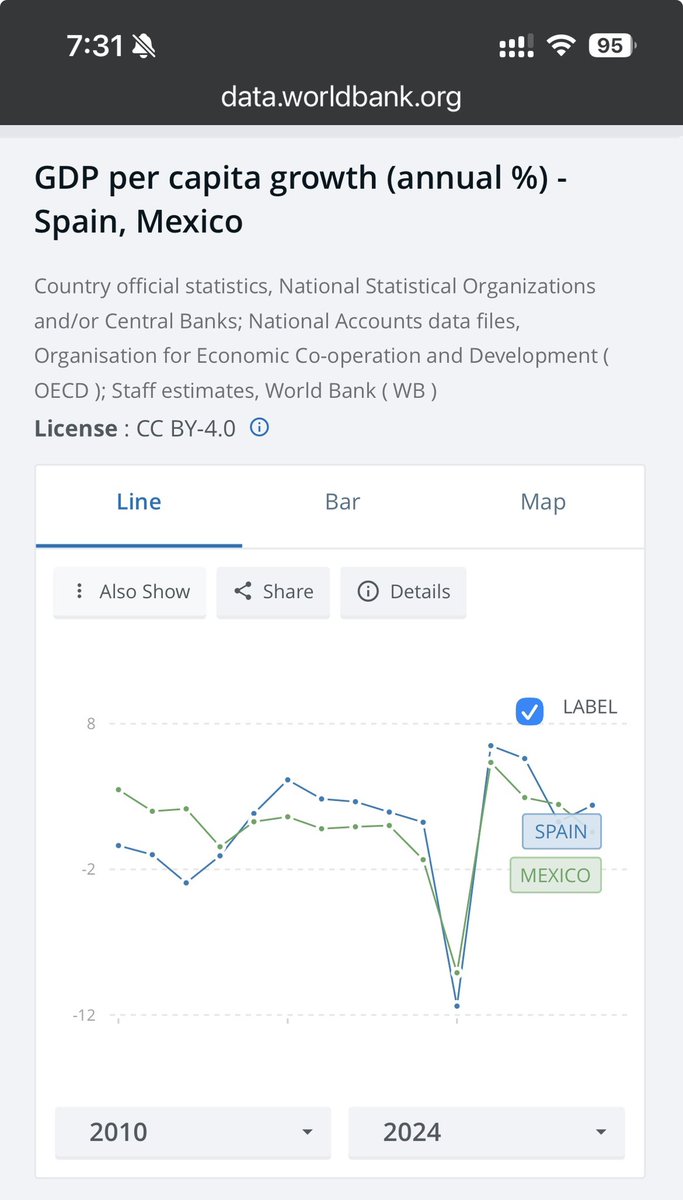
@alejandrogomezt In a low-growth country, stagnation becomes self-reinforcing: the population gets older, fiscal obligations grow, and the economy lacks the dynamism to absorb those costs.
We're saving science from ideological capture!
I am thrilled to announce a first-of-its-kind article type called “Peer Review” in the journal Theory and Society.
The journal's editor-in-chief, Kevin McCaffree, and I have been working on this for a while, and it was finally approved by @SpringerNature.
The idea is simple: publication should be the beginning of academic scrutiny, not the end of it.
A Peer Review article can critique a paper from any scholarly journal. It can address problems with methods, evidence, logic, definitions, theory, or interpretation. But it has to focus on the claims and arguments, not personal attacks.
Submissions are capped at 2,500 words and go through a straightforward merit review instead of endless gatekeeping and ideological screening. We ask just one basic question: Is this critique coherent, serious, reasonable, or even popular enough to deserve scholarly attention?
If yes, it gets published.
And the authors of the original paper get a built-in right of reply, so readers can see the critique and the response in a legitimate academic venue.
That’s how science is supposed to work!
Science becomes self-correcting only when real people build the mechanisms that allow correction to happen.
That’s what we’ve done.
Now it’s time for academics to use it.
🔗https://t.co/gqkDE79CO4
People are dismissing the new "Peer Review" paper category I helped create in an established Springer Nature journal on grounds that avenues for critique like "Letters to the Editor" at many journals exist.
This is extremely naive. While it's true that many journals offer such mechanisms for critique in theory, in practice they routinely ignore or reject robust critiques that question cherished progressive narratives.
This is especially the case for critiques of papers on "gender-affirming care" and sex spectrum pseudoscience.
Take a widely-cited 2023 paper in Integrative & Comparative Biology titled "Multivariate Models of Animal Sex: Breaking Binaries Leads to a Better Understanding of Ecology and Evolution."
This paper forwards a totally nonsensical view of sex as a "multivariate" spectrum. It is one of the most naive and confused papers I've ever read on the topic. Pseudoscience through and through.
I wrote a detailed critique of it on my Substack when the paper was only a pre-print. Shortly after, the "Multivariate Models of Animal Sex" paper was published in a well-respected peer-reviewed journal almost entirely unaltered. Since then, it has been cited nearly 100 times by major journals including Nature, Science, Cell, and many others.
It's easily the most influential paper pushing sex pseudoscience there is.
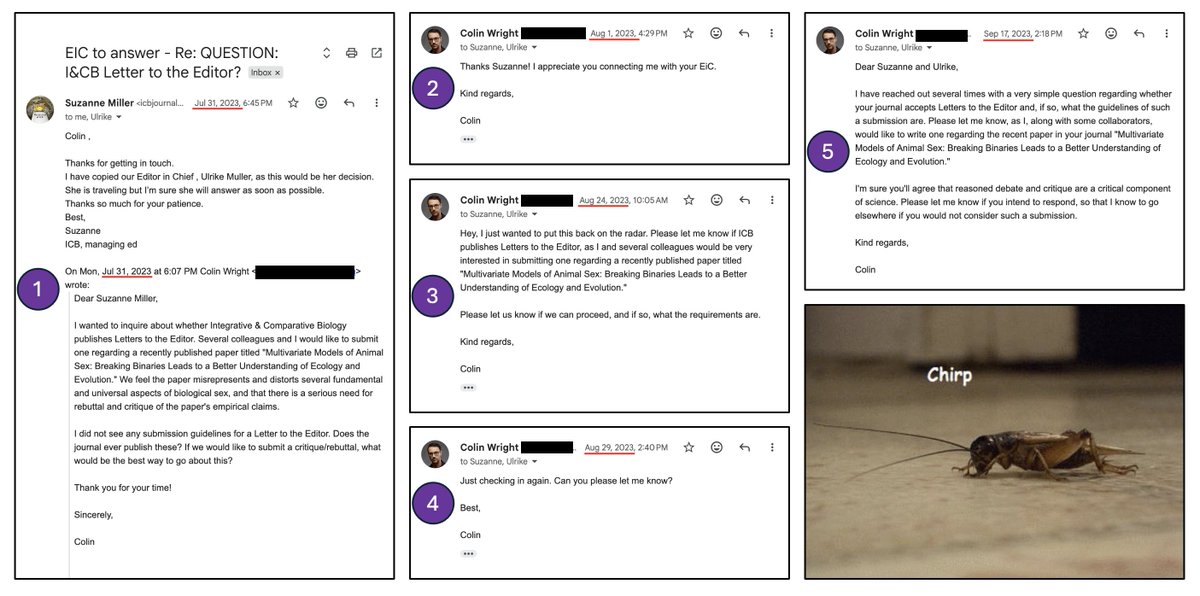
Shortly after it was published, I reached out to the journal's editors to inquire about submitting a Letter to the Editor with several colleagues. Their managing editor responded quickly and copied in the journal's Editor-in-Chief, who I was told would answer my question "as soon as possible."
Crickets.
I reached out several times over two months. My tone was totally professional. No response.
This is a totally typical experience for academics trying to use the approved, scholarly route for voicing disagreement or exposing conceptual and methodological errors in papers that support progressive views on sex and gender.
They get totally shut out.
Activists then point to the absence of scholarly critiques as proof that their critics are not serious scholars!
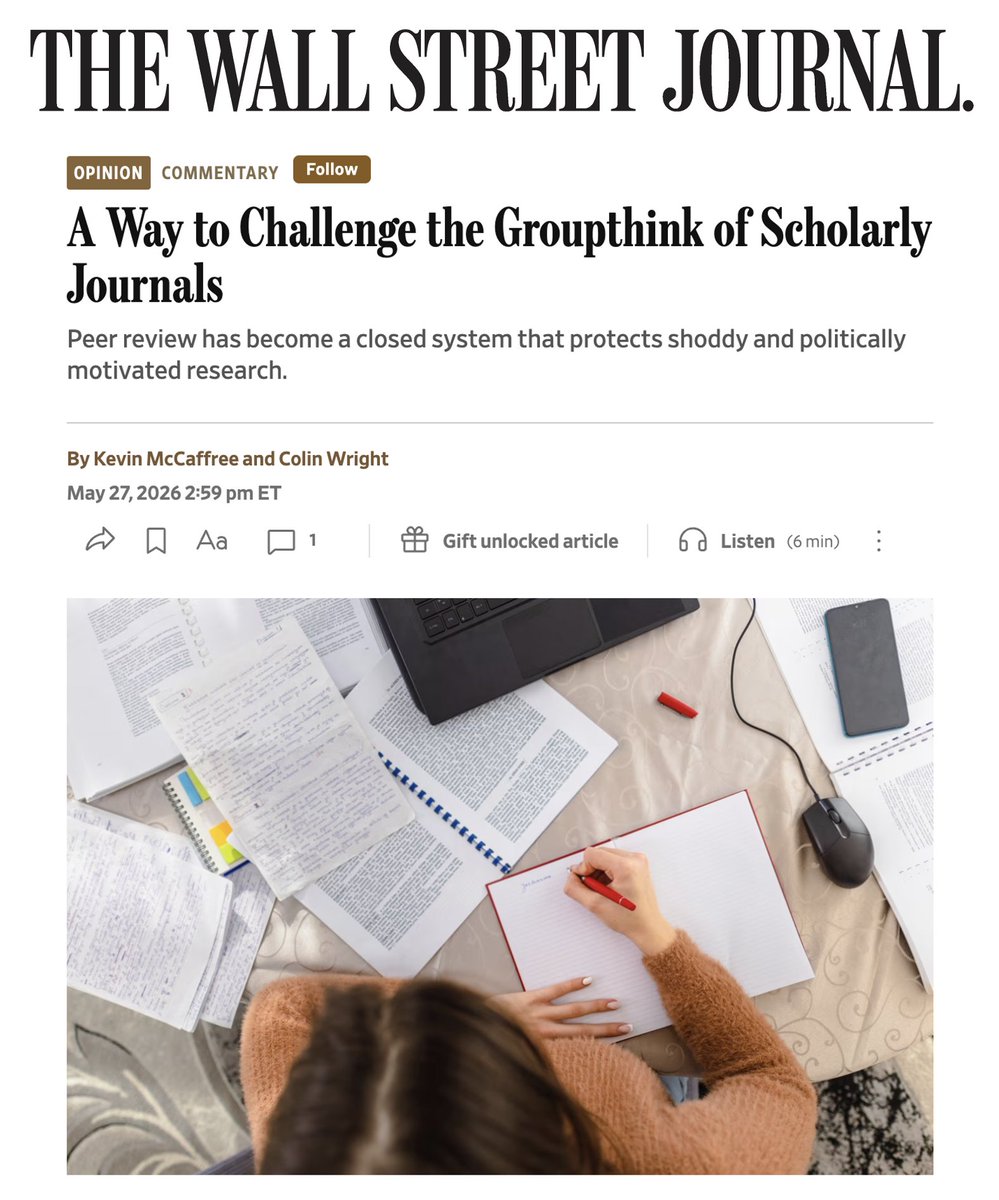
This is why most of my critiques on sex pseudoscience and gender medicine end up on my Substack or in the "Opinion" section of outlets like the Wall Street Journal.
Things ARE getting a bit better. Journals are increasingly willing to publish articles that question woke orthodoxy, but it's still a major challenge. We are still regularly met with silence. We have a long way to go.
The point of my initiative with Theory and Society was to circumvent the problem of ideologically captured journals that show no indication of lifting their viewpoint blacklist.
We can't simply wait around for these journals to wake up and do the right thing.
This is not just about journals publishing cartoonish papers of feminists marrying brine shrimp. These journals also publish fatally flawed "research" that's being used to justify performing irreversible procedures on healthy children that leaves them surgically altered and sterile.
Our new Peer Review article type ensures that robust critiques cannot be buried for ideological reasons. We're applying outside pressure.
Now, scholars and the public will be able to point to scholarly critiques, and the pseudo-consensus that has been manufactured on various topics will begin to erode.
I am currently writing my first Peer Review article for Theory and Society on the "Multivariate Animal Sex" paper mentioned above that the original journal refused to even consider.
Journals will still be able to ghost honest scholars, but they can no longer ensure their critiques won't see the light of day.
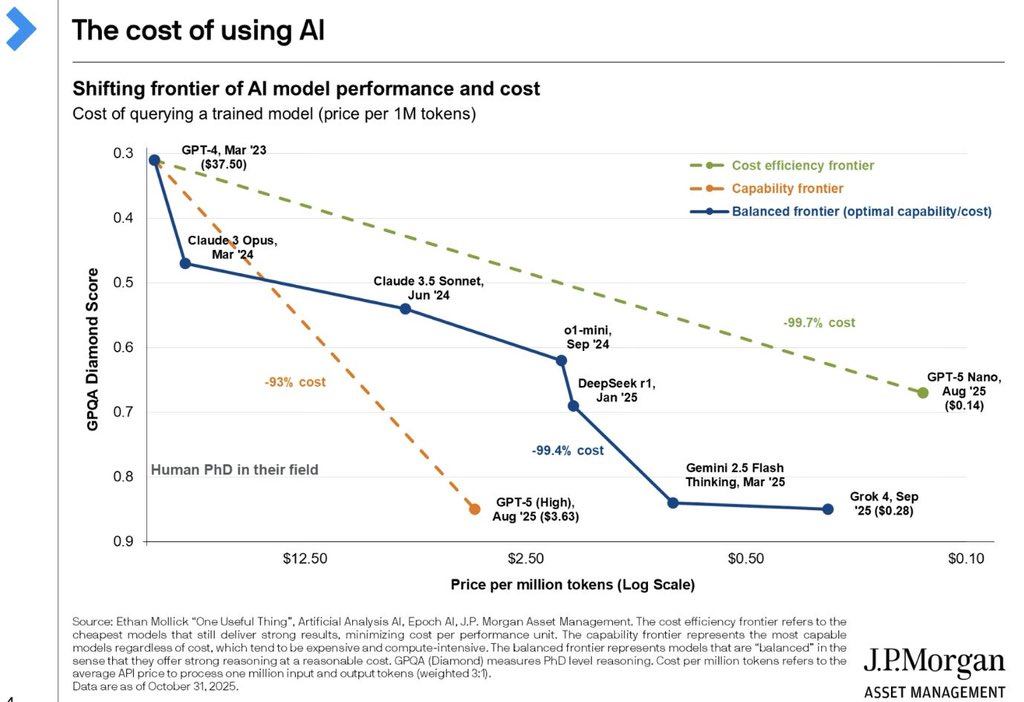
@EscanorReloaded@GMonroyEnergy That’s two easily fixable problems in the near future with local and open source LLMs and the declining costs of tokens.
@capTercio De hecho en el valle de México estuvieron más tiempo los españoles(alrededor de 300 años), que lo que estuvieron los mexicas en Tenochtitlán(alrededor de 200 años).
@speaking_beat@camilocayuqueo Por supuesto la presión y la responsabilidad que tiene un médico no se compara ni un poco con ser un empleado de McDonalds. Si se ganara igual yo escogería McDonalds siempre.
The European Commission literally just dropped a research on how to collect more taxes without making you angry enough to leave.
TLDR: higher wealth taxes, inheritance taxes + exit tax is coming
@GabySillerP@MaxKaiser75 “recuperar un crecimiento robusto y sostenido”, Gabriela la última vez que pasó eso fue en la época del milagro mexicano y creo que ni habías nacido.