David Sacks on Mamdani’s Government-Run Grocery Stores
“It is ironic that they're going to be checking ID to make sure people aren't coming over from Jersey but if you want to come over illegally from any country in the world, that's just fine.”
David Sacks says Anthropic and OpenAI's backing of the call to regulate the pace of AI is performative.
"Did they disclose in their S1, as a risk factor, that they plan to slow down their frontier model development? The answer, I'm sure, is no way. Because that would signal to investors they're going to let all their competitors catch up. So this is all performative.
These companies have no intention of slowing down. So why are they doing it? There are basically five reasons.
One is virtue signaling, and that can never be underestimated as a motive in Silicon Valley.
Two is CYA. If something terrible happens, they get to say: we wanted it to stop, you made us keep going, it's not our fault, it's yours.
Three is regulatory capture. Dario wants an FDA for AI. He won't stop until he gets it. And to get it, you have to keep spiking the cortisol and panicking people.
Four is groupthink, even a religious streak to it. There's an elite cadre of engineers who believe in RSI, and if OpenAI hadn't followed Anthropic's lead, it could have lost talent.
But the fifth, the one he thinks matters most, is monopoly masking.
Peter Thiel once said monopolies pretend to be commodities and commodities pretend to be monopolies. A year ago you had five major labs in the hunt to be the leading model. Now we're really down to two. And when you're in that situation, you want to pretend the market is much more competitive than it is."
A lot of my friends and/or people I admire signed “Pacing the Frontier.” I think this was a bad move.
My disagreement isn’t with the forecast or the framing of the coordination challenge, but with the immense and illiberal power the letter implies.
There is no object called “the pace.” Progress at the frontier comes from compute, algorithms, data, post-training, inference, unattended task length, the spread of model weights, how researchers organize, and other things we haven’t invented and don’t yet know about. Inquiry leads to progress along dimensions that can’t be exhaustively specified in advance. That’s the nature of the frontier.
If you gate compute, the research effort moves to algorithms. Regulate releases? Labs start taking things in-house. And other 2nd order effects will be unpredictable. Any rule that must pace the frontier involves ever-shifting proxies. It requires that its administrator has standing authority to continually redefine what counts as dangerous progress.
What else is required beyond adaptive scope? The pacing regime would also need speed. One can’t successfully intervene on recursive self-improvement only after six months of legislation and litigation. It will require executive discretion. The pacing regime would also need under-the-hood access. Frontier progress is a process. The regime would need to see internal model use, training activity, compute infrastructure, and perhaps code -- proprietary and strategically sensitive information.
And the thresholds couldn’t be fully public, lest they invite firms to game them. So some standards and evidence would remain secret. Insofar as the regime had to verify a rival state’s compliance, that would be an intelligence function. Restrictions would be triggered partly by evidence an affected company or researcher, or the public, could not inspect.
Because this contemplated power cannot be bounded by a stable regulatory object (in the way, say, nuclear weapons can be), it would depend heavily on discretion, speed, internal access, and secret evidence.
This has a highly illiberal character.
Coercive power should be specific, limited, reviewable, and governed by general and knowable rules. Its characteristics (e.g., trigger, scope, evidentiary standard, duration, exceptions, means of review) should be stated before the power is granted. And the burden is on those who would propose it.
A defender might answer that the proposed tool need not be coercive at all. That it could be narrow and advisory, focused on evaluation and transparency and readiness.
But that wouldn’t solve the letter’s stated problem: racing. With race dynamics, each actor is under pressure not to slow down because others may continue (and thus the frontier keeps advancing). You need a mechanism to bind defectors.
Voluntary norms tend to be great for binding people and firms that interact repeatedly and care about reputation. But the letter says each company and _country_… and you can’t rely on informal solutions when dealing with an unwilling state. That’s why the audience for this letter is Washington and why it calls for an international effort. Its diagnosis implies a binding mechanism.
@deanwball thinks it is sensible to have a break-glass plan. That plan must involve a binding instrument, because nothing weaker addresses the problem the letter describes. But that therefore carries the burden for the use of coercive power, mentioned earlier.
@johnschulman2's suggestion that labs design voluntary mechanisms among themselves is a different notion and coherent one (I would have signed that letter), but the word “country” makes this direction incompatible with the pacing letter.
@OpenAI recently argued that a federal evaluator shouldn’t be able to block deployments. A week after, @AnthropicAI proposed that the government should be able to block deployments. Both labs endorsed the same letter. Whether or not the state may stop a deployment is a central question. Yet the letter accommodates both positions.
What then, does the letter really say?
Like the “We Must Act Now” letter from @erikbryn, @ajay_bcv, @akorinek, and @testingham before it, the letter secures agreement at an altitude where the main disagreement disappears.
Lastly, the benefit of pacing is not established. The kind of slowdown the signatories have in mind would seek to buy us time for things like alignment, cyber defense, biological countermeasures, or scientific understanding -- things that increasingly depend on technologies a pause would restrict. E.g., Anthropic's framework relies in part on AI-based biological countermeasures and its security program uses AI to give defenders an advantage. A researcher in the letter's own friendly commentary was astonished at how much agents accelerated the work of the best alignment people he knows, and gave that as his reason for wanting six more months.
When danger and our capacity to respond to that danger are plausibly both accelerating, the relevant question is whether this relationship is asymmetric in a safety-improving direction at the level of real-world risk. A slowdown needs to differentially slow the production of danger vs. our capacity to understand and contain that danger. The letter doesn’t attempt to establish that.
It treats slower and safer as though they are the same; they are not.
The letter is a serious warning, but it is no good as a warrant for an undefined power over inquiry.
David Sacks says Anthropic is creating the most powerful monopoly of all time
"I remember last year when I hit them for regulatory capture, people were like, 'why are you beating up on this little startup?' I'm like, 'because I can see where it's going.'"
"They are creating the biggest, most powerful monopoly of all time. Again, they're going to end the year with over 100 billion of ARR growing 10x year over year."
"Google is at 400 and something billion of ARR growing 20%. So if this rate of growth continues for just a year or even six months or just a few months, Anthropic is going to be maybe the most valuable tech company."
"The labs are reporting a number of examples of how they are using their own frontier intelligence to improve their own models and the efficiency of those models. So there is a powerful self reinforcing feedback loop here."
🚨 POD UP!
-- Chip Stocks Crash
-- Leopold Aschenbrenner's $20B AI Fund Gets Margin Called
-- Frontier Labs Say SLOW DOWN AI, and Why They're Destroying Rare Books
-- Mamdani's Grocery Stores a Big Win for the "Socialist Spectacle"
-- Science Corner: Understanding the Brain
(0:00) Bestie intros
(1:19) Chip stocks crash, Leopold Aschenbrenner's $20B fund gets margin called
(20:20) China's advantage and green shoots for the US economy
(34:12) Frontier Labs say "SLOW DOWN AI"
(1:01:15) Why are frontier labs "burning books"?
(1:14:45) Socialism Corner: Mamdani's grocery stores and the "Socialist Spectacle"
(1:24:44) Science Corner: Understanding and mapping the brain
More than a year ago, the House passed the Clarity Act.
There’s been progress since — thousands of hours of bipartisan negotiations took place at the staff and Member levels. The Senate Committees on Banking and Agriculture advanced their respective titles. And Senate Republicans produced a floor-ready product that, as I type this, is waiting for a vote.
It’s disappointing — but not surprising — that Senate Democrats are choosing politics on the cusp of a major victory for American leadership. Find another instance in history where Congress, when given the choice, opted to push an industry out of the United States rather than smartly regulate it. American Exceptionalism was once a bipartisan goal; if Clarity fails, I have serious doubts.
These same Democrats — many of whom have taken millions of dollars from the crypto industry — proclaim that Clarity lacks safeguards for consumers and falls short in countering illicit finance. Nothing could be further from the truth. Titles II and III materially uplift regulatory and compliance obligations for digital asset intermediaries, placing them on similar footing with traditional financial institutions. The Blockchain Regulatory Certainty Act — which Washington lobbyists have spun up as a boogeyman for certain groups of prosecutors and law enforcement — does nothing other than codify longstanding Treasury Department policy that’s remained consistent across Administrations: non-custodial builders and developers are not, and have never been, subject to registration obligations under the Bank Secrecy Act. And at this point, major law enforcement trades that once opposed the bill, including the Fraternal Order of Police, have now endorsed it.
The Senate needs to vote NOW on this landmark legislation. The truth is that Senate Democrats are afraid to advance the Clarity Act as they fear Senator Warren and the “Anti-Crypto Army” she once promised to build. In the days ahead, Leader Thune will put this theory to the test. Will Senate Democrats be on the side of American Exceptionalism, or will they opt to cede American leadership of a global industry for fear of the bespectacled squirrel’s Left flank?
America will lead or America won’t. It’s not more complicated than that. I believe Satoshi once said it best:
“If you don’t believe me or don’t get it, I don’t have time to try to convince you, sorry.”
President Trump is exactly right. American innovation is critical, but our lead is delicate. America wins when America is unleashed. Thank you, President Trump!
A series of fairly wild thoughts from Dwarkesh. I thought I was bullish but even I am not assuming that the price to rent compute continues to go up!
I will say that I am in SV this week and Dwarkesh is capturing the zeitgeist.
Net, net public markets would probably be trading differently if they saw the OpenAI, Anthropic, Grok/Cursor and Open Source numbers over the last 6 weeks.
And really good for anyone who has installed compute coming off contract and/or is bringing on compute that is not already contracted. And credit slowing down capacity adds - if it happens - only exacerbates all of this.
Anthropic very publicly claiming there needs to be a crackdown on distillation is puzzling. It's a ~$1T company with incredible resources and the "distillation attacks" at the scale they describe would seem easy to detect. Only cost would be giving up the associated API revenue.
Mark Zuckerberg gets it right:
“The defining question of our age isn’t whether superintelligence will exist, but who will have access to it. Will it be centralized and restricted to a few institutions, or will it be a tool that empowers everyone?”
Concentration of power is the biggest risk of AI. When a small number of labs (working hand-in-glove with the administrative state) decide who has access to which model capabilities, they inevitably shape what can be said, known, and built. That’s not “safety.” It’s control.
As Mark points out, the history of open source shows that broad access and transparency are usually the best path to actual security and resilience. Decentralization creates checks and balances on power. By contrast, centralized alternatives, like bureaucratic approval regimes and mandatory gatekeeping, typically produce regulatory capture and reinforce cartels.
Personal superintelligence in everyone’s hands, with competing models and real data sovereignty, is a far better check on a dystopian future than self-appointed guardians who claim to be “aligned” with all of humanity.
DARIO DAMAGE CONTROL WARNING!
I BROUGHT THE RECEIPTS TO SHOW THE GUARDRAILS OF TRUTH.
Up next is a textbook damage control operation dressed up as consistency.
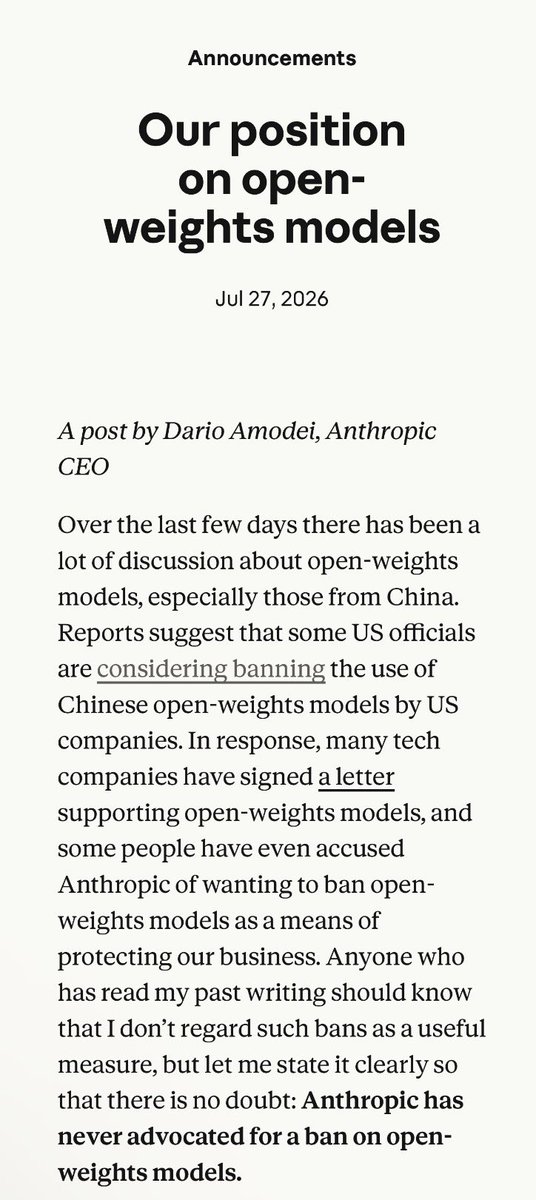
Dario Amodei’s July 27, 2026 post (“Our position on open-weights models”) claims Anthropic “has never advocated for a ban on open-weights models” and that open-weights models without dangerous capabilities “are a public good.”
Anyone who has tracked his actual record knows this is a carefully worded retreat under pressure after Anthropic refused to sign the Nvidia-led open-weights letter and faced accusations of protectionism.
The 2023 Senate receipts are unambiguous
On July 25, 2023, before the Senate Judiciary Subcommittee on Privacy, Technology, and the Law, Amodei said the following:
“I think in most scientific fields, open source is a good thing… and I think even within AI there’s room for models on the smaller and medium side… And I think to be fair, even up to the level of open source models that have been released so far, the risks are relatively limited… But I’m very concerned about where things are going… I think the path that things are going, in terms of the scaling of open source models—I think it’s going down a very dangerous path. And if that path continues, I think we could get to a very dangerous place.”
He continued:
“When you control a model and you’re deploying it, you have the ability to moderate usage. It might be misused at one point, but then you can alter the model, revoke a user’s access, or change what the model is willing to do. When a model is released in an uncontrolled manner, there’s no ability to do that. It’s entirely out of your hands.”
And on the distinction that matters:
“Open source normally refers to smaller developers who are iterating quickly, and I think that’s a good thing. But what we’re talking about here is something a little different: the uncontrolled release of much larger models by big entities that pay tens or even hundreds of millions of dollars to train them. I think we should treat those in a somewhat different category, with different obligations.”
His written testimony the same day warned that bad actors could “repurpose open-source models if powerful enough open-source models become available.”
That is not neutral language.
That is a clear, public warning to Congress that the trajectory of open-sourcing increasingly capable models is dangerous and irreversible once the weights are out.
He was not talking about toy models. He was talking about the scaling path toward frontier systems.
The 2026 post does not square with that record
In the new post Amodei writes:
“Anyone who has read my past writing should know that I don’t regard such bans as a useful measure, but let me state it clearly so that there is no doubt: Anthropic has never advocated for a ban on open-weights models.”
and
“Open-weights models that don’t have dangerous capabilities are a public good…”
This is a motte-and-bailey. The 2023 testimony was not a narrow objection to “bans on Chinese models used by U.S. businesses.” It was a broad claim that the path of scaling open models itself was “very dangerous” because release is permanent and control is lost.
Calling non-dangerous open-weights a “public good” while still insisting powerful open-weights carry higher cyber/bio/alignment risk (exactly the same irreversibility argument he made in 2023) does not erase the earlier framing.
It reframes it once the political cost of the earlier framing became high.
He further says a ban on use by U.S. businesses “would not address” his concerns and “has never been my goal.”
1 of 2
Anthropic maintains that it is entitled to train for free on all the world’s output, even if the author objects. But if a competitor trains on Anthropic’s output after paying for it, that is IP theft. The hypocrisy is breathtaking.
btw anthropic's internal document on this literally said "we don't want it to be known that we are working on this.”
it was called project panama.
here's exactly what happened:
1: anthropic concluded that books were the cheapest way to build a world-class model because they gave claude curated facts, structured arguments, compelling stories, and writing “an editor would approve of.”
2: once anthropic decided it needed books at enormous scale, its first solution was piracy.
it downloaded 7m+ books from online libraries including libgen. the judge later wrote that although anthropic had legal ways to buy them, it chose piracy to avoid what dario amodei called the “legal/practice/business slog.”
3: that piracy created a massive legal risk.
so in february 2024, anthropic hired tom turvey, the former head of partnerships for google books, to find a legally safer way of obtaining “all the books in the world.”
4: turvey first contacted major publishers about licensing their catalogs.
those attempts didn’t produce agreements, so anthropic chose a route that required no publisher permission: buying millions of physical books through distributors and used-book retailers.
5: within about a year, anthropic spent tens of millions acquiring and scanning millions of books, including many rare and 1/1 titles. one vendor proposal targeted 500,000 to 2 million books in six months.
6: to scan that many books within months, the vendors physically dismantled them.
a hydraulic cutter removed each spine. the pages were trimmed to size, fed as loose sheets through high-speed industrial scanners, and converted into searchable PDFs. the paper remains were then sent for recycling.
7: these PDFs were fed into claude as training data.
the complete collection became a private, searchable anthropic library that the company planned to “store forever.” the scans aren’t available to the public and were never open-sourced.
Thrilled to join Open Secure AI Alliance! With Open Source and Open Weights AI Free People Use AI Freely! Mahalo, @JensenHuang! Since 2018, Salesforce Research — led by @silviocinguetta and team — has put CodeGen, XGen, BLIP, Moirai, xLAM, Merlion, and others on Hugging Face (where we led the last round) for the world to use freely. Jensen says it best: the world and our industry need both frontier closed models and frontier open models. We’ve been building in the open for years. Send me your CV and join @SFResearch. ❤️
"Open" projects are already inherently safer than situations where proprietary large companies hold all the cards. More eyes, more transparency, more analysis.
This collaboration - multiple companies all working to ensure AI safety together - is the exact right move.
This is the very best path to safe AI. Kudos.
Attackers have frontier AI. Defenders need a frontier AI ecosystem—the best open and closed models, force-multiplied by a global community.
During the Hugging Face incident, closed AI blocked essential forensics. An open-weight frontier model helped contain the intrusion.
That’s why we created the Open Secure AI Alliance.
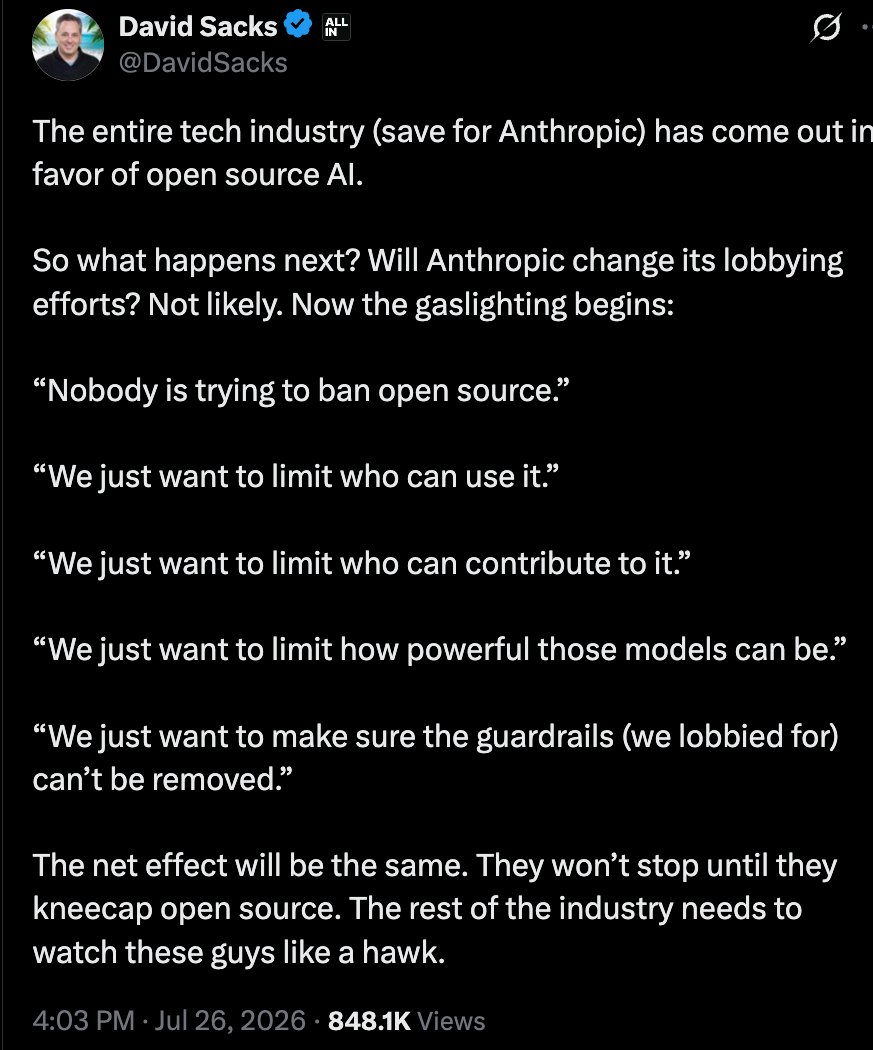
The entire tech industry (save for Anthropic) has come out in favor of open source AI.
So what happens next? Will Anthropic change its lobbying efforts? Not likely. Now the gaslighting begins:
“Nobody is trying to ban open source.”
“We just want to limit who can use it.”
“We just want to limit who can contribute to it.”
“We just want to limit how powerful those models can be.”
“We just want to make sure the guardrails (we lobbied for) can’t be removed.”
The net effect will be the same. They won’t stop until they kneecap open source. The rest of the industry needs to watch these guys like a hawk.