Complexity ? it seems that the same can be said about how much of the brain “algebra” (spiking) & else we already know and how much we still ignore of large scale emergent brain “function”
Terence Tao told me something that is both clarifying and unsettling about large language models.
The mathematics underlying today’s LLMs is not especially exotic.
At its core, training and inference mostly involve linear algebra, matrix multiplication, and some calculus.
This is material a competent undergraduate could learn. In that sense, there is very little mystery about how these systems are constructed or how they run.
And yet the real mystery begins there.
What we do not understand well is why these models perform so impressively on certain tasks while failing unexpectedly on others. Even more striking, we lack reliable principles that allow us to predict this behavior in advance.
Progress in the field remains largely empirical. Researchers scale models, change datasets, run experiments, and observe what emerges.
Part of the difficulty lies in the nature of the data itself.
Pure randomness is mathematically tractable.
Perfectly structured systems are also tractable.
But natural language, like most real-world phenomena, lives in an intermediate regime. And we humans hate that liminal space!
It is neither noise nor order but a mixture of both. The mathematics for this middle ground remains comparatively underdeveloped.
So we find ourselves in a peculiar position. We understand the machinery, yet we cannot reliably explain its capabilities. We can describe the mechanisms that produce these systems, but we cannot predict when new abilities will appear or how performance will vary across tasks.
That tension, between relatively simple mathematical tools and highly unpredictable behavior, is the central puzzle of modern AI.
(Video link in comments)
A Stanford mathematician spent 40 years watching brilliant students fail at hard problems.
Not because they were stupid.
Because nobody taught them what to do before they started solving.
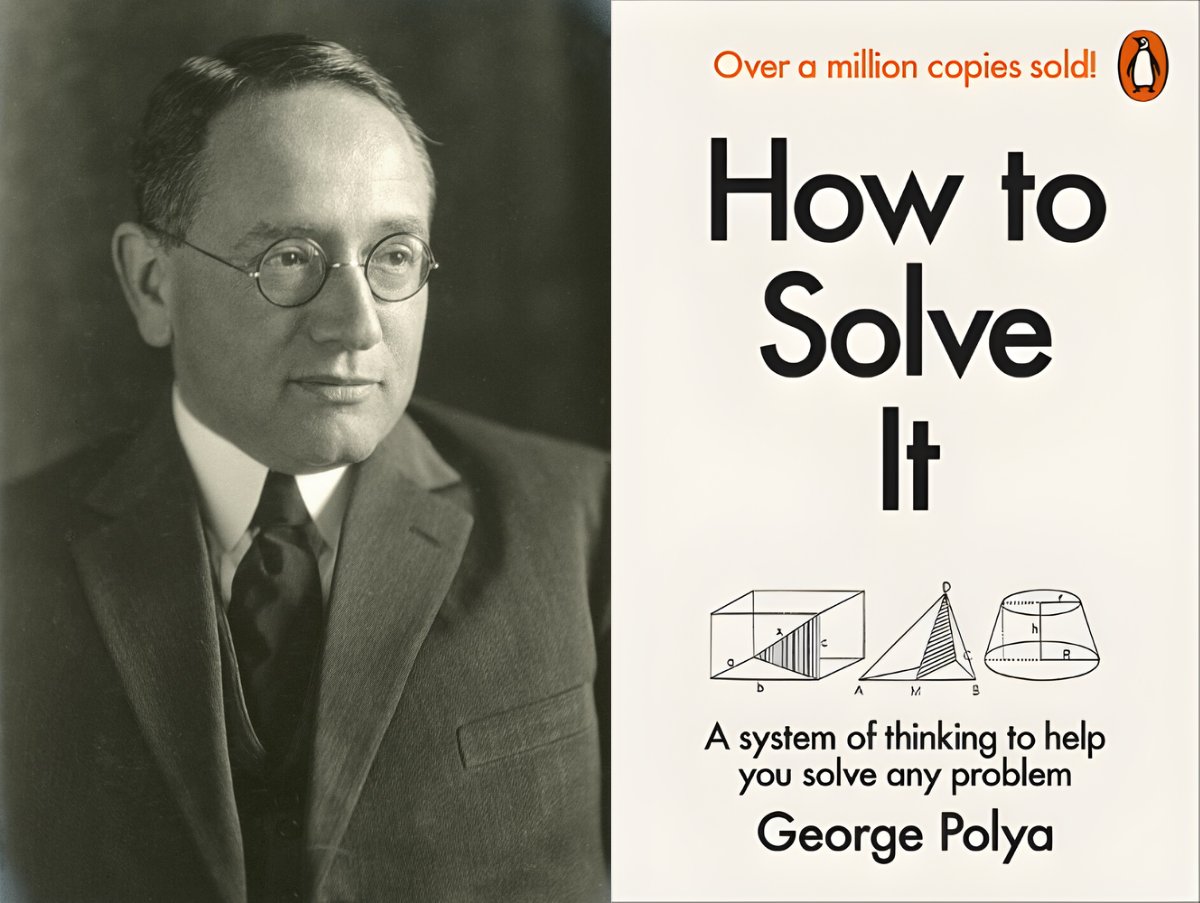
His name is George Pólya.
His 1945 book has sold over a million copies and never gone out of print.
Marvin Minsky, the man who built the first neural network machine at MIT, said publicly that everyone should read it.
Most people have never heard of it.
The failure Pólya watched repeat itself for four decades was always the same.
A problem appears. The student feels anxiety. They immediately start calculating.
Not because calculating was the right move. Because it felt better than sitting with not knowing.
The calculation was almost always wrong.
Not from lack of skill. From lack of understanding what was actually being asked.
He called it the most neglected step in all of problem solving.
Step one is to understand the problem. Not skim it. Not assume you've seen something similar. Actually understand it.
His filter was one question: can you restate the problem in your own words without looking at it?
If you can't, you haven't understood it. You've only read it.
Most people skip this and spend hours stuck on a problem they never actually understood.
Step two is to make a plan. Not execute. Plan.
The pattern Pólya saw in every successful problem solver was the same. When something feels impossible, find a simpler version and solve that first.
Not because the simpler version is the goal. Because it gives you a method you can carry back.
He phrased it once with precision: if you cannot solve the proposed problem, try to solve a related one.
That question alone is worth more than most problem-solving courses ever taught.
Step three is to execute. Everyone thinks this is the whole game.
It is the third of four steps. Pólya spent the least time on it because it is the most obvious. Once you understand and have a plan, execution is mostly patience.
Step four is the one almost nobody does.
Look back.
Not to check the arithmetic. To ask: can I verify this with a different method? Can I use this method somewhere else? What would I do differently?
This is where the real learning lives.
Every expert Pólya studied had this habit. Every struggling student skipped from the answer to the next question, carrying nothing forward, starting from zero every single time.
His deepest insight was not a technique. It was a diagnosis.
Intelligent people feel bad at problem solving because they confuse reading a problem with understanding it. They confuse starting to work with having a method. They confuse getting an answer with having learned anything.
These are not the same things.
The students who get genuinely good at hard problems are not the ones who practice more.
They are the ones who slow down at the two moments every instinct tells them to rush.
The beginning and the end.
The problem was almost never as hard as it looked.
They just hadn't understood it yet.
In 1980, two years before Feynman's famous Caltech lecture on Quantum Computing, a 43-year-old Soviet mathematician named Yuri Manin published a slim 128-page popular-science book called Вычислимое и невычислимое — Computable and Noncomputable — through the Moscow publishing house Sov. Radio. Manin was not a computer scientist. He was already one of the great algebraic geometers of his generation: a Lenin Prize laureate (1967), professor of algebra at Moscow State University, principal researcher at the Steklov Mathematical Institute, the mathematician behind the Gauss–Manin connection and the Mordell conjecture for function fields. He had been forbidden from foreign travel since 1968. The book was written in Russian, never officially translated for nearly thirty years, and its argument about quantum computation took up barely three pages of the introduction...
https://t.co/pOZ0460JWB
What's striking about Manin's framing — and what got almost entirely lost when the Western quantum computing canon formed around Benioff, Feynman, and Deutsch — is the direction of the argument.
Feynman's 1982 case for quantum computers was pragmatic and engineering-flavored: classical machines can't efficiently simulate quantum systems, therefore we should build quantum machines that can.
Manin came at it from the opposite end. He looked at molecular biology — at protein synthesis on messenger RNA, at the absurd information density and energetic efficiency with which living cells perform what looks structurally like Turing-machine computation — and concluded that nature had already solved the problem. Classical physics, he argued, simply cannot account for what biology does. The mathematical theory of quantum automata must already be implicit in the substrate of life. Engineering quantum computers wasn't the goal; it was the obvious downstream consequence of taking biology's existence-proof seriously.
That places Manin in a different intellectual lineage than the one quantum computing eventually inherited. He was downstream of Schrödinger's What Is Life? (1944) and the broader Soviet tradition of treating life as a physical system whose laws had not yet been written — Vernadsky, Lyapunov, the cybernetics revival under Berg and Glushkov.
The West built quantum computing as an engineering discipline of qubits-as-fabricated-systems, and pushed biology off into a separate and often-dismissed sub-field called "quantum biology."
Forty-five years later, with the work emerging on microtubules, tryptophan networks, ordered water, and coherent processes in neural lattices, the field is, in a real sense, finally catching up to its own actual origin.
The translation below is from pages 13–15 of the introduction.
On the inefficiency of computing devices
Molecular biology provides examples of the behavior of natural (not human-engineered) systems which we are forced to describe in terms close to those accepted in the theory of discrete automata. The figure below depicts the scheme of protein synthesis on messenger RNA: it closely resembles the depiction of a Turing machine copying information from one tape to another.
Classical continuous systems governed by differential equations can imitate discrete automata only when their phase space has an exceptionally complex structure — an abundance of stability regions separated by low energy barriers. Loading a program carves out a sophisticated system of passages through these barriers, predetermining the motion of the phase trajectory through this labyrinth. As a physical system, the computing device must be highly unstable, since an error of a single character in the program generally leads to an entirely different trajectory. Yet the computational process itself must be exceptionally stable — that is, spontaneous errors (transitions of the trajectory across a barrier that should remain closed, as a result of fluctuations) must have very low probability. It is well known that these requirements — combined with slowness of operation and the exponential growth of dissipated energy as complexity increases — erected the barrier that halted the development of mechanical computers.
[Citing Poplavsky's 1975 paper on thermodynamic models of information processes:] A genuinely instructive calculation can be found there: the quantum-mechanical description of the methane molecule by the lattice method requires computation at 10⁴² points. If we assume only 10 elementary operations are performed at each point, and suppose all computations are carried out at ultra-low temperature, then even so the calculation of the methane molecule would require expending energy roughly equal to that produced on Earth over a century.
On quantum automata
It is possible that for a better understanding of such phenomena a mathematical theory of quantum automata is lacking. The mathematical model of such objects must exhibit highly unusual properties compared with deterministic processes. The reason is that the capacity of the quantum state space is dramatically greater: where in the classical case there are N discrete states, in quantum theory — which permits their superposition — the state space lies in Cᴺ. When classical systems are combined, their state-counts N₁ and N₂ simply multiply; in the quantum case one obtains C^(N₁·N₂).
These rough estimates show that systems exhibiting quantum behavior are potentially far more complex than their classical counterparts. For example, since the system has no unique decomposition into parts, the state of a quantum automaton may be regarded in many different ways as states of entirely different virtual classical automata.
In carrying out such a program, the first difficulty will be finding the right balance between mathematical and physical principles. The quantum automaton must be abstract: its mathematical model should use only the most general quantum principles, without prejudging physical implementations. Then the model of evolution is a unitary rotation in finite-dimensional Hilbert space, and the virtual decomposition into subsystems corresponds to the tensor-product decomposition of that space. Somewhere in this picture the place of interactions — traditionally described by Hermitian operators and probabilities — must still be found.
Notes on this translation:
The C in "Cᴺ" is the field of complex numbers; Cᴺ is N-dimensional complex Hilbert space. C^(N₁·N₂) reflects the tensor product H₁ ⊗ H₂ — the structure that gives quantum systems their entanglement-driven computational advantage.
The Poplavsky reference is to R.P. Poplavsky, "Thermodynamical models of information processing," Uspekhi Fizicheskikh Nauk 115:3 (1975), 465–501.
Nota para aclarar confusiones sobre el rol de CONICET en nuestro país.
La ciencia no es solo clave para el crecimiento económico sostenido, es un pilar de la democracia: expone ficciones y aportar evidencia verificable para tomar mejores decisiones https://t.co/9c3LBMpsaw
🎉 The results are in!
Congratulations to the 21 awardees of an IBRO Collaborative Research #Grant, who were selected to receive support for their collaboration with other research groups.
🔗 Discover who they are: https://t.co/v0ny4EXnNC
Intelligent plagiarists are scientists that "rewrite previous findings in different words". Have you experienced that in your field? please share your fav one
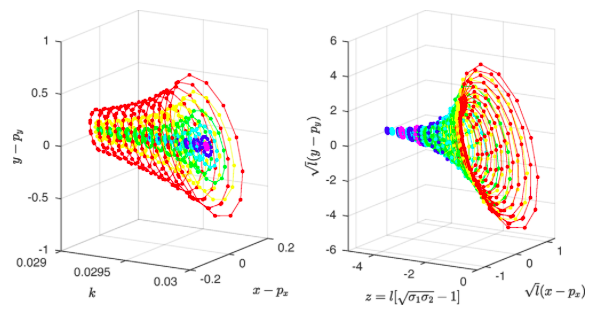
Just out! following the steps of A. Corral @acorralcrm who first introduced finite-time scaling of low-D bifurcations as analogy to critical behavior of finite size systems: Finite-time scaling on low-dimensional map bifurcations https://t.co/SuRHxU2BeL
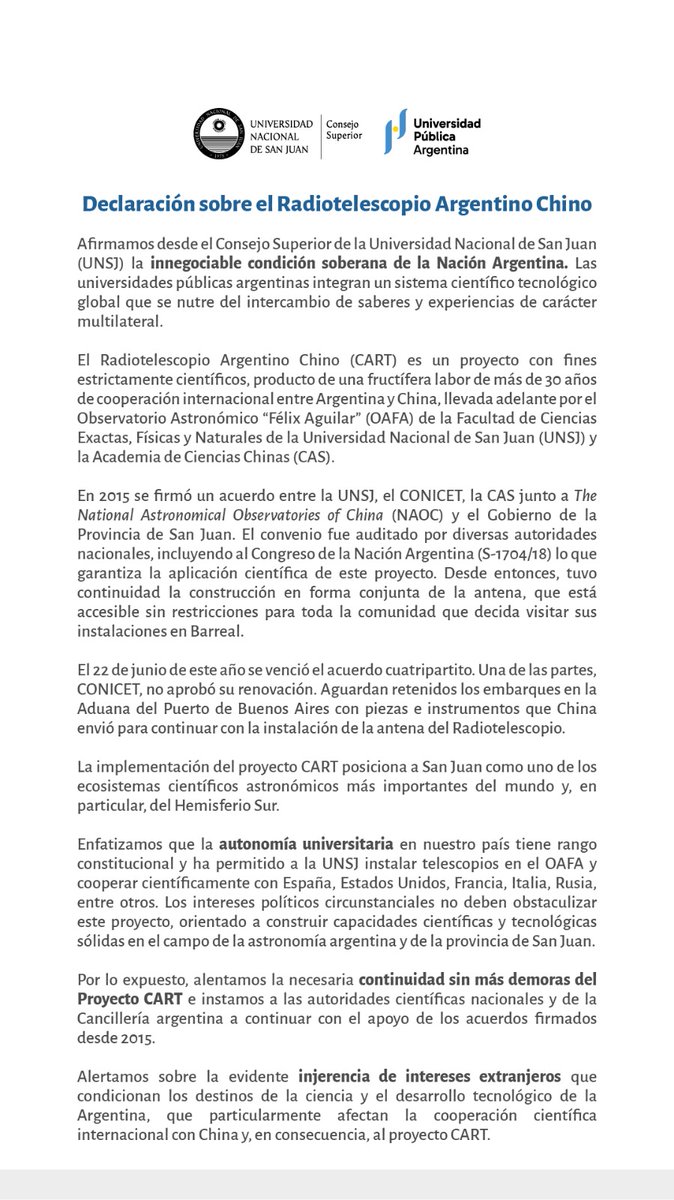
Declaración de la Universidad Nacional de San Juan sobre la inexplicable paralización del Radiotelescopio CART cuyo montaje estaba a punto de finalizar👇Tienen retenidas en la Aduana piezas e instrumentos enviados desde China
Two decades ago (16 october 2002) our dearest Per Bak passed away. His scientific contributions remain one of the most cited papers, as well as his influence in the way we natural scientists approach physics and vice versa. We all miss him!
https://t.co/uKsf7Futla
Mañana los trabajadores del sector nuclear vamos a estar concentrando en la rotonda de Zárate.
Las centrales nucleares no se venden, el sector nuclear se defiende.
☢️💪🏼
Gente, quiero invitarlos este jueves al banderazo que hacemos en el Centro Atómico Constituyentes para que no privaticen NA-SA, la empresa que administra las centrales nucleares.
Milei quiere cerrar nuestro plan nuclear y que seamos un país bananero.
Ayuden a difundir!!
✊✊


![JosephJacks_'s tweet photo. In 1980, two years before Feynman's famous Caltech lecture on Quantum Computing, a 43-year-old Soviet mathematician named Yuri Manin published a slim 128-page popular-science book called Вычислимое и невычислимое — Computable and Noncomputable — through the Moscow publishing house Sov. Radio. Manin was not a computer scientist. He was already one of the great algebraic geometers of his generation: a Lenin Prize laureate (1967), professor of algebra at Moscow State University, principal researcher at the Steklov Mathematical Institute, the mathematician behind the Gauss–Manin connection and the Mordell conjecture for function fields. He had been forbidden from foreign travel since 1968. The book was written in Russian, never officially translated for nearly thirty years, and its argument about quantum computation took up barely three pages of the introduction...
https://t.co/pOZ0460JWB
What's striking about Manin's framing — and what got almost entirely lost when the Western quantum computing canon formed around Benioff, Feynman, and Deutsch — is the direction of the argument.
Feynman's 1982 case for quantum computers was pragmatic and engineering-flavored: classical machines can't efficiently simulate quantum systems, therefore we should build quantum machines that can.
Manin came at it from the opposite end. He looked at molecular biology — at protein synthesis on messenger RNA, at the absurd information density and energetic efficiency with which living cells perform what looks structurally like Turing-machine computation — and concluded that nature had already solved the problem. Classical physics, he argued, simply cannot account for what biology does. The mathematical theory of quantum automata must already be implicit in the substrate of life. Engineering quantum computers wasn't the goal; it was the obvious downstream consequence of taking biology's existence-proof seriously.
That places Manin in a different intellectual lineage than the one quantum computing eventually inherited. He was downstream of Schrödinger's What Is Life? (1944) and the broader Soviet tradition of treating life as a physical system whose laws had not yet been written — Vernadsky, Lyapunov, the cybernetics revival under Berg and Glushkov.
The West built quantum computing as an engineering discipline of qubits-as-fabricated-systems, and pushed biology off into a separate and often-dismissed sub-field called "quantum biology."
Forty-five years later, with the work emerging on microtubules, tryptophan networks, ordered water, and coherent processes in neural lattices, the field is, in a real sense, finally catching up to its own actual origin.
The translation below is from pages 13–15 of the introduction.
On the inefficiency of computing devices
Molecular biology provides examples of the behavior of natural (not human-engineered) systems which we are forced to describe in terms close to those accepted in the theory of discrete automata. The figure below depicts the scheme of protein synthesis on messenger RNA: it closely resembles the depiction of a Turing machine copying information from one tape to another.
Classical continuous systems governed by differential equations can imitate discrete automata only when their phase space has an exceptionally complex structure — an abundance of stability regions separated by low energy barriers. Loading a program carves out a sophisticated system of passages through these barriers, predetermining the motion of the phase trajectory through this labyrinth. As a physical system, the computing device must be highly unstable, since an error of a single character in the program generally leads to an entirely different trajectory. Yet the computational process itself must be exceptionally stable — that is, spontaneous errors (transitions of the trajectory across a barrier that should remain closed, as a result of fluctuations) must have very low probability. It is well known that these requirements — combined with slowness of operation and the exponential growth of dissipated energy as complexity increases — erected the barrier that halted the development of mechanical computers.
[Citing Poplavsky's 1975 paper on thermodynamic models of information processes:] A genuinely instructive calculation can be found there: the quantum-mechanical description of the methane molecule by the lattice method requires computation at 10⁴² points. If we assume only 10 elementary operations are performed at each point, and suppose all computations are carried out at ultra-low temperature, then even so the calculation of the methane molecule would require expending energy roughly equal to that produced on Earth over a century.
On quantum automata
It is possible that for a better understanding of such phenomena a mathematical theory of quantum automata is lacking. The mathematical model of such objects must exhibit highly unusual properties compared with deterministic processes. The reason is that the capacity of the quantum state space is dramatically greater: where in the classical case there are N discrete states, in quantum theory — which permits their superposition — the state space lies in Cᴺ. When classical systems are combined, their state-counts N₁ and N₂ simply multiply; in the quantum case one obtains C^(N₁·N₂).
These rough estimates show that systems exhibiting quantum behavior are potentially far more complex than their classical counterparts. For example, since the system has no unique decomposition into parts, the state of a quantum automaton may be regarded in many different ways as states of entirely different virtual classical automata.
In carrying out such a program, the first difficulty will be finding the right balance between mathematical and physical principles. The quantum automaton must be abstract: its mathematical model should use only the most general quantum principles, without prejudging physical implementations. Then the model of evolution is a unitary rotation in finite-dimensional Hilbert space, and the virtual decomposition into subsystems corresponds to the tensor-product decomposition of that space. Somewhere in this picture the place of interactions — traditionally described by Hermitian operators and probabilities — must still be found.
Notes on this translation:
The C in "Cᴺ" is the field of complex numbers; Cᴺ is N-dimensional complex Hilbert space. C^(N₁·N₂) reflects the tensor product H₁ ⊗ H₂ — the structure that gives quantum systems their entanglement-driven computational advantage.
The Poplavsky reference is to R.P. Poplavsky, "Thermodynamical models of information processing," Uspekhi Fizicheskikh Nauk 115:3 (1975), 465–501.](https://pbs.twimg.com/media/HHCIl1ib0AAPeMD.jpg)