DFA Audio: It's Edwin's Monday Evening Property Rant! https://t.co/lqDR7nrzyi
0:00 Property market parachutes
5:46 Economic warning signs
10:21 Political and economic outlook
16:20 Victorian election analysis
19:32 Investment trends in Victoria
25:09 Global markers and interest
28:56 Construction industry woes
38:04 Regulatory and policy failures
43:41 Listing and market data
47:11 Social and market dynamics
54:42 Auction market performance
1:03:20 Rental and immigration shifts
1:08:02 Innovation and final thoughts
While some will interpret this in a narrow, climate-related sense, a bigger issue is also in play: the world's economies have lost the ability to come together to address shared challenges.
Part of this stems from America's retreat from its traditional global leadership role, a shift that goes well beyond not participating in this gathering. Part of it is a sense of general economic malaise that pushes countries toward excessive short-term thinking.
Meanwhile, the challenges requiring coordinated global action will continue to grow, including in AI and cyber.
#economy #markets
DFA Audio: Australian Home Prices Are In Free-Fall: Any Signs Of A Parachute? https://t.co/mNGoMfbDtg
0:00 Economic outlook
3:17 Housing market decline
4:36 Auction clearance analysis
8:13 Expert property forecasts
10:08 Fiscal policy and conclusion
DFA Audio: Markets See Deep Red As The AI Trade Breaks: Seeking Safer Havens? https://t.co/iltjybrutn
0:00 AI bubble and US market rout
2:19 Anthropic debut and AI impact
3:55 Tech sector correction
5:20 Global market sell-off
6:14 Commodities and monetary policy
7:14 Fed outlook and uncertainty
8:46 Consumer outlook and spending
9:44 European equity performance
10:44 UK market and economic trends
12:19 Asian tech sector decline
13:58 China and Japan market stress
15:33 India as an outlier
16:04 Australian market downturn
17:16 Corporate news and outlook
18:06 Crypto market liquidation
19:44 Risks and economic consequences
The Fed is printing money to buy UST bills.
GFC: $280B
Covid: $320B
2026 (nothing): $380B
Everyone is talking about whether the Fed will hike rates.
No one is talking about Warsh printing money like we are in a crisis to buy USTs.
As the Fed Balance sheet has expanded by $380B this year.
And Bessent is issuing more short-term UST bills to buy back long-term US debt.
The Treasury has no choice but to shift its debt load to shorter durations while the Fed prints money to absorb that supply.
This is QE.
The pain we are feeling now is the political cover for THE BIG PRINT.
Steve Eisman, the investor who famously predicted the 2008 financial crash, warns that as much as 65% of the S&P 500 is now exposed to the AI boom, claiming the ENTIRE STOCK MARKET has effectively become ONE GIANT AI TRADE.
Eisman warns that the AI boom has become so deeply embedded in the US economy that almost the entire stock market is exposed to it. He estimates that technology companies account for 40% of the S&P 500, rising to 50% when including companies like Google and Amazon. Once banks, utilities, asset managers and industrial companies involved in AI infrastructure are included, he argues that as much as 65% of the S&P 500 is effectively tied to AI, meaning the entire market has become one giant AI trade.
He also raises concerns about Nvidia's circular financing model, claiming the company provided billions in investments and loans to AI businesses that subsequently purchased its chips. He argues that this created a virtual AI empire supported by Nvidia, but warns that the arrangement is now unravelling. "And while the party lasted, everybody was happy. And now the party's over." According to Eisman, AI companies will increasingly need to survive on their own financial strength, making stock selection and company valuations more important than ever.
I didn’t expect for the $CBA.AX share price to defy gravity for this long even as our propadee Ponzi is crashing before our very own eyes
Most expensive bank in the world as a multiple of earnings and book I’m pretty sure
Some will say it is ‘safe’ because of the passive index buying and the big super brainiacs
And my response would yeah same as Aussie propadee it’s rock solid bullet proof ‘safe’ until it isn’t…
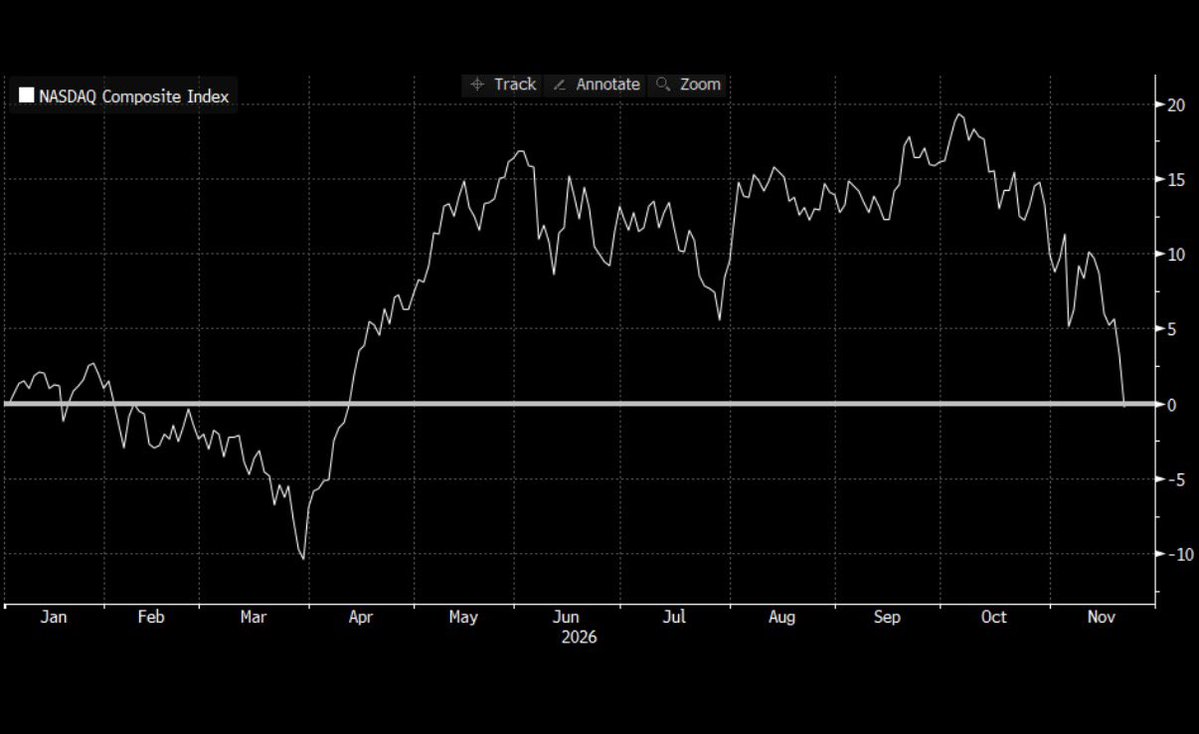
An indication of the (still ongoing( tech-led selloff in US stocks:
The Nasdaq’s year-to-date return just hit 0%, wiping out a ~20% gain from just over a month ago.
#economy#stocks#markets#tech
DFA Audio: How Far And For How Long Will Property Prices Fall? https://t.co/dze3RucPp3
0:00 The state of the market
1:55 Market drivers and trends
4:05 Expert outlook and forecasts
5:53 Domain housing forecast
7:45 Economic pressure on buyers
9:49 Long-term outlook
11:38 Conclusion and services
Reflecting this week’s sharp fall in stocks, where a seventh straight day of S&P 500 losses would mark its longest losing streak since 2020, the yield on the 10-year Treasury has pulled back to 4.97%.
While the direction aligns with conventional correlations, the relatively modest size of this week’s yield move down is less typical.
The decline in yields has been contained by hawkish Fedspeak, lingering inflation worries and, most of all IMO, the realization that lower equity valuations are unlikely, at least for now, to deter tech companies from issuing bonds.
#economy #markets #economy #bonds #investing #investors #stocks
The AI trade is unwinding fast. On an intraday basis the Nasdaq has now fallen 13.9% from its 6 October peak, deep into a correction. The S&P 500 is off 8.5% after six straight losses, its longest losing run since 2024. More than half of Nasdaq stocks are 20%+ below their highs.