Cheers, chills, and a standing ovation when RASolute 302 showed unprecedented survival on daraxonrasib for patients with progressive pancreatic cancer
Seldom do you sense you’re witnessing a historic moment in cancer care but this feels like ras targeting has arrived
#ASCO26
In my opinion OpenEvidence has basically ended the need for UpToDate, however, some disagree.
Can we at least all agree that there is virtually no role now for medical book chapters, reviews etc… that are obsolete the second they are finally published.
🆕🗞️ A Vaccine💉for cancer🦀interception.
A preventative approach aiming to reduce cancer incidence by targeting precancers and early-stage cancers. For patients with Lynch syndrome. Out @NatureMedicine📰
Paradigm↩️intervene early✅
#Cancer@OncoAlert
https://t.co/3TLgqPLsKi
Is it sexy? No.
Is it incredibly important for how we treat patients? Absolutely 🧠🧬
For over 20 years, 6 months of oxaliplatin plus a fluoropyrimidine has been the default for stage III colon cancer, and often high-risk stage II and rectal cancer. The cost has always been cumulative neuropathy that can follow patients for life ⚡️🖐️
The SCOT trial, the largest study in the IDEA collaboration, gives us long-term clarity with nearly 6,100 patients and more than 6 years of follow-up:
📊 5-yr DFS identical with 3 vs 6 months: 72.9% vs 72.9%
📈 5-yr OS identical: 82.4% vs 82.4%
✅ Noninferiority for OS formally met for 3 months
Where this really matters clinically:
🟢 CAPOX clearly supports 3 months
🟢 Low-risk stage III shows no OS penalty
🟡 Even high-risk disease sees only tiny absolute OS differences
⚠️ Meanwhile, neuropathy nearly doubles when oxaliplatin is extended to 6 months. Many patients pay a lifelong price for minimal benefit.
SCOT also uniquely included rectal cancer patients treated with upfront surgery, and here too, 3 months held up. This fits perfectly with modern TNT strategies 🧩
Takeaway:
This isn’t flashy, but it’s foundational. For most patients with localized colon or rectal cancer, 3 months of adjuvant CAPOX is enough. Six months should be the exception, not the rule, and always a shared decision 🤝
Sometimes the most important advance is knowing when to stop.
@OncoAlert@TheGutOncLab
#GI26
https://t.co/geX09H4ltq
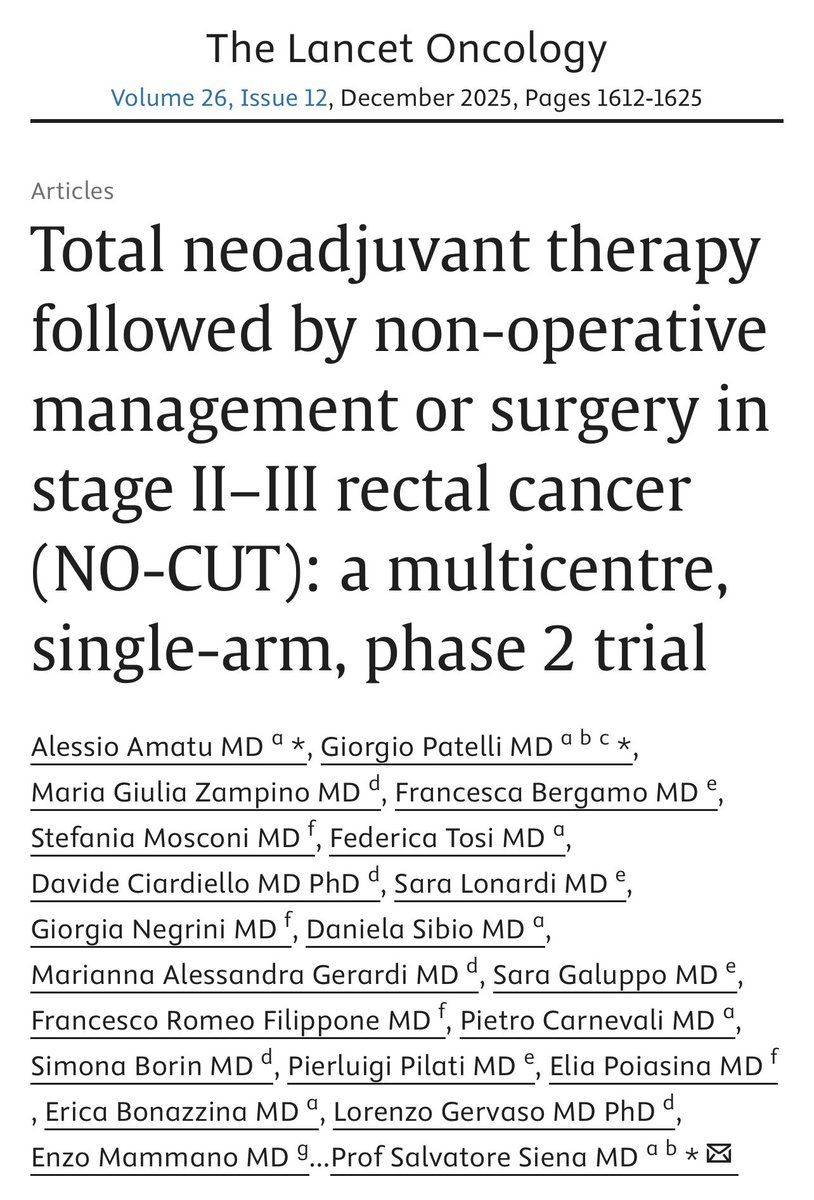
Does organ preservation after cCR with TNT🧨
affect distant metasases rate in rectal ca?
Results of NO-CUT🚫🔪trial @TheLancetOncol
show 26% of pMMR/MSS pts achieve cCR and
distant RFS 95% in nonop group vs 74% SOC
@OHSUKnight@tsikitis@HKennecke
https://t.co/rR8GfdZuHu
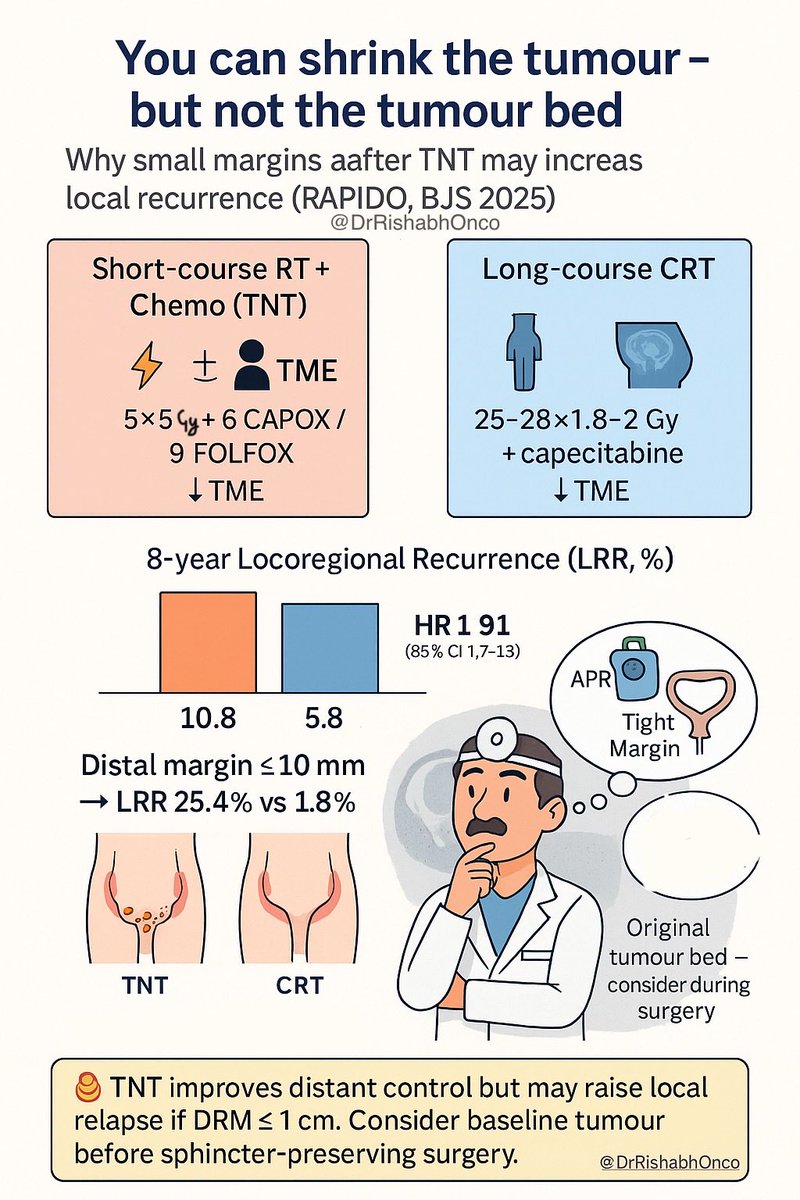
🧠 You can shrink the tumour—but not the tumour bed.
New RAPIDO analysis in BJS 2025 shows why small margins after TNT can turn dangerous 👇
💡 Trial: RAPIDO (n = 920, LARC)
🎯 TNT = 5×5 Gy + 6 CAPOX / 9 FOLFOX → TME
vs CRT = 25–28×1.8–2 Gy + capecitabine → TME
📊 8-year results:
• LRR 10.8% (TNT) vs 5.8% (CRT) → HR 1.91
• Spike seen only after sphincter-preserving surgery (SPS)
→ 12.1% (TNT) vs 4.8% (CRT) (HR 2.6)
• 🚨 If distal margin ≤ 10 mm → 25.4% (TNT) vs 1.8% (CRT) 💥 (HR 15.5)
🔍 Why?
TNT causes tumour shrinkage but leaves scattered viable cells in the original tumour bed.
✂️ Cutting “too close” (<1 cm) may slice through microscopic disease → higher local recurrence.
🇸🇪🇳🇱 Geography tells the story:
Sweden = more APR → no difference
Netherlands = more SPS & tight margins → higher TNT LRR
🩻 Takeaway:
TNT reduces distant mets ✅ but may raise local relapse if DRM ≤ 1 cm ⚠️
➡️ Surgeons must factor in baseline tumour bed, not just post-TNT shrinkage.
📖 Prata I et al. Br J Surg 2025
🔗 https://t.co/MqeM0xqH8i
#OncoTwitter #ColorectalCancer #RectalCancer #RadOnc #Surgery
@OncoAlert@esmo_open@BJSurgery@myESMO
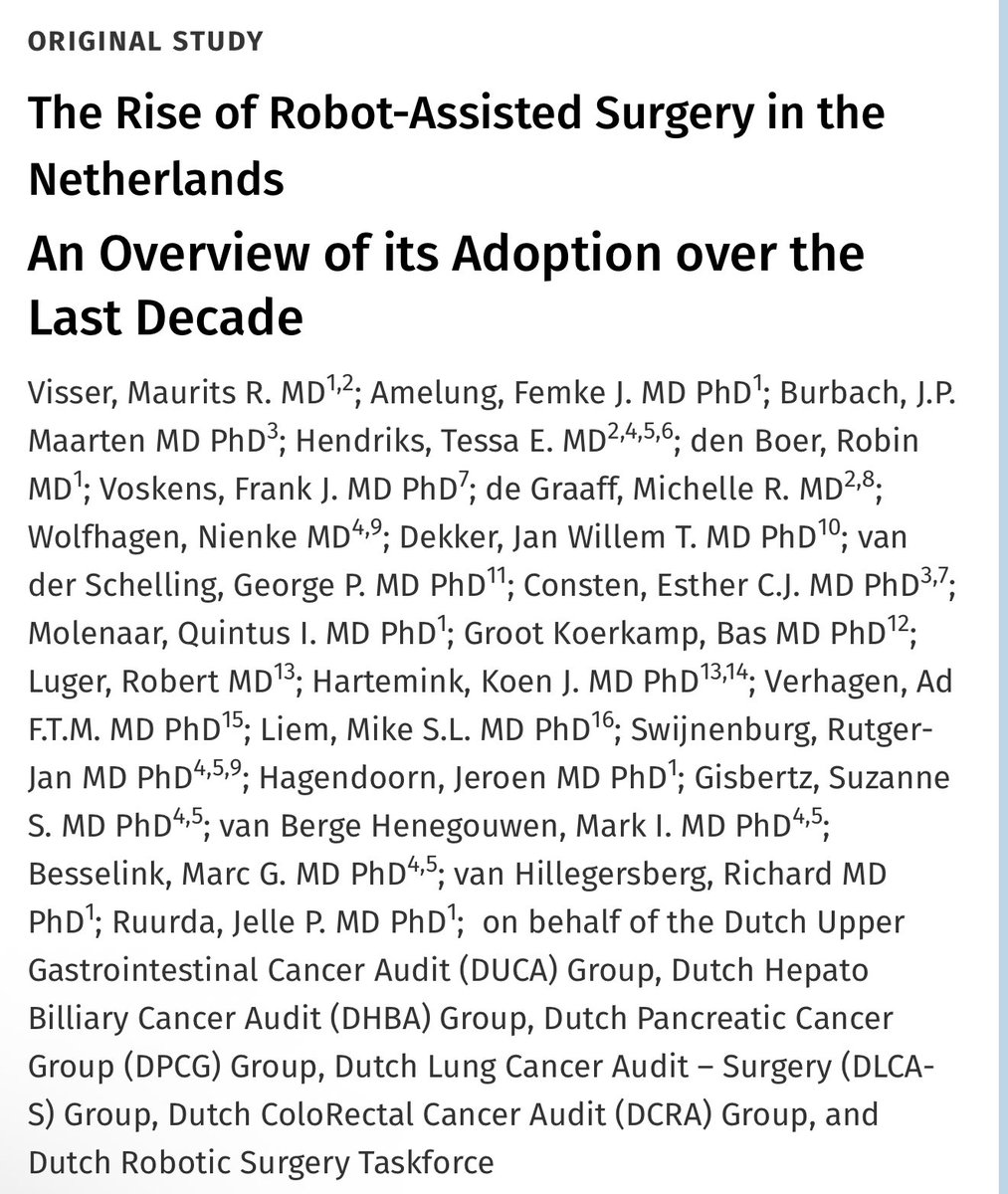
#Rise of the #Robots 🦾 in the Netherlands 🇳🇱 GI surgery @AnnalsofSurgery
😳 How does this compare to your country? Data?
Nationwide use 🦾 per organ among 77,361 resections (2014-2023):
✅ pancreas 1% to 33%
✅ thoracic 3% to 11%
✅ colon 6% to 14%
✅ rectum 19% to 45%
✅ liver 10% to 25%
✅ esophageal 33% to 40%
↔️ gastric 19% to 19%
⏩️ https://t.co/N8R4V6xroY
RA-CUSUM charts offer a powerful tool to track surgeon performance in rectal cancer cases—spotting trends in complications, operative time, and outcomes in real time.
https://t.co/Rjiyhw3gTQ
This study shows how RA-CUSUM can identify high and low outliers in robotic rectal surgery—offering a data-driven path to continuous surgical improvement.
https://t.co/Rjiyhw3gTQ
For the 36th consecutive year since U.S. News & World Report launched its "Best Hospitals" rankings, Mayo Clinic again ranks at the top of the 2025–2026 list.
Read more: https://t.co/mVhFe0Np7A
Safe Same-Day and Short-Stay Stoma Closures Revolutionize Care
by Ferrari D, Violante T (...) Larson DW et 7 al. in J Gastrointest Surg
🪡 read our summary 👉 https://t.co/3FezoUcaGO
📖 read the article: https://t.co/YQFxohPOUU