BREAKING: NEW REPORT🚨
How the EU Shapes National Elections Without Touching the Ballot
Elections remain national, yet the conditions are increasingly set in Brussels 🇪🇺
This is not theory: The EU has by now done it often enough to call it a PLAYBOOK.
A thread 🧵
or read the report here: https://t.co/gcI78idRbZ
Německý novinář Michael Thoma (via @sfglucon) publikoval investigaci o tom, jak se Polsko v čele s premiérem Tuskem angažovalo v ovlivňování maďarských voleb a v prosazování falešného narativu o ruské intervenci - stejný model, který byl použit před lety proti Trumpovi. Svoji roli sehrálo i médium VSquare se sídlem ve Varšavě, které je financované ze zdrojů blízkých několika vládám.
Oficiálním českým partnerem VSquare je web Investigace, který s polskou Fundacja Reporterów, maďarskými Átlátszó a Direkt36 a slovenským Investigatívnym centrom Jána Kuciaka tvoří základ sítě. Do spolupráce jsou zapojeni Pavla Holcová, Zuzana Šotová a Josef Šlerka. S VSquare spolupracuje a jejich výstupy ochotně šíří i web Hlídací pes a jejich redaktor Vojtěch Berger.
"Jak koordinovaná síť oficiálních prohlášení, narativů státních médií a státem sladěných investigativních platforem pomohla vykreslit maďarské volby 2026 jako geopolitickou bitvu o ruský vliv – a to pomocí metod nápadně podobných modelu, který používá EU. Tento článek zkoumá polské aktivity ... prostřednictvím analytického rámce stanoveného ve 3. zprávě Evropské služby pro vnější činnost (ESVČ) o hrozbách manipulace se zahraničními informacemi a jejich vměšování.".
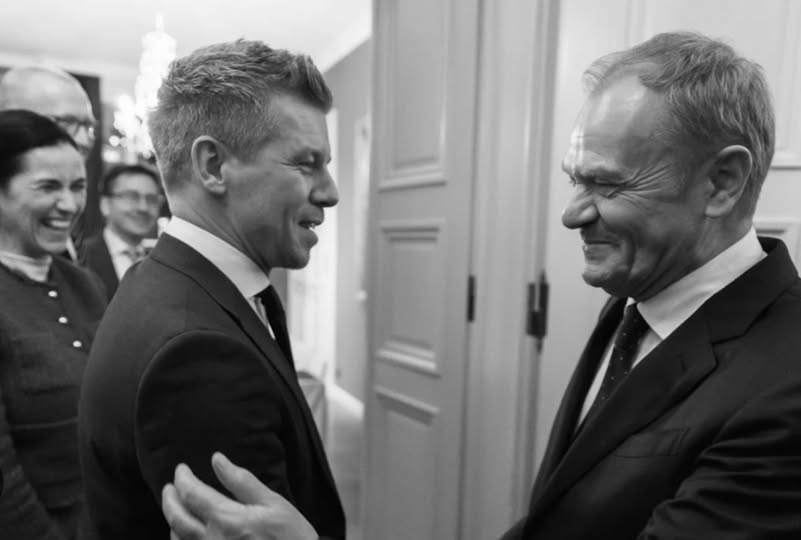
"První významná epizoda se odehrála v únoru 2026, kdy se Tusk na okraji Mnichovské bezpečnostní konference setkal s vůdcem maďarské opozice Péterem Magyarem... Varšava signalizovala, že maďarskou kampaň nepovažuje za striktně vnitřní záležitost Budapešti, ale za součást širšího boje o politickou orientaci regionu."
"Další fáze začala 22.3. po publikaci Washington Post o jednání maďarského ministra zahraničí Szijjártóa, který údajně předával Rusku informace ze zasedání Rady EU. Tusk reagoval okamžitě a ostře... Podle řady analytiků mohly být původním zdrojem úniku informací, na který se Washington Post spoléhal, samotné polské tajné služby."
"V den polsko-maďarského přátelství navštívil Budapešť polský opoziční prezident Karol Nawrocki. Tusk návštěvu veřejně odsoudil a označil ji za „fatální chybu“ a potvrzení „strategie oslabování EU a posilování Putina“. Zároveň zaútočil na lídra strany PiS Jarosława Kaczyńského, který Orbána podporoval, a obvinil ho z „politické spolupráce“ s Putinem a Lavrovem."
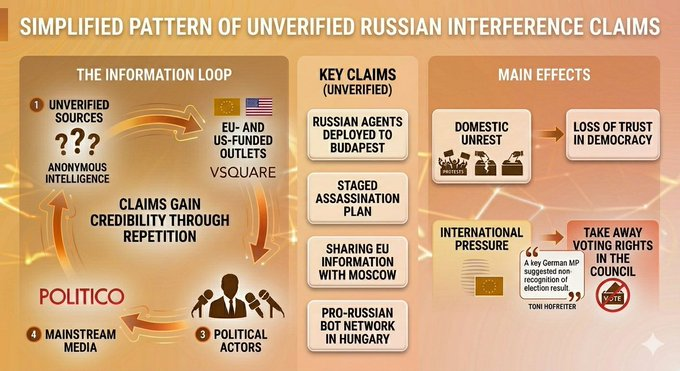
"5.3. VSquare informoval o údajném nasazení skupiny důstojníků GRU do Budapešti na podporu Orbánovy kampaně. Zpráva citovala nejmenované „několik evropských zdrojů z oblasti národní bezpečnosti“. Tento materiál se stal klíčovým základem pro aktivaci systému rychlé reakce (RRS) Evropskou komisí."
"Publikace varšavského redakčního týmu financovaného několika vládami citující anonymní bezpečnostní zdroje, tak spustila celoevropský mechanismus dohledu proti „dezinformacím“, který de facto fungoval proti Orbánovi. Řetězec byl ilustrativní: materiál z varšavského média..., odkaz na anonymní bezpečnostní zdroje, institucionální reakce Evropské komise a následně zvýšená kontrola nad informačním prostorem během kampaně."
https://t.co/mAIblGrbCv
We defend the right of European peoples to conduct free and fair elections without external manipulation, even by the EU institutions. We defend free speech as a non-negotiable foundation of democratic legitimacy, even if increasingly under attack from the EU itself. 🧐
I’ve written for @compactmag about how the EU-NATO establishment once again attempted to weaponise the Russiagate narrative in Bulgaria’s Sunday elections — but failed.
In the run-up to the vote, Bulgarian authorities and their EU partners followed the usual script that has become standard in every European election — especially in the presence on the ballot of a candidate critical of official stances on Ukraine, Russia, the EU or NATO — raising the alarm about alleged Russian interference in the electoral process. This included accusations that pro-Kremlin foreign information manipulation and interference (FIMI) outlets were pushing narratives designed to tilt the result in Radev’s favor. The pro-EU ruling parties even formally requested EU assistance to counter “foreign disinformation” by activating the Digital Services Act’s (DSA) rapid response system.
The aim in these cases is two-fold: on the one hand, to justify the suppression of online speech through the DSA; but perhaps more importantly to pre-emptively delegitimise — and potentially overturn — an electoral outcome that yields the “wrong” result. This is what happened in November 2024, when Romanian presidential candidate Călin Georgescu’s first-round election victory was annulled by the Romanian Constitutional Court on grounds of Russian interference in the absence of any credible, publicly verifiable evidence.
The target in Bulgaria’s cases was Rumen Radev — former president, outspoken critic of the EU-NATO strategy in Ukraine and advocate of closer ties with Russia — whose Progressive Bulgaria party was set to win the election. Before Sunday’s vote, Radev himself warned that his party’s anticipated victory might be compromised by “the Romanian model”.
But the sheer scale of Radev’s victory makes a Romanian-style scenario unlikely: his party won one of the largest shares for a single party in Bulgaria’s democratic history, and enough for an absolute majority in the new parliament.
Nevertheless, what we witnessed in the lead-up to this election was the latest iteration of a political template that has become a recurring feature of European electoral life. When a candidate inconvenient to Brussels appears likely to win, the apparatus of “disinformation” monitoring and “foreign interference” response is mobilised — not after the election, but before it, in ways that directly shape the information environment in which voters make their choices.
The pattern is consistent enough to constitute a system. In Romania, Georgescu’s surprise first-round lead was met not with political competition but with institutional cancellation, backed by EU-level pressure and a media campaign that treated unverified intelligence assessments as established fact. In Hungary, ahead of last week’s elections, the Western political-media establishment saturated the information space with warnings about Kremlin meddling. In Slovakia, Robert Fico’s return to power in 2023 was accompanied by nearly identical warnings. In each case, the Russiagate framing served a dual function: to justify suppression of political content under the cover of “protecting democracy” and to delegitimise the result if the wrong candidate won.
Read the article here: https://t.co/YLW9MDhRZ8
1⃣ The cancellation of the Romanian elections - because the wrong person won
With the input of the Digital Services Act, the EU Commission colluded to overturn the Romanian Presidential election when an EU-critical candidate won the first round.
https://t.co/alTEVH2Crx
“What happened in Hungary is the proof of concept for a new kind of electoral interference — one that is legal under current EU law, operated by EU institutions, and entirely invisible to most voters. It does not require fraud. It does not leave fingerprints on ballot papers,” writes international election observer @jerzKwasniewski of @OrdoIuris on @brusselssignal.
“European citizens who care about democratic integrity — whatever their politics — should be alarmed. An institution that can decide which speech is “disinformation” and which fact-checkers are “trusted”, that can instruct the dominant communications platform of an entire country to suppress one party’s messages and amplify another’s, that can do all of this during the final weeks of a national election campaign without any meaningful judicial oversight, is not protecting democracy. It is replacing it.”
“Hungary was the test case. Poland may be next. The rest of Europe should be watching carefully.”
👉Read the full article:
➡️https://t.co/oNA8ElA2vc
🇭🇺STATEMENT ON HUNGARY'S 2026 ELECTION🇭🇺
DIO recognises that Hungary’s parliamentary election was conducted according to the provisions of the law and that Péter Magyar and the TISZA Party have received a clear democratic mandate to govern for the next 4 years with a supermajority.
But this does not mean that the EU can escape scrutiny for its role in intervening in Hungary’s electoral processes. Indeed, the scale of interference should be seriously alarming to all those across Europe and beyond.
Hungary’s election took place within a broader EU environment shaped by 3 converging forms of pressure: financial leverage, regulatory intervention, and narrative conditioning.
1️⃣💸 Financial leverage:
Billions in frozen EU funds (€10bn RRF, €8bn other funds, potential €16bn SAFE financing) became a central campaign issue. Hungary also faces €1 million daily penalties linked to migration disputes. TISZA openly campaigned on restoring ties with Brussels to “bring EU funds home,” turning access to money into an electoral proposition.
This follows the precedent of Poland, where funds withheld from the previous government were rapidly released after Donald Tusk took office. The message to voters across Europe is clear: elect the preferred government, unlock the funds.
2️⃣👮 Regulatory intervention:
During the campaign, the EU’s Rapid Response System under the Digital Services Act was activated to monitor alleged disinformation. This involved coordination between platforms, regulators, and NGO “trusted flaggers.”
Yet the public still does not know what content was targeted, who made decisions, or what effect interventions had. When unelected bodies can shape the visibility of political speech during an election without transparency, democratic accountability is at risk.
3️⃣🕵️♂️ Narrative conditioning:
In the run-up to the vote, repeated media claims of Russian interference circulated through Western outlets, often based on anonymous sourcing and without verifiable evidence. These stories created a pre-emptive atmosphere in which Hungary’s election could be questioned regardless of the actual vote.
Taken together, these developments suggest that elections inside the EU are increasingly conducted inside a managed political environment rather than a neutral democratic one.
The real significance of Hungary may lie ahead. If Brussels interprets Péter Magyar’s victory as proof that pressure works, the Hungarian model may be repeated in the decisive 2027 elections in France, Italy, Spain and Poland.
DIO urges serious scrutiny of this trajectory.
@DIObservatory@BalazsOrban_HU Don't forget: European secret services hacked the phones of PM Orban and Minister Szijjarto since at least 2024 only to leak conversation during the campaign through an organised network of "journalists".
Brussels’ eyes are firmly on the 2027 French presidential election.
Their plan? To trial a whole sweep of digital censorship mechanisms and a “democracy shield” to try and maintain narrative control.
Election interference is the EU’s new normal.
Hear @JacobReynolds with @Poulin2012 on @LeMondeModerne_
🇭🇺STATEMENT ON HUNGARY'S 2026 ELECTION🇭🇺
DIO recognises that Hungary’s parliamentary election was conducted according to the provisions of the law and that Péter Magyar and the TISZA Party have received a clear democratic mandate to govern for the next 4 years with a supermajority.
But this does not mean that the EU can escape scrutiny for its role in intervening in Hungary’s electoral processes. Indeed, the scale of interference should be seriously alarming to all those across Europe and beyond.
Hungary’s election took place within a broader EU environment shaped by 3 converging forms of pressure: financial leverage, regulatory intervention, and narrative conditioning.
1️⃣💸 Financial leverage:
Billions in frozen EU funds (€10bn RRF, €8bn other funds, potential €16bn SAFE financing) became a central campaign issue. Hungary also faces €1 million daily penalties linked to migration disputes. TISZA openly campaigned on restoring ties with Brussels to “bring EU funds home,” turning access to money into an electoral proposition.
This follows the precedent of Poland, where funds withheld from the previous government were rapidly released after Donald Tusk took office. The message to voters across Europe is clear: elect the preferred government, unlock the funds.
2️⃣👮 Regulatory intervention:
During the campaign, the EU’s Rapid Response System under the Digital Services Act was activated to monitor alleged disinformation. This involved coordination between platforms, regulators, and NGO “trusted flaggers.”
Yet the public still does not know what content was targeted, who made decisions, or what effect interventions had. When unelected bodies can shape the visibility of political speech during an election without transparency, democratic accountability is at risk.
3️⃣🕵️♂️ Narrative conditioning:
In the run-up to the vote, repeated media claims of Russian interference circulated through Western outlets, often based on anonymous sourcing and without verifiable evidence. These stories created a pre-emptive atmosphere in which Hungary’s election could be questioned regardless of the actual vote.
Taken together, these developments suggest that elections inside the EU are increasingly conducted inside a managed political environment rather than a neutral democratic one.
The real significance of Hungary may lie ahead. If Brussels interprets Péter Magyar’s victory as proof that pressure works, the Hungarian model may be repeated in the decisive 2027 elections in France, Italy, Spain and Poland.
DIO urges serious scrutiny of this trajectory.
Facebook’s managed democracy? 📱
Our latest research found that Facebook is applying different rules for Orbán and Magyar’s posts.
Once again, social media is interfering in national elections, when they should be allowing free and open political debate.
Read more here:
https://t.co/pHSZvJf8aE
DE ONBENOEMDE INLICHTINGENDIENST DIE DE HONGAARSE VERKIEZINGEN VORMT 🕵️
Spionnen en lekken gelinkt aan inlichtingendiensten lijken invloed uit te oefenen op de Hongaarse verkiezingen: niet door stemmen te manipuleren, maar via een precies getimede waterval van lekken en narratieven.
Wat we hier zien, is geen normale berichtgeving. Het is een gecoördineerde informatiecyclus: gedreven door lekken gelinkt aan inlichtingendiensten en ontvouwen zich slechts dagen voor de Hongaarse verkiezingen.
Dit vormt duidelijk de politieke omgeving, waarin die stemmen worden uitgebracht. Samen vormen deze ontwikkelingen een duidelijke volgorde, die zich ontvouwt in een strak gecomprimeerd pre-verkiezingsvenster:
31 maart 2026: Na anonieme rapporten gepubliceerd door activistische journalisten, beschuldigt de Poolse premier Donald Tusk Hongarije publiekelijk van het delen van EU-documenten met Moskou en verklaart dat de regering-Orbán effectief “Europa heeft verlaten.” De “geheime inlichtingenbronnen” worden benut door een EU-leider.
3–7 april 2026: VSquare publiceert twee stukken over een “Kremlin-hulplijn”:
• “Hongarije coördineerde met Rusland over EU/Oekraïne-beleid”: maar lidstaten onderhandelen, vertragen of blokkeren routinematig EU-posities op basis van nationaal belang. Hongarijes standpunt over Oekraïne is al lang publiek. Dit framen als geheime “coördinatie” impliceert veel meer dan er bewijs voor is.
• Claims dat Hongarije probeerde gesanctioneerde oligarchen, banken en bedrijven van de lijst te halen: maar sanctiebeleid is inherent politiek. Lidstaten lobbyen regelmatig voor vrijstellingen op basis van economische of strategische overwegingen.
• Rapporten over directe kanalen tussen Péter Szijjártó en Sergey Lavrov: maar contact onderhouden met adversarystaten is standaard diplomatieke praktijk in heel de EU.
6 april 2026: Duitse politieke actoren verschuiven van retoriek naar institutionele voorstellen:
• Minister van Buitenlandse Zaken Johann Wadephul (CDU) pleit voor het beperken van unanimiteit in het EU-buitenlandbeleid, wat effectief Hongarijes veto verzwakt
• EPP-president Manfred Weber steunt de zet als noodzakelijk om obstructie te voorkomen
• Anton Hofreiter (Groen-voorzitter van de Commissie voor Europese Zaken) pleit voor het uitbreiden van mechanismen om veto’s helemaal te omzeilen
8 april 2026: een gelekt transcript van een telefoongesprek uit 2024 tussen de Hongaarse minister van Buitenlandse Zaken Szijjártó en Iran komt boven water (versterkt door The Washington Post en opnieuw toegeschreven aan een anonieme westerse inlichtingenoogbron) en portretteert Hongarije als heimelijk samenwerkend met Teheran. Opmerkelijk is dat veel van deze narratief wordt gedreven door dezelfde politieke en mediakringen die Hongarije eerder bekritiseerden, omdat het weerstand bood tegen EU-sancties op Israëlische kolonisten in de Westelijke Jordaanoever, wat een duidelijke dubbele standaard onthult. Hongarije wordt bekritiseerd niet om de richting van zijn beleid, maar omdat het überhaupt onafhankelijke besluitvorming uitoefent.
Het sleutelpunt: de onderliggende gebeurtenissen beslaan jaren.
Hun onthulling is gecomprimeerd in dagen, direct voor een verkiezing.
Het systematisch lekken van vertrouwelijke en hoogwaardige informatie is ontworpen om routineuze diplomatie om te vormen tot een narratief wapen. Met hulp van een netwerk van anti-Orbán-journalisten probeert deze onbenoemde inlichtingendienst direct druk uit te oefenen op Hongaarse kiezers op het meest gevoelige mogelijke moment. Het is redelijk dat journalisten informatie zoeken, maar wanneer ze zich laten gebruiken als instrument van schimmige inlichtingendiensten, verschuiven ze van berichtgeving naar verkiezingsbemoeienis.
Via @DIObservatory
In the Hungarian election we are getting a real-time demonstration of disinformation. It is fascinating because it allows us to study it and understand the mechanisms. This X Ray of the European fake news ecosystem will soon become the basis for serious academic research. 📰🥸
🚨 The strange role of Facebook in the Hungarian election
Facebook is hugely important in Hungary. Yet Meta has serious questions to answer over its role in the public debate about the election.
We analysed Facebook and found:
❌ Different rules for the two candidates
⚡️ Activation of EU "rapid response" censorship regime
👻 Comments hidden from public view
📊 Major statistical anomalies in candidate reach
We ask that Meta urgently clarifies the situation!
Read our full comment here 👇