Where is the world’s $13 trillion in sovereign wealth actually sitting?
According to Global SWF’s 2026 data, sovereign wealth funds now manage more than $13 trillion in assets. But this capital is far from evenly distributed.
🇳🇴 Norway remains the undisputed giant. Its
La @FECRDC a l’honneur de vous informer, après une évaluation attentive des conditions d’organisation, que la 8ème édition de la Conférence sur l’Énergie en République Démocratique du Congo (DRC⚡️NRJ8), initialement prévue du 11 au 13 juin 2026 à Kolwezi, est reportée.
Cette décision a été prise afin de garantir les meilleures conditions de participation de toutes les parties prenantes tant nationales qu’internationales au vu de l’intérêt que suscitent les thèmes qui seront développés et des solutions à y dégager.
En conséquence, la conférence se tiendra désormais du 📆17 au 19 septembre 2026 à Kolwezi.
Nous restons convaincus que cette nouvelle programmation permettra une participation encore plus large et une qualité d’échanges renforcée.
📩 Pour toute information ou inscription : [email protected] , [email protected]
#RDCNRJ2026 #Energie #Kolwezi #Mines #Infrastructure #Investissement #TransitionÉnergétique #RDC #ConférenceInternationale #FEC #PartenariatPublicPrivé
🚨 MYTH VS REALITY: Nigeria's Electricity Sector
Will higher tariffs automatically improve electricity supply? Are DisCos the only issue?
Our latest policy memo argues that Nigeria's electricity crisis is deeper than these common assumptions.
Ethiopia🇪🇹's USD 2.8 Billion Koysha Dam Will Add 2,200MW to the Grid. With GERD and Gibe III, Ethiopia Is Becoming Africa's Largest Electricity Exporter. https://t.co/wyQvr88hjM
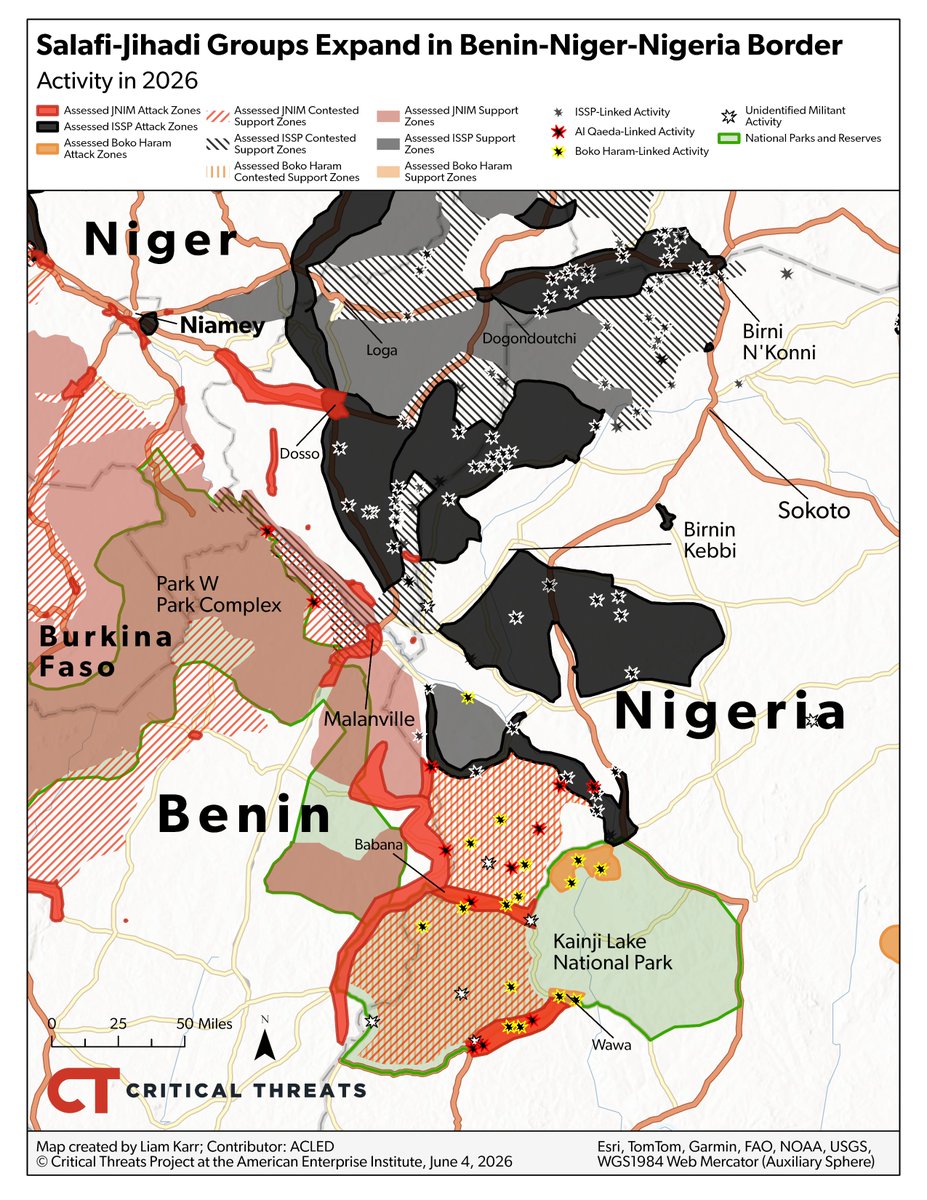
NEW | Benin is working to increase counterinsurgency coordination with its neighbors, including joint operations with Nigeria and diplomatic efforts to repair frayed ties with Alliance of Sahel States members Burkina Faso and Niger. 1/5
Dangote Refinery boosts jet fuel amid US-Iran tensions
Nigeria’s Dangote Refinery has increased its output to 700,000 barrels per day. The ramp-up comes as global aviation fuel supply tightens due to US-Iran tensions and the closure of the Strait of Hormuz, positioning Dangote as a key supplier of jet fuel.
Algeria exported 46 BCM of gas in 2025.
Down from 49 BCM in 2024.
The decline is the story and the Trans-Saharan Pipeline is the answer.
Algeria is Europe's 3rd largest gas supplier.
But domestic production is falling.
Any European buyer planning 10-20 year supply security has to ask: what happens when Algerian fields plateau?
The TGSP Nigeria → Niger → Algeria is the strategic fix.
This is not Algerian gas... It's Nigerian gas.
The pipeline transforms Algeria from a declining producer into a permanent transit corridor.
30 BCM/year of Nigerian molecules flowing north Algeria stays the reliable, bankable supplier Europe needs for decades beyond its own reserve life.
3 countries win differently.
Algeria: preserves its European relationships long after domestic fields decline.
Niger: breaks energy isolation, integrates into a continental delivery network.
Nigeria: gains a pipeline alternative to LNG, adding leverage in global gas markets.
A TGSP delivering 30 BCM/year is exactly the corridor European buyers need to underwrite right now.
The pipeline has been discussed for decades.
The current crisis has made it urgent.
While US owners of European football teams have faced protests from fans for years, friction is rising. Some fear the sport is losing its way in pursuit of profit and that outside money is distorting the game’s balance of power. https://t.co/trkLtAMftL
Footage shows the moment a French military fighter jet intercepted a drone believed to have come from Russia in Latvian airspace.
The incident is the latest in a series of drone incursions into NATO territory amid Russia’s war on Ukraine.
Thailand has one of the lowest total fertility rates (TFR) in the world. In 2025, the TFR was 0.87, and the preliminary numbers for the first months of 2026 are even lower. The rate is so low that deaths have exceeded births since 2021 and now run 34% higher than births.
Thailand’s fertility collapse has always fascinated me. With a flight to a Bank of Thailand conference in Bangkok ahead of me, I spent some time reviewing the data.
Thailand’s TFR fell below replacement in 1991. That is early. It means completed fertility has been below replacement for at least a full generation. In 1991, Thailand was neither rich nor well-educated. Even today, its income per capita (in PPP, the right measure here) is about Mexico’s level, around 28% of the U.S.
The standard theories for East Asian ultra-low fertility, such as a toxic educational arms race or extreme gender inequality, have little bite here. On the World Economic Forum’s Global Gender Gap Index 2025, Thailand scored 0.728 and ranked 66th. South Korea scored 0.687 (101st of 146), and Japan 0.666 (118th of 148, last in the G7).
I think Thailand is the clearest example of modernity without high income, and that combination is a recipe for demographic collapse.
To illustrate this point: if Thailand’s TFR remained at its current level for 200 years, the population would decline from 65.8 million in 2025 to 1.51 million in 2225. While this is a hypothetical scenario used to make the argument, not a forecast, it gives a sense of the magnitude of the population change involved unless TFR increases at some point. This is not about closing a few maternity wards or fixing Social Security, but about winding down an entire country.
Does anyone have a better theory? I don’t have enough information on Thai demographics, and I am happy to update my view.
Two caveats. First, I use Thailand’s official data from the National Statistical Office. The UN WPP data (and the databases built on it, such as the World Bank’s) are, as always, way off. Second, the official statistics may undercount births somewhat. Even if they do, the picture changes little.
🚨🇬🇧 UK Women are ‘The Angriest in Europe’.
Wonder if it’s got anything to do with the fact they are most likely to be ****** in the UK than anywhere else in Europe.
Notice that Politicians & Legacy Media have not once covered this terrifying statistic.
Churches in Democratic Republic of Congo find themselves on the frontline of the community response to a deadly Ebola outbreak.
Al Jazeera’s Alain Uaykani reports.
Le Département des Sciences Économiques tire pleinement profit de la nouvelle politique de recherche de l’UPC* pour inciter, encourager et accompagner les étudiants à passer des idées aux actions à impact concret.
Aujourd'hui, l’UPC est fière de l’étudiante Gloire Munkokole ainsi que de nombreux autres étudiants qui ont su transformer leurs travaux académiques (~projets turorets) en initiatives réelles, en projets entrepreneuriaux, en innovations sociales ou en solutions répondant aux défis de nos communautés riveraines.
Cette dynamique illustre la volonté de l’UPC de faire de la recherche non seulement un exercice intellectuel, mais également un levier de transformation économique et sociale.
*La politique de recherche de l’UPC est disponible au Secrétariat Général de Recherche et disponible en ligne.
#Mobilités 🚆🚌🚲
2026 est l'année des mobilités en Centre-Val de Loire !
📣 La Région lance une grande consultation publique pour imaginer les déplacements de demain.
👋 Vos déplacements, parlons-en !
Du 8 juin au 10 juillet, donnez votre avis ↙️
https://t.co/9XiVihxBQt
⬇️
Adieu le zinc… Bonjour les centres commerciaux
On y va pour se balader ou croiser du monde. Ils sont la fusion entre @Tinder et les bistros.
La France des bistros n’est pas morte. Elle a déménagé au niveau -2 à côté de @Sephora
🗣️Alors qui est pour les Bistros de quartier ?