Join our 🧬 #LiquidBiopsy team at Queen Mary University of London’s Blizard Institute as a 🔬 Research Technician. Develop cutting-edge pipelines to extract genetic and epigenetic information from #cfDNA and RNA.
🗓️ Deadline: 24th July
✅ Apply: https://t.co/oZVM63TRDZ
We will soon have an opening for a three-year postdoc with expertise in machine learning and bioinformatics analysis of sequencing data to work on our liquid biopsy projects. Please get in touch by email or DM if interested.
Wonderful @CNAPS2024 meeting in Graz was a great pleasure and a source of inspiration from #cfDNA community. As my first #CNAPS, it was a chance to see the people behind the papers. Many thanks to the organisers and all the attendees who made it possible.
MethylBERT: A Transformer-based model for read-level DNA methylation pattern identification and tumour deconvolution https://t.co/8cPcKhkks5 #biorxiv_bioinfo
DNA methylation atlas of normal human tissues. Impressive work by Prof. Tommy Kaplan and his team shared recently at @CRUK_CI will advance epigenetic-based #liquidbiopsy
More in their recent paper https://t.co/IqJpDfHl0p
Interested in cell-free DNA and #liquidbiopsy? Want a ride to catch up on the recent progress related to the biology of #cfDNA? Ask for hitchhiking!
Here is our new review: A hitchhiker’s guide to cell-free DNA biology https://t.co/hzwsSVCJyP
Our paper on #cfDNA fragment end profiling in cancer is out. We focused on capturing shifts in end coordinates and sequence motifs in cancer-specific open-chromatin regions (OCRs) 🧵1/4 https://t.co/TCeq7x9aCd
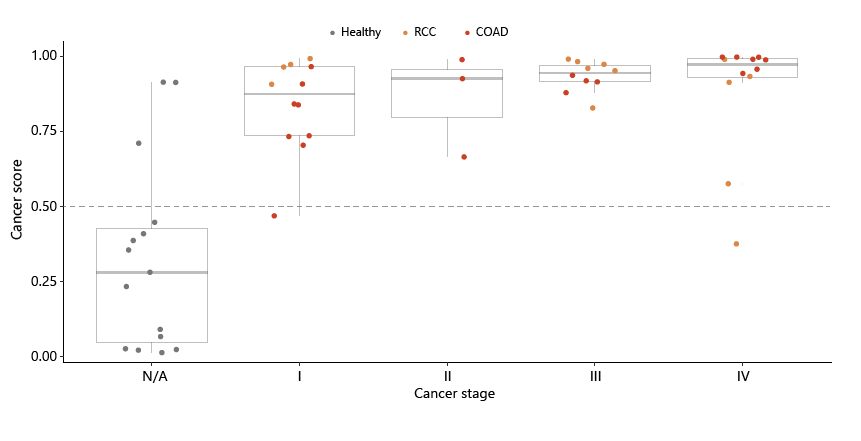
Based on the retrieved data we built a classifier to discriminate cancer (CRC and RCC) vs healthy in a cohort of 170 #liquidbiopsy samples. AUCs reached 0.9 🧵3/4
🧬 2021 Top #CancerGenetics Articles 🧬
#4: The Detection of Cancer Epigenetic Traces in Cell-Free DNA
👩⚕️👨⚕️ Anastasia P. Koval, Konstantin A. Blagodatskikh et al.
Read now 👉 https://t.co/OE3KMOq1Qt
@DShcherbo#Cancer#Oncology#Genetics
@ATJCagan@MatLupien Exciting! I'm eager to read the paper, and the tweetorial is a masterpiece. By the way, why not include elephants or whales, just to stick with the classics? Any constraints on genomics or sample collecting?