$INTC is going to be an epic comeback story. Domestic AI workloads (strong geo-political narrative) and new 18A targeting accelerators and edge inference.
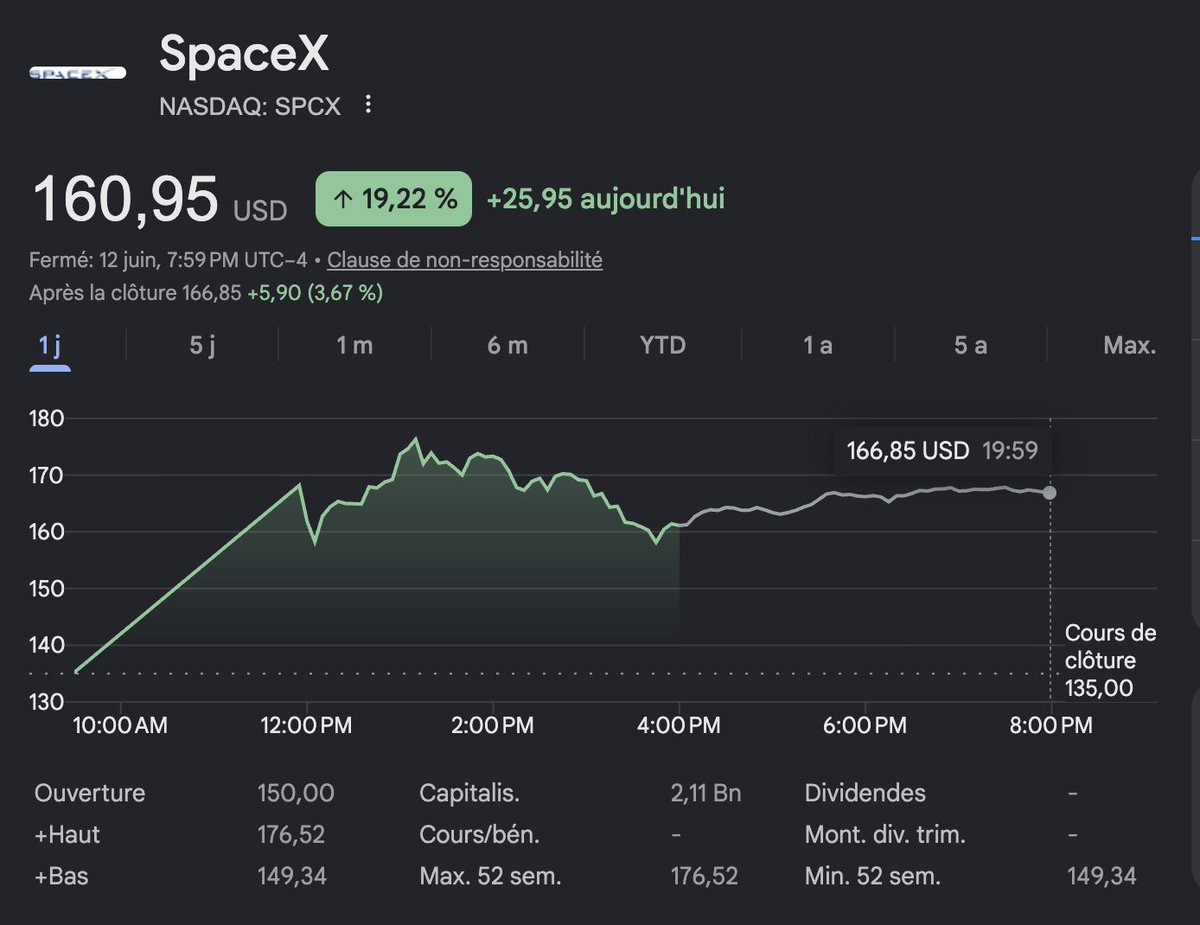
$SPCX: on why I think $30T is achievable on GW opportunity ALONE.
- SpaceX currently has Colossus and is fielding contracts at scale. Anthropic paying ~$15B annually for access, Google ~$11B/year for 110k GPUs. That's the anchoring point. Now you want to back into 100GW revenue IF SpaceX owns that much capacity.
Power Math
100GW = 100,000 MW
- Using the industry model from current hyperscaler builds: a 100MW AI data center generates roughly $1B in annual revenue (this is normalized across GPU rental, colocation, and managed service contracts). That's a ~$10M revenue per MW rule of thumb in hyperscaler AI infrastructure.
- 100,000 MW × $10M per MW = $1 trillion in annual revenue
- That's the ceiling if SpaceX owns all 100GW outright and operates at market rates.
Reality Check Against Current Contracts
- Anthropic contract: $15B/year for unknown capacity (but likely in the range of 1-2GW of equivalent compute based on the GPU counts and contract value)
Google contract: $11B/year for 110k GPUs (~1.5-2GW equivalent)
- This suggests SpaceX is capturing $5.5M to $11M per GW annually, closer to the lower end of the hyperscaler range. If we use the conservative $5.5M/GW:
100GW × $5.5B per GW = $550B annually
If SpaceX pushes pricing (and they can if they give customers highest ROI) and hits that $10M/MW benchmark:
100GW × $10B per GW = $1 trillion annually
$1T x 30x sales = $30T MCap
/end
SpaceX a clôturé son premier jour de cotation à 2 100 milliards de dollars, +19%. Tout le monde regarde le chiffre. Personne ne regarde ce qu'il price réellement.
Laissez-moi vous dire ce que le marché vient d'acheter, et pourquoi je pense que cette boîte vaudra 30 à 50 trillions d'ici 5 ans.
D'abord, le symbole. Cette IPO est un référendum. D'un côté, 20 ans de discours sur la décroissance, la sobriété, la redistribution, la fin de l'histoire gérée par des comités. De l'autre, un homme qui a dit "je vais rendre l'humanité multiplanétaire", que tout le monde a traité de clown, et qui vient de créer la plus grosse entreprise cotée de l'histoire en partant d'un entrepôt à El Segundo. Le marché a voté. Le wokisme avait des départements RH, SpaceX avait des fusées. Les fusées ont gagné.
Ensuite, la mécanique économique, parce que c'est là que tout le monde se trompe. Les analystes valorisent SpaceX comme une entreprise de lancement plus Starlink. C'est comme valoriser Internet en 1995 sur le marché du fax. Starship ne réduit pas le coût du kilo en orbite de 20%, il le divise par 100. Et chaque fois dans l'histoire qu'un coût d'infrastructure est divisé par 100, ce n'est pas le marché existant qui grossit, ce sont des industries entières qui naissent. Le coût du calcul divisé par 100 a donné Internet, le smartphone, l'IA. Le coût de l'orbite divisé par 100 va donner une économie spatiale complète.
Faisons la liste de ce qui devient rentable quand le kilo en orbite coûte le prix d'un billet d'avion. Les data centers orbitaux, avec énergie solaire continue et refroidissement gratuit, au moment exact où l'IA fait exploser la demande énergétique terrestre. La fabrication en microgravité de semi-conducteurs, de fibres optiques, d'organes imprimés impossibles à produire sous gravité. Le tourisme orbital de masse, puis les hôtels lunaires, qui passeront du fantasme au business plan exactement comme la croisière de luxe au 20ème siècle. Le transport point à point terrestre, Paris-Tokyo en 40 minutes. L'industrie minière des astéroïdes, dont un seul corps de classe M contient plus de métaux que tout ce que l'humanité a extrait depuis le néolithique. Et Mars en ligne de mire, pas comme destination touristique, mais comme le plus grand projet d'infrastructure jamais entrepris, avec tout ce que ça implique de demande en énergie, matériaux, robotique, IA.
SpaceX ne participera pas à ces marchés. SpaceX possède le péage d'entrée de tous ces marchés. C'est AWS, mais pour la civilisation. Apple vaut 3 500 milliards en vendant des rectangles de verre sur une seule planète. Le premier monopole d'accès à une frontière infinie à 30 ou 50 trillions dans 5 ans, ce n'est pas de l'exubérance, c'est une simple règle de trois sur l'expansion du marché adressable.
Et maintenant, la partie que je préfère. Ce futur n'a pas besoin de bureaucrates. Il n'y a pas de comité consultatif en orbite. Pas de commission Théodule sur Mars. Chaque dollar de cette nouvelle économie sera créé par des ingénieurs, des techniciens, des soudeurs, des pilotes, des entrepreneurs. Les diplômés en gestion de la norme vont devoir apprendre un métier utile, et franchement, c'est une excellente nouvelle pour eux aussi : construire est infiniment plus fun que contrôler.
Parce que c'est ça, le vrai signal d'aujourd'hui. Pendant 50 ans on nous a vendu un futur rétréci : moins d'énergie, moins d'enfants, moins d'ambition, gérer le déclin proprement. Et là, d'un coup, le plus gros actif financier du monde est un pari sur l'abondance, l'expansion et l'aventure. Le pessimisme vient de passer en position vendeuse sur lui-même.
Le futur sera méga fun. Il y aura des hôtels avec vue sur la Terre, des honeymoons en orbite, des gamins qui diront "papa, c'était comment avant les fusées réutilisables" comme on dit "c'était comment avant Internet". Et quelque part dans les années 2030, un humain marchera sur Mars en livestream devant 5 milliards de personnes, et ce jour-là plus personne ne se souviendra du nom d'un seul de ses détracteurs.
Achetez de l'optimisme. C'est encore sous-valorisé.
AMD CEO LISA SU HELD A MINI PC ON STAGE THAT RUNS A 235B MODEL AND REPLACES YOUR $440/MONTH AI STACK
amd's ryzen ai max+ 395 is the first x86 chip that runs a 200 billion parameter model on one piece of silicon. cpu and gpu share 128gb of unified memory, no separate graphics card needed
the gmktec evo-x2 runs qwen3 235b fully, deepseek v3 comfortably and llama 3.3 70b with headroom. on linux you get 110gb of usable vram out of 128gb
amd claimed the chip beat an nvidia rtx 5080 by more than 3x on deepseek r1 inference. a lunchbox sized pc outrunning a $1,000 discrete gpu on a real ai workload
a heavy ai user pays $200 for claude code max, $200 for chatgpt pro, $20 for cursor and $20 for gemini. that's $5,280 a year and the box pays itself off in 9 to 10 months
install ollama, pull the model, point claude code at localhost. same interface, nothing leaves the machine, nothing costs per request
bookmark this and read the article below
I’ve had a number of conversations with folks inside and outside government about the current situation with Anthropic, and here is what I believe to be true:
— As we know, Anthropic publicly released its Mythos class models earlier this week under the commercial name Fable.
— Fable is Mythos with guardrails. But if those guardrails fail, then you’ve exposed Mythos and its advanced cyber capabilities to people who shouldn’t have them. (Keep in mind that Anthropic itself widely promoted the idea that Mythos was a cyberweapon and needed to be regulated as such. They asked for government regulation of Mythos and championed the guardrails on Fable. If there is a vulnerability — big or small — it is Anthropic’s responsibility to patch.)
— A highly credible trusted partner of both Anthropic and the USG who was testing Fable came forward with a jailbreak of those guardrails. The Admin asked Dario to fix the jailbreak or de-deploy the model. Dario refused.
— In their blog post, Anthropic defended its decision by saying the jailbreak isn’t serious. That is not what the trusted partner and the USG believe; nor is that kind of minimizing language consistent with Anthropic’s brand as the AI safety company. It’s difficult to fathom how they could claim a jailbreak allowing operability of a cyber weapon could be defined as not “serious.”
— In the past, Anthropic has always said that safety must be top priority and taken super seriously. In this case, Anthropic prioritized the continued offering of the consumer model over safety.
— In reaction, the Admin issued the export control. The Admin did this reluctantly. It’s been very surprised that Anthropic hasn’t wanted to cooperate with a reasonable safety request (ie fixing the jailbreak issue). Anthropic’s reaction is very much at odds with their branding and ethos as a safe AI research community.
— The Admin’s hope now is that Anthropic remediates the safety issue, the export control is lifted, and Fable goes back into general release. The Admin wants all of this to happen as soon as possible. It is frankly bewildered that Anthropic hasn’t wanted to comply with safety requests that it previously said were its highest priority.
— Those trying to misdirect and tie this action to the prior DoW/Anthropic issues are wrong. The Admin values Anthropic’s technical capabilities and feels that this issue, while serious, should be easily resolved. The ball is in Anthropic’s court.
What if it’s not 2-3 more, but in perpetuity…
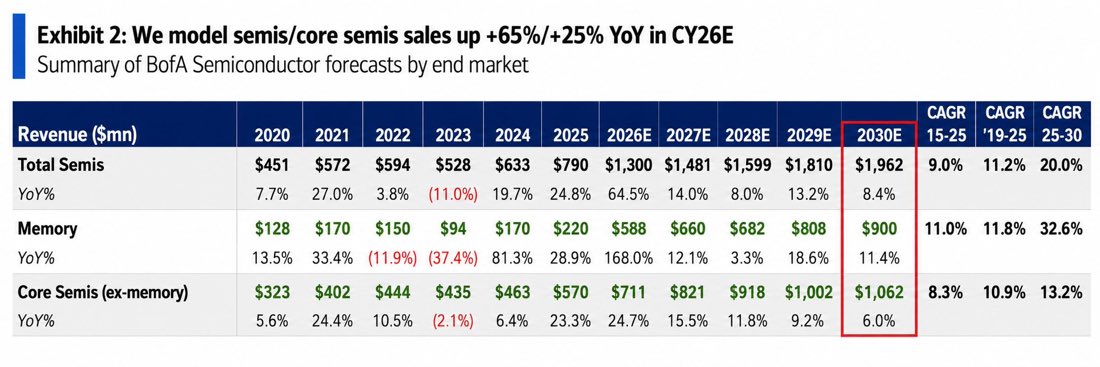
I don’t think people understand that complexities eat up die size and how large this market will be when billions of people are pulling inference demand parabolic.
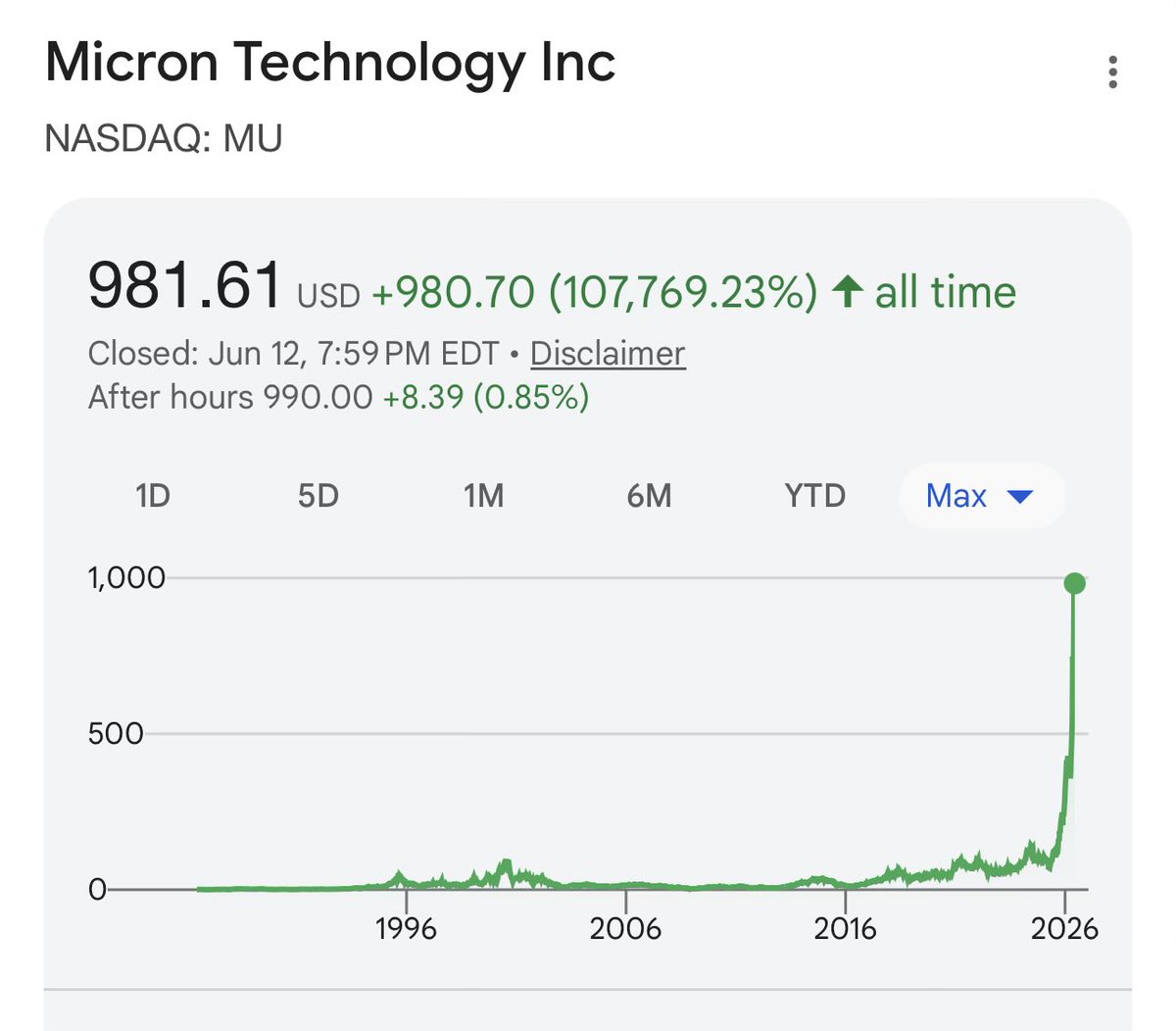
$MU $SNDK
"Everyone's making fun of these Koreans for being long memory stocks. But we're talking single-digit P/E multiples. It's probably going to last 2-3 more years. Triple digit growth." — @firstadopter
"Layer that onto the fact that 4 years ago, all these memory companies saw their revenue get cut in half. So they didn't expand capacity. And it takes 3-4 years to expand capacity."
"We're going to see mega pricing power. We haven't seen anything yet. These stocks are going to keep going higher, and their revenue rates are going to be astronomical."
From his appearance on the show last month.
$SPCX | CFRA 𝐢𝐧𝐢𝐭𝐢𝐚𝐭𝐞𝐬 𝐒𝐩𝐚𝐜𝐞𝐗 at 𝐒𝐞𝐥𝐥, sets 𝐏𝐓 𝐚𝐭 $𝟏𝟏𝟓
Analyst initiates with a Sell rating, citing an unfavorable risk-reward profile due to extremely ambitious growth plans and elevated valuation expectations.
think of spaceX as potentially owning the AI stack (models, infra, chips?) as materially lower space costs driving higher ROI to model providers (anthropic, OAI etc). going from 25GW towards 100-500-1000 inevitably requires $$$... if land and infra (about 25-35% of costs) is stripped out and people use space at 1/10th the price, then the question becomes...who wouldnt use it.
Would you rather invest in hyperscalers that have soaring CapEx, or in AI hardware companies that are on the receiving end of that CapEx?
I know my answer.