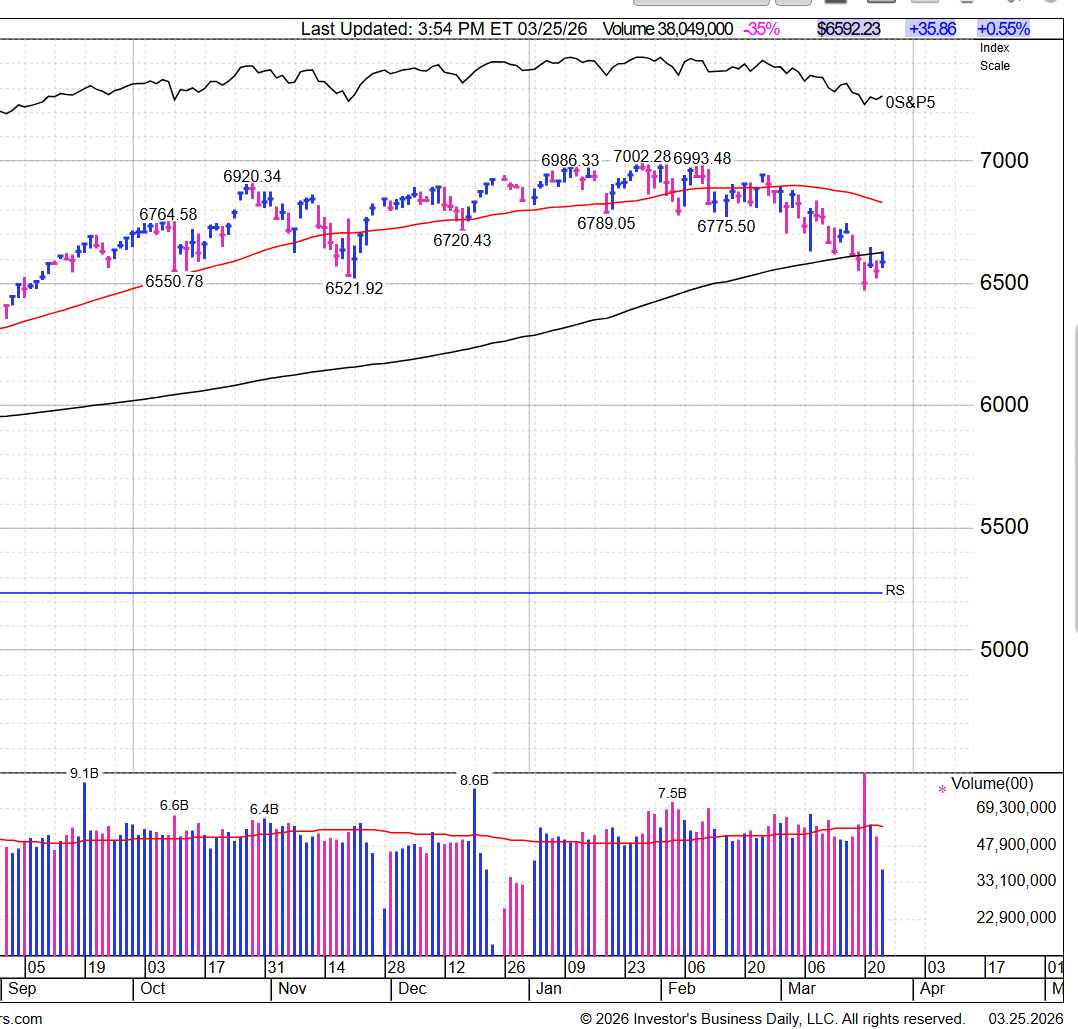
🗣 In a correcting market, tracking Relative Strength RS is essential because it acts as a filter to identify resilient leadership before the broader indices bottom. While most stocks fall during a correction, those with high RS tend to hold steady or decline significantly less than the market average. This "relative outperformance" suggests that institutional accumulation is occurring despite the prevailing gloom. By focusing on stocks that hold above key moving averages or prior bases while the market makes new lows, you are essentially narrowing your watchlist to the candidates most likely to lead the next bull cycle.
Furthermore, RS serves as a crucial timing mechanism for entering new positions. Historical market leaders often exhibit an RS line making new highs before the stock's actual price does a phenomenon known as a "blue sky" breakout in relative strength. When the market eventually turns and the selling pressure evaporates, these high RS names typically spring higher first and with the most velocity. Monitoring these stocks during a downturn ensures you are positioned in the highest velocity names at the exact moment the market trend shifts back to an uptrend.
A man who commits a mistake and doesn’t correct it once he becomes aware of it is making a greater mistake. A man who fails to learn from his mistakes is committing a sin.
—Mark Minervini
Linda Raschke’s 4 Trading Principles:
There are four basic principles of price behavior which have held up over time. Confidence that a type of price action is a true principle is what allows a trader to develop a systematic approach.
The following four principles can be modeled and quantified and hold true for all time frames, all markets. The majority of patterns or systems that have a demonstrable edge are based on one of these four enduring principles of price behavior. Charles Dow was one of the first to touch on them in his writings.
Principle One: A Trend Has a Higher Probability of Continuation than Reversal
Principle Two: Momentum Precedes Price
Principle Three: Trends End in a Climax
Principle Four: The Market Alternates between Range Expansion and Range Contraction!
I see three major opportunities to potentially multiply my capital going forward:
⭕️1. Gold, silver, uranium and miners (now entering the 2nd inning)
⭕️2. Mainland Chinese equities (especially tech) — still in the 1st inning
⭕️3. Properties in Hong Kong and Tier-1 cities in Mainland China (nearing the bottom of the cycle)
🔶This is just my personal take.
The perpetual doomers in Hong Kong’s financial scene will probably mock this outlook. Time will tell who laughs last.
The timing may be perfect because the idiots might still be trashing HK and China when #Gold #Silver and miners top.
Trolls should do the opposite and see what happens.
#Gold #Silver 🔥
Good rules from my good friend Stan the Man. I just spoke with him the other day. Stan is a national treasure. He calls me his "brother from another mother." If you haven't read his book, it's a classic and a fundamental must for anyone intetested in trend analysis.
Most traders obsess over their win rate. Minervini doesn't.
He explains why you can strike out seven out of ten times and still win -- as long as the math on risk-reward works in your favor over hundreds of trades.
The holy grail isn't a setup. It's asymmetry.
The market's character is still one of a bear market or cyclical correction; strong open, fade into close and major average living below the 200-day line. Before a reliable bottom can be established, we need to see better price and volume action, including better action from breakout names forming bases.
We are clearly NOT out of the woods yet. The market backdrop is one where sentiment has improved with rising pessimism, but not a full capitulation. The VIX has reached bear warning levels, but remains below true washout extremes. A volatility washout is not required for a bottom, but would add conviction.
Bullish Scenario
--The war ends
--Oil prices recede
--Stagflation concerns ease
--Central banks continuing their easing trajectory
Under this scenario, we would expect:
-A broadening market advance
-Emergence of new leadership from sound bases
-A Follow-Through Day (FTD) on the NYSE and/or NASDAQ confirming institutional buying with little in the way of immediate distribution
-Significant drop in volatility
Bearish Scenario
--The war persists or escalates
--The Strait of Hormuz remains disrupted
--Oil prices make new highs
--Stagflation becomes evident in hard economic data
This would likely result in:
-Limited general market rally attempts with most breakout stocks failing
-Lack of follow-through from breakout names
-Further deterioration in breadth and leadership
-Dearth of setups in buyable position
-Continued elevated volatility and distribution
In that case, sentiment would likely need to reach higher levels of pessimism before a durable market bottom could form. In its absence, and end to the factors that are pressuring the market could cause the market to bottom in less dramatic fashion.
All I set out to do was make a living from trading. But once I realized that the stock market is the greatest financial opportunity on earth, my goal became much bigger—to build enough wealth so I would never have to worry about money again. I wanted the personal freedom that comes with financial independence, and I achieved that by age 38.
I made my first trade at 18 years old in 1983. However, I didn’t get truly serious about trading until I was 25 in 1990. Still, it took me until I was 28 to fully commit to the discipline necessary to trade at the highest level. From that point on, my life changed—and the rest is history.
When I started, the Dow was trading just a little above 1,000. People were worried and they warned me that the market was too high. Today, the Dow trades over 45,000, and you hear the same worries. The fact is, it's never been a better time to be a stock trader. Those who say you can't succeed have no credibility because they never succeeded themselves. I'm here to tell you you can. The proof that I'm smarter than them comes not from my success, but from my belief in you.
Go get it! You can do it. 😇🙏
🚨 THIS IS HOW A REAL BLACK SWAN STARTS!
What people were warning about has now happened.
Israel and the US have launched strikes on Iran.
And if you think this is just another headline that markets will ignore
YOU ARE COMPLETELY WRONG.
This setup is VERY different from the last symbolic strikes.
This is not a one-off hit.
This is the kind of operation that can last for days, and Reuters reported the US military had already been preparing for a sustained, weeks-long operation against Iran.
That one fact explains a lot.
Because when a conflict stops being a headline and turns into a multi-day operation, the market stops pricing “shock” and starts pricing DURATION.
And duration is where the real damage starts.
There are only a few ways this goes from here, and they are NOT equal.
- LIGHT SHOCK: both sides exchange strikes, both claim victory, and markets slowly stabilize after the first panic.
- HEAVIER SCENARIO: the US gets pulled deeper, the operation drags on, and uncertainty starts hitting oil, shipping, inflation, and military spending all at once.
- WORST CASE: Iran disrupts the Strait of Hormuz, and the whole macro picture changes in hours.
That last one is the REAL danger.
About a fifth of global oil supply moves through the Strait of Hormuz, and Reuters has repeatedly flagged that any disruption there can push oil sharply higher.
Now connect the dots.
- If oil spikes, inflation risk comes back FAST.
- If inflation risk comes back, yields can jump.
- If yields jump, liquidity gets low.
And when liquidity gets low, risk gets DUMPED.
That is how the dominoes start falling.
And the market is already nervous.
Reuters reported Brent had already pushed to its highest since late July before the latest escalation, while tanker costs on Middle East routes hit six-year highs as war risk grew.
That is NOT normal.
That is the market telling you the risk premium is already building before the full chain reaction even hits.
So the point is simple.
This can still end as a short shock.
But if it stretches, or if Hormuz gets hit, it becomes a completely different market.
Not a dip.
Not a fake panic.
A REAL regime shift in oil, inflation, and risk.
That is why you have to be ready for different paths, not just the one you hope for.
And yes, moments like this can create OPPORTUNITY.
But first they create CHAOS.
I've studied macro for 10 years and I called almost every major market top, including the October BTC ATH.
Follow and turn notifications on.
I'll post the warning BEFORE it hits the headlines.
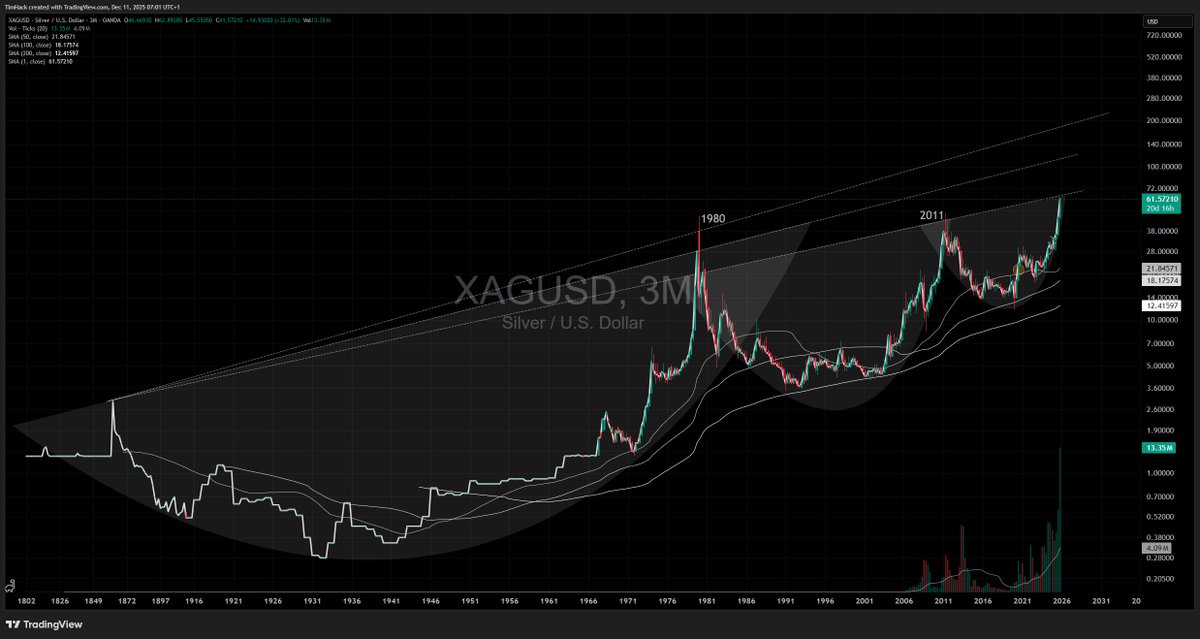
The 163-year-old silver cup and handle:
Some people say that silver is undergoing a correction or is overbought, but that is complete nonsense.
On the contrary, I am now convinced that silver has not even broken out yet.
If you track the price back to 1800, you will be shocked to discover that a second, larger cup lies ahead.
And since one could argue that the squeeze of the 1980s was exaggerated by Hunt speculation, a staged mega cup has formed, breaking out first at $65 and then again at $100, with the final breakout occurring at around $200, causing a long-term push towards $1000.
This is how end of US exceptionalism looks like.
Trade war on, yields up.
Trade war off, yields up.
Inflation beat, yields up.
Dollar down, yields up.
Dollar up, yields up.
Risk on, yields up.
Risk off, yields up.
US10Y back up to Trump's breaking point
Good news is bond vol is relatively "low"
Anything near 140 on the move index, you'll again see action from the administration
The world's most feared investor.
Paul Singer hasn't had a down year since 1977.
His fund returned 14% annually for 46 years, going from managing $1.3 million to $72 billion through activist investing...
Here are 8 of his best investing rules:
(No. 6 is fascinating)
And in an instant, YOUR life changed too. There's a lesson in everything. The smartest people are the ones looking the hardest for lessons and opportunities when others see tragedy.