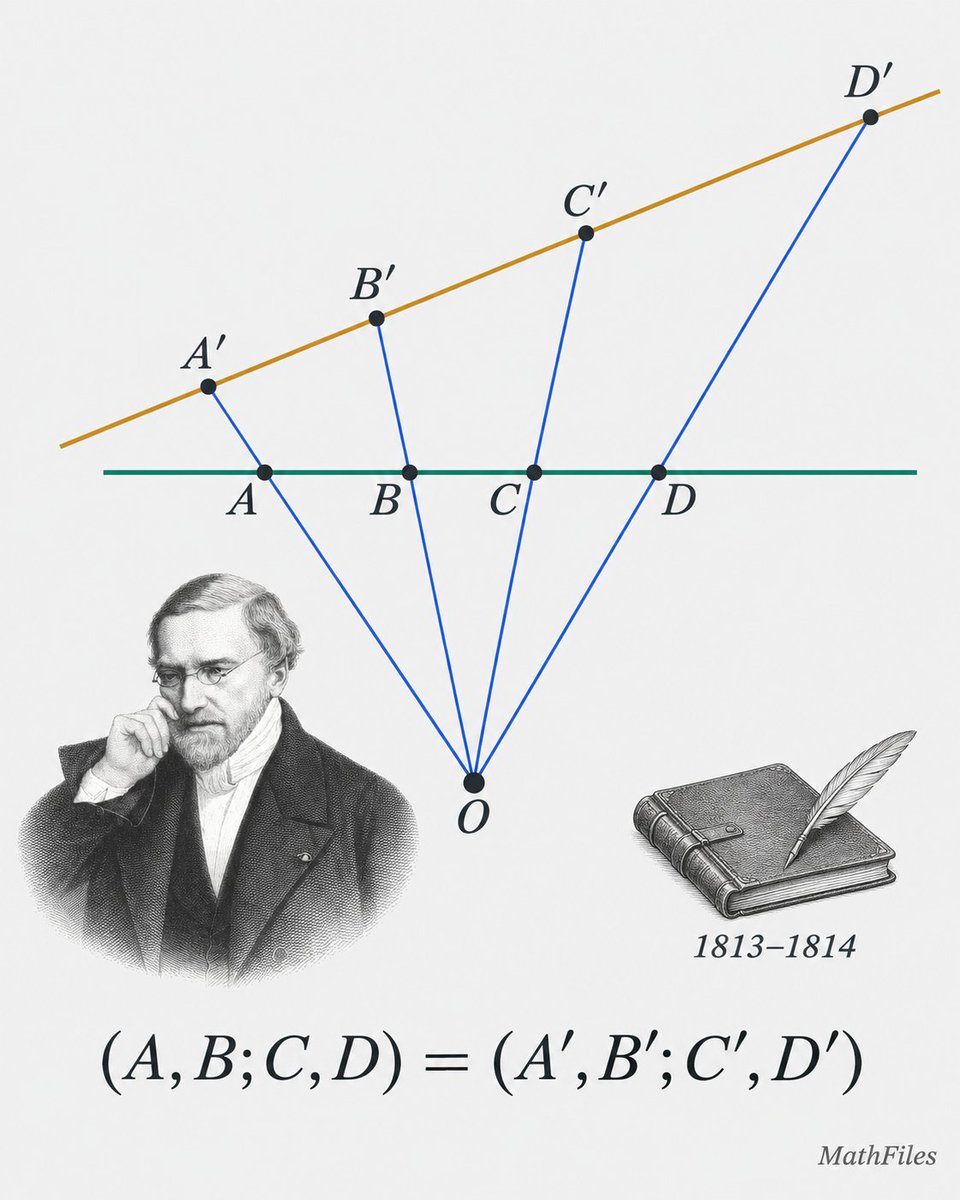
In November 1812, a 24-year-old French military engineer was left for dead on a frozen battlefield during Napoleon's disastrous retreat from Russia.
His name was Jean-Victor Poncelet.
Russian soldiers discovered that he was still alive and took him prisoner. He then endured a long, exhausting march across Russia before reaching a prison at Saratov, on the Volga River, in March 1813.
At first, Poncelet was too weak to think about mathematics. But when spring arrived, he began reconstructing the mathematical knowledge he had acquired during his education.
He had few books and limited writing materials. Curiously, he found that many technical details had faded from his memory, while the fundamental principles remained.
He began thinking about geometry in a different way. Which properties of a figure remain unchanged when it is projected into another figure?
A circle may appear as an ellipse under perspective projection. Distances and angles can change, but certain deeper geometric relationships survive. Poncelet investigated such properties while imprisoned in Russia.
When he returned to France in September 1814, he brought the material of seven mathematical notebooks written during his captivity.
In 1822, he published his influential Traité des propriétés projectives des figures, helping establish the modern theory of projective geometry.
The seven prison notebooks were later incorporated into a mathematical treatise published in 1862.
This episode is documented in Poncelet's own writings and appears in Eric Temple Bell's Men of Mathematics.
One detail makes the story particularly memorable.
Poncelet was isolated from the mathematical institutions and libraries of Europe, yet he continued developing serious geometry.
A prisoner of war had turned a period of extreme hardship into a substantial body of mathematical research.
The notebooks he carried home became part of the history of modern geometry.
@jmotivator@Beth_Kindig@EdLudlow@technology At the same time AI is heree to stay.
Adoption rate climb rapidly and most will also - subscription prices will drop. Heavy users will pay a bit more or same as regulars. The fact that heavy users are not profitable is not a problem - it it works the same for internet.
@Hiena_N A ko tu iesaki - turpinat pirkt katru gadu 10% dargakas polises? Tas ir cikls kas barojas pats no sevis un dzen uz augsu med. pakalp. cenas gadu no gada. Beigas ar dargu polisi piemaksasi par arstu tikpat cik kadreiz maksaji bez polises. Privatie ari griezh un pareizi dara.
@fermatslibrary Just wanted to share my thought process. Even though many comments made sense / helped, it somehow didn't seal it for me and I continued to think about core reason and perfect circle is just a special case you can roll around @Andrew_int_wood@scovell222, @21milkman
@fermatslibrary Imagine circling a square with P = 2pr. coin will rotate once 360 because it has roled the full perimeter lenght and it also rotates 90 on every corner. So for any equalateral poligon it will rotate one additional time since exterior angle is 360/n. For circle n is infinity.
Here’s a counterintuitive fact: hold one coin still and roll an identical coin around its edge. After one full lap the moving coin has made two full turns - not one.
@Gundars_Abolins@mabasurf Iekļaušana nenozīmē sabāzt visus vienā maisā. Bērns ar grūtībām matemātikā var būt izcils vizuālajā mākslā. Viņš neko neiegūst, mēģinot apgūt matemātiku līmenī, ko nevar pacelt. Risinājums ir grupas pēc līmeņa: palīdzam tur, kur ir grūtības, un dodam izaugsmi tur, kur ir talants.
@Gundars_Abolins@mabasurf Nevar vienā hokeja komandā trenēt tos, kuri tikko uzkāpuši uz ledus, kopā ar tiem, kas spēlē jau 3 gadus. Nevar mācīt vijoli tiem, kas nemāk to turēt rokās, kopā ar tiem, kas jau spēlē skaņdarbus. Līmeņu grupas palīdz augt VISIEM, nevis bremzē.
@Gundars_Abolins@mabasurf Risinājums ir vienkāršs: jādala skolēni pa līmeņu grupām konkrētos priekšmetos. Citādi mēs apzogam abus galus – gan tos, kuri var un grib mācīties sarežģītāk, gan tos, kuriem vēl jānostiprina pamati. Pašreizējā sistēma bremzē visu progresu.