In case you do not know, we have something called zkRWA.
This is because, there is tokenization and there is private tokenization. The latter uses ZK as an underlying tech to ensure privacy.
This is what I explained in the article below. He sure to read it, guys 👇
When you read a16z 2026 predictions, you will learn that RWA is graduating from Tokenization to Origination.
What does this mean and why does it matter? I will be using @EpicOnChain as a case study
🧵 Read more👇
This is the full ZK Ecosystem Map.
Do you remember that RWA was denied mainstream several times, until it became everyone's reality this year, 2025? ZK will do the same.
BOOKMARK This Post. You will come back to it when ZK goes mainstream in 2026. (There are 125 projects)
Yesterday, I highlighted 9 clear facts about Zk coprocessors and mentioned the top 3 Zk coprocessors.
Today, I will be making a comparative analysis on (Axiom, Brevis, and Lagrange), viewing them from 4 lenses:
{1} Product Design
{2} Adoption and Integration
{3} Market and,
{4} Workflow mechanisms
Let's dive into it:
~ Product Design
From the product lens, each has its own architectural design unique to its core focus, while @axiom_xyz focuses on Rollups, @brevis_zk focuses on dApps, and @lagrangedev on crosschain interoperability and verification.
However, their performances and security models differ, while Axiom has proven Ethereum mainnet blocks in 15s, Brevis achieved 99% in 12s, and 80 times performance gains for dAPP, while Lagrange has limited information on its performance efficiency. Here @brevis_zk wins.
In terms of security, Axiom runs a ZK-only proof model, while Brevis and Lagrange adopt a Hybrid model to secure data on-chain and also use operators on the Eigen layer to ensure secured off-chain verifications.
Who wins here? TBA, when we look at the Integration Friction under the "Adoption and Integration".
~Adoption and Integration
What is a working infrastructure if no one integrates it?
The more a product is adopted the better it seems.
The comparative analysis below shows how well each coprocessor has been adopted across chains.
From the image above, you'll realize that Brevis and Lagrange are close competitors with 20+ live protocol integrations, while Axiom has only a record of one currently.
Axiom raised the most funds but with less adoption metrics, while Brevis tops with the most adoption rate.
Also, ease of integration in the image was measured using Low-High scale, with Lagrange having a high friction based on its dynamic economic structure and use of "State committees."
The Economic model depicts the revenue generation mechanism. Axiom and Brevis collect fees using the native chain's token (e.g ETH on Ethereum) while Lagrange uses its $LA token for pricing.
In conclusion, viewing each coprocessor from the Product and Adoption lens, we can ascertain that each one of them has its unique architecture, specific product-market fit. But in terms of performance and adoptions, Brevis stands out as the Top Coprocessor.
Tomorrow, I'll cover the remaining lens and how well each of the coprocessors fits into the market (who each serves best), and the ease of their workflow mechanisms.
Stay Tuned.
𝐙𝐊-𝐏𝐫𝐢𝐯𝐚𝐜𝐲 𝐄𝐜𝐨𝐧𝐨𝐦𝐢𝐜𝐬: 𝐁𝐮𝐢𝐥𝐝𝐢𝐧𝐠 𝐓𝐫𝐮𝐬𝐭 𝐖𝐢𝐭𝐡𝐨𝐮𝐭 𝐓𝐫𝐮𝐬𝐭𝐢𝐧𝐠 𝐀𝐧𝐲𝐨𝐧𝐞
Today, no matter what you do, your digital action leaves a footprint. Each search, message, and payment is stored somewhere. The existing systems were built on undeserving trust because, at the end of the day, there is no privacy. Privacy has always been treated like a favor, not a right. Yet technology has reached a point where it can now be proven instead of promised. That is the power of Zero Knowledge.
------
📌 Breaking Privacy
The old web was built on confidence in companies, without user control. Every data server was policy-secured, not proof-secured. That was the 19th-century DeFi until we realized that every policy could be changed and every server could be hacked.
Interestingly, Web3 replaced trust with transparency. And this transparency solved one problem by creating another, proving trust but compromising privacy, as all transactions, positions, and trades would be made public forever. But what we need is not blind transparency or blind trust, but rather a system where truth can be verified without exposing the data that proves it. Hence, ZK technology.
------
📌 The Core of ZK
A zero-knowledge proof allows you to prove that a statement is true without revealing the underlying information, by turning computation into proof. In simple terms, you can prove that you paid your tax without showing your income. You can also prove that you have enough collateral without showing your wallet.
This concept turns privacy into infrastructure. Instead of depending on laws or terms of service, privacy is baked into the system itself. Ethereum’s shift toward RISC-V is part of this vision. It will make privacy computation faster and cheaper by design.
Ethereum’s upcoming shift to RISC-V is making private computation faster and cheaper by design.
------
📌 The Four Pillars of Real Privacy
→ Confidentiality: Hiding amounts or values from public view.
→ Unlinkability: Preventing others from connecting your actions to your identity.
→ Selective Disclosure: letting you reveal data only when needed.
→ Verifiable Compute: Proving that a result is correct without revealing inputs.
When ZK technology covers all four pillars, which it does, it turns the system into a complete architecture for privacy.
------
📌 The Builders of Private Compute
→ @Zcash pioneered shielded transactions using zk-SNARKs. It connects privacy and regulation by introducing viewing keys for optional auditability.
→ @SuccinctLabs runs a universal prover network that allows developers to outsource heavy cryptographic computation.
→ @cysic_xyz builds hardware acceleration for ZK proofs using GPUs and ASICs, converting compute power into yield assets and lowering proof cost to real-time levels.
→ @brevis_zk is a zk coprocessor that lets developers compute on historical data privately, allowing DeFi apps like @uniswap or @Frax to run data analytics without revealing the underlying transactions.
→ @arcium focuses on confidential computing on Solana. It uses Multi-Party eXecution Environments where encrypted data is processed in parallel across node clusters.
→ @encifherio offers private token transfers and swaps on Solana using ZK proofs, making it the closest thing to a private Venmo for blockchain.
Together, they point toward one direction: privacy is becoming modular. It will plug into any chain or app like liquidity or gas today.
------
📌 Privacy Economics
Privacy benefits markets by reducing adverse selection, protecting user autonomy, and curbing data monopolies. But in a free market, users seldom pay for it, making it underprovided. ZK gives a mechanism to enable privacy to be economically sustainable, thus internalizing the externality.
Supply and Demand of Proofs
→ Demand side: Protocols, dApps, institutions will want privacy, compliance, auditability, and proof-based trust.
→ Supply side: Prover networks (like Succinct), hardware accelerators (Cysic), zkVMs, and specialized services will deliver proofs.
Tokens, economic mechanism design, plus governance, must align supply with demand. @SuccinctLabs, for example, raised $55M led by Paradigm to enable developer access to ZK proofs. Their SP1 zkVM is an infrastructure, used by protocols like @Mantle_Official.
☑️ Game Theory and Equilibrium: Users weigh cost vs privacy utility. Provers weigh cost, rewards, and staking risk. As proofs become cheaper and ubiquitous, a stable equilibrium will only form where privacy is the default, not the premium.
☑️ Correcting Information Asymmetry: ZK levels the playing field because no one can hide falsity behind opacity. In DEXs, private intent layers reduce front-running and insider advantage.
------
📌 Privacy Economic Architecture
1. Private Intent Layer
If you want to prove, you prove privately.
The Private Intent Layer allows users to submit encrypted orders or transfers. The system processes them privately and posts only a verifiable receipt to the blockchain, removing transaction exposure while keeping execution transparent. It reduces the risk of MEV and protects users from front-running.
Here's how it works:
→ Users submit encrypted intents (e.g., trade, transfer).
→ Proof networks or encrypted compute match or execute.
→ A succinct receipt posts on-chain that proves correctness.
This hides volumes, counterparty, and timing. Then curtails MEV while preserving correctness.
2. ZK Data Permits
The ZK Data Permit extends the logic of Zcash’s viewing keys by making the user define who can access their data, for how long, and for what reason.
3. Private Historical Compute
This is the real meeting point between data utility and confidentiality. Here, protocols prove aggregate facts about history (90-day profit, risk ratios) without raw data. @brevis_zk and other zk coprocessors make this possible.
------
📌 How Can Non-Private Systems Become Private
Like I said earlier, privacy can be added where it was never designed to exist.
→ DEXs can route orders through the Private Intent Layer, providing best execution without exposing sizes or prices.
→ Lending protocols can accept ZK proofs of collateral health instead of public wallet balances.
→ Wallets can use ZK Data Permits to give auditors or partners temporary access.
→ Oracles can publish ZK-verified summaries instead of raw feeds.
→ Bridges can verify KYC status without receiving identity data.
These examples prove that privacy can scale horizontally across every layer of blockchain.
------
📌 The Privacy Movement
Privacy applications have already processed over $10B in 2024. It is showing strength again, meaning that the figure could reach over $50B to $100B. Transaction fees on these networks are already below a cent, showing that privacy no longer costs performance. Therefore, when Ethereum completely shifts to RISC-V and hardware acceleration is fully added, private computation will become as fast as public execution.
------
📌 The End of Blind Trust
ZK turns trust into math. It removes the need to hope that systems do the right thing and lets you verify it directly. This implies that the future of digital privacy will rely solely on default cryptography that enforces confidentiality. The next evolution of Web3 will not ask for trust. It will prove it.
Thanks for reading!
Happy Weekend, Guys.
As we all know, AI is one of the fastest-growing narratives. Same as Artificial General Intelligence. However, the most important fact about it won't be speed or scale, but rather trust, which proves that every step an intelligent system takes is correct and worth paying for.
Simply put, the next-gen AI and Web3 will not pay for “work done.” It will pay for verified intelligence.
𝐓𝐡𝐞 𝐂𝐨𝐦𝐩𝐥𝐞𝐭𝐞 𝐀𝐈 𝐒𝐭𝐚𝐜𝐤: 𝐏𝐚𝐲 𝐎𝐧𝐥𝐲 𝐟𝐨𝐫 𝐕𝐞𝐫𝐢𝐟𝐢𝐞𝐝 𝐈𝐧𝐭𝐞𝐥𝐥𝐢𝐠𝐞𝐧𝐜𝐞
------
📌 Measuring Verified Intelligence
Every smart system needs a benchmark. In this case, it’s how many correct micro-steps per dollar (χ) a platform delivers. And instead of tracking raw compute or token emissions, the goal is to measure efficiency and truth, the verified steps that will move the results forward. This single metric keeps everyone honest. Quantum processors, GPU clouds, agents, and even smart contracts must meet the same rules. If the step isn’t verified, it doesn’t count.
------
📌 The Flow Of Verified Work
Now picture the process:
→ An agent picks a task.
→ The work is divided across compute markets, whether GPUs, quantum processors, or hybrid setups.
→ Each task generates a proof, such as model results, data reads, or program runs.
→ A ZK coprocessor verifies these proofs beside the blockchain.
→ Finally, the smart contract pays only when the receipt passes verification.
Every participant in this loop, from the agent to the verifier, works toward one goal: Raising the verified efficiency score, χ.
------
📌 The Brains: Agents and AGI Systems
The intelligence layer is led by teams building autonomous systems that request proofs instead of trusting outputs:
→ @SentientAGI is building a decentralized open economy, where models and agents own their work and earn from it. Each model has its own identity, revenue rights, and verifiable outputs.
→ @ritualnet connects on-chain applications directly to off-chain AI inference, allowing contracts to call verified model outputs.
→ @gizatechxyz focuses on verifiable machine learning, where models can prove (cryptographic proof) they performed a task correctly without exposing private parameters.
Together, these projects turn agents into active negotiators. They choose compute resources carefully, verify every step, and pay only for confirmed results.
------
📌 The Muscle: Compute Markets
Behind every agent is compute power, now organized as an open marketplace. Agents can shop for power based on both cost and proof.
→ @akashnet decentralizes GPU cloud resources for AI training and inference.
→ @ionet aggregates thousands of unused/idle GPUs into one global compute pool.
→ @rendernetwork extends its 3D rendering marketplace into AI workloads with programmable GPU APIs.
→ @nosana_ai specializes in containerized inference for machine learning.
→ @golemproject connects consumer GPUs for small-scale AI tasks.
→ @bittensor_ creates an incentive layer for AI models, where AI subnets earn rewards for quality responses.
→ @gensynai and @NousResearch's Psyche enable decentralized model training with cryptographic verification.
In this open market, “cheap” no longer means the lowest sticker price. It means the best verified performance per dollar.
------
📌The Data Layer: Provenance and Receipts
AI is only as reliable as the data that feeds it. We have a growing list of protocols, ensuring that inputs are verifiable, reproducible, and linked to their origin:
→ @grass decentralizes data collection from real users and adds verifiable on-chain provenance.
→ @0G_labs and @brevis_zk make it possible to retrieve both crosschain and off-chain data with verification.
→ @HerodotusDev allows developers to prove historical blockchain states and link them to AI logs.
Together, they create a data fabric where every piece of information has a receipt.
------
📌 The Proof Engine: ZK Coprocessors
ZK coprocessors serve as the bridge between all layers. They check every off-chain operation, including computation, data integrity, and model inferences, then compress everything into a small proof that the blockchain can confirm in seconds. and return a compact, verifiable proof that the blockchain can confirm in seconds.
→ @axiom_xyz verifies Ethereum’s historical data.
→ @lagrangedev turns data queries and AI computations into verifiable proofs.
→ @brevis_zk handles crosschain verification for data and compute results.
→ @RiscZero and @SuccinctLabs SP1 allow any program to run off-chain and return a zero-knowledge proof of correctness.
These coprocessors make the principle of “proof first, payment second” practical.
------
📌Proof Generation Network: Cysic
@cysic_xyz fills the most demanding gap in the verification stack, “proof generation.” It accelerates and decentralizes zero-knowledge proof creation through specialized hardware and a global prover network.
When an agent finishes a compute job, the heavy work of generating the proof is routed through Cysic. It uses optimized hardware like GPUs, FPGAs, and dedicated ASICs to produce proofs faster and cheaper. The finished proof then moves to a coprocessor for verification and payment.
------
📌 The Model Layer: Verifiable ML
As AI models move on-chain, they must prove that they actually performed the work they claim. That’s what zkML projects focus on:
→ @ezklxyz compiles ONNX models into zero-knowledge proofs for verifiable inference.
→ @ModulusZK develops performance standards for provable inference on zkML systems.
→ @gizatechxyz unites these capabilities for on-chain AI application model executions.
This layer makes AI auditable, allowing for a model to prove its output without revealing its proprietary weights. The system protects both intellectual property and trust.
------
📌 The Quantum Edge
Quantum computing doesn’t replace this system. It strengthens or enhances it. What does that mean?
Quantum engines handle complex subtasks within AGI loops, including optimization, search, or memory mapping. Each quantum run is treated like any other compute job. It produces a verifiable transcript, passes through a coprocessor, and triggers payment only when verified.
The rule remains the same. Proof first. Payment second.
------
📌 The Loop Examples
1. A Research Agent gathers data across multiple chains → Proves every source using Grass and Brevis → Runs analysis with Giza → Verifies every inference with Lagrange → Pays compute providers via Brevis receipts → Releases results after verification.
2. A Trading Assistant runs strategies on Akash or Bittensor → Verifies each inference with EZKL → Processes payments once verified on Axiom.
3. A Developer Bot tests code on Render or Nosana → Verifies the results through RISC Zero → Unlocks payment after proof confirmation via Axiom.
Each example shows the same outcome. You don’t trust the output. You trust the proof.
------
📌 The Economics of Verified Work
Every layer contributes to a new type of economy, one that values verified intelligence instead of raw compute.
→ Agents choose providers with the best verified costs.
→ Markets compete to produce faster, cheaper proofs.
→ Developers are rewarded for accuracy.
The entire ecosystem runs on the χ scoreboard, the ratio of verified steps to total cost. When systems become more efficient, χ rises. When verification becomes heavy, χ falls. This feedback keeps the innovation disciplined.
------
📌 What About Security?
Post-quantum security is the foundation of this ecosystem. How does it work?
→ Agents sign transactions with post-quantum cryptographic keys.
→ Models are signed and timestamped for traceability.
→ Every proof remains stored and replayable for future audits.
This ensures that verified intelligence is also secure intelligence.
------
📌 Open Questions
1. How much verification overhead can live systems tolerate?
2. Which AGI tasks gain the most from quantum acceleration today?
3. What incentives will push compute providers to include proofs by default?
4. Which data should be verified on-chain, and which off-chain?
These questions will define how scalable and fair verified intelligence becomes.
------
📌 Wrap Up
The future of AI is about having the most accountable model. A model that can prove its intelligence works as claimed. The fact is, Web3 provides the rails for transparent value exchange, ZK coprocessors keep everyone honest, and Quantum expands what’s possible. Together, they create a new economy where every action has a receipt, and every payment represents truth delivered. In this system, intelligence is proven, priced, and paid for.
If you've been paying attention to market updates, you'll realize that after BTC and BNB, MNT is the next in line as one of the best-performing assets in this run. Below are the developments leading @Mantle_Official to new highs over the past month:
------
Recent Statistics:
* TVS level and 30-day change: $2.57B, up ~14.1%.
* TVS composition: Canonical ~$1.97B, External ~$555.9M, Native ~$36.5M
* Stablecoins on Mantle: ~$732.8M, 30-day change +16.6%, 7-day +4.27%
* Bridged TVL level and mix: total ~$2.04B with Canonical ~$776M, Third-party ~$1.01B, Native ~$255M. Top bridged assets include USDT ~$507M, ETH ~$383M, CMETH ~$339M, USDE ~$159M, METH ~$143M
* Chain and app monetization (snapshot): chain revenue (24h) ~$2,580; app revenue (24h) ~$13,830
* Trading activity: DEX volume (7d) ~$181.8M (WoW −27.4%); Perps volume (7d) ~$0.44M (WoW +5,935% on a minimal base)
* DA cost profile (structural): 1-year total on-chain cost ~$18.15K. Avg cost per L2 operation ~$0.000178; avg per day ~$49.7
* Data posted to EigenDA (throughput proxy): ~186.3 GiB; ~785 MiB per day average
* Activity (L2BEAT ops metric): past-day ops count ~64,000; past-day UOPS ~0.74 (methodological metric)
* Mantle staking stack footprint (mETH ecosystem): mETH protocol TVL > ~$1.15B (indicates demand for Mantle’s staking engine, though much sits on mainnet)
------
Mantle’s Last 30 Days: What Actually Happened
📌 Protocol & Infrastructure
→ Mantle completed its transition to a ZK rollup via OP Succinct, switching from optimistic proofs to zero-knowledge proofs. After the cutover, Mantle became the largest ZK rollup by TVL (above $2B).
→ As part of that upgrade, the network’s validation and state transition logic were rearchitected to support faster finality and lower proof costs per transaction.
📌 Tokenization / RWA Infrastructure
→ Mantle launched a new tokenization platform (Tokenization as a Service (TaaS) model) for institutional asset issuance, bringing on board WLFI’s USD1 stablecoin as a native asset.
📌 Oracles & Tooling
→ DIA added MNT price feeds on Mantle, giving developers access to verifiable, on-chain pricing for MNT. That supports collateralized applications, risk modules, and overall better transparency.
→ Developer tooling updates and internal previews revealed enhanced debugging and monitoring modules for the new Succinct architecture, smoothing the transition period for projects already on or migrating to Mantle.
📌 Partnerships & Distribution
→ USD1 stablecoin integration was rolled out, with WLFI’s team tying its issuance directly into Mantle’s tokenization rails.
→ Bybit and Mantle published a 2025 roadmap together, outlining deeper collaboration in trading, payments, savings, staking rewards, and cross-product synergy.
→ Alchemy Pay announced support for direct fiat on-ramps into MNT, allowing users to enter the Mantle ecosystem with traditional payment rails more easily.
📌 Market & Adoption Signals
→ MNT broke successive ATH over the month. It is majorly tied to the combination of the ZK upgrade, USD1 integration, and Bybit collaboration.
→ The mETH / cmETH staking economy is still very active. Despite fluctuations, the demand for Mantle’s LSD protocol stack held, reinforcing Mantle’s capital layer as a serious play.
📌 Risks & Watchpoints
→ USD1 reserve transparency continues to be questioned by some observers. As usage of USD1 on Mantle scales, reserve disclosures, audits, and attestation consistency will be crucial to sustaining trust.
→ Native DeFi depth is still under development. While Mantle is punching above its weight in infrastructure, many core applications and liquidity moats are still in early stages or migrating from other L2s.
I entered October with deteriorating health, but thankfully, I am stronger now. I sincerely appreciate those who reached out during my absence.
While I was away, all I could do was observe the state of the market and the sentiments on the TL. With this, I came to understand that the "HODL" policy had changed. That is, narratives and trends still drive attention, but the easy upside remains in short windows. Then, alts feel heavy even with BTC hitting new highs.
Why does it feel different?
→ Marginal bids are in ETFs, basis trades, and market-neutral books, so trending moves decay faster.
→ Derivatives drive discovery, and funding resets momentum quickly.
→ Liquidity is scattered across L2s and venues. Thus, depth is patchy and rotation is very fast.
→ Airdrops still matter, but value perceived skews to yappers and engagement farmers.
→ Unlocks are larger and more frequent, which often makes supply outpace organic demand.
But one thing is very clear. HODL still works for BTC and a few top assets. And for everything else, you can only aim for short windows around real catalysts, enter on spot-led strength, plan clean exits, then rinse and repeat.
------
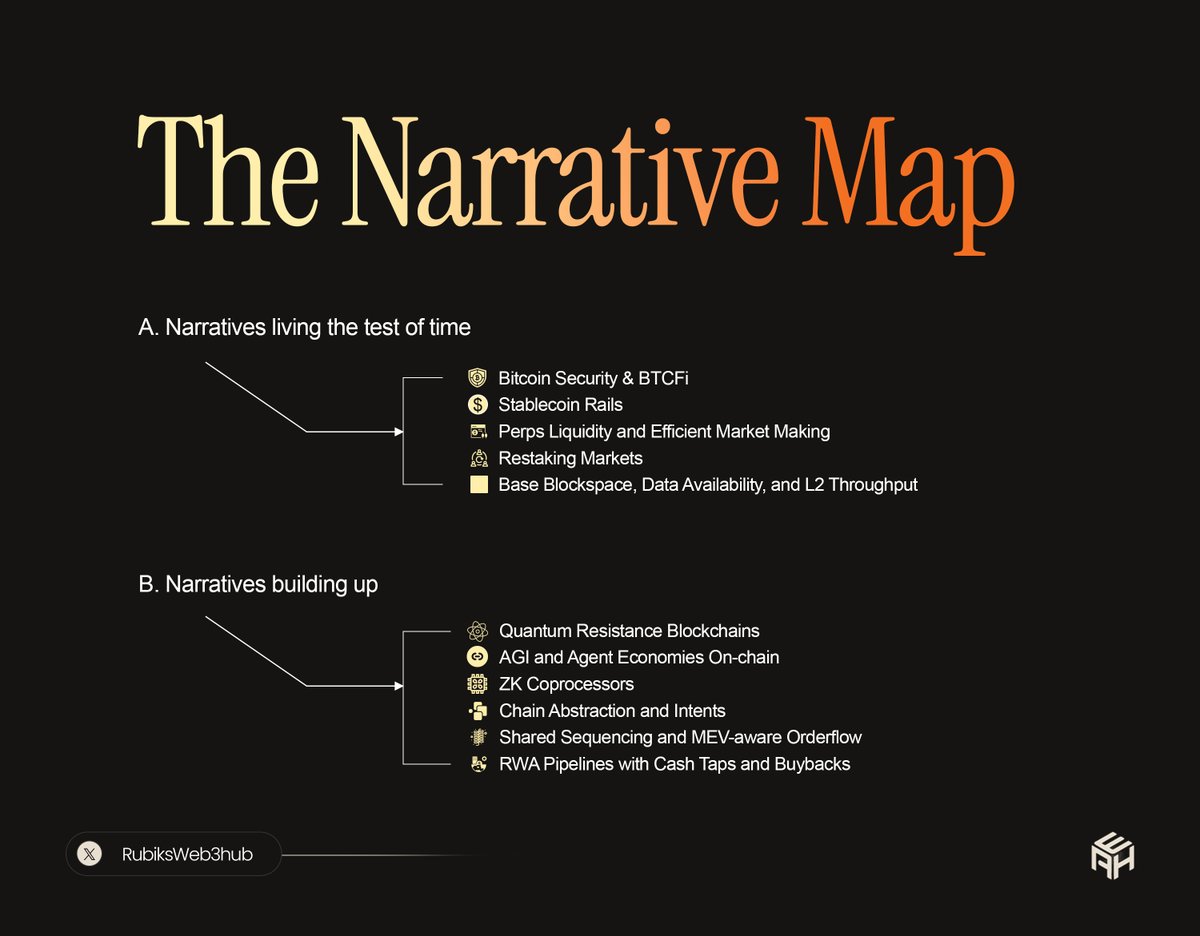
The Narrative Map You Can Trade
📌 Narratives living the test of time:
1. Bitcoin security & BTCFi:
The stack around Bitcoin keeps getting faster and more programmable. Recent upgrades on BTC-anchored layers were done to cut latency while inheriting Bitcoin finality, and new EVM-style approaches that settle back to BTC are maturing. The enabled a steadier settlement layer plus fresher pipes for apps, which is why this theme keeps finding product and liquidity. @babylonlabs, @Lombard_Finance, and @SolvProtocol are great examples.
2. Stablecoin Rails:
Merchants and processors continue to fold stablecoins into real payments, so dollar tokens keep compounding as the default settlement rail in crypto. As processors expand support and issuers professionalize reporting, stablecoins become more like financial plumbing than a narrative, and that durability shows up in steady volumes and clearer fee switches. Global stablecoin supply is above $300B. This enabled major policy voices to acknowledge its systemic relevance, while regulators move towards purpose-built frameworks. The Bank of England’s governor flagged stablecoins’ role in payments this week. Also, Financial Times shared that stablecoin generated $8.9T in first-half transaction volume this year.
3. Perps Liquidity and Efficient Market Making:
Derivatives drive price discovery now. Perpetuals set the tape, funding flips fast, and the best venues marry deep order books with smart inventory bands. When spot leads and perps confirm, moves are cleaner and more durable. And when perps drag price without spot, the edge decays. Notably, Perp DEX monthly volume cleared the $1T mark in September, a first for this sector, with leaders like @Aster_DEX and @HyperliquidX rotating at the top. Protocol-level dashboards show sustained daily flow at the majors.
4. Restaking Markets:
Restaking evolved into real security services with enforceable slashing. AVSs are launching, operators are professionalizing, and restaked collateral has become an input for multiple networks. EigenLayer has rolled out slashing and multichain verification features and reports multibillion restaked collateral and dozens of live AVSs.
5. Base Blockspace, Data Availability, and L2 Throughput:
Rollups keep outsourcing data availability to specialized layers to cut costs and raise throughput, and the adoption curve is visible. As DA reliability and pricing improve, more apps scale without wrecking user costs, which is why they keep compounding into different narratives. Celestia reports dozens of rollups using its DA layer and visible activity on analytics. EigenDA is live as an AVS in the restaking stack with published pricing and integrations, and DA layers are now treated as a discrete market.
📌 Narratives Building Up
1. Quantum Resistance Blockchains:
Post-quantum signatures are moving from papers to implementations. Standards exist, some chains already sign accounts with hash-based schemes, and others are mapping migration via account abstraction so users can rotate to PQ wallets without breaking compatibility. The big unlock for this narrative will be mainnets with PQ accounts for users and validators, plus audited libraries and a clean recovery plan. @QANplatform already began this. Also, STARK proofs used by @StarkWareLtd are widely considered post-quantum because they rely on collision-resistant hashes rather than discrete log assumptions.
We should know that NIST finalized three primary post-quantum standards in 2024, including ML-KEM and ML-DSA, and approved SPHINCS+ as SLH-DSA. XMSS and LMS are recommended in NIST SP 800-208, with XMSS specified in RFC 8391. The Quantum Resistant Ledger uses XMSS at the protocol level today. Government and industry migration guides describe dual-signing for backward compatibility.
Read more about Quantum Resistance Blockchains here: https://t.co/4wYp6DYW2o
2. AGI and Agent Economies On-chain:
Agent networks are shifting from theory to production. @SentientAGI launched The GRID as an open AGI network. @autonolas reports millions of on-chain agent interactions, and the ASI merger is consolidating AGIX and OCEAN into one liquidity pool. Compute supply from @ionet and @akashnet is scaling to match agent needs.
3. ZK Coprocessors:
Proof systems are becoming off-chain engines. @brevis_zk, @axiom_xyz, @RiscZero, @SuccinctLabs, and @lagrangedev all run prover networks that offload heavy compute and return proofs to Ethereum and other chains. Performance is improving, with real-time block proving now demonstrable.
Read more: https://t.co/rPgtmbAtej
4. Chain Abstraction and Intents:
User flows are inching toward one balance, one approval, many chains under the hood. Account abstraction is live, cross-chain intent standards are being drafted toward practical usage, and universal accounts are rolling out, so solvers route and pay gas for users. When exchanges and wallets adopt these paths, switching costs fall and flows concentrate. @ParticleNtwrk is a leading platform with universal accounts and interop, stating intents as a core primitive.
5. Shared Sequencing and MEV-aware Orderflow:
Neutral sequencers and protected orderflow aim to cut censorship and bleed while enabling atomic cross-rollup execution. Designs are public and early mainnets are online, but adoption is just starting. The inflection comes when named rollups flip on shared sequencing and publish measurable improvements, or when protected orderflow rebates reach users at scale. We have @AstriaOrg, @EspressoSys, @radius_xyz, and @nodekitorg implementing these, with multiple L2 teams testing shared sequencing.
Read more: https://t.co/oF2FcSa9H8
6. RWA Pipelines with Cash Taps and Buybacks:
Tokenized treasuries and credit keep climbing as issuers professionalize custody, attestations, and distributions. When protocols pair these cash taps with buybacks or fee sharing, holders can point to tangible flows instead of pure emissions. The flywheel is compliance first, revenue second, and liquidity third. The total RWA value topped $30B and is rising, with BlackRock’s BUIDL fund accelerating issuance and dividends while expanding to multiple chains.
------
Event-driven Playbook:
To stay on track with these narratives, pick 2 to 3 “living” narratives as your core watchlist. Add 2 “building” narratives as your hunting ground. Everything you do each day maps to these 4 to 5 lanes.
📌 What to watch:
→ TGE and first listings: The largest impulse often arrives inside 7 to 10 trading days.
→ Liquidity shocks: New CEX listings, market-maker mandates, vault launches, LST integrations, RWA onboarding.
→ Program flips: Points to tokens, fee switch on, or buyback switch on.
→ Unlocks: Size, recipients, schedule. Treat weekly supply above 1% of circulating as caution.
→ CEX perps to spot handoff: If funding cools while spot volume rises, the drive is healthier.
📌 How to act:
→ Enter on spot-led breaks with rising open interest (OI) that does not force funding too positive.
→ Scale while top-of-book depth holds and slippage stays inside your limit.
→ Trim into known supply events and campaign ends.
→ Flatten if the catalyst window expires without continuation.
------
On-chain Hunting System
📌 Signals to track:
→ Deployer graph: Follow top engineering teams, their auditors, and their deployer wallets.
→ Fresh pool radar: First $1M depth in the main pool is your alert, then walk the book to confirm real depth.
→ Bridge flows. Net inflow to a project’s home chain often leads headlines.
→ Social plus code. GitHub commits and contract changes rising with social traction beat pure hype.
------
Token Design Tells
📌 What reduces churn:
→ Sinks and sources: Burns, buybacks, fee share, or staking that actually removes float.
→ Emissions path: Thin utility with front-loaded emissions is a sell-the-rip setup.
→ Alignment: Users who create network value must capture a large share of it.
→ Market-maker mandate: Transparent inventory bands and clear liquidity obligations are a green flag.
------
Execution rules
📌 Sizing:
→ Scouting size at 0.25 to 0.5 of your unit risk when signal fires.
→ Add up to 1.0 only on confirmed spot-led continuation.
📌 Exits
→ Pre-declare exits around the next unlock, listing, claim, or program flip.
→ Take profits in three clips into known supply.
📌 Time
→ Respect time boxes. If the window closes, get flat.
→ Rotate the stack. Idle cash remains in safe yield, not stale bags.
------
The goal of this write-up is to tell us how to treat the current market. That is, you should think in catalysts and cash cycles. This will help you to hold conviction in a few cores, but treat the rest as trades wrapped around real events. That is how you catch early gems without living at the screen.
Stay healthy, stay alert, and be early.
Thanks for reading!
Again, attention = liquidity. I've explained why and how.
Now, the liquidity engine for attention is gaining momentum, and you need to be a part of it.
This is why I'm sharing the latest on @inspectxyz's products and the market situation of $INSP.
🧵
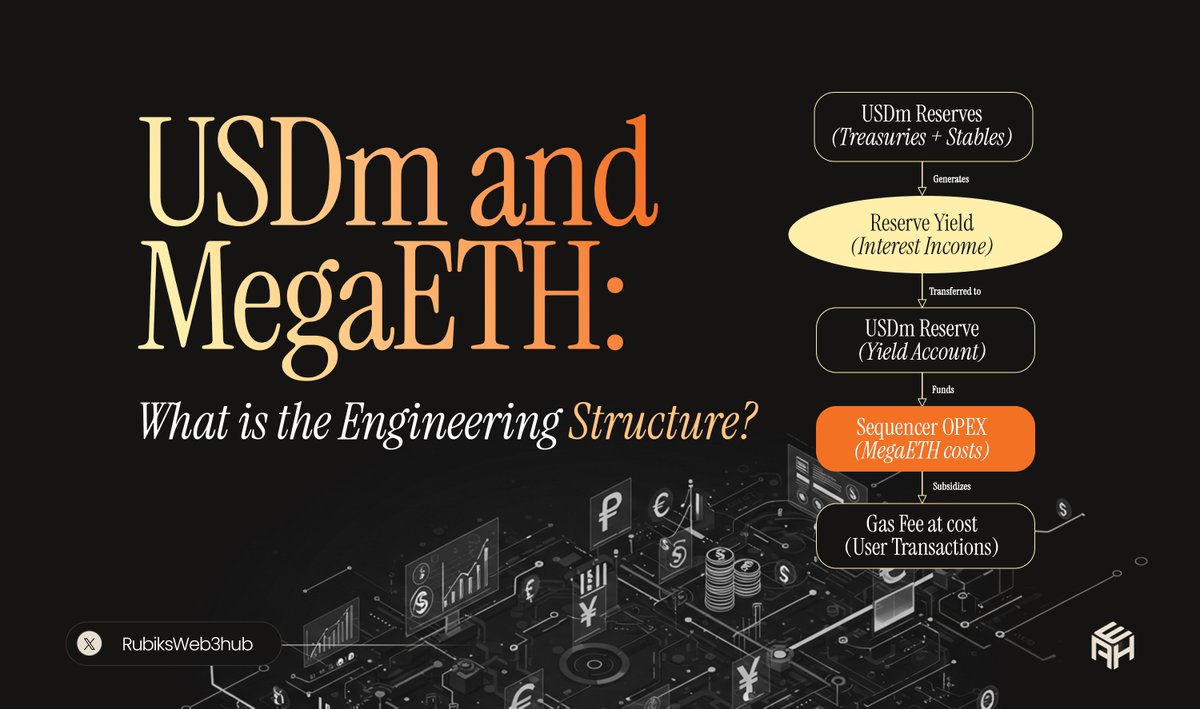
𝐔𝐒𝐃𝐦 𝐚𝐧𝐝 𝐌𝐞𝐠𝐚𝐄𝐓𝐇: 𝐖𝐡𝐚𝐭 𝐈𝐬 𝐓𝐡𝐞 𝐄𝐧𝐠𝐢𝐧𝐞𝐞𝐫𝐢𝐧𝐠 𝐒𝐭𝐫𝐮𝐜𝐭𝐮𝐫𝐞?
TL;DR
USDm is issued on Ethena’s USDtb rails and backed primarily by tokenized U.S. Treasuries (BlackRock BUIDL via Securitize). The reserve yield is programmatically routed to cover MegaETH sequencer OPEX, so gas can be priced at cost while keeping fees stable as throughput scales. Integration is deep across wallets, paymasters, and apps on @megaeth. USDT0 and cUSD remain first-class assets.
------
📌 𝐓𝐡𝐞 𝐃𝐞𝐯𝐞𝐥𝐨𝐩𝐦𝐞𝐧𝐭 𝐒𝐭𝐚𝐜𝐤
1. Economic layer
→ Reserves: USDm v1 uses the USDtb reserve model: ~target 90% BUIDL (tokenized short-duration Treasuries) held via Securitize, plus liquid stables for redemptions. It has 24/7 atomic swaps between USDtb and BUIDL, which tighten settlement and transparency.
→ Yield source: BUIDL’s T-bill yield accrues on reserves such that yield is earmarked to fund sequencer costs on MegaETH.
2. Issuance
→ Issuer rails: Ethena provides the stablecoin stack (contracts, treasury operations, reserve disclosures). USDm adapts its collateral mix over time.
→ Compliance/custody: USDtb has a clear path toward compliance (GENIUS Act notes with Anchorage) and institutional integrations.
3. Execution & Settlement
→ Chain integration: MegaETH bakes USDm into paymasters, wallets, DEX routes, oracles, and app services. Gas can be paid cheaply while USDT0 and cUSD remain supported routes.
→ Sequencer OPEX link: Reserve yield flows to a funding sink that offsets the L2’s sequencer costs. This inverts the usual fee-margin model and lets MegaETH run the sequencer at cost.
📌 𝐌𝐞𝐜𝐡𝐚𝐧𝐢𝐜𝐬
1. Reserve backing and mint/redeem
→ Backing: USDm v1 is economically equivalent to USDtb units sitting on BUIDL, with a liquidity sleeve in stablecoins to support redemptions. Reserve composition is adjustable by policy.
→ Mint/redeem path: On issuance, assets routed through venues become USDtb exposure. Atomic swap rails allow moving between USDtb and BUIDL 24/7, improving settlement finality and liquidity management. Redemptions unwind the path in reverse.
2. Yield routing to L2 costs
• Computation: Net portfolio yield of reserves → USDm Reserve Yield Account → periodic transfer to Sequencer OPEX bucket. Gas prices can then track data and compute costs rather than a markup.
Why? As data costs change and throughput scales, fee volatility doesn’t need to be pushed to users to protect L2 margins.
3. Onchain, Ethena’s USDtb/USDe contracts provide ERC-20 interfaces and policy hooks. MegaETH then integrates paymaster support and router/oracle paths for USDm.
------
📌 𝐈𝐧𝐭𝐨 𝐌𝐞𝐠𝐚𝐄𝐓𝐇 𝐀𝐫𝐜𝐡𝐢𝐭𝐞𝐜𝐭𝐮𝐫𝐞
MegaETH’s execution architecture is heterogeneous:
✔️ One active sequencer
✔️ Full nodes,
✔️ Replica nodes (apply diffs without re-execution), and
✔️ Prover nodes.
It targets ~10 ms latency and 100k+ TPS, secured by Ethereum and paired with EigenDA for data availability. The USDm design complements this by de-linking fee revenue from user surcharges and pinning it to reserve yield.
------
📌 𝐃𝐞𝐯𝐞𝐥𝐨𝐩𝐦𝐞𝐧𝐭 𝐑𝐨𝐥𝐞𝐬
1. MegaETH (MegaLabs):
→ Integrates USDm into wallets, paymasters, gas accounting, indexers, and routing.
→ Maintains a fee policy that prices gas at cost, funded by USDm yield.
→ Preserves competing stablecoin routes (USDT0, cUSD) to avoid lock-in.
2. Ethena
→ Operates the stablecoin stack and reserve policy for USDtb. Provides issuance, risk, disclosures, and protocol governance.
3. Securitize / BlackRock
→ BUIDL custody/transfer, investor compliance, and tokenized fund operations that underpin USDtb’s reserve quality and liquidity rails.
------
📌 𝐀𝐝𝐯𝐚𝐧𝐭𝐚𝐠𝐞𝐬
→ Fee Stability at Scale: Yield covers sequencer OPEX as usage rises, so MegaETH avoids hiking fees to defend margins.
→ Institutional Reserve quality: BUIDL and Securitize add a clear operational framework and integrations across CeFi/DeFi.
→ Adaptable Reserve Policy: Ethena’s stack allows shifting collateral mix (e.g., to include USDe exposure) if conditions change.
------
📌 𝐑𝐢𝐬𝐤𝐬 𝐚𝐧𝐝 𝐎𝐩𝐞𝐧 𝐐𝐮𝐞𝐬𝐭𝐢𝐨𝐧𝐬 (𝐄𝐧𝐠𝐢𝐧𝐞𝐞𝐫𝐢𝐧𝐠 𝐚𝐧𝐝 𝐏𝐨𝐥𝐢𝐜𝐲)
→ Reserve yield vs. OPEX mismatch: If short-rate yields compress or DA costs rise, yield may not fully cover sequencer costs, forcing policy changes or supplemental revenue.
→ Counterparty/compliance dependencies: Reliance on BUIDL/Securitize and associated investor frameworks introduces offchain and regulatory dependencies.
→ Smart-contract surface: USDtb, paymasters, routers, and OPEX routing add integration risk. I expect audits and management.
→ Liquidity pathing: Deep liquidity for USDT0 and cUSD will coexist. This means USDm needs competitive venue support to minimize routing slippage in practice.
→ Governance clarity: Who will manage reserve-mix changes for USDm, and how OPEX distributions are parameterized? This matters a lot to users and integrators.
You can also check a simplified explanation of USDm, written by @St1t3h:
https://t.co/Fkk6NqzfAy
I also wrote a technical article on MegaETH contemporary Economics. Read below 👇
“Where has Starr been?”
The first 7 months of every year test me the hardest, as both a medical student and a trader.
There’s always an MB to prepare for (so I don’t fail out of med school 😂) and big goals to chase. The balance isn’t easy. It gets overwhelming.
This year was no different but I scaled through and now I’m back louder, sharper, and ready to flood your timeline with value. 🚀
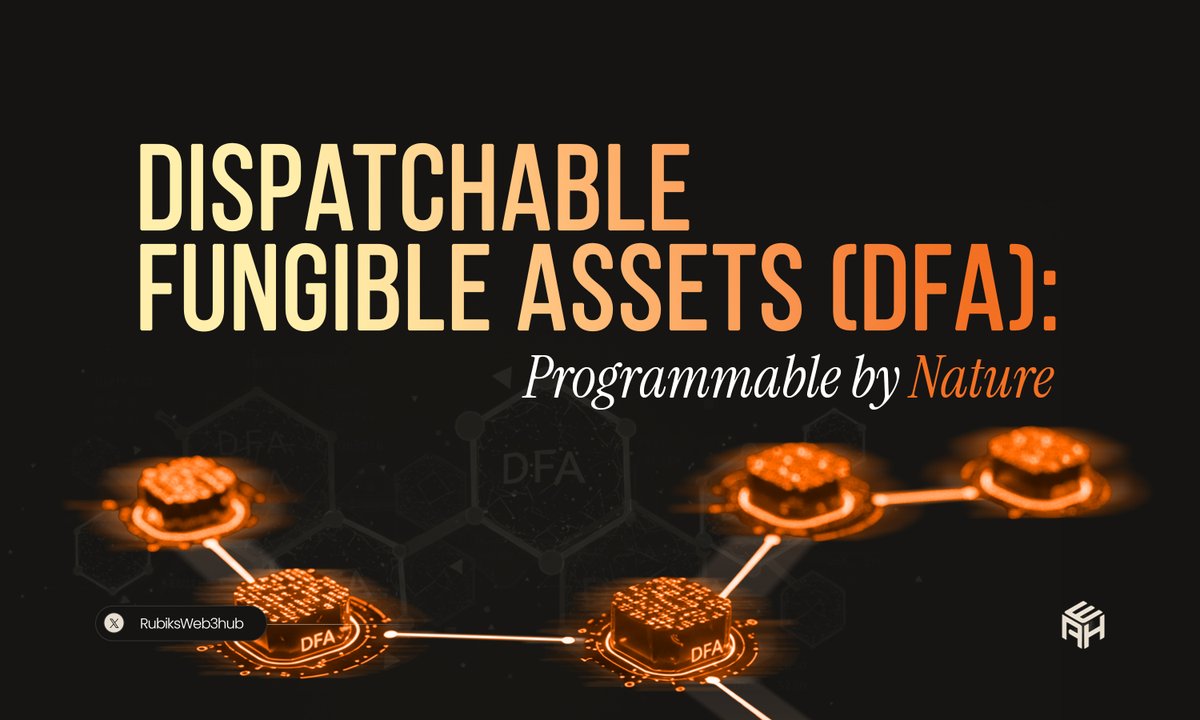
𝐃𝐢𝐬𝐩𝐚𝐭𝐜𝐡𝐚𝐛𝐥𝐞 𝐅𝐮𝐧𝐠𝐢𝐛𝐥𝐞 𝐀𝐬𝐬𝐞𝐭𝐬 (𝐃𝐅𝐀): 𝐏𝐫𝐨𝐠𝐫𝐚𝐦𝐦𝐚𝐛𝐥𝐞 𝐛𝐲 𝐍𝐚𝐭𝐮𝐫𝐞
A token that executes its own logic during a transfer is a live design choice. On Aptos, tokens run internal functions the moment a transfer occurs. That includes restaking liquidity, redirecting fees, enforcing transfer rules, and distributing rewards. These functions are not part of an external contract, but rather embedded into the asset. This model is referred to as Dispatchable Fungible Assets.
Read on 👇
----
REMOVING REPETITION FROM PROTOCOL DESIGN
Protocols often rebuild the same features. Reward claimers, staking routers, compliance filters, and fee-split contracts, just to add steps for the user and an extra hack gap for the protocol. But DFA simplifies this. It builds directly on Aptos’ object system. Meaning the tokens on Aptos are treated as structured onchain objects, allowing developers to assign behavior to them. It also includes a dispatcher, which holds function pointers tied to common actions like transfer, deposit, withdrawal, mint, or burn. When any of these actions occur, the token automatically runs the corresponding logic, and the execution is part of the transfer itself.
----
EXAMPLE: @ThalaLabs xLPT
Thala Labs has a DFA version of its LP token, called xLPT. This token represents liquidity staked in ThalaSwap. In a regular setup, moving the token would require the user to restake manually and re-enter the yield system. However, with xLPT, the token handles that automatically. Every transfer triggers a restake of the underlying LP, while the user need not act. The token keeps farming without pause, and it can also be used across protocols, held in a wallet, or deposited into a vault. Its behavior stays active.
----
THE PATTERN IS EXPANDING
More Aptos-native protocols are using DFA to simplify their infrastructure. @AriesMarkets is applying DFA to its interest-bearing tokens, enabling auto-compounding during user actions without external rebalancing logic. @EchoProtocol_ is integrating DFA into its restaking asset, such that reward updates will run every time the token moves. @AmnisFinance is testing DFA for its staked APT, ensuring that each transfer will apply yield, route a portion to the insurance fund, and record the action internally. This setup removes the need for reward dashboards or claim schedules and keeps the value flow native to the token.
----
HOW IT HELPS
For Builders:
• Their focus is on core logic. They no longer need to manage external wrappers, manual accounting, or time-based updates.
• The protocol becomes thinner, integrations become easier, and audits become smaller.
• This is pure composability.
For Users:
• They interact less and receive more.
• No restaking steps.
• No claim schedules.
• No missed rewards.
----
ON A FINAL NOTE...
Dispatchable Fungible Assets reduce reliance on external systems. They bring control and execution closer to the asset, allowing protocols to write less, while users do less, and the token does more. What do you think about applying a similar model to your favorite chains, L1s, and L2s included? Can a similar model be established on Mantle, Arbitrum, or SEI?
Thanks for reading!