Solid mathematical ideas almost always outperform contrived engineering tricks.
For years deep learning has been dominated by increasingly complex architectural hacks: CNN blocks, attention layers, channel mixers, residual pathways, normalization stacks.
Every few years a new architecture is announced as if it were a revolution.
One of the most famous examples was Kaiming He and Residual Networks (ResNet). At the time he was paraded around the AI world like a celebrity because residual connections supposedly “solved” deep learning.
But these were largely engineering patches.
Now something much more interesting appeared.
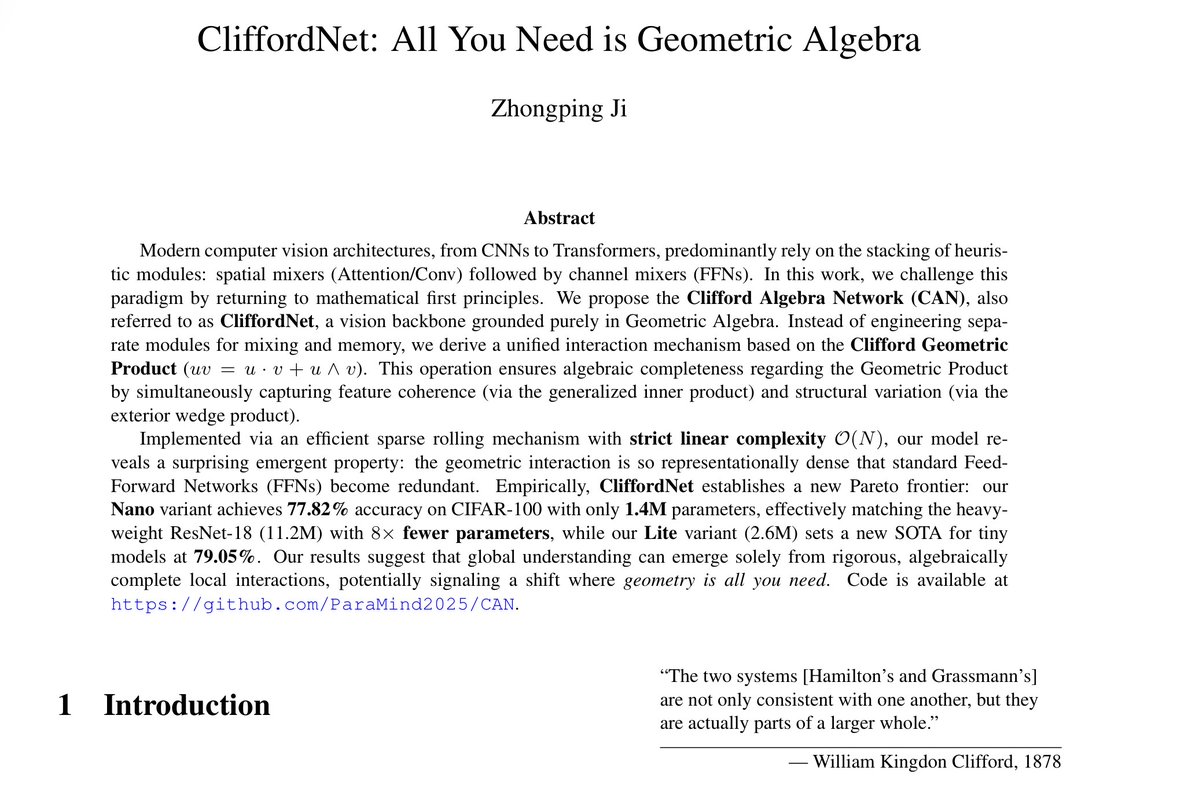
A new architecture called CliffordNet returns to mathematics — specifically Clifford Algebra, developed in the 19th century by William Kingdon Clifford.
Instead of stacking arbitrary modules, the model is built around the geometric product
uv = u·v + u∧v
A single algebraic operation that simultaneously captures inner product structure and geometric interactions.
In other words: the math already contains the interaction mechanism.
No attention blocks.
No mixer layers.
No architectural spaghetti.
The result:
• 77.82% accuracy on CIFAR-100 with only 1.4M parameters
• roughly 8× fewer parameters than ResNet-18
And with strict O(N) complexity.
The paper even suggests that once geometric interactions are modeled correctly, feed-forward networks become largely redundant.
A good reminder for the AI community.
Engineering tricks can dominate for years.
But eventually mathematics shows up and deletes half the architecture.
Paper:
https://t.co/9rQuZYvZ0o
19th century geometry just walked into computer vision.
Google Deepmind argues that LLMs can never make real scientific discoveries.
They published a paper breaking down Albert Einstein’s private view of scientific discovery.
In a famous letter to his friend Maurice Solovine, Einstein drew a diagram of how science actually happens.
It is a cyclical loop.
First, you experience raw sensory data. Then, through a mysterious, non-logical act of intuition, you make an intuitive "jump" to abstract axioms. Finally, you use strict logical deduction to derive consequences from those axioms.
Generative AI has completely mastered two-thirds of this loop.
• Induction: Statistical pattern matching across billions of tokens.
• Deduction: Formal proof generation, like AlphaProof solving complex math Olympiads.
AI can crunch data and it can prove theorems.
But it cannot make the jump.
The paper argues that AI completely lacks Abduction, the generation of novel explanatory hypotheses when observational data is scarce.
The prevailing tech myth says that "creativity is just data compression." That if you feed an LLM enough text, scientific breakthroughs will naturally pop out.
Einstein’s formulation of General Relativity proves that is a delusion.
When Einstein formulated relativity, the observational data didn't demand a new physics framework; classical mechanics was still massively successful. The breakthrough required a conceptual rupture. An intuitive leap from physical reality to a brand-new set of foundational axioms.
An LLM can execute the math once the axioms are given. But it is structurally incapable of formulating those premises on its own.
It can interpolate inside existing human thought, but it cannot transcend it.
The translation of physical reality into formal axioms remains the absolute, hard bottleneck of artificial scientific invention.
We can build models with trillions of parameters. We can scale compute into the stratosphere.
We can make the calculator infinitely fast.
But until we solve grounding, the machine can process all the data in the universe.
It still can't make the jump.
@IncomeTaxIndia Unable to file ITR-2 for AY 2026-27. Cannot add bank account as e-verify fails. Aadhaar OTP shows "link Aadhaar to PAN" warning but Link Aadhaar page confirms it is already linked. Net banking gives Access Denied. Grievance 26246657 raised.
Please help.
Took a shot at,
Story telling - itinerary building.
Context: for any new user who wants to plan from zero , no context , just x place in mind. https://t.co/UsNsLHZcjj
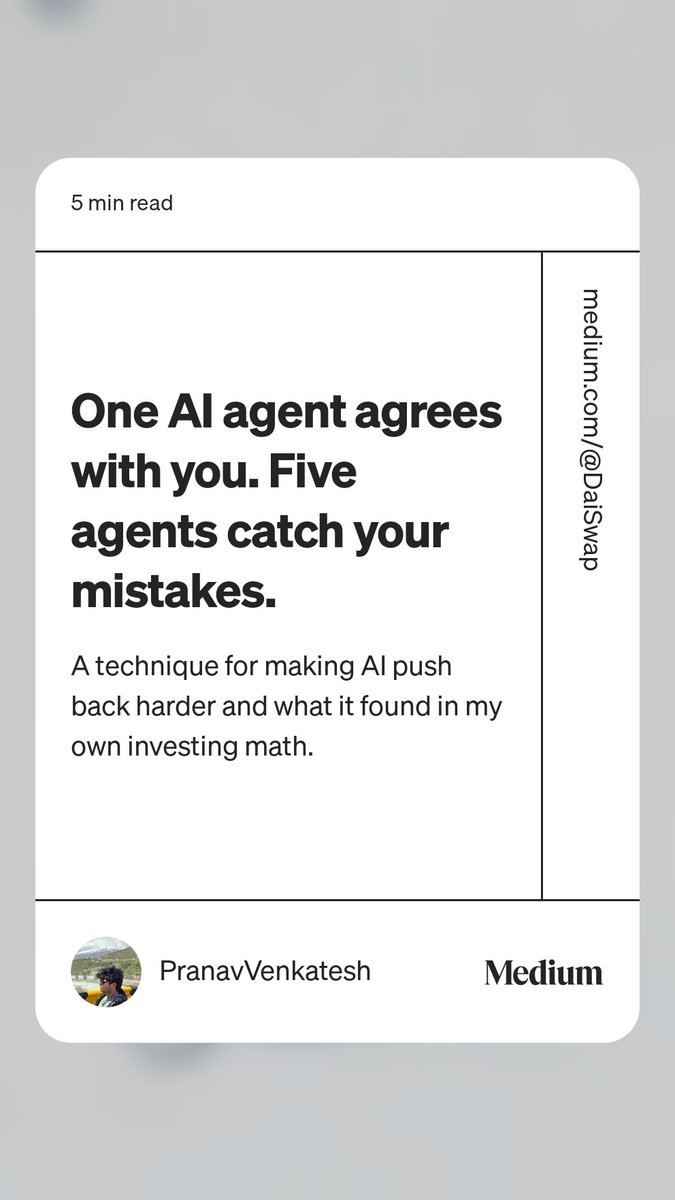
Every indian retail investor has done this dance - sold a winner too early , held a loser too long , bought based on someone else's thesis.
I'm building an AI to argue with me about my portfolio before I make those mistakes again.
https://t.co/VfClOr6ENf
YOU have the power to give any day just as much importance as you give the start of a new year.
If a date can make you begin, a random Tuesday can keep you going.
Don't think of LLMs as entities but as simulators. For example, when exploring a topic, don't ask:
"What do you think about xyz"?
There is no "you". Next time try:
"What would be a good group of people to explore xyz? What would they say?"
The LLM can channel/simulate many perspectives but it hasn't "thought about" xyz for a while and over time and formed its own opinions in the way we're used to. If you force it via the use of "you", it will give you something by adopting a personality embedding vector implied by the statistics of its finetuning data and then simulate that. It's fine to do, but there is a lot less mystique to it than I find people naively attribute to "asking an AI".