TLDR: The moat is moving beyond the code itself and toward everything around it.
The customer you understand, the workflow you own, the data you collect, the judgment you apply, and the improvement loop you refuse to stop running.
First NYC @Techweek_ in the books!
One question that kept coming up was: if AI makes software easier to build, what is the moat?
Here are a few of my favorite answers:
5) Compounding improvement. A lot of people can launch. Fewer will obsessively make something 1% better every week long after the first version works.
6) Capital. If you already have momentum, capital can be used to capture the market and deter competition.
@AlexSJacquez What a backwards way of thinking.
Government isn’t innately “due” any revenue (i.e. taxpayer dollars).
If you want more revenue, do what any other service provider does. Make the case that the value exceeds the cost.
Carti keeps your visitors moving, turning browsers into buyers.
For our first 100 customers, we’re giving it away totally free.
Try it here: https://t.co/LGHBnYIkKE
Most Shopify stores lose customers in silence.
→ Not because of price
→ Not because of product
But because no one answers their question fast enough.
So I built this👇
With Carti, your customers enjoy:
→ No waiting
→ No friction
→ No lost momentum
After all, most purchases are impulsive.
The second someone has to “think about it”… they’re gone.
An instant answer is often the difference between a sale and a bounce.
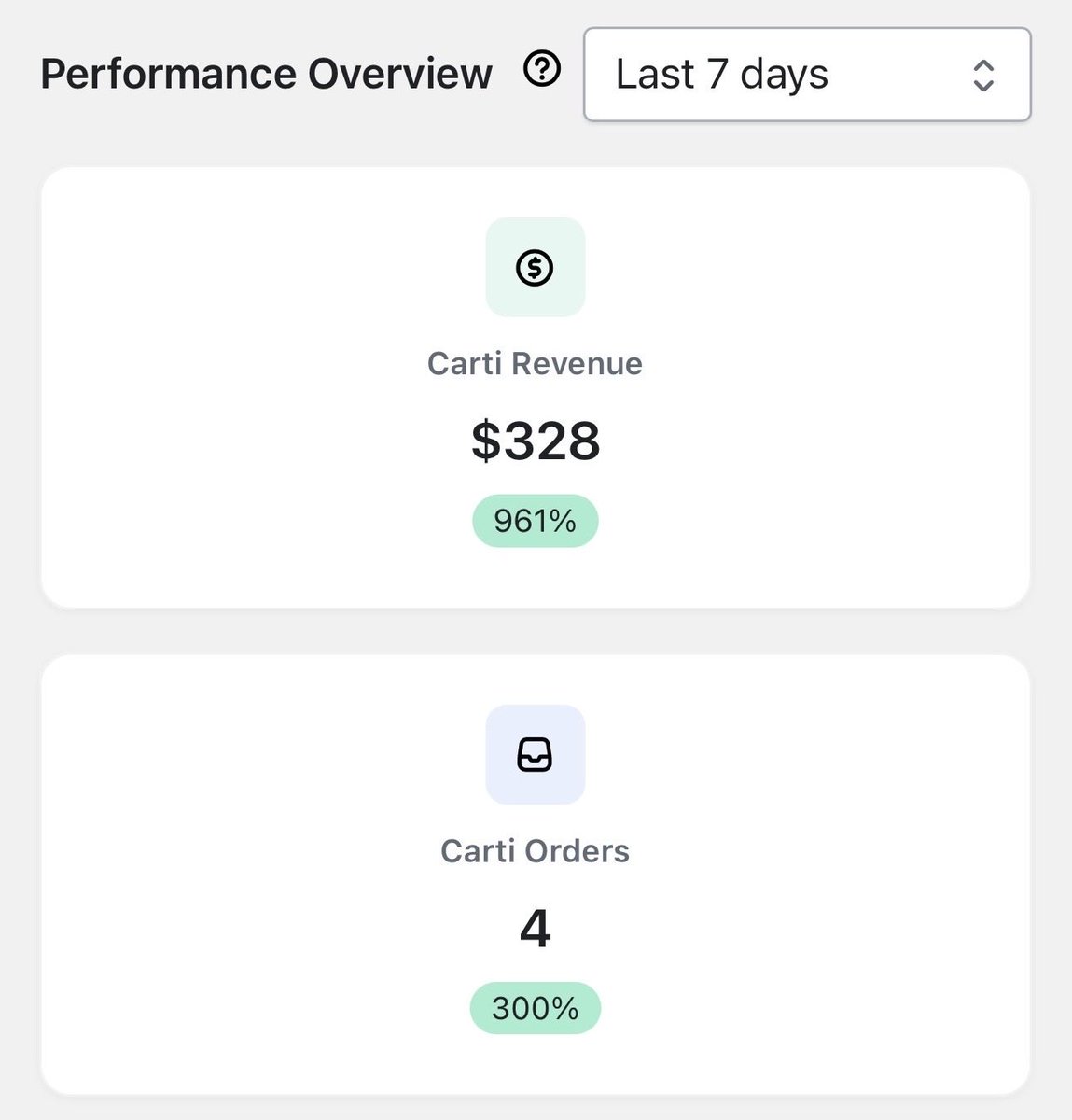
Installed our AI chatbot on a new Shopify store.
First full week:
→ 4 orders driven, with 2x AOV
→ 0 manual replies
Small win, but this is the goal. Turning customer questions into revenue.
Not bad for a free app.
@MichaelMindrum Sorry, can you explain what’s wrong with this claim explicitly? I understand your example, but seems like a straw man here. I assume I’m misunderstanding?
@aleabitoreddit Love the thesis. Why 2 year LEAPS specifically though? Also, where does the confidence in further rate cuts come from? Political, or just believe we’re still well above neutral?