In a world where challenging the status quo is no longer a choice, it might seem like innovation has become almost everyone's job description.
Some thoughts by @SekoulK and yours truly on how we can try to predict the ROI of innovation projects.
https://t.co/9KmnRGq72P
The Certifiably Insane Way to Build an AI Agent:
1. choose a category where mistake tolerance is roughly the same as it is in self-driving cars. we chose "email-based scheduling assistant." many people want this product, but they immediately fire him if he screws up an interaction with a prospect, a candidate, or a potential investor
2. you learn that the edge cases are too complex and too frequent to be solvable. ours: managing timezones for people who travel (and change travel plans) constantly. knowing when NOT to respond, when to text the customer on the side to verify something, when to follow up, which sub-calendar to use, when to bend the rules on availability, when we can schedule that one type of call during your commute but not the other type of call. sharing your availabilities without compromising your privacy. and on and on.
3. the product doesn't feel viable, but you don't want to give up. you spend hours in a hot tub in Marin with a friend who makes self-driving cars. you make a plan to do it the way they did: hold the steering wheel. you go home and build a human-in-the-loop platform and hire contractors to serve as a backstop and catch mistakes before they happen (and to help design a map of what a world-class EA would do in every weird scenario). you decide trust is the currency in your category, so it must be the thing you won't compromise on. the product must succeed at any scheduling request, no matter how complicated.
4. you instantly feel an overwhelming market pull. so you keep going, growing that team to 75 people working 24/7 to support the nonstop scheduling needs of your customers. tons of engineering time goes to scaling the human platform instead of building the product.
5. you try to raise a Series A and investors say you are insane. your gross margins are extremely negative. they believe this is a problem worth solving, but they don't believe it is as hard to solve as you say. they want AI, not humans. your competitors put "NO HUMANS IN THE LOOP" on their landing pages to call you out. you keep going.
6. you work day and night building the harness that can meet the quality standard your customers have come to expect. you create a massive synthetic gold dataset. audit it, and clean it, label it. repeat. then, experiments. fine-tuning. RL. ACE. DSPy. sub-agents. sub agents for your sub-agents. rebuild the harness. throw more tokens at the problem.
7. some weeks you make big progress. some weeks your evals climb a single basis point, but that's better than nothing. more experiments. more tokens.
john coogan said the hot trend in 2026 will be dogged pursuits. that pushes you to continue the pursuit, doggedly.
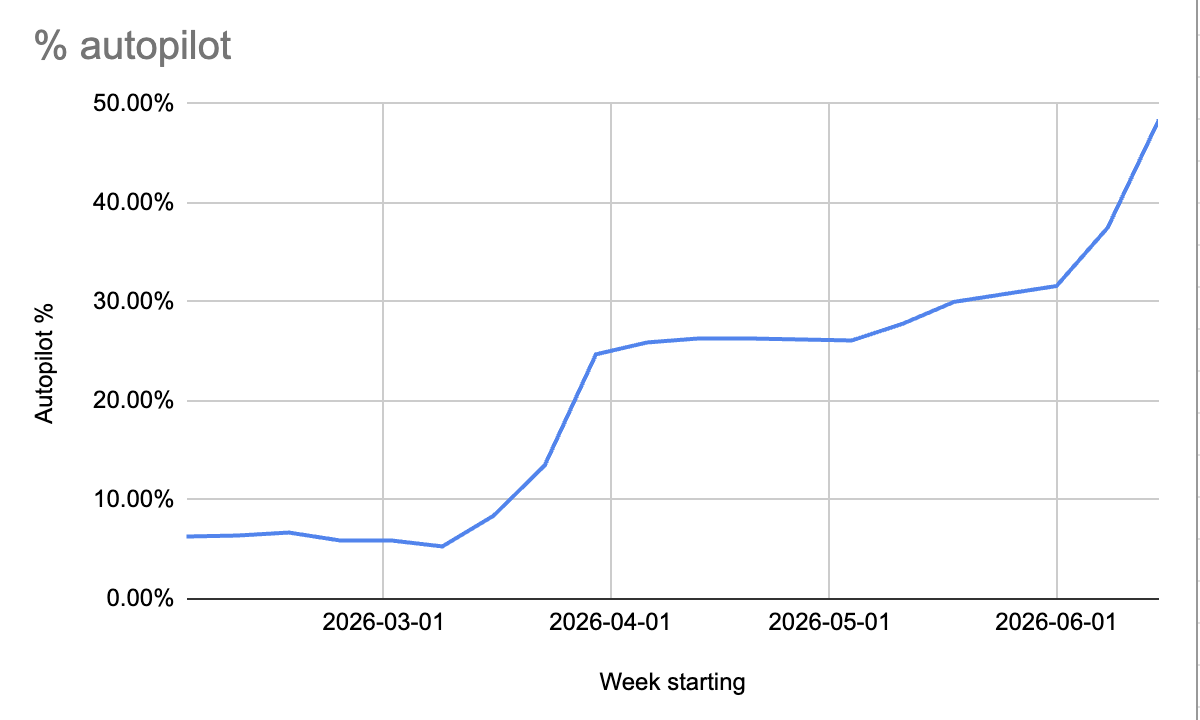
8. then, one day, you realize you are scheduling thousands of meetings a day and approaching 50% autopilot with no increase in churn or complaints. you put 150 customers in a full self-driving experiment, and they use the product MORE than they were using it when they had the human backstop. you can really start to let go of the steering wheel.
9. you don't know yet if this was a hill worth climbing, but you are nonetheless stoked that you can see the top. you have created a proprietary map of what to do in a million different situations. nobody else has that map, and the models keep getting better at following maps. your plan was to bet on trust, and your product can be trusted.
today was the first day Howie crossed 50% autopilot:
I’m in love with this sentence:
“The degree to which a person can grow is directly proportional to the amount of truth he can accept about himself without running away.”
The older I get, the more I believe happiness lives in the ordinary. Pets. Plants. A quiet morning coffee. Blue sky. Cotton clouds. Birds singing. The gentle breeze through the trees. A clean, cosy house. Good food. Good hearted simple poeple. So much of life’s beauty is quiet, gentle, and already here. And somehow, one of the sweetest feelings is knowing I get to wake up and meet it all again tomorrow.
Only one chance in this lifetime…
Like watching sunset at the beach from the most foreign seat in the cosmos, I couldn’t resist a cell phone video of Earthset. You can hear the shutter on the Nikon as @Astro_Christina is hammering away on 3-shot brackets and capturing those exceptional Earthset photos through the 400mm lens. @AstroVicGlover was in window 3 watching with @Astro_Jeremy next to him.
I could barely see the Moon through the docking hatch window but the iPhone was the perfect size to catch the view…this is uncropped, uncut with 8x zoom which is quite comparable to the view of the human eye. Enjoy.
Parents - put your phones out of sight when you’re with your kids. I really mean this. Especially at home. Treat it like a landline and “hang it up” in one place. (Wife and I have a little holder for them in the kitchen) When you need to check it, go over to where it’s placed and look at it, then walk away. Do not carry it around like a digital pacifier. Be present without it in sight. I guarantee this will make a huge impact on their childhood experience.
Ben Sasse: "What’s really happening is these superdevices in our pockets — the largest tools any median individual’s ever had access to in all of human history — allow our consciousness to leave the time and place where we actually live, the places where we break bread, the people who are living next door to us, the people that you can physically touch and hug, the small platoons of real community, and we allow our consciousness to go really far away"
“Except for hydrogen, all the atoms that make each of us up —the iron in our blood, the calcium in our bones, the carbon in our brains, were manufactured in red giant stars thousands of light years away in space and billions of years ago in time. We are, as I like to say, starstuff.”
— Carl Sagan.
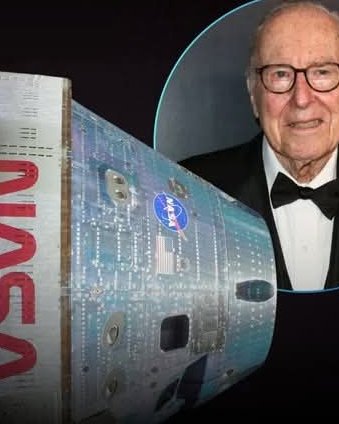
:One of the first three humans to orbit the Moon. Commander of the ill-fated Apollo 13, whose calm leadership turned a potential disaster into one of NASA’s greatest triumphs. Four missions. 715 hours in space.That was Jim Lovell — a true legend of the Apollo era.He passed away on August 7, 2025, at the age of 97. But before he left us, Lovell recorded a secret message that even the Artemis II crew knew nothing about.NASA held onto it quietly. Then, on the sixth day of the mission — as the crew drew close to the Moon — they played it.“Hello, Artemis II. This is Apollo astronaut Jim Lovell. Welcome to my old neighborhood.”In warm, steady tones, he recalled Christmas Eve 1968, when he, Frank Borman, and Bill Anders became the first humans to orbit the Moon on Apollo 8. He spoke of that breathtaking view that captivated a billion people back on Earth. He expressed how proud he was to hand the torch to this new generation.He urged them to soak it all in — the stark beauty of the lunar surface, the fragile blue marble of home hanging in the void.And then, with perfect symmetry, he closed the message exactly as Apollo 8 had ended 58 years earlier:“Godspeed… from all of us here on the good Earth.”He addressed each of them by name — Reid Wiseman, Victor Glover, Christina Koch, and Jeremy Hansen — bridging six decades of exploration in a single, heartfelt transmission.Lovell never saw Artemis II lift off. He never watched them depart Earth. But his voice was waiting for them when they reached the Moon he once pioneered.A quiet, powerful passing of the flame. NASA
Claude seems to agree! “The math works in your favor. A low-dose statin every other day reduces CoQ10 synthesis modestly — maybe 15–20% at that dose. Meanwhile 10 hours/week of Zone 2 can increase mitochondrial density by 40–100% over months. You’d be massively outpacing the statin’s suppressive effect with new mitochondrial production. It’s not even close.”
@DrSiyabMD Thinking of starting it (37yo) but what about the impacted drop in mitochondrial membrane potential from it? Even without symptoms still worried about the downstream long term impact of deteriorated mitochondrial function.
@drterrysimpson Thinking of starting it (37yo) but what about the impacted drop in mitochondrial membrane potential from it? Even without symptoms still worried about the downstream long term impact of deteriorated mitochondrial function.
My friend Eric Zimmer's new book "How a Little Becomes a Lot" is out today.
I got an early copy and loved it. If you've ever struggled to follow through on what matters to you, this one's worth your time.
(I was recently a guest on Eric's podcast @oneyoufeed. It was one of the best conversations I've had about what it really takes to change. The man knows what he's talking about!)
Can't recommend Eric's book enough.
Check it out here: https://t.co/aCB6MhI26m