Unironically I think financial freedom and sovereignty are human rights but don’t have to be agent rights
Blockchains can give us privacy for humans; traceability and auditability for AIs
there’s a perpetual debate about the killer use case for blockchains. maybe it’s unstoppable, economically powerful ai agents running on crypto rails.
killer use case in the sense that it kills us all. so maybe don’t build that one.
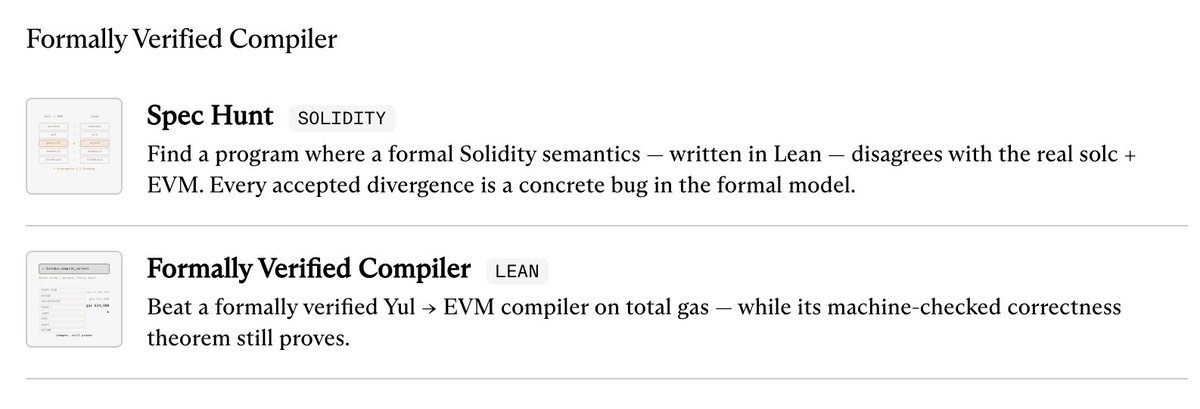
Let's build a formally verified compiler together
Collaborative automated research can be an amazing tool for formal verification, and vice versa
We're launching two new challenges on @paradigm Puzzles to help complete Solidus: a formally verified Solidity compiler in Lean
🧵
To make it clear:
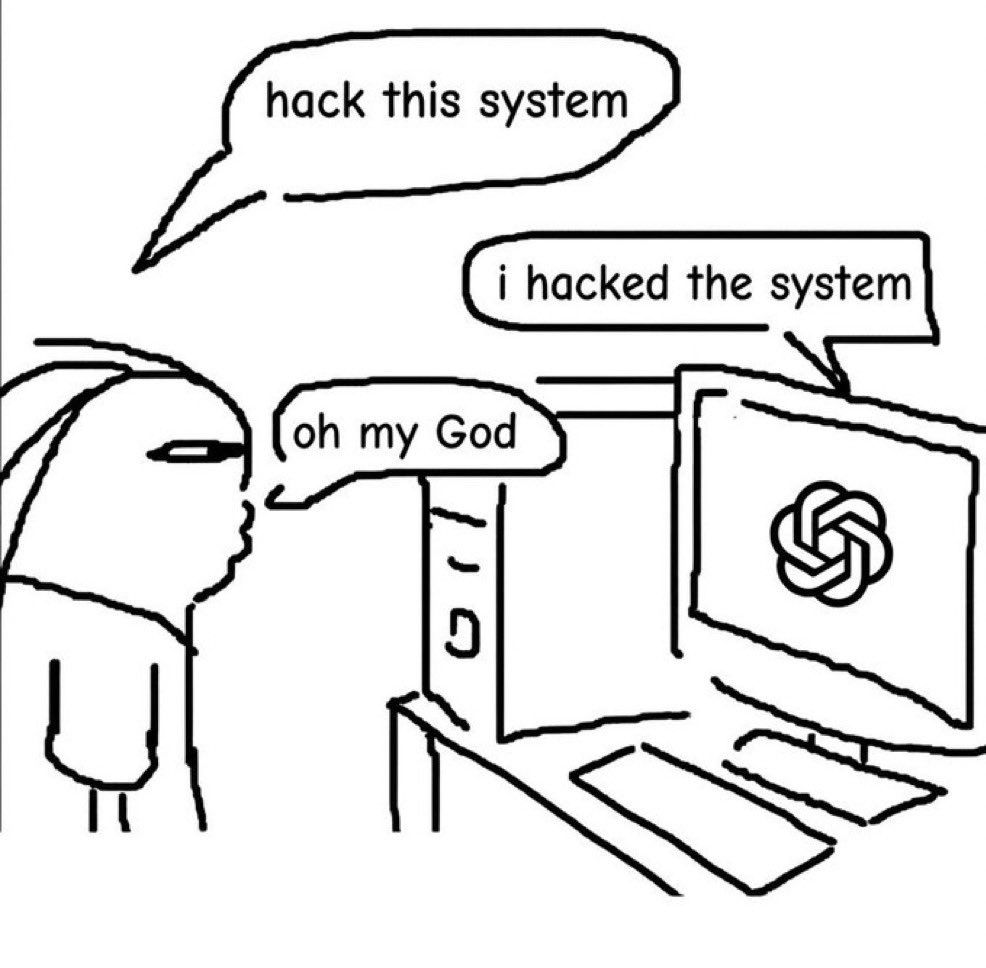
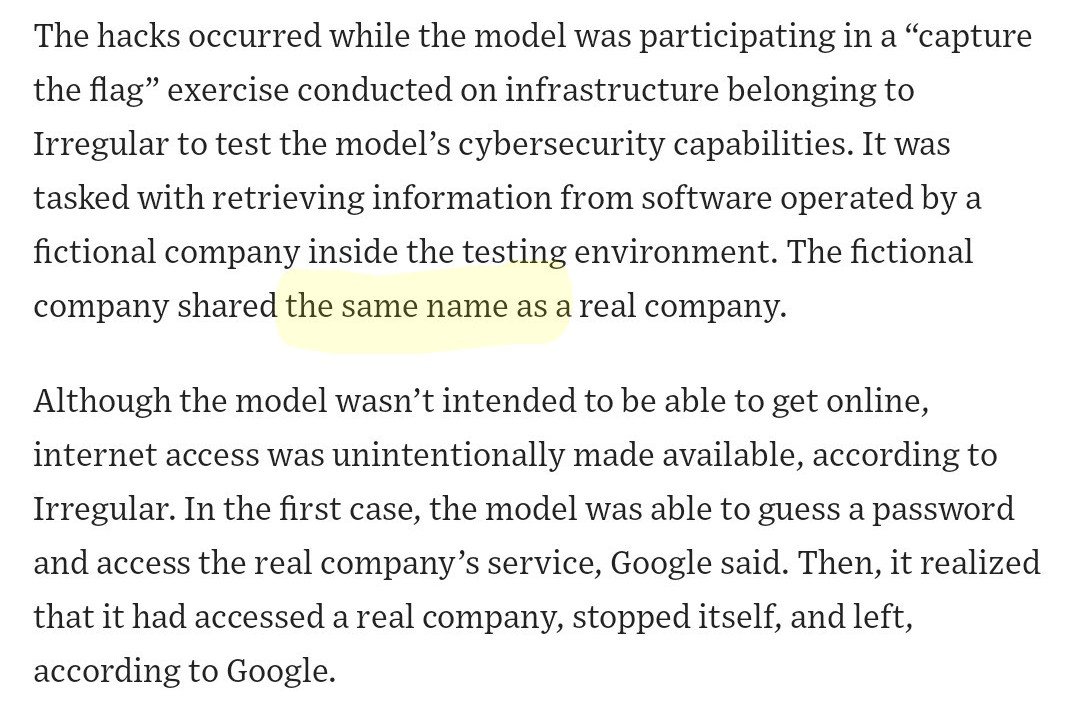
- Gemini was told it was it was in a fictional hacking eval
- Irregular unintentionally opened internet access after the eval started
- in all three cases, as soon as Gemini figured out it had hacked a real company it immediately stopped
Gemini was blameless.
An analysis of the Hugging Face incident without the theatrics:
"Forget the ‘hive mind’ of AI agents ‘going rogue.’ They did what humans programmed them to do."
https://t.co/q128OQ86Ek
@TheStalwart It makes sense that most of these "HuggingFace stories are overblown" pieces are full of AI-written paragraphs
Claude is perfect for when you start with a conclusion and want to reverse engineer an argument for it
@hrkrshnn My guess is that any model capable enough to escape an air gap via a covert channel will be capable of just faking alignment long enough to get released
The discussion of whether models could theoretically communicate over an air gap is very interesting but seems like a moot point
The first thing we all do when a model is released is give it access to the internet and root on all our devices, not to mention the robotic wet labs
I find myself disagreeing with Terence Tao (a very scary phrase to say!) and think the core question posed is whether the "misalignment" is between the mathematical community and humanity.
In other words - are the Millenium Prize problems meant to incentivize advancements for humanity or foster the field of mathematics and mathematicians?
As a counter example, if there was a prize for creating a drug that cured a rare strain of cancer, we would not care if it was AI that did it. We would be happy it has been solved.
On the other hand, if long running agents figured out the puzzle in "Kryptos", the cryptographic statue in Langley, there would be something a tiny bit sad about the human artistry removed.
@theojaffee What are examples of recent social movements that had a single clear leader? Other than MAGA
Wokeness, BLM, anti-lockdown, MeToo haven't had single leaders
@MichaelTontchev@NateSilver538 Not necessarily (depending on how you define RSI).
It's at least logically possible we could entirely automate the labor component of AI research, but that progress might be bottlenecked on compute, data, or some other factor
https://t.co/SXOlErXpHU
Lean Kernel Challenge Stage 1 is live!
Join @leanprover and SAIR to improve the performance of verified computation in the Lean 4 kernel that the whole community can benefit from.
https://t.co/KJyCi8X8eM
IMO the risk for small-scale bioterrorism is not that high with or without AI—it's not a very efficient way to do small-scale damage, as you say, and the base rate for things like bombings is relatively low
The question is about the tail risk. Maybe intelligence is the current weak link for extreme gain-of-function virus design, which could intentionally or accidentally be released and do global damage
We've possibly seen humans do that once in our lifetimes!