It’s 2011. An Ocarina of Time and a Starfox remake are coming to the latest Nintendo system
It’s 2026. An Ocarina of Time and Starfox remake are coming to the latest Nintendo system
A beautiful example of an "optimal stopping problem" – Feynman's restaurant problem – with a great backstory behind it. This is a fun, well written article, and a fun math problem too.
https://t.co/0Nng9KLDHa
Local minima are rare in high dimensions because a strict local minimum has to curve upward in every direction, so all Hessian eigenvalues must be positive.
In a D-dimensional toy model where eigenvalue signs are independent, that’s a 2^(-D) event. In GOE-like random matrix models, positive definiteness is even rarer, roughly exp(-cD^2).
So as dimension grows, random critical points are much more likely to be saddles than minima. This is one reason high-dimensional optimization is often a saddle-escape problem, not a bad-local-minimum problem.
Wrote up some of the math here: https://t.co/vkaVqVD64N
On this day in 1906, André Weil was born in Paris. Number theorist, founding member of Bourbaki, and the W in the Taniyama–Shimura–Weil conjecture.
He spent the 1940 war in a French prison after refusing military service and used the time to do some of his best mathematics, writing his sister Simone that "my mathematics work is proceeding beyond my wildest hopes, and I am even a bit worried - if it's only in prison that I work so well, will I have to arrange to spend two or three months locked up every year?"
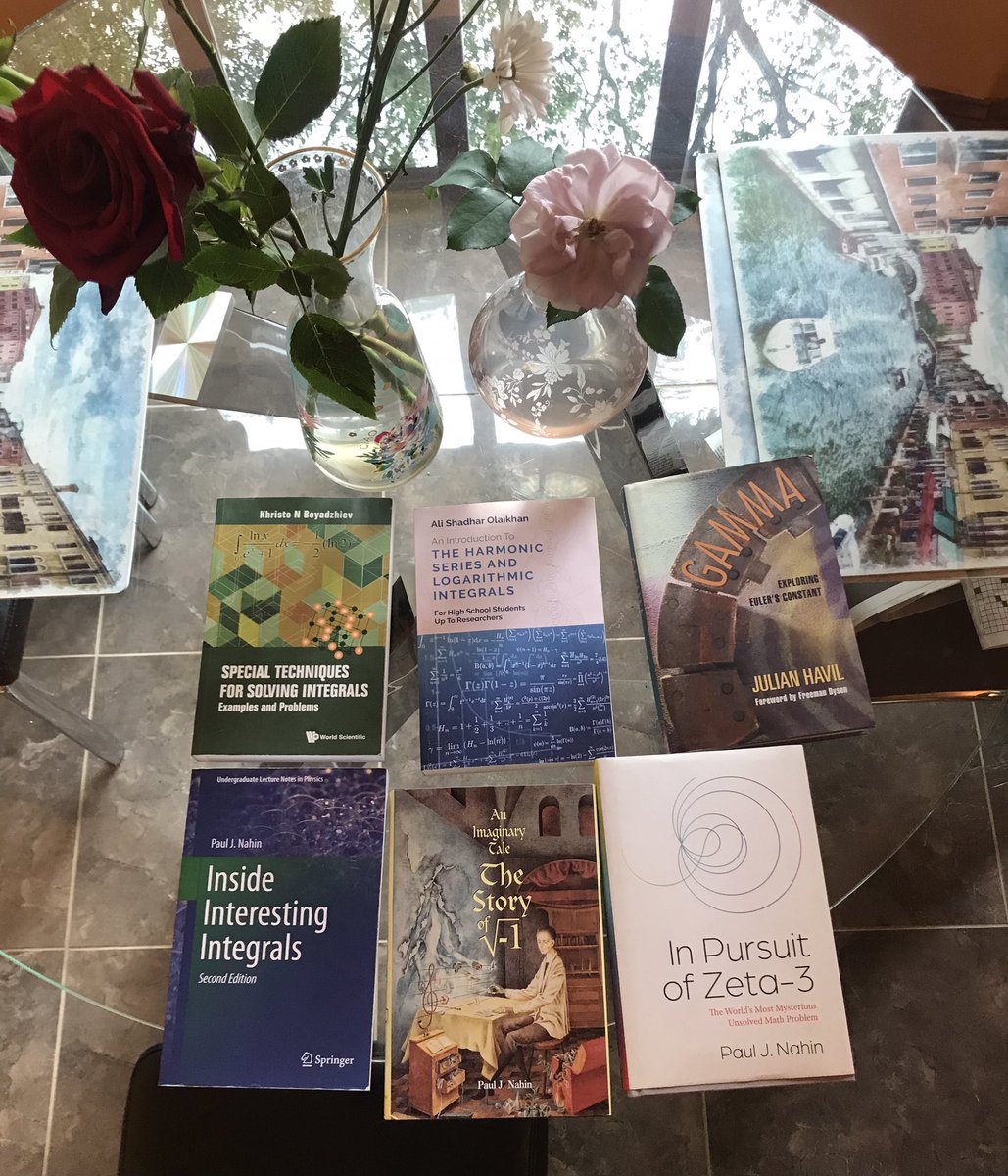
These are among my favorite math books I’ve studied in the past two years or so. For newcomers to complex numbers, I recommend Nahin’s book on sqrt(-1).
This is a great example of the stranglehold academic institutions have on scientific identity.
They’ve created a belief system where if you leave, you are treated as if you’re effectively dead, as if your contributions no longer matter.
We must normalize being scientists first, and having institutions rank far down the list of what defines who we are.
This didn’t happen by accident. It’s the result of billions in taxpayer revenue and resulting massive marketing power that shapes how the public thinks about science.
What made Albert Einstein tick?
Popular myths about the physics laureate’s brain are as enduring as his impact on our understanding of space, time and gravity.
Perhaps the most common of them is that Einstein had an unusually large brain, but this simply isn’t true.
After he died in 1955, Einstein’s brain was removed by a pathologist named Thomas Harvey, who preserved, photographed, and measured it. It weighed 1,230g, which is at the low end of average for modern humans.
However, further examination of photographs by a team at McMaster University, Canada, revealed that Einstein’s parietal lobes were 15% wider than average. While these lobes are implicated in mathematical, visual, and spatial cognition and it is intriguing to think they may help explain Einstein’s remarkable abilities, this link cannot be proved.
One thing we can be sure of is Einstein’s work ethic, curiosity and humility, which helped him achieve great things.
"We have been endowed with just enough intelligence to be able to see clearly just how utterly inadequate that intelligence is when confronted with what exists. If this humility could be imparted to everybody, the world of human endeavours would become more appealing," he said.
He was awarded the Nobel Prize in Physics 1921.
Learn more: https://t.co/ePOJS6lb0W
Happy π-day! 🥳
To celebrate this day I’ve decided to show you how to prove the irrationality of π!
What is your favourite thing related to π? 🤔
Meanwhile, have a nice read!
🧵[1/8]
Hey White House, please remove the Tropic Thunder clip. We never gave you permission and have no interest in being a part of your propaganda machine. War is not a movie.











![Mathinity_'s tweet photo. Happy π-day! 🥳
To celebrate this day I’ve decided to show you how to prove the irrationality of π!
What is your favourite thing related to π? 🤔
Meanwhile, have a nice read!
🧵[1/8] https://t.co/6jinqPEojZ](https://pbs.twimg.com/media/HDYJMlabkAAPzfh.jpg)





