How to prioritize the important things in life.
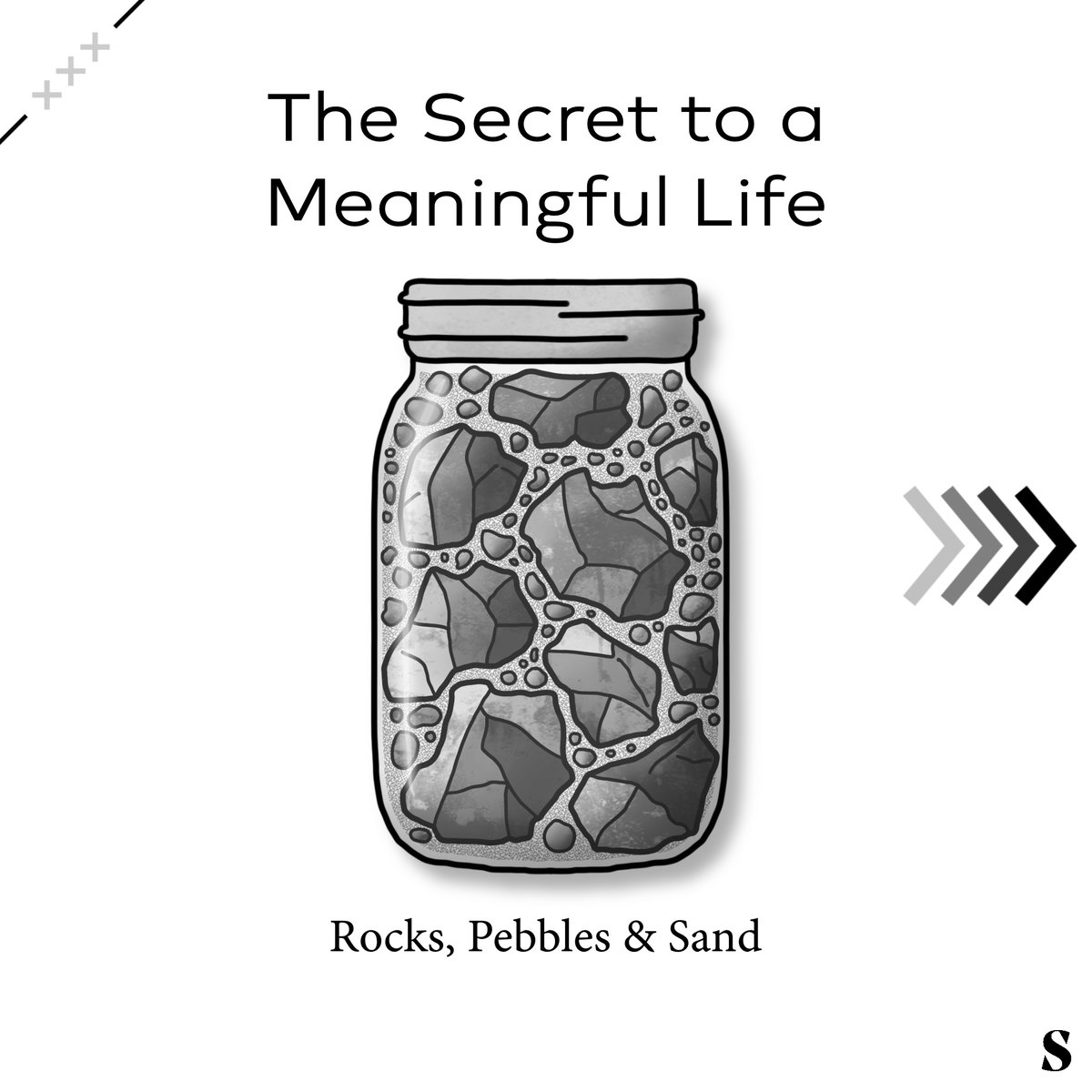
Rocks, Pebbles, & Sand:
There's a rather well-known story that I like to remind myself of every so often.
A professor walks into his class and sets a few items out on the table:
• A large glass jar
• A bunch of rocks
• A bunch of pebbles
• A pile of sand
The professor puts the rocks into the glass jar and holds it up in front of the students.
"Is the jar full?" he asks.
They all nod their heads—yes, the jar is full.
Then he pours the pebbles into the jar. He shakes it a little bit and lets the pebbles settle into all of the space between the larger rocks.
Again, he asks, "Is the jar full?"
Smiling, they again all nod their heads—yes, now the jar is full.
Then he pours the pile of sand into the jar. He shakes it a little bit and lets the sand fill every last bit of space between the large rocks and pebbles.
Once again, he asks, "Is the jar full?"
The students realize they've been beaten—yes, now the jar is full.
The professor proceeds to explain that the jar represents your life:
• The rocks are the most important things—your family, dearest friends, health, and basic needs.
• The pebbles are the other important things—your career, looser friends, and hobbies.
• The sand is everything else in your life—your possessions, loose acquaintances, and miscellaneous worries.
The professor makes his two key points:
1. If you only have your rocks (and remove the pebbles and sand), your jar still feels full.
As long as you have your family, your dearest friends, your health, and your basic needs, your life will always feel full.
2. If you put the sand into the jar first, you'll never have room for the rocks and the pebbles.
If you spend all your time worrying about material possessions and low-meaning things, you'll never have time to focus on what truly matters.
I love this story and find value in reminding myself of it often.
It's easy to get caught in the "sand trap" and lose sight of what is important.
Lesson: Focus on the rocks and trust that the rest will fall into place around them.
If you enjoyed this or learned something, follow me @SahilBloom for more like it in the future.
Psychologist Mihaly Csikszentmihalyi is the "Godfather of Flow."
"Flow State" is how we:
- Produce meaningful work
- Cultivate meaningful hobbies
- Create lives of joy and fulfillment
Here are his 8 ways to cultivate Flow State:
If you sit in back-to-back meetings at work, read this:
Microsoft's Human Factors Lab studied 14 participants across two days of video meetings.
• Day 1: 4 back-to-back 30-min meetings.
• Day 2: 4 30-min meetings with 10-minute breaks in between.
Participants wore EEG caps to monitor electrical activity in their brains.
The results were fascinating...
The two key takeaways:
Takeaway 1: Back-to-Back Meetings Promote Stress
Back-to-back meetings created an accumulating buildup of stress in the brain.
Anticipation of transitions caused further spikes.
Short breaks in between meetings allowed the brain to reset and never experience the stress buildup.
Takeaway 2: Breaks Promote Performance
Back-to-back meetings resulted in negative levels of frontal alpha symmetry, a brain state connected to lower levels of engagement.
Short breaks in between meetings resulted in positive levels, meaning participants performed better.
Conclusion: Take More Breaks
The conclusion of the study seems to be that short breaks in between meetings are necessary:
• Eliminate stress buildup
• Improve performance
• Reduce impact of attention residue
I started implementing 25-minute meetings into my schedule (a built in 5-minute break) and immediately noticed a positive impact.
A short walk or some movement in that window provided a clear reset.
25-minute meetings also eliminate the 5 minutes of “how about the weather” low value chit chat most meetings open with.
If you set the tone to dive in and stay focused, there are few things that take more than 25 minutes.
Try it!
If you enjoyed this or learned something, follow me @SahilBloom for more in the future.
Age when their business launched?
Jeff Bezos: 30
Oprah Winfrey: 32
Reed Hastings, Netflix: 36
Doris Fisher, Gap: 37
Vera Wang: 40
Eric Yuan, Zoom: 41
Sam Walton, Walmart: 44
Adi Dassler, Adidas: 48
Bernie Marcus, Home Depot: 50
Charles Flint, IBM: 61
Here are their stories 🧵
Bryan Johnson spends $2 million a year to be 18 years old again.
In 2021, he reduced his epigenetic age by 5.1 years in 7 months (a world record)
His 13-steps for a long healthy life:
ChatGPT is overhyped.
That's what I told myself after 2 weeks of trying (and failing) to use it well.
Turns out, I was just a poor prompt writer.
But after spending hundreds of hours tinkering, I've finally cracked it.
And now, it's my personal writing assistant.
Here's how: