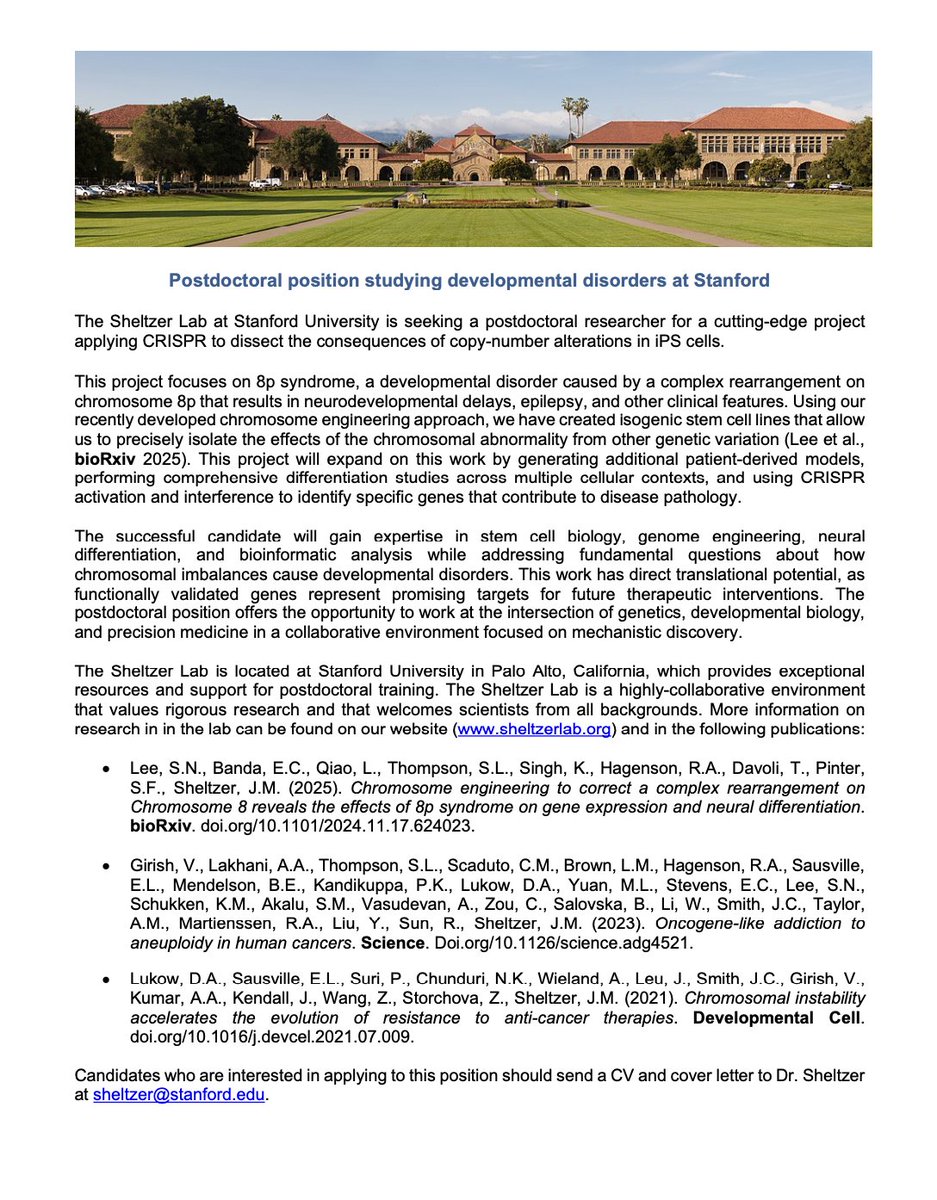
I’m excited to share a new postdoctoral opportunity in my lab at Stanford to study the consequences of gene dosage alterations in iPS cells. Check out the posting below and shoot me an email if you’re interested -
@theMadridZone The penetration and player positions at our front are really bad.
Not tactics, no pattern and no sense of discipline with our players upfront.
The defenders..., I don't want even go there, lack of cohesion and consensus defending.
He has a lot of work to here.
There’s Nothing More Annoying Than a Poorly Formatted Personal Statement. Here’s a simple formatting guide that will make your Statement of Purpose (SOP) clear, professional, and readable 👇
If your format is all over the place, your message will drown in the noise.
Formatting isn’t decoration, it’s how your story breathes.
1️⃣ Header
➜ Keep it simple.
Example:
Statement of Purpose – PhD in Public Health (Epidemiology Track)
📌 You don’t need to include your name, email, or address at the top.
Admissions programs already have that information in your file.
No need for fancy headers, logos, or colours.
2️⃣ Spacing & Layout
➜ Use 1.0 or 1.15 line spacing.
↳ Avoid cramped, single-spaced blocks of text.
➜ Leave comfortable margins (1 inch).
➜ Use Times New Roman, Arial, or Calibri (11–12 pt).
📌 Consistency > Creativity.
3️⃣ Structure
Paragraph 1: Research Problem & Motivation
Paragraph 2: Academic or Technical Foundation
Paragraph 3: Research Experience
Paragraph 4: Professional Application
Paragraph 5: Program Fit
Paragraph 6: Long-Term Vision
📌 Logical flow > Fancy storytelling.
4️⃣ Formatting Rules
➜ No tables.
➜ No subheadings or sections.
➜ No photos, graphs, or visuals.
➜ Avoid unnecessary underlining or bold text.
Your words should carry the weight, not your formatting.
5️⃣ Keep It Focused
➜ 800–1,000 words (about 2 pages).
➜ Proofread for flow and grammar.
➜ Read it out loud, if it doesn’t sound like you, rewrite it.
———-
📌 The best statements are clear, confident, and human.
✍️ Final Thought
If your story is strong, your formatting should disappear.
Because nothing distracts faster than a messy page.
So before you hit submit, ask yourself:
“Does my statement look as professional as it sounds?”
Researchers at @UCLA built mini models of human lungs, hearts and brains to study hantaviruses and identify potential therapies. With no current treatments, these deadly rodent-borne viruses pose a serious threat to public health. #ResearchPowersProgress https://t.co/M8Z9hTFO2W
A new blog from OpenAI and Retro Bio describes a custom AI model (“GPT-4b micro”) that can design better Yamanaka factors, the proteins used to reprogram mature cells into induced pluripotent stem cells.
In 2006, a scientist named Shinya Yamanaka discovered four proteins that could, together, “reprogram” skin fibroblast cells back into stem cells. He began with 24 transcription factors and removed them, one by one, until only four proteins “essential” for reprogramming remained: OCT4, SOX2, KLF4, and c-MYC.
GPT-4b micro was trained on protein sequences, biological text, and tokenized 3D structures. (The training data has not been released, afaik.) This model “designed novel variants of the Yamanaka factors that achieve a 50x increase in reprogramming efficiency in vitro compared to standard proteins.”
In other words, AI-designed Yamanaka proteins coax fibroblasts to become stem cells ~50x more efficiently than “normal” Yamanaka proteins.
The blog post hyperlinks to a handful of prior efforts to engineer Yamanaka factors, but not many. Therefore, I built a table showing more studies in which scientists engineered efficient Yamanaka factors.
One of these studies, not mentioned in the blog post, reported an engineered Oct4 protein that raised “the efficiency of making mouse and human iPSCs more than 50-fold in comparison to” standard Yamanaka factors. It was published in 2011.
Here are some of those prior efforts:
2011: Researchers fused OCT4 to a transactivation domain. Adding this to Sox2, Klf4, and c-Myc boosted iPSC efficiency “more than 50-fold” in both mouse and human fibroblasts.
2014: A team reported that mutating Sox17, which normally drives endodermal differentiation, could reprogram fibroblasts as efficiently as Sox2.
2016: Mutant versions of KLF4 improved reprogramming efficiency and reduced unwanted differentiation.
2018: Several groups showed that c-MYC, the most oncogenic of the four factors, could be replaced with safer alternatives such as L-MYC or N-MYC, without sacrificing efficiency.
These are just a few examples. In reality, the literature is filled with rational engineering of Yamanaka factors, many reporting big jumps in efficiency, stability, or safety.
The difference between these prior efforts and the OpenAI/Retro work is not the goal, but the method. Previous groups used mutagenesis, fusions, or structure-guided design. These AI-designed proteins, by contrast, are far more distinct from natural Yamanaka proteins. The AI model is able to explore a “broader space” of possible designs, and that is really cool. It's something that I hope scientists will be able to build upon.
Until the protein sequences are shared, though, it will be difficult to benchmark claims, because "efficiency" is defined so differently across experiments.
Also, in practice, one of the reasons we even WANT better Yamanaka factors is to use them in therapeutics, such as for "partial reprogramming" efforts that aim to reverse aging inside of human organs. But in those applications, efficiency is not even the biggest bottleneck for therapeutics; delivery (getting these proteins into the right cells, at the right time, safely) is.
Still, the work is encouraging. It shows, as many other models have recently shown, that AI models can be repurposed for biology and be used to generate viable proteins that go beyond what evolution has otherwise sampled.
Repost
Are you interested in working in a multidisciplinary research environment that combines plant breeding, food science, artificial intelligence, and multi-omics?
The Dry Bean Breeding & Computational Biology Lab at the University of Guelph is currently accepting applications for two more PhD positions beginning in Winter 2026. These positions offer an exciting opportunity to be part of a collaborative team tackling real-world challenges in sustainable agriculture and agri-food innovation. Students will benefit from strong industry and government partnerships, access to cutting-edge technologies, and the chance to contribute to high-impact research. We welcome applicants from diverse academic backgrounds and are especially committed to fostering an inclusive and innovative research culture.
To apply, please email a cover letter, CV, and the contact information for three references to me at [email protected] with the subject line “PhD Application – YOUR NAME.”
For more information about our program, please visit https://t.co/Ruo977Iw2s