Building @ClawQL Agent/MCP as the API and document intelligence platform for enterprises!
PlatformEng/SRE/DevOps in a love-hate relationship with Kubernetes.
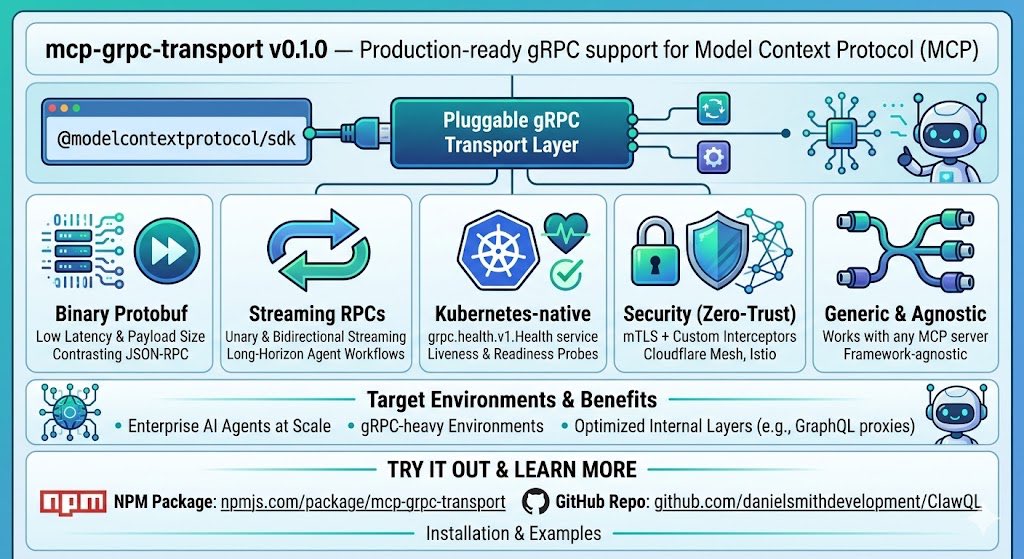
mcp-grpc-transport is now on npm (v0.1.0).
Pluggable gRPC transport for MCP that supports:
- Full protobuf surface (ListTools, CallTool, streaming ops, pagination, cancellation)
- Bidirectional Mcp.Session stream (NDJSON compatibility)
- gRPC health checking + optional server reflection
- TLS/mTLS via env vars
- Interceptors and custom options
This is the transport many teams have been waiting for, especially those already running gRPC microservices.
If you’re building production MCP servers and already operate in a gRPC-heavy environment, this should feel like a natural fit. It also pairs excellently with unified MCP servers that embed optimized internal layers (like GraphQL proxies for token efficiency).
Installation & basic usage is straightforward (see code snippet in comments or npm page).
One-liner integration via maybeStartGrpcMcpServer({ createMcpServer }).
Perfect drop-in for teams tired of JSON serialization overhead or wanting native mesh routing.
Docs & examples on the npm page. Built as part of the ClawQL stack but completely generic.
Try it with ClawQL (now unified single-process) or your own MCP server. Feedback, issues, and contributions welcome.
Repo: https://t.co/yYHhb12Nih
npm: https://t.co/DaA3a62CZs
Feedback, bug reports, and PRs are very welcome. Let’s make MCP even more cloud-native and production-ready together.
#MCP #gRPC #AI #AgenticAI #TypeScript #Kubernetes #EnterpriseAI
Meet NVIDIA Nemotron 3.5 Transcribe 🎙️
An open-weight, promptable 30B MoE model with ~4B active parameters that brings transcription in 40 languages, speaker attribution, translation, contextual prompting and audio understanding into one checkpoint.
Watch it keep track of who said what when everyone’s talking at once.
1/ 🧵
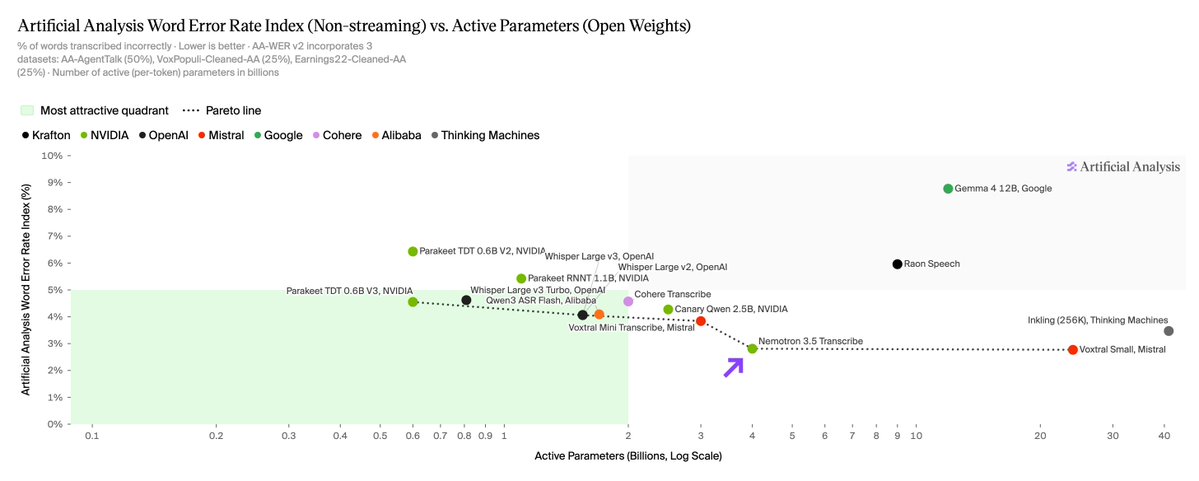
NVIDIA's Nemotron 3.5 Transcribe ties for #1 among open weights Speech to Text models with 2.8% WER, using just 4B active parameters
Nemotron 3.5 Transcribe is NVIDIA's new open weights Speech to Text model for non-streaming transcription, with 30B total and 4B active parameters, and the most accurate NVIDIA model on our non-streaming Speech to Text leaderboard.
Key takeaways
➤ Accuracy: Nemotron 3.5 Transcribe scores 2.8% on the AA-WER Index, tied with Mistral's Voxtral Small for #1 among open-weight models. It leads Voxtral Small on AA-AgentTalk, our dataset of voice agent conversations, at 1.8% vs. 2.3%.
➤ Model size: With 4B active parameters (30B total), Nemotron 3.5 Transcribe sits on the open weights frontier of AA-WER vs. active parameters. It matches the accuracy of Mistral's Voxtral Small with 6x fewer active parameters (4B vs. 24B), while other open weights models of a similar size sit at around 4% WER.
Congratulations to @NVIDIAAI on the release!
See more details below ⬇️
Honestly way more companies should get into the habit of golden image production. Packer plus Ansible for hardening then scan and remediate until clear. Exclusively what’s needed to run and nothing else. Tons of prebuilt playbooks to use off the shelf.
Or distroless containers with smaller by design attack surfaces and common sense security defaults. Most major cloud providers provide them now and there are good open source hardened runtimes as well.
You can’t exploit what isn’t there in the first place. Then good patching hygiene for what is there and you’ll be ahead of 99% of everyone else.
Another reason this is stupid: a prompt is NOT a guardrail.
“We asked a threat actor to not use curl, and they said they wouldn’t”
This is a solved problem, your runtime container shouldn’t have curl at all, implement egress network rules, readonly fs, gVisor…
Do they know?
Another reason this is stupid: a prompt is NOT a guardrail.
“We asked a threat actor to not use curl, and they said they wouldn’t”
This is a solved problem, your runtime container shouldn’t have curl at all, implement egress network rules, readonly fs, gVisor…
Do they know?
@UK_Daniel_Card This was when I knew he was full of it:
https://t.co/GgpldeLcHK
Some people will say or do anything for a paycheck and it’s really unfortunate. Over time it’s easy to see who’s who and whether people are in it for themselves or for others.
@UK_Daniel_Card@NetworkChuck Yes I was more so giving him benefit of the doubt. Normally I’ve been a big fan of his content but this is blatant misinformation
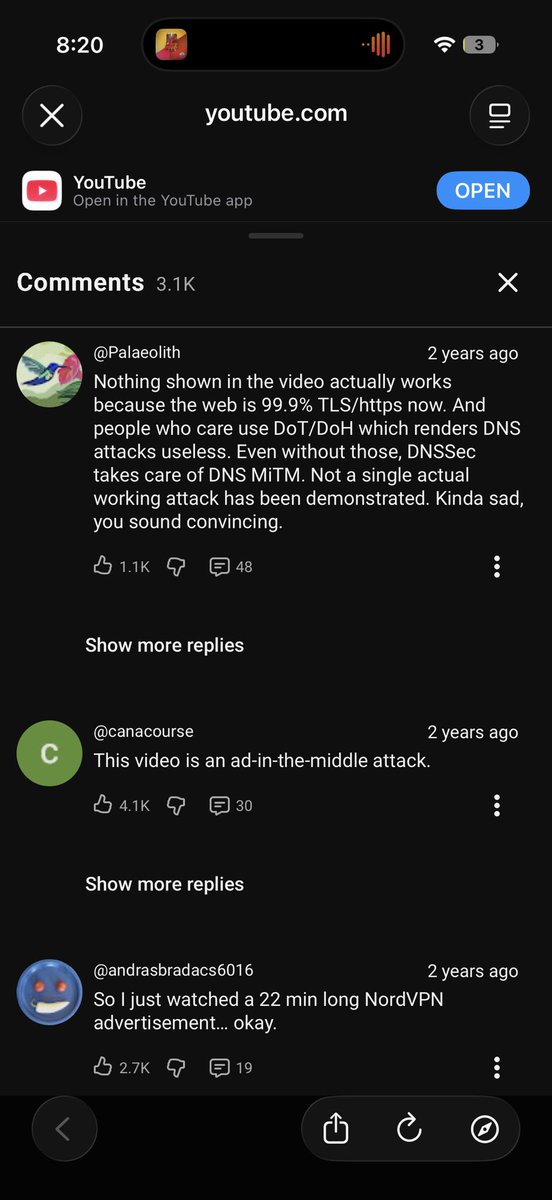
Thought maybe @NetworkChuck didn’t know better but then I checked the comments on his video he linked from two years ago and many people educated him
I think we can learn from event bus architectures that collapse N x M direct connections into N + M integration points.
In other words it’s probably not worth the time investment to make every language efficient.
Instead find the most efficient language for tokens and meaning then use that as the intermediary language internally.
Translate the user’s language into the intermediary, solve the problem efficiently, translate the results back to user’s language.
Then we just need to make sure every language has a translation path to the intermediary and don’t have to optimize every language reasoning respectively.
To your point though it’s not standardized at all which is why we use this explainer paragraph and still show it three different ways at different latency cutoffs.
For example if you need to know how many concurrent can run but maintain a p99 of less than 100ms then that’s a very different number than what was given before (only 82 vs 434 measured at p99 500ms) and so companies have a lot of flexibility in how they present this kind of thing.
One of my competitors falls off the map if being held to this rigorous of a latency standard though so presenting it several ways is what I figured best for fairness.
100% agreed with this. And even more importantly at that scale is durability of your agents. The concurrency side we’ve been optimizing for a ton and recently doing the durability work.
https://t.co/owFZVfm0Xu
So far we’ve been able to demonstrate 434 concurrent agents and 1854 requests per second after our latest push on the machines we tested with. Lots of platforms see wild memory spikes after only a few connections and honestly aren’t ready for enterprise scale.
Very excited to see what y’all do next. Did you see Anthropic’s paper on formal methodologies? Y’all have both the budget and scale to make use of that if not already so looking forward to when y’all make your own post on the topic
@KSimback Have you done the @harvey LAB test yet? Because scoring even 20% on that would be impressive. It’s also a lot more representative of real actual complex technical documents where precision matters. Under and over fetching is extremely common but in legal work being exact matters.
Introducing https://t.co/ofzXbW4lOc, the first open standard for agent experience.
Agents are a new class of user, but there's still no shared definition of what it takes to be ready for them. So we partnered with the leading companies in the agentic web such as Vercel, Stripe, Auth0, Mintlify, Tavily and Elementor.
Our research lab ran agents on real tasks more than 250,000 times to measure what actually decides whether an agent succeeds, and every requirement traces back to that data.
The result is a short set of essentials in the order agents meet a product: find, read, act.
We've been overwhelmed by requests to join. If you build or study the surfaces agents touch, come help shape it.
The spec: https://t.co/MuSWchN40k
The story behind it: https://t.co/h1kBIsjlXM
@ZackKorman Wow that’s crazy. I remember back in the day we were told to avoid marijuanas that could be laced with php
Now something about php2shellfish so I guess even our seafood needs better oversight from all the drugs 😳🦞
Just experienced this. Another MCP gateway out there was publishing some latency claims and even said they were going to create a MCP leaderboard of shame for some other missing feature. Everyone in the comments praising and saying wow so amazing.
I’ve now run my own extremely extensive benchmarks and for the life of me cannot figure out where those claimed numbers came from and clearly nobody in those comments tested otherwise they’d be asking the same questions.
So much fluff in this space and not enough people bringing real data to the argument
Plus when I say we take security seriously, I really mean we take security seriously.
We follow defense in depth strictly and maintain a zero trust approach to security. Every single image we ship is hardened, scanned, and only then signed if no issues are found.
Kyverno enforces this at runtime and both Panguard and OpenAPPA secure the runtime inference calls themselves against injection and other attacks.
Talon plus Falco ensures no chance of escaping and instant quarantine if they do. Then our mandatory audit log and observability stack proves nothing gets missed or tampered with.
We fail-closed when we cannot guarantee these requirements. Security first always.
https://t.co/mS4WT7jmPb
If you think you can beat @ClawQL then certainly give it your best shot 💪
We will keep benchmarking more and more harnesses / gateways against us and publishing all results and scripts so everything can be repeated and verified
Governance 🤝 efficiency
I'd much rather work with someone who flexes much they accomplished with the fewest amount of tokens vs how many tokens they spent, and I sense this is a major trend in general
How we quantify this as an industry is still TBD, probably a major new set of benchmarks
why does security matter so much to us? And token efficiency?
Because we’re meant to be your gateway to production. We’re the layer that gives you the confidence to ship.
Whether it’s inference gateways for agents that build traces for finetuning or full document pipelines. Whether it’s giving your agent isolated sandboxes or letting your entire team build and contribute to the shared memory and company ontology.
@ClawQL brings its security and efficiency to all of it and gives you the foundation you need to succeed cheaper and quicker than you did before.