@GaryCardone@EgyptianMaxi Billionaire for a reason! Thanks for sharing your strategy. Not sure what all the fuss is about. Especially coming Fred. I just DCA and not worry about timing.
Everybody wants to buy the dip until it's time to buy the dip.
You don't end up on the receiving end of the greatest wealth transfer in human history by believing what everyone already believes.
You get there through proof of work and conviction when everyone else doubts.
Sorry for your loss Kat! I know my words can’t and won’t help but I am grieving with you.
I am going to lose my rock and father from stage 4 cancer this year. How do we say goodbye forever?
The only thing that keeps me sane and grounded is to Stay strong, be the father he showed me how to be and to be forever grateful for all the love they have given us❤️ thoughts and prayers to you and your family.
"its unsustainable if bitcoin doesnt go up forever"
you know what else is unsustainable
increasing fiscal deficit
decreasing moral surplus
increasing longevity
declining birth rate
increasing value of capital
declining value of labor
yeah i'll take my chances with this one
One of the clearest ways to understand what Michael @Saylor has done with $MSTR is this: the battle starts in the mind.
Before capital is raised, before bitcoin is bought, before markets recognize anything, there is first a decision about what is true and what is false.
Saylor’s real edge was not just financial engineering. It was mental clarity.
Most of the world still thinks inside the old framework:
cash is safe
inflation is normal
treasury management means holding melting assets
volatility is danger
convention is wisdom
Saylor looked at the same world and came to a different conclusion. He decided those common assumptions were not truth, but lies dressed up as prudence.
He built Strategy around bitcoin as its primary treasury reserve asset, and the company explicitly says it uses equity, debt financings, and operating cash flow to accumulate bitcoin and to offer investors different forms of bitcoin exposure through its securities.
So the deeper story is not merely that MSTR buys bitcoin.
It is that Saylor rejected one mental model and replaced it with another.
The old model says:
“Protect yourself by holding dollars and staying conventional.”
The new model says:
“Protect yourself by anchoring in the hardest asset and structuring capital around it.”
That is a battle of thought before it is a battle of finance.
Saylor identified what he believed was a lie at the center of the system, then acted on what he believed was true.
Transformation begins with renewed thinking, not outward effort alone.
MSTR is the institutional expression of that conviction.
The progression looks like this:
Thought
Fiat cash is not a safe store of value. Bitcoin is superior treasury property.
Feeling
Urgency, conviction, courage, willingness to endure criticism.
Action
Accumulate bitcoin. Raise capital. Build securities around the strategy. Educate the market.
Habit
Repeat the process over and over with discipline.
Character
A company and a leader known for clarity, consistency, and long-duration conviction.
That is why Saylor stands out. Many executives see the same data, but they do not act because they have not won the battle in the mind.
They are still governed by fear of looking foolish, fear of volatility, fear of opposition, and loyalty to inherited assumptions.
Saylor seems to have done the opposite. He renewed the framework first, and the corporate actions followed.
Not every thought deserves agreement. Some thoughts are distortions. Some are accusations. Some are old mental habits.
In the MSTR/bitcoin context, many corporate leaders still accept thoughts like:
“Bitcoin is too risky.”
“Serious companies do not do this.”
“You have to wait for universal approval.”
“Preserving purchasing power with fiat is good enough.”
Saylor’s approach suggests that he interrogated those thoughts rather than submitting to them. He seems to have asked: Is that actually true? Or is it just the consensus voice of a system that no longer deserves trust?
That is where this becomes bigger than investing. It becomes a lesson in leadership.
Great leaders do not merely react to current conditions. They examine the assumptions underneath them. They ask whether the entire mental map is broken. When they find a deeper truth, they reorganize around it.
That is what Saylor has done with MSTR:
he turned a balance sheet decision into a philosophy,
a philosophy into a capital strategy,
and a capital strategy into a corporate identity.
Michael Saylor’s work with MSTR and bitcoin is not just a financial story. It is a mental story.
He won the battle in the mind first.
He refused the lie that conventional treasury assets were truly safe.
He embraced the belief that bitcoin was the stronger foundation.
Then he built a company around that conviction.
That is the pattern:
Renew the mind.
See clearly.
Act boldly.
Repeat consistently.
And over time, what begins as a thought becomes a strategy, and what becomes a strategy can reshape an entire company.
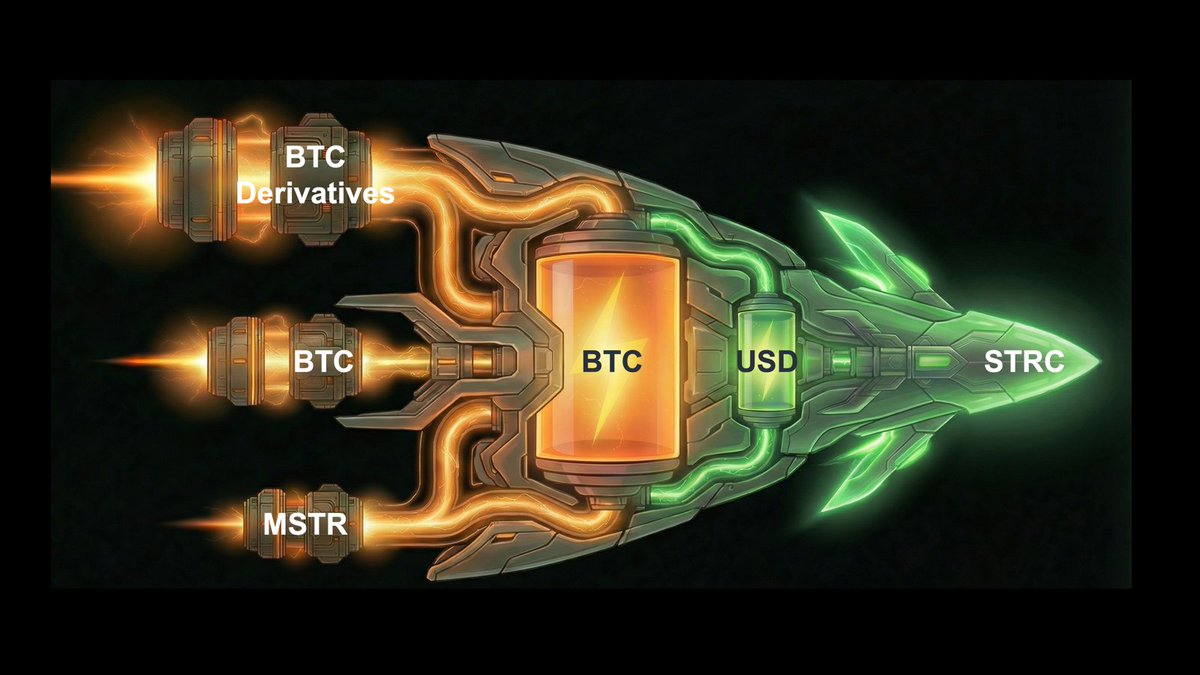
people aren’t ready to admit this but Saylor is the most important engineer to work on bitcoin since Satoshi, and the $STRC / $MSTR stack is the most important innovation in finance since bitcoin itself
he solved what was arguably the most important unsolved problem in hyperbitcoinization, which was how do we shunt massive amounts of rule-bound legacy capital into bitcoin in a sustainable way and within the bounds of existing financial regulation