Tracy Iwu [@Tracy_iwu ] was handed a brief with nothing in it.
No ad budget. New product. Naira in freefall.
She and the marketing team still drove $1M in savings deposits in 3 months.
Here's exactly how they did it 🧵
Today, we're introducing Lassie and $47M in funding led by a16z.
We're building AI that runs small businesses, starting with doctors' offices.
Lassie is already trusted by 700+ practices across the country, working autonomously to provide them with 30 hours of labor per month.
To get here, we first had to leave Robinhood and Superhuman to work in offices ourselves.
Here's how that went.
In the last 6 months at @Ahrefs, we analyzed over 1 billion data points across 14 studies. Here's what we learned about AI search optimization:
1) "Best X" blog listicles are the single most prominent content format cited by AI chatbots. They make up 43.8% of all page types cited by ChatGPT specifically.
2) 67% of ChatGPT's top 1,000 citations come from sources marketers can't influence: Wikipedia (29.7%), homepages (23.8%), app stores (6.6%). Only 32.3% are influenceable content like educational pages, reviews, news, and blog posts.
3) 28.3% of ChatGPT's most-cited pages have zero Google organic visibility. These pages get cited repeatedly by ChatGPT despite not ranking in Google at all. A completely separate discovery layer.
4) ChatGPT only cites about 50% of the URLs it retrieves. It fetches dozens of pages per query but uses half as background context without attribution. This means that being retrieved and being cited are very different things.
5) Adding schema markup had zero meaningful impact on AI citations. AI Overviews actually dipped −4.6%, while AI Mode (+2.4%) and ChatGPT (+2.2%) showed changes indistinguishable from zero.
6) YouTube mentions have the highest correlation (0.737) with AI brand visibility out of all the factors we studied (including all the conventional SEO metrics like backlinks, page count, DR, etc). This held true for both Google-owned and OpenAI products.
7) AI Overviews reduce clicks to the #1 result by 58%. That’s up from 34.5% just 10 months earlier. The trend is accelerating.
8) 99.9% of AI Overviews appear on informational intent queries. Transactional, navigational, and local searches are almost entirely AIO-free. Shopping triggers AIOs just 3.2% of the time.
9) For a given search query, Google’s AI Mode and AI Overviews reach the same conclusions 86% of the time — but cite almost entirely different sources (only 13.7% citation overlap).
10) AI Overviews change every 2.15 days on average, with 70% of content differing between consecutive observations. But semantic similarity stays at 0.95. The words, sources, and entities constantly shuffle, but the actual meaning barely moves.
Your team is in the jacuzzi at the offsite your company paid for. They're talking about how bad management is.
Perks aren't the problem. They just land on whatever foundation is already there.
@FourthCanvas CEO @victorfatanmi talks about what it takes to builds great work culture
The Code of Care is an example of taking a simple concept seriously!
The clear thinking exhibited is evidence that many man- hours/deliberations went into this over the years.
This is a solid reference for any company that's serious about building a great work culture!
Every organization has those core values. Many times, they hang boldly on the walls but mean nothing to the people.
We wanted more. And over the years, we’ve committed so much to ensuring our values translate to everyday reality.
10 years in the making.
77 specific behaviours.
3 core values.
1 Code of care.
We’re releasing the Code of Care, which is the internal guide behind the culture at FourthCanvas. We created this document for our team members, but then we thought, “what if we made it public?”
There you go.
Hopefully, this becomes a reference material, or at least an inspiration for you, as you live and do your work with Care, and lead your organization with the same level of intention.
Get the code: https://t.co/3vd1ufKOFs
You can’t outwork the whole world. There’s always going to be someone somewhere willing to work as hard as you. Someone just as hungry. Or hungrier.
Assuming you can work harder and longer than someone else is giving yourself too much credit for your effort and not enough for theirs. Putting in 1,001 hours to someone else’s 1,000 isn’t going to tip the scale in your favor.
What’s worse is when management holds up certain people as having a great “work ethic” because they’re always around, always available, always working. That’s a terrible example of a work ethic and a great example of someone who’s overworked.
A great work ethic isn’t about working whenever you’re called upon. It’s about doing what you say you’re going to do, putting in a fair day’s work, respecting the work, respecting the customer, respecting coworkers, not wasting time, not creating unnecessary work for other people, and not being a bottleneck. Work ethic is about being a fundamentally good person that others can count on and enjoy working with.
So how do people get ahead if it’s not about outworking everyone else?
People make it because they’re talented, they’re lucky, they’re in the right place at the right time, they know how to work with other people, they know how to sell an idea, they know what moves people, they can tell a story, they know which details matter and which don’t, they can see the big and small pictures in every situation, and they know how to do something with an opportunity. And for so many other reasons.
So get the outwork myth out of your head. Stop equating work ethic with excessive work hours. Neither is going to get you ahead or help you find calm.
[The Outwork Myth — It Doesn't Have To Be Crazy At Work, 2018]
"2025 was growth; this year is scale".
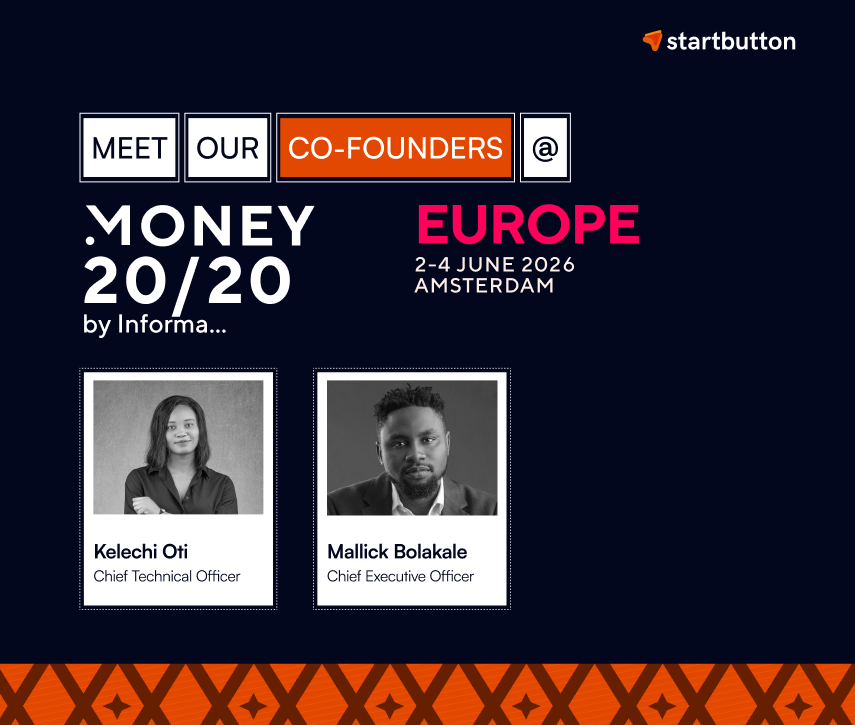
Our CEO, Mallick, had a chat with the amazing folks at @TechCabal detailing our journey so far at Startbutton Africa.
From discovering the problem -> validating the idea -> growing and expanding across 15 African countries in 3 years.
Follow our story here: https://t.co/qmSBMZNdNK
Expanding into Africa? The product is rarely the problem.
Entity setup, tax exposure, payment rails. Most founders figure this out after they've already spent the runway.
Startbutton solves that layer. Our co-founders are at Money 20/20 Amsterdam this week. Let's talk.
I had an "I wish I thought of this" moment when I saw this last week.
Simple. You get the idea, and it stays with you for a long time.
Bonus point: The QR Code leads you to a landing page where you can gratifyingly "clean" the dirty vehicle.
A well-thought-out campaign 👏
Image Credit: @RGA
@lulumeservey Fair point.
I think the original still works though. “Making it useful” implies that it’s information is understood and we can use it to do whatever we want to do including solving problems.
This is good thinking.
Investors want to know how big it can grow. So they pick the best metric(s) that tell them that.
Should it carry much weight? Not really.
The framework and alternative you shared works
But the desire ‘easily’ to predict the future and have certainty gives it that much weight.
One of the most frustrating questions I get during investor pitches is about market share, and I honestly think it's usefulness is overrated.
If I tell you Sycamore has 2% of the SME credit market in Nigeria, how would either of us know if the number is even correct?
On Grindmaxxing:
The argument has never been that great things don’t require hardwork or periodic moments of pulling off all-nighters and insane work routines.
It’s that, for how long?
At what point do we draw the line?
At what point does it turn to a flaw?
At what point does it start to yield diminishing returns?
In grindmaxxing there are a couple of questions inside it.
First question is that whether you should do it or not, and to what level. I don’t think there is one right answer because it is situational and plays into the dynamics of the market.
Most startups the mode is either finding PMF or scaling that.
PMF is about building, talking to customers and learning from those activities. There is some level of grind involved but I think the risk of too much grind and you don't internalize the learnings enough to correct the path. The speed makes you blind.
Then at scaling, there can be grind because the business is booming, but goal should be finding leverage to scale effectively. With leadership, hiring, with processes, software, anything.
Then there can be higher urgency when you are in some landgrab moment where there is real advantage in being first. Many will over-index on being the first, often it doesn't matter the way you think it would. It matters when you learn from it, because you gain advantage being the first to learn, not because you somehow automatically capture the market and can keep it. Often in reality doesn't really matter much if someone comes later with lot better product or experience. Customer will gravitate to the better solution, not to the solution that was first.
And I think you can be fast in different ways.
You can be very fast but have a very inefficient model. Or you can have a very efficient model and use less effort to the get same speed. The latter will might be slower at first, but will be more compounding and more scalable in long run.
For example in the beginning, you might be onboarding every customer. But eventually you have to realize it probably won’t scale, your and your team's time is not leveraged well, you don't learn much from repeating that over and over. You have to find leverage from the product, or some other solution that doesn’t require as many human hours.
So many startups and teams do have to work a lot and intensively. But there will always be a tradeoff to consider. Teams will burn out. Mistakes will happen. Bad decisions will be made. A lot of the work might be wasteful if the team never stops to consider.
Sometimes it is not an option. You have to grind through it. I get that. But you as a founder can still choose the culture, the values, the operating principles. Is it based on grind, or is it based on something else? Grind is not always optional, but culture built around grind is.
--
And second questions which the most interesting part to me, which is always optional, if you make the grind as part of the narrative and the brand.
Does the grind narrative actually make your brand better or more valuable for customers? I’d argue only a few businesses benefit from the grind narrative. Most probably do not.
For example, when I joined Coinbase early, we knew that trust was the most important thing. We had to be secure and project stability and trust. That was what I was also trying to do with design. The team also did it on the legal side by trying to be the trusted option operating from the US instead of the Caymans or China or somewhere else (many of those are now gone).
In the aspect of trust, in domains where you want high trust and stability, like banking, security, databases, payments, insurance, infrastructure, etc., the grindmaxxing narrative doesn’t make me trust the vendor more. It makes me trust it less.
Because it makes me think about the mistakes that might eventually happen, or the risk complete implosion of the vendor.
I always evaluate vendors on their culture and brand. I want my vendors trustworthy and operating values that provide stability. We’ve picked vendors over others because we sensed stability and a kind of unhurried expertise. And often we have picked right.
I don’t want to buy vendors and then have them create problems for us, or force us to find another vendor a couple years later.
When you work in a high-trust domain and sell to businesses, the better story is almost how stable and boring your operations are. I want people operating in healthy way, making solid decisions, focusing on operational excellence not building cafes, sleeping at the office or other various side quests.




![DanielTAdeyemi's tweet photo. Tracy Iwu [@Tracy_iwu ] was handed a brief with nothing in it.
No ad budget. New product. Naira in freefall.
She and the marketing team still drove $1M in savings deposits in 3 months.
Here's exactly how they did it 🧵 https://t.co/VIgzrn6eqw](https://pbs.twimg.com/media/HGAzcAaXUAAv8dp.jpg)