There are so many critical insights on oil oil & the global economy here by @Rory_Johnston
"It's gonna be a catastrophe. It will be devastating."
The Iran shock shows how fragile global energy flows really are, especially for poorer countries,
It marks a lasting break in trust & assumptions about stability.
#OilMarkets #Hormuz #EnergyCrisis #Geopolitics #SupplyChains
Must read post from @lugaricano. His weak-strong bundles paper has guided my thinking a lot, and this post makes an excellent case for how the relationships of tasks to one another within a job will affect automation and displacement.
https://t.co/xUKLvFY5ci
Can the global market survive a 10 million barrel-per-day supply hole?
Is $200 oil coming?
Will Europe run out of jet fuel during the peak summer season?
Is North America now the most energy-secure place on Earth?
Is the "seal broken" for permanent risk in the Strait of Hormuz?
Will high prices trigger an irreversible surge in EV adoption?
It was a pleasure to host @Rory_Johnston on yesterday's @BBGIntelligence Energy Exchange. Replay link below.
25/ Not using the latest AI tools in your research and writing is increasingly malpractice.
The purpose of research is the useful output, not the human-mediated process. The rigor should be in the thinking and verification, not in who typed the words or ran regressions in R.
My car has a full self-drive mode that works really well. When I drive to Penn from home, the car drives itself about 95% of the time. The self-drive mode isn’t perfect. The car sometimes refuses to take a side street, a few yards after leaving home, that could shorten the commute by a few minutes. Just before I arrive, I override the system, turn left onto my desired street, and then engage self-driving mode again. Once I reach Penn, the car can't handle the parking lot, so I park it myself. Overall, though, the self-drive mode makes the commute much more pleasant and less tiring. For instance, I can concentrate much more on the audiobook I am listening to. I love it.
This little anecdote highlights an important point about AI that is often overlooked. You should view AI as a complement to your skills, not as a replacement. The goal isn’t to ask Claude for a literature review and accept whatever it provides. Instead, you ask for a review, then verify the papers yourself, identify what’s missing, push back, and keep working until you’re confident you understand the relevant work. Similarly, you might get a first version of Python code from an LLM, but then you test, modify, and refine it yourself. Most horror stories about LLMs come from people who blindly trusted the model, not from those who used it as a highly capable assistant.
In economic terms, AI is complementary capital to your human capital, not a substitute. Your goal should be to reorganize your workflow to maximize the elasticity of complementarity between AI and your skills, and to accumulate further skills that are complementary to AI.
My life has been revolutionized over the last three years. I drive to school with AI, I research for papers with AI, I learn new material with AI, I prepare my lectures with AI, I handle email with AI, I shop for groceries with AI, I pick movies to watch with AI, I search for new books to read with AI, I plan my travels with AI, and yes, I write on X with AI. Without AI, I would not be active on X because I refuse to spend three hours in the morning agonizing over how to make each sentence flow correctly or to generate a nice figure illustrating my point. I started writing this post at 9.15 am, and I am about to post it at 9.38 am: this was only possible due to AI.
Being against AI is like being against electricity because a moron electrocuted himself using a hairdryer in the shower.
@neilkli@TheStalwart This is what lots of research is about though? A research field progresses by bringing about higher evidentiary standards. A very small proportion of people make novel contributions. Don't see what's wrong with this.
@jacobtechtavern@thomasforth https://t.co/0nmqd3iPrV
Here's a theory. Applies to parcel level. If markets aren't sufficiently competitive and parcels are differentiated enough it *could apply at market level.
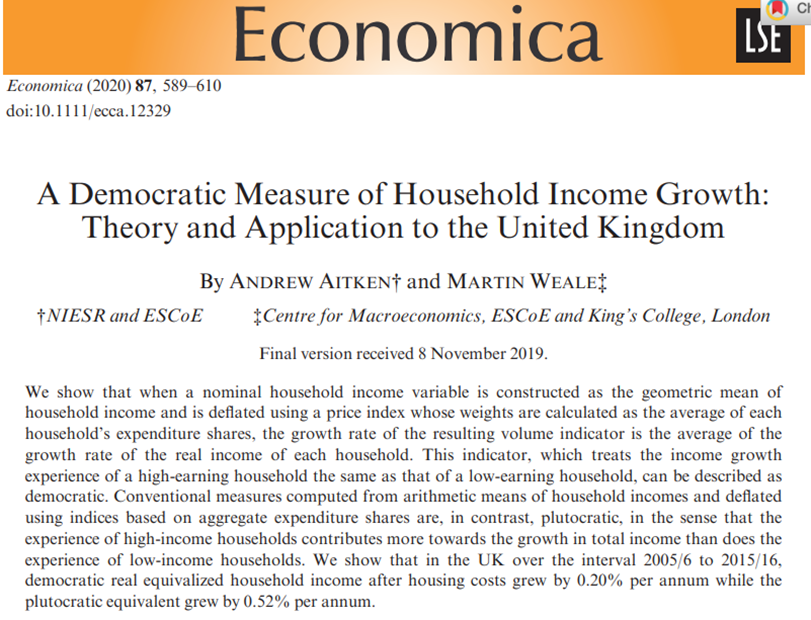
Measurement matters: Britain's stagnation of living standards is worse than you think
Standard income growth measures uses averages that overweight the rich. If high earners do well, the "average" looks healthy -- even if most households see little progress. A better approach asks: how fast did each household’s real income grow, on average?
To do that, you need two fixes. Which is what this 2020 paper in Economica does.
First, use the geometric mean of income. This treats percentage gains equally -- a 10% increase for a low-income household counts the same as for a high-income one. Second, use a democratic price index, which reflects the average household’s inflation experience, not the spending patterns of big spenders. The democratic price index corrects for the fact that the commonly used CPI tends to represent people that are definitely in the top 30% of the income distribution. It corrects by weighing according to number of households, not according to expenditures.
Put together, this gives a more accurate measure of average of real income growth across households. Applied to the UK, the result is stark: real income growth is much weaker than standard measures suggest.
The "usual" measure shows 0.52% per annum growth in real income. Not bad, not great. However, once corrected for the democratic price index and the geometric mean of income, its 0.2% per annum - close to stagnation pretty much.
In our 5th Anthropic Economic Index report released today, our research shows that people who have used Claude for 6+ months are better at yielding successful responses from the model than new users.
We think this points toward learning curves.
Is AI the biggest change in education since the printing press? Yes.
This weekend, I decided to learn about the life and work of Erving Goffman purely out of personal interest. Goffman was one of the most influential sociologists of the 20th century and a professor at Penn. I had a few free hours after a tough week of travel and work, and thought it might be a good distraction.
I asked Claude to prepare a study plan based on my professional background, prior knowledge, and the hours I had available: an introduction to Goffman’s life and work, selections from his best and most influential writings, and an examination of his impact on social theory. The plan was outstanding. A top expert on Goffman would likely have done better. A 90th percentile real professor of sociology would not have, or at least not without serious effort.
As I read The Presentation of Self in Everyday Life (complete) and Asylums and Stigma (selections), I could ask Claude for clarification, connections to the wider literature, and links to material I already knew. The Q&A and the exploration of collateral ideas were so good that I ended up spending much more time than I anticipated. Last night I had to force myself to go to bed.
Did Claude get everything right? Perhaps not, but neither do I in my own graduate seminars. Even in my areas of top expertise, I often do not answer students’ questions precisely or correctly. One should not compare Claude to the perfect professor but to a real one. And every answer I could verify (I checked many) was at least a solid A-.
Am I an expert on Goffman now? Of course not. But I would say I am now familiar with an important thinker at the level a regular master’s course on modern sociological theory would produce in the week it dedicates to him. Doing the same work using Google alone would have taken much longer. I know because I have undertaken similar projects with other thinkers in the past. One had to spend considerably more time before reaching the core of the contribution.
I can now imagine someone designing self-learning courses in many fields that are better than what you can get outside the very top universities, at close to zero marginal cost. Where does that leave a normal university? I do not know.
But colleagues in departments that want to stop the spread of AI are deluding themselves. This type of technology does not come once a century. It comes once a millennium.
Class is often overlooked as a driver of observed career and wealth disparities. This paper is a pretty incredible study into the role of class in the career progression of academia.
Class has a substantial impact at nearly every stage of the academic pipeline.
Important work.
On a personal note, this tracks with my own experience as a first-gen student. In grad school, I was shocked at the number of peers who had academic parents. They arrived on the first day knowing about the journal publishing system, the importance of conferences for networking, etc.
@SebC__ I've read it. It's a neat study design. It doesn't confirm anything he says. Variance decomposition is descriptive, not causal. It's highly dependent on the inputs. In this case, the individual talent ranges. Change those inputs and you'll get completely different results.
@Jon_Mackenzie Neat design. Skeptical there's enough reliable variation in talent in the sample to make this a meaningful decomposition. No variation in talent would mean no attribution of outcomes to individual talent etc