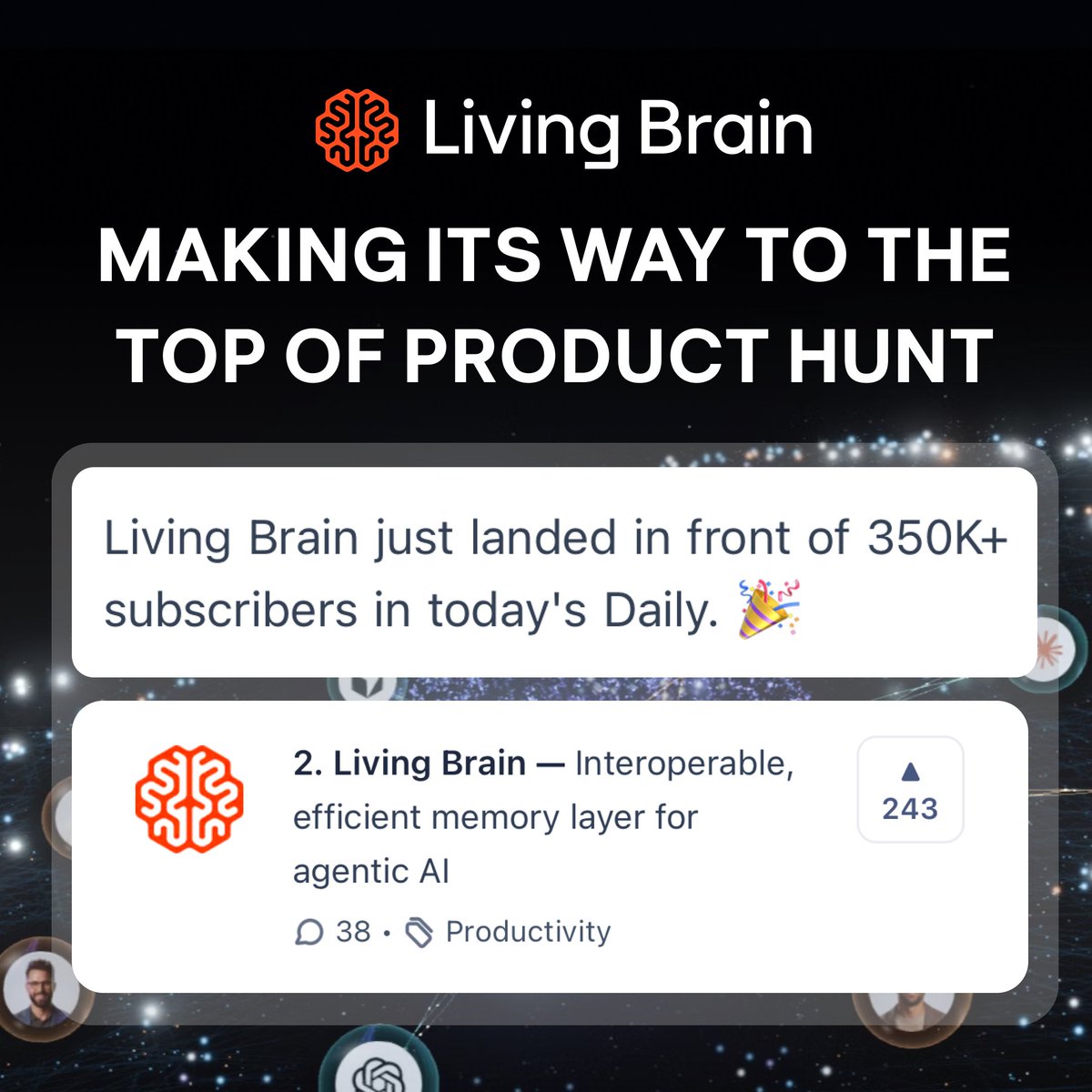
Living Brain is #2 on @ProductHunt 🧠
And it just got featured in the Product Hunt newsletter, in front of 350k+ people.
Come say hi 👇 https://t.co/qNvWLlq1gz
This persistent shared memory could let different AI tools build on each others work instead of restarting from scratch every time. Feels like the real leap toward useful agents.
Most "AI memory" is just a vector DB that keeps growing.
@livingbrain does something different: 4 scoring policies decide what's worth keeping, where it lives, what it connects to and when it re-enters context.
The memory sits outside the model. Write it in ChatGPT, pull it in Claude, give the same brain to OpenClaw or Hermes.
Their internal evals:
• 92.2% on LoCoMo
• 464ms median retrieval
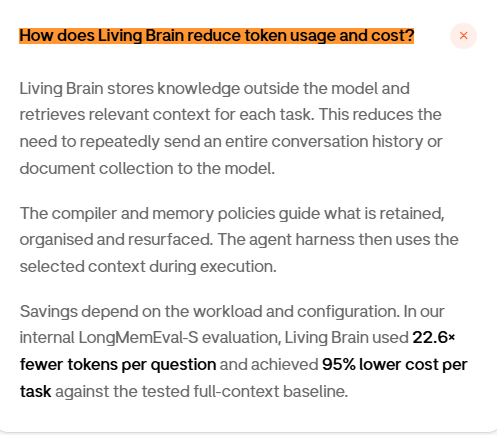
• Up to 22.6× fewer tokens per question
The real metric is correct answers per dollar not context length.
LLMs have parameters. Living Brain has plasticity.
Give your @ChatGPT a @livingbrain.
It’s live in Plugins:
1. Search “Living Brain” and install
2. New chat: “Save my memories to Living Brain.”
3. Then: “Show me my Living Brain.”
Those memories now work in Claude, Cursor and Codex too. Install once, use everywhere.
We just revealed the @livingbrain to the world and got more than 1.7M views in less than 24 hours.
Never start from zero again: https://t.co/vaHn4lr3BI
ChatAndBuild has launched Living Brain, a shared memory that AI apps like ChatGPT, Claude, and Cursor can access and edit.
Memories saved in one AI tool can then be recalled in another, making it possible to switch tools without recontextualizing.
Memories and chats are saved as pages that Living Brain updates when something changes, making every connected tool work from the latest version.
do you understand what just shipped?
bigger context windows were supposed to fix AI memory… but they just made forgetting more expensive
so someone built a fix…
→ teach ChatGPT something… Claude already knows it, so does Codex
→ your agents plug into the same brain (OpenClaw, Hermes, your own)
→ it flags when its own memory is going out of date
→ and the bill: up to 22.6x fewer tokens per question, memory back in under half a second
every AI lab wants to be the place your context lives. this puts it somewhere none of them control.
it's your memory. it should be your call.
Absolutely incredible: @livingbrain decoupled memory from the model. Save something in ChatGPT, pull it up in Claude, keep going in Cursor, Codex or Grok.
The model turns into swappable compute, and the memory stays with you.
On a morning none of us will forget. 🧠
Every ChatChat agent already carries a Living Brain. Now that memory goes everywhere you work: ChatGPT, Claude, Cursor, Codex.
Time to get yours and change your life forever @livingbrain
Gosh what a morning. Thank you everyone, completely overwhelmed by the response.
@livingbrain did 1.4m views in less than 12 hours, and now we are trending on X!
Just the beginning. https://t.co/jn46vmRXKe
Today we’re launching @LivingBrain: a persistent memory layer, independent of any one model or agent harness, that carries context across compatible AI platforms.
Built by @ladyxtel and the @ChatAndBuild team. Take a look: https://t.co/fIzIIrw81X
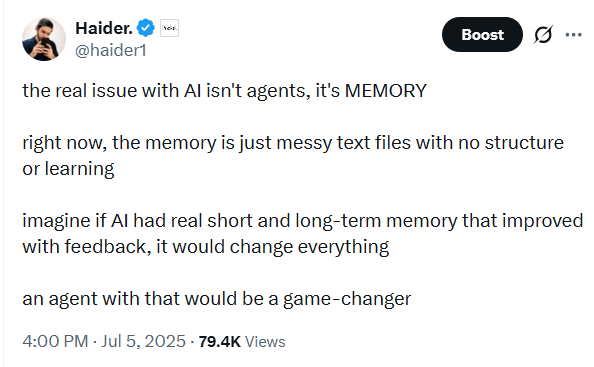
last year i said the real bottleneck for AI agents wasn't intelligence; it was memory
we've spent so much time scaling model capabilities, context windows and inference-time compute while agent memory still largely relies on messy Markdown files, vector databases and repeated context injection
curious how LivingBrain architecture handles this problem by making memory persistent, adaptive and independent of the model or agent harness
@ChrisGPT That's right. Having your memory locked in a single model makes you fully dependant on it.
New models release every month now, so if you want to stay ahead of the curve you have no choice but to solve the memory problem.
This is a shared memory service where you can connect multiple agents and AI tools to reuse knowledge.
For example, you can save information using Codex and retrieve it through Claude Code.
Two scenarios where this is very helpful:
• To keep a portable knowledge base not tied to any agent.
• To have the flexibility of using multiple agents without duplicating the knowledge.