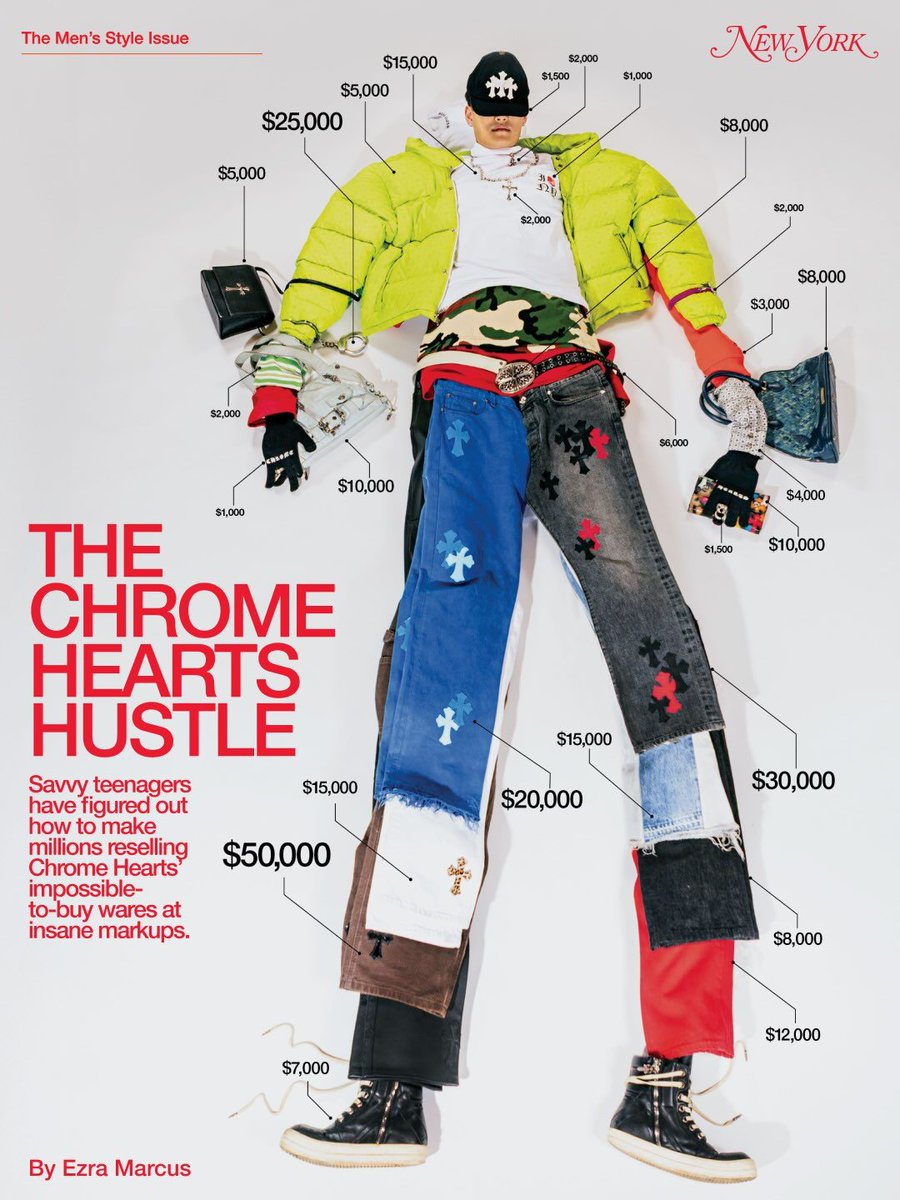
Chrome Hearts has become extremely popular over the past few years among the young and wealthy, and especially among crypto entrepreneurs fresh off absurd windfalls from meme coins and NFT projects. “A lot of young teenagers, they’re making $10 million, $50 million at the age of 19, 20 — it’s instant, so a lot of them don’t know how to spend it,” says Raphael Badalov, a 22-year-old reseller who goes by the handle byraph. Vincent Ferraro, another reseller, says, “They wake up rich overnight. Like, why not live your dream? Get your dream car, get your dream jeans.”
Except they can’t. As with Hermès, it is impossible to purchase much of anything at a Chrome Hearts store unless you’ve cultivated a yearslong relationship with the brand. The resellers have been swarming the internet since the early 2020s, cashing in on this fact. The brand responded to the surge of resellers by banning them from stores, introducing an appointment-only booking system, and training salespeople to look out for suspicious customers.
Online, “Chrome Hearts reseller” has become yet another recognizable Gen-Z digital hustle, as familiar to the kids as “peptides booster” or “OnlyFans creator.” Jack Jiang, a 19-year-old reseller, moves more than $20 million worth of product a year. “I’ve sold jeans for $300,000 before, and you and I are having a regular conversation about it,” Badalov says. “But let’s not forget that’s f***ing insane.” Theft is an increasing problem for the resellers. This past winter, four guys in ski masks broke into Ferraro’s Soho showroom. “They took over $1.2 million of stuff, which was, like, 60 pairs of jeans,” he says. Months later, a 17-year-old broke into Jiang’s shop through a window at night and made off with over a million dollars’ worth of jewelry and pants.
How much longer can it last? Read more on the Chrome Hearts resale craze from our “Men’s Style” Issue: https://t.co/dnXH24y5q9
Across the euro area, heterogeneity is striking: some countries saw sizeable increases in the wage share and more favourable relative-price dynamics, while others lagged behind. Italy records the largest shortfall from the benchmark in 2026Q1. (3/3)
Italy stands out: in 2026Q1, real wages were ~7 pp below benchmark. The gap is split roughly equally across productivity, relative prices (energy shock) and wage share—possibly reflecting weaker union bargaining power. Not causal, but a guide for further research. (2/3)
Thanks to @suerf_org : https://t.co/nFhu44lfKl
Comparing real wages with 2019 levels can mislead. Before shocks, households expected wages to keep rising. A productivity-based benchmark captures the foregone path. The gap reflects terms of trade, wage share and productivity (1/3)
Veneti, son 15 anni che vi diciamo che #Zaia vi frega.
E vi ha fregato (in compagnia di #Brugnaro).
Ora vediamo per quanto a lungo vi fatte fregare da #Stefani e #Venturini, la nuova coppia gatto e volpe
New toy. Explore the paper's data yourself - pick books from the Western canon and compare what they endorse across all six dimensions. The Prince vs the memoir of a man who bought his own freedom. Austen vs Nietzsche. Hobbes vs Mill. Link in the next tweet.
Last week I published "The Fatal Conceit, Renewed." Today I publish its companion: a catalogue of the methodological errors in the work of Thomas Piketty and Mariana Mazzucato.
The errors are not peripheral. They are devastating — and they all lean in the same direction. In econometrics, we have a name for an estimator whose errors all point one way: biased. In politics, we also use the same name.
Why spend the effort taking these two apart? Because they are dangerous. Piketty and Mazzucato are the intellectual darlings of today's left. They supply a veneer of scholarly respectability to what the left is forever seeking: a justification for higher taxes and more state intervention. The oldest idea in politics — that a few enlightened people know better than the rest of us what to do with our money.
The fame is real. The findings are not. Here is the audit.
Unpopular opinion. I sussidi al cinema servono, nel migliore dei casi, a finanziare consumi dei ceti più abbienti. Nel peggiore dei casi sono soldi sperperati che vanno a truffatori.
Vanno aboliti e basta.